![]()
TRANSITIONING TO SALES MANAGEMENT: NEW RESPONSIBILITIES AND EXPECTATIONS
Congratulations! You have joined the ranks of sales management. This may even be your first experience as a manager. The good news is that you are not alone. Many resources like this book exist to learn from and help support your growth as a manager and a leader. You have climbed the sales ladder, have cultivated your skills, and are ready for a new challenge.
You can probably imagine that transitioning into management is very natural for some and more like charting unknown territory for others. You have a whole new set of responsibilities, and at the same time, the expectations others have of you have completely changed. In fact, these new demands come from both your sales team and your management team. This chapter will walk you through some of the core issues and hopefully provide you with some comfort knowing that (1) many have been here before, and (2) success is well within your reach.
GOING FROM “SELLING” TO “MANAGING”
While it is likely that you came from the world of selling, it is not a requirement. Sales managers typically choose management themselves, but other times senior management chooses them because they are seen as well respected by their peers and they possess many of the necessary traits of a good manager and leader. So while understanding the elements of selling are very important, what it takes to manage is a very different skills set. The following is a brief look at sales versus sales management and where they overlap.
First it is necessary to understand what the ideal salesperson should look like. He typically exhibits the following behaviors and traits:
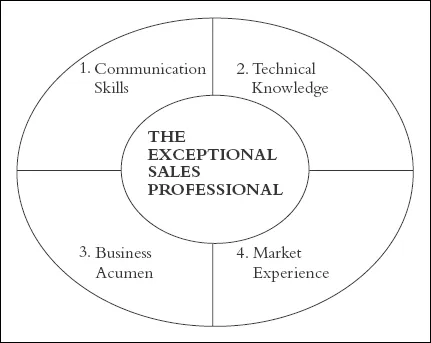
Furthermore, the truly well-rounded sales professional needs to possess four core areas of skills:
- The communication and interpersonal skills necessary to carry out sales
- A mastery of the sales process and how it relates to the business
- Fundamental business competency
- A solid understanding of the industry and marketplace
Figure 1-1 depicts these four categories.
On the other hand, the ideal sales manager has her own exemplary characteristics and traits, including the following:
Of course, when you compare these to those of the salesperson, you will see many overlapping characteristics; yet look at them more closely, and you will clearly see areas of difference.
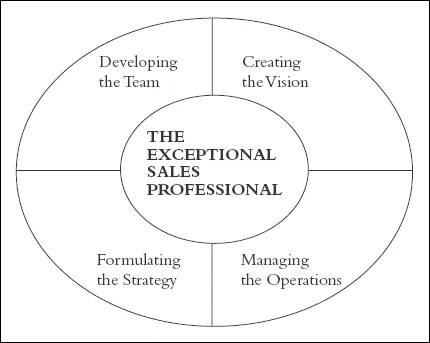
The four core areas of skills that truly well-rounded sales managers must possess are:
Figure 1-1. The sales skills model.
- Critical management, communication, and team-building skills
- The ability to lead into the future
- An in-depth understanding of the business dynamics and competitive forces that impact the sales strategy
- The core tools for building and managing accounts and channels of distribution
Figure 1-2 illustrates these four categories.
The interesting thing about sales managers is that they never fully remove themselves from the sale. “Selling” or “working” managers are good examples of this truism. For instance, in many companies, managers are expected to do just that—manage—while in other organizations managers are actually in charge of a certain number of accounts. They are expected to meet their “numbers” as well as ensure that their team does the same.
This scenario is common with many smaller sales organizations in which the limited budget and resources require a manager to cover a certain number of accounts. However, this is also the case with some of the largest corporations—the logic being that the sales manager built and forged many of the relationships as a salesperson, so why lose some of that momentum now? In a company with this philosophy, you would be very involved with customers during the entire sales process.
Figure 1-2. The sales management model.
The tools and techniques in this book will improve you as both a manager and a salesperson. By covering some of the critical areas of selling, the book will help you develop your staff as a manager as well as fine-tune many of the skills you already possess as a salesperson. Remember, whether you are in an actual sales capacity or not, “selling is everything.”
UNDERSTANDING THE CURRENT SALES CULTURE
Before taking a look at some of the challenges you face as a new sales manager, it is important to take a deeper look into your corporate and departmental culture. The sales culture you are inheriting (good, bad, or indifferent) has its roots in the larger corporate environment.
Culture within an organization or even industry is an extremely broad topic. In this context it does not relate to a person's country of origin. Rather, it relates to the overall feeling that one gets when working in a particular industry, company, and department.
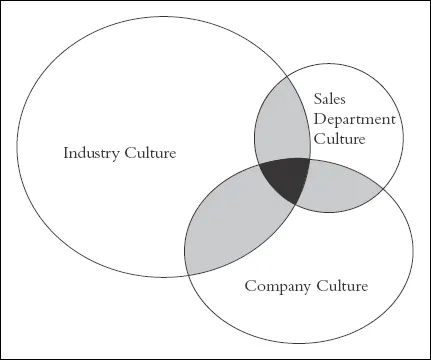
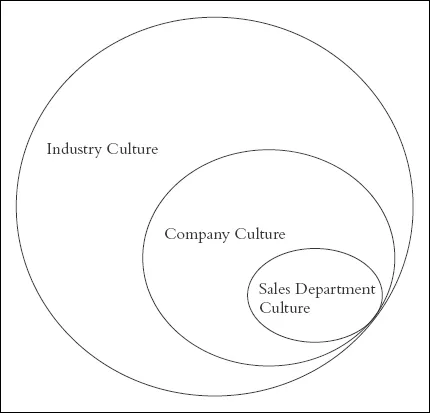
Figure 1-3 shows three major culture sets—that of the industry as a whole, the company, and the sales department within that company. This cultural misalignment is often the reality. The ideal is depicted in Figure 1-4, where all three cultures meld together.
It is important to understand how much cultural overlap there is between your department and your company, and your company and the industry. Obviously, when there is more overlap, there is a greater chance of success.
Here are some questions you should ask in determining the business culture that surrounds you.
Figure 1-3. Cultural misalignment.
Figure 1-4. Cultural alignment.
About the Industry
- Is it a conservative environment? Is the dress code formal or casual?
- Is it a very analytical type of business? Typical industries include research, consulting, engineering, etc.
- Is it a creative environment? Typical industries include consumer products, advertising, etc.
About the Company
- What does senior management value?
- How does your company communicate to outside stakeholders, the media, etc. (public relations and corporate communications)?
- Is the corporate culture actually defined by your organization?
- How are performance management and reviews done at your company (hierarchical, 360, peer review, etc.)?
About the Department
- Is there a great deal of interaction among departments, or do individuals or separate groups work in silos?
- Is there an “us versus them” mentality? For instance, is there competition for budgets, resources, etc.?
- What are the differences or similarities among departments such as marketing, sales, finance, human resources, research and development, operations, etc.?
The problem of cultural misalignment is often exhibited in large corporations with numerous business units, where a distinct culture could exist in different parts of the company. Industries that would commonly fall into this category are media conglomerates, financial services, consumer products, and most multinational corporations. But ironically, many small companies have similar “culture clashes” to contend with. Of course, you are not likely to be in the position to affect major change across the organization, but you can play your part, and that's something you should keep in mind.
Now that you have looked at the different levels (industry, corporate, departmental), it is important to relate your department to the overall company. For example:
- How is sales viewed by the company?
- Do resources (people, time, money) seem limited, or is there an abundance of resources available?
- To what level of detail do you have to prove your business case?
- Is yours and the rest of your department's collaboration with others expected, and is it easy or difficult to achieve?
- Does the human resources department support your efforts with training, compensation planning, rewards programs, hiring, counseling, etc.?
While all of these areas will be explored in more depth, you should at least be making mental notes of some of these questions and/or issues. Now that you are in the management ranks, you will have ways to effect change, be it subtle or major change initiatives. Some of these categories might be as small as facilitating more discussions with other departments like marketing and finance. But you may effect a large-scale initiative, like changing the performance management process to better achieve corporate objectives.
Now that you have the basics for understanding the culture and environment you operate in, it is necessary to focus on some specific challenges and opportunities that fall under your new management responsibilities.
UNDERSTANDING WHO IS ON THE CURRENT TEAM
Managing Former Peers
The first issue for many new managers is managing those who just days ago were at the same level as them. Several issues crop up when a person is promoted to manage people who were formerly peers. They commonly fall into the following three categories:
- Managing friends
- Managing nonallies
- Managing experienced salespeople
Before delving into the challenges, let's first take a look at some of the positives. The new sales manager already knows many of the sales representatives’ strengths and weaknesses. This is a tremendous asset when it comes to delegation. This also gives the new manager early insights when preparing a plan for the training and development of team members.
In addition, the newly appointed sales manager already has a certain amount of rapport with the team. This allows for open discussions about issues. A good rapport also creates a supportive foundation for problem solving and achieving goals.
As a new manager, you already possess certain management and leadership characteristics and have the backing of the management team. This enhances your credibility with both management and your sales staff.
Furthermore, as a new manager, you have overnight gained “position power.” Whether you now have a new corner office, or you remain in the same compact space, the fact is that power has shifted.
At the same time, without having extensive management experience and practice under your belt, making the transition to management is a significant adjustment. Even areas that seemed very basic and straightforward before will require extra effort and attention. Here are some of the core categories that touch on this transition phase of your new job as a sales manager.
Managing Friends
Many management consultants and psychology of management pundits suggest that any friendship should be set aside after a hierarchical change. The logic is that it is difficult to discipline and affectively give direction if you are too close to your subordinate. Also, the inherent premise in friendship is that both people are more or less on par with one another. Now the simple act of changing your title can change perceptions and emotions. Friendships are complicated even before someone is promoted, so when business and money are involved, this can only further complicate any issues or tensions.
On the other hand, friendships won't necessarily complicate working relationships. If handled correctly, the closeness of the relationship could lead to more positive results for all parties involved.
One of the mistakes people make with friends is to confuse work and personal issues. This can sometimes lead to the manager giving advice to their friends on issues that are unrelated to the job, yet the line is still blurred. Giving advice because you care is part of being a friend. But a boss is in a position of power in the relationship. Giving advice to a friend (now a subordinate) may suddenly seem like you are judging him. Even when you are giving advice directly related to the job, it can be difficult to do so; if the feedback is negative, she may feel that your perception of her has changed negatively. If this starts to happen, it hurts the team, the friendship, and the company. This problem can be avoided by proper goal setting and relating feedback to the goal. If you set goals properly and both parties accept them, the manager won't appear to be judging the friend. The friend's achievement will be measured by whether or not she reaches the goal.
Another challenge early on in management is dealing with weaknesses of a friend and/or former peer. How does a sales manager approach this person to correct a problem without destroying the relationship? Here the manager must specifically define and isolate the negative behavior and focus on job and the performance requirements, not on the personality. For example, you might be tempted to say, “Sally, what's with all the complaints you have with the finance department? I think you're overreacting to the terms they are stipulating for new customers. It's making us all look bad.” Instead, you could say: “Sally, why don't we sit down together with Steve in the finance department and talk about their requirements? They probably have some policies they must abide by and that make sense. We can stress the importan...