eBook - ePub
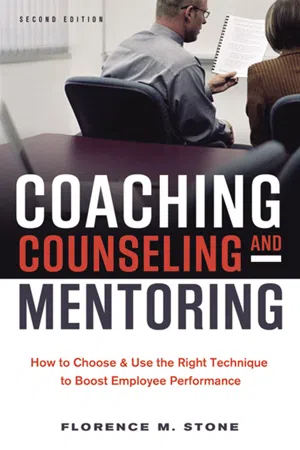
Coaching, Counseling and Mentoring
How to Choose and Use the Right Technique to Boost Employee Performance
- 240 pages
- English
- ePUB (mobile friendly)
- Available on iOS & Android
eBook - ePub
Coaching, Counseling and Mentoring
How to Choose and Use the Right Technique to Boost Employee Performance
About this book
Coaching, counseling, and mentoring can dramatically improve employee productivity and satisfaction. But there's a big difference between continuously encouraging employees to do their jobs well (coaching), attempting to fix poor performance (counseling), and helping top performers excel (mentoring). Unfortunately, most managers don't truly understand how and when to do each. Coaching, Counseling & Mentoring provides helpful tools like self-assessments and real-life scenarios, and gives managers specific, practical guidance on using these techniques to improve the performance of all their people.This updated and revised second edition includes useful scripts for talking to employees about sensitive issues, and new material on topics including working with off-site employees, what to say when an employee denies a problem exists, whether or not to coach temps and part-timers, how to draw the line between the mentoring and supervisory role, and what to do when counseling fails. This is an essential guide for managers who want to build their confidence and skill in getting the most from their people.
Information
Subtopic
ManagementIndex
BusinessSECTION
II
Counseling
CHAPTER
5
Why Counsel Troublesome People?
Based on Your Coaching, you can boost both individual and department or division performance. But that hard work can be undone by just one staff member who doesn’t carry his or her weight. The individual’s work output may be poor or below standard. Due dates may be missed, affecting the work of others down the line. The employee may lack initiative and seem uninterested in the job, behaving as if every workday were a blue Monday. Or he or she may be continually late or absent, by coincidence, almost every Friday.
Managers should begin to counsel the employee to turn around his or her performance, but increasingly many move swiftly to termination without any effort to change work behavior. Why does this happen? These managers work for companies with an at-will employment policy, and they mistakenly believe that their employees consequently have no due-process rights. They don’t realize that not providing documented warnings and a reason for firing an employee can cause the individual to assume that he or she is being fired for an unlawful reason. Disgruntled, such an employee will seek out a lawyer unless offered a severance package or other reason for not charging some form of discrimination. Consequently, even managers with reason to fire employees can lose in court if the employee makes a good enough case.
Even in companies with an at-will policy, managers are wiser to intervene in the event of problem behavior, hold well-documented counseling meetings, and make an effort to turn around the situation—if, for no other reason, than to justify subsequent termination in the event that there is no change in performance.
There is another reason for intervention as soon as a performance problem is evident. Poor performance can affect others’ work within the department or the work of the group as a whole. And there are still other reasons that managers should immediately act to improve job performance; these include:
• Lost Productivity. A poor performer produces only about one-third the work of average workers.
• Lost Business. Problem performers aren’t likely to extend themselves to get or keep an account or to handle difficult customers tactfully.
• Lost Time. Poor performers take up a disproportionate amount of supervisory time, as much as 50 percent. This means that there isn’t much time left for the rest of the staff, including time to coach them.
• Lost Talent. Many of your best workers, as they lose respect for you and begin to doubt the fairness of your evaluations, will job-hunt; your less productive workers will stay, but as they are no longer afraid of you, they may try to get away with the same stuff as your troublesome employees.
• Lost Self-Esteem—Yours. As you firefight to make up for shortfalls in the problem performer’s work, you may become angry and frustrated and burnt out. In time, you may lose your self-confidence. This could affect your own job performance and others’ perception of you.
And lastly, consider this: a problem employee may in fact have much to offer—if good counseling helps the individual turn around his or her performance. That’s talent saved, not lost!
Failure to Take Action
Given these consequences, you have to wonder why managers don’t take action before a performance problem escalates to these serious levels. Numerous explanations are given, besides a misunderstanding of at-will. They range from over-identification with the employee’s feelings to lack of faith in the human resources department to support the manager’s actions, to reluctance to play judge and jury over another’s career. Let’s look here at three key reasons why:
Fear
Managers worry that they will lose control of the discussion as the employee cries or gets angry, that the effort will end in the employee being fired, and that ultimately they will find themselves in court, defending their actions. Such fear is understandable. Articles in the press citing sixfigure awards to plaintiffs in lawsuits about unfair discharge are more than enough to scare a manager with a problem performer, particularly if that individual is a member of a protected work group. It’s a lot easier to engage in wishful thinking that the performance problem will resolve itself; either the problem will disappear or the employee will leave on his or her own. But neither happens very often.
If it helps you as a manager to confront a long-term employee about a performance problem, and counsel the individual to turn his or her work around, think of what you must do as a version of tough love—what I call “tough-love supervision.” Tough love is a nationwide program designed to aid troubled teens and their parents. It’s a program that encourages young people to take responsibility for their behavior. And three of tough love’s ground rules can be adapted to counseling:
1. The goal is to remedy poor performance, not to demean a person. Annoyance is directed at the work and not at the employee.
2. It is based on a genuine desire to see the individual do better. If you keep this positive attitude in mind, you won’t feel as if you are destroying another person’s career by bringing up performance faults. You are actually helping the individual.
3. It seeks to achieve agreement with the problem performer and help you build together an action plan to turn the employee’s performance around.
Crisis Management
Another reason performance problems aren’t addressed has to do with today’s leaner organizations. With so much to do and so little time in which to get it done, managers can become so accustomed to crisis management that they aren’t as aware as they might otherwise be of everything happening around them. Problems that they should notice go unnoticed—until someone or some incident brings it starkly to their attention. Even then, however, they may do nothing. They make the mistake of not doing anything because they see counseling as too time-intensive. They think it is easier to fill the performance gap themselves, although, given their schedules and the importance of their organization’s strategic intent, it is a terrible waste of their time to do the undone work of one of their employees.
Lack of Training
Although training in counseling skills would enable a manager to resolve individual performance problems that diminish the productivity of the entire department, few companies give new supervisors or managers or team leaders the instruction they need to help them with troubling or troubled employees. This is unfortunate because counseling is a responsibility and, like most managerial responsibilities, can be mastered with training and experience.
A Definition of Counseling
The semantics associated with counseling may actually be more complex than the process itself. Some describe counseling as an ongoing process for development, and they describe coaching as a means of addressing specific performance problems. There are others who consider counseling as one element of coaching (they throw mentoring into the coaching pot, too).
Does it really matter what we call one process or the other? Not really. But it is important that you be clear about the purpose of each process as you use it. When we talk about counseling, we are referring to a nonpunitive disciplinary process, the most important step of which is one-on-one meetings with the problem employee in which your purpose is to get the employee to acknowledge the difference between actual performance and expected performance; identify the source of the problem; and develop an action plan to bring performance up to minimum expectations, if not higher. The secret to good counseling is in the communication process, and that entails the following three practices:
1. Communicate openly, directly, and honestly. Don’t be ambivalent about telling an employee that he isn’t doing the job that you want done. If you hem and haw about a performance problem, talking around the topic rather than being clear about its nature and seriousness, you leave the employee with the mistaken notion that you aren’t really concerned about the situation and that there is no need to change his behavior. At the least you leave the employee confused, at worst you leave yourself open later to a lawsuit based on your failure to make absolutely clear to the employee the problem with his performance and the implications of a continuation of that behavior.
You need to make clear that you’re talking not only about the effect on work itself and the standards by which the individual’s performance is being measured (your expectations of the employee) but also the consequences of continuing poor performance, like being denied a raise or, worse, the start of progressive disciplinary action, which ends in termination if the problem continues.
2. Practice active listening. In particular, you want to learn how to use silence to encourage the employee to talk about what is happening in the workplace, the problems she is having, and what she will do to achieve the results you want. Certainly, you don’t want to dominate the conversation, lecturing the individual about her performance problems. Rather, you want to create a dialogue in which you speak only about one-fifth of the time, thereby practicing the 20/80 rule. Setting a conversational tone also minimizes the likelihood of the discussion turning into a confrontation while increasing the likelihood that you and the problem employee, together, will come up with a workable action plan for turning her performance around.
3. Probe and question. The key to one-on-one counseling is, first, to ask open-ended questions that will identify possible causes of the problem performance, then to ask more pointed questions to determine the specific cause. You can then follow up with a closed-ended question to confirm your conclusion: “Although you say you have a clear idea of your responsibilities, isn’t it true that you have a hard time prioritizing your assignments?”
If you consider these three skills, it should be evident why all three are so important to counseling: they enable you to make clear to a problem performer that she is accountable for a certain level of performance, that you are not receiving that level of performance, and that you expect that improvement. When you practice all three at once, you create a supportive environment in which a problem performer feels free to open up to you and discuss what is behind his or her misbehavior or performance deficiencies. Then, together, without demoralizing the employee, you can both define areas for improvement and agree on an action plan for achieving that improvement.
If your communication style already is a combination of assertiveness, active listening, and probing, then you are fortunate. But if you aren’t there yet, don’t worry. Developing a counseling style is something that can easily be learned. Listening and probing skills come with practice; and assertiveness comes with self-confidence, with practice, and with documentation that supports your comments about the employee’s performance.
The Need for Counseling
If you are fortunate, you won’t have to apply your counseling skills frequently. After all, many shortfalls in performance can be handled during the performance-appraisal process, at one of the three or four meetings you hold during the year. If you’ve planned your appraisal reviews correctly, you’ve set aside an hour or more for each of your employees and therefore have sufficient time not only to identify their accomplishments but also to discuss failures in their performance and create action plans to ensure that they will reach the standards for their job or meet their goals by the end of the year.
Generally, in appraisal interviews you will be discussing situations like an employee’s failure to follow up with a vendor on an order (an oversight), a staff member’s reluctance to fully utilize the new office technology (need for additional training), or an employee’s failure to complete a market research report on schedule (work overload, need for a temp). Unless these problems are part of a pattern, they usually can be remedied through some coaching in the form of training or redirection.
Performance problems that demand counseling include continuing poor work quality or quantity, frequently missed deadlines, disorganization, chronic tardiness or absenteeism, frequent and lengthy disappearances from the workstation, lack of initiative or even a total lack of interest, with the employee seemingly wishing to be anywhere other than at work, lack of cooperation, and even insubordination.
Some of these problems will be found to stem from skill deficiencies, others from repetitive or dull jobs, still others from post-downsizing depression or grief, or burnout, or frustration about being asked to do the impossible without the equipment, funds, or time to get the assignment done, a condition in many of today’s downsized companies. Other performance problems—like making disparaging remarks about the company, the boss, or work to others within and, worse, outside the organization, like customers; refusal to follow instructions; minimum output but maximum complaints about department policies or procedures; or sulkiness or uncooperativeness—may stem from an attitude problem rooted in a conflict with you, a peer, or corporate policies or procedures.
Finally, many performance problems can be traced to personal problems in the employee’s life, from financial difficulties to divorce, to a chronically ill child or parent, to an emotional problem, to substance abuse. A study by the National Institute on Drug Abuse found that substance abusers are late three times more often than the average worker, sixteen times more likely to be absent, four times more likely to have workplace accidents, and three times more likely to use health-care benefits.
Let’s look at a situation in which there was a need for counseling, but the manager was unaware of it until it was brought to his attention—by staff, peers, and his boss through a 360-degree feedback program.
CHARLIE: HOW 360-DEGREE FEEDBACK OPENED HIS EYES
Charlie is the manager of an office supp...
Table of contents
- Cover
- Title
- Copyright
- Contents
- Introduction: Three Ways to Develop High-Performance Employees
- Section I: Coaching
- Section II: Counseling
- Section III: Mentoring
- Epilogue
- Index
Trusted by 375,005 students
Access to over 1.5 million titles for a fair monthly price.
Study more efficiently using our study tools.
Frequently asked questions
Yes, you can cancel anytime from the Subscription tab in your account settings on the Perlego website. Your subscription will stay active until the end of your current billing period. Learn how to cancel your subscription
No, books cannot be downloaded as external files, such as PDFs, for use outside of Perlego. However, you can download books within the Perlego app for offline reading on mobile or tablet. Learn how to download books offline
Perlego offers two plans: Essential and Complete
- Essential is ideal for learners and professionals who enjoy exploring a wide range of subjects. Access the Essential Library with 800,000+ trusted titles and best-sellers across business, personal growth, and the humanities. Includes unlimited reading time and Standard Read Aloud voice.
- Complete: Perfect for advanced learners and researchers needing full, unrestricted access. Unlock 1.5M+ books across hundreds of subjects, including academic and specialized titles. The Complete Plan also includes advanced features like Premium Read Aloud and Research Assistant.
We are an online textbook subscription service, where you can get access to an entire online library for less than the price of a single book per month. With over 1.5 million books across 990+ topics, we’ve got you covered! Learn about our mission
Look out for the read-aloud symbol on your next book to see if you can listen to it. The read-aloud tool reads text aloud for you, highlighting the text as it is being read. You can pause it, speed it up and slow it down. Learn more about Read Aloud
Yes! You can use the Perlego app on both iOS and Android devices to read anytime, anywhere — even offline. Perfect for commutes or when you’re on the go.
Please note we cannot support devices running on iOS 13 and Android 7 or earlier. Learn more about using the app
Please note we cannot support devices running on iOS 13 and Android 7 or earlier. Learn more about using the app
Yes, you can access Coaching, Counseling and Mentoring by Florence Stone in PDF and/or ePUB format, as well as other popular books in Business & Management. We have over 1.5 million books available in our catalogue for you to explore.