- 192 pages
- English
- ePUB (mobile friendly)
- Available on iOS & Android
eBook - ePub
About this book
The sudden transformation from player to coach is a dramatic one, and managers are usually expected to make the transition under their own steam. This dilemma is faced by many high-powered salespeople. A compact primer on making the difficult move from a narrow independent workstyle to a host of diverse responsibilities, this guidebook is written in a quick-grasp, conversational style perfect for the new sales manager. In clear, simple terms it shows how to:* Plan sales force operations efficiently* Implement the plan* Appraise the sales force and operations* Control operations* Communicate up and down in the organization* Recruit and maintain the sales forceFrom Selling to Managing gives the newly appointed manager everything he or she needs to be a success -- again.
Information
Subtopic
ManagementIndex
Business1
The Transition
From Selling
to Managing
Most field sales managers have been salespeople far longer than they have been managers; consequently, the transition from salesperson to manager can be extremely difficult. In fact, many who try never really make the grade. Since this problem occurs so frequently in sales organizations, perhaps it would be well to begin by considering some of the problems involved in making a successful adjustment to the responsibilities of a manager.
As a sales manager, your duties will vary widely from one company to another. Some field sales managers are actually only super-sales reps who handle the more important accounts; some supervise only one or two reps and devote the remainder of their time to direct sales efforts; still others may devote their entire time to supervision and do no direct selling themselves. But all have certain features in common.
The sales rep and the sales manager both deal with people. If you are a sales rep, these people are your prospects and customers. You must be able to influence them, win their confidence and approval. If you are a manager, you must be able to get along with your sales force, win their confidence and respect so that they perform well for you. The sales rep and the sales manager must each be capable of planning the particular activities demanded by their position. Both are, of course, concerned with sales, orders, profits, and their own promotion and advancement. However, it is the critical differences between these two jobs that must be understood if we are to have a sound understanding of the management function.
Five Critical Differences
Between Selling and Managing
The first responsibility of sales reps is to develop accounts. They must be able to sell accounts in their territory, strengthen the bonds that tie the accounts to the company and to themselves, thus steadily increasing sales volume. As field sales manager, on the other hand, you have one overriding concern—to develop people—salespeople. This is by far your chief responsibility. Of course you are concerned about a good sales volume and satisfactory profits, but you cannot achieve these without having developed men and women who can produce that volume and those profits. The moment you step up the line into management you step into the area of responsibility for people, for their growth and development. You are expected to provide the leadership under which your people will produce the sales and profits. Your success no longer depends on your own sales ability but on your capacity to help others to develop and grow in their jobs, to become more skilled and effective, and to perform better as sales reps. Your time, thought, and effort must be directed primarily to the development of people. The following interview, in which a sales rep is called into her boss’s office and told of the advancement she is about to receive, emphasizes the responsibility of the field sales manager and helps put the position in proper focus. The boss probably said something like this:
Barbara, you have been brought in here today because we have long recognized the very superior performance you’ve been turning in. You have increased sales to our most important accounts and have opened many valuable new ones. You have covered your territory in a thorough, systematic manner and have kept your expenses well in line. Your paperwork has always been done promptly and carefully. In short, you have done a top-notch job as a salesperson in your currently assigned territory, and we are about to reward you for this fine performance. A much larger territory will be assigned to you with, of course, the opportunity to earn much more money. Your new territory is so large that you will be unable to cover it by yourself; you will need the help of a number of people. We consider the entire territory as yours, and we hold you responsible for developing profitable sales from it just as you have been doing in your present territory. Your success will depend upon, and you will be evaluated on, your ability to get your sales force to perform as well as you did as a salesperson. We want to feel that when one of your reps calls upon an account we will be as well represented as if you were there in person. This new assignment is thus a job of developing the people under you so that they may become as good as you are.
The second difference is that sales reps perform their jobs by themselves, whereas you perform your job with others. Some of the best salespeople are described as lone wolves because they are interested only in themselves and their own success. They have no feelings for their bosses, the people they work with, or their companies. But they do produce an excellent volume of profitable business. Their customers like them, and no one in the company would recommend the discharge of such a person. They are assets to the companies and to the districts of which they are members. But not one of them will ever be a manager because they totally fail to understand the meaning of teamwork.
The third difference is functional. The sales rep is like a player on a football or baseball team, while the manager is like the coach. The manager must develop his player into a team. He does this by winning their loyalty, by making them feel that they are working for a great company, that their products are the very finest, and that company management is tops and really “on the ball.” He must see to it that his team members like their fellow workers, respect and look up to their supervisors, and are comfortable with them as people. The sales rep is just an individual with a specific job to do, and can do that job without being part of a team. It is the responsibility of the manager to build a team and to get his salespeople to react as members of a team rather than as individuals working alone.
If the job of the field sales manager could be described with a single word, that word would be communicator. Lyndall F. Urwick likens the organization chart of a business to the electrical plan of a large building. Each little block indicating an employee and his or her job is a point through which messages pass like electrical energy. If that post is disconnected, nothing can flow through it in either direction.
The field sales manager manages such a post. It is his function to communicate down to his sales reps and, through them, to their prospects and customers on such matters as product and price information, company policies, and the corporate image. He must also communicate upward to management concerning customer reaction, competition, acceptance or rejection of any product or line, the reaction of salespeople to company policy and compensation plans, methods of handling orders, and a host of other vital matters. It is inconceivable that top management can do a proper job without good communications between the sales reps and their customers, relaying information to them through the field sales manager. It is equally unlikely that customers and salespeople can be loyal and contented unless communications from the top, through the field sales manager, inform them of the reasoning behind management’s decisions and actions.
A fourth and vital distinction between the sales rep and the field sales manager is the fact that unlike the salesperson, the manager is a part of management. Their relationship is much the same as that between an officer and an enlisted person in the armed forces. While there must of necessity be warmth and understanding, there must still be recognition that the manager, like the officer, is in command. The manager now represents management, and so can no longer make fun of or run down company policies and objectives. Instead, the manager must be able to explain, sell, and implement these policies.
Finally, the contrast between the sales rep and the field sales manager is accentuated by the fact that the field sales manager has a great many more—and diverse—responsibilities. Sales reps have a number of accounts that they are expected to call on, sell, and service. This is their chief and almost sole responsibility. The field sales manager’s varied responsibilities may include developing people, recruiting new sales reps, running a branch office, seeing key accounts, handling records, conducting correspondence, and perhaps working with other departments such as advertising, engineering, and credit. Consequently, the field sales manager must know how to organize the work load and use time effectively to a greater extent than is required of the sales rep.
These then are five critical differences between the sales rep and the field sales manager. They demand of the person who moves from the sales force to the first echelon of sales management an entirely new approach to the job and its responsibilities.
The Cycle of Management
To understand the unique problems of sales management as distinct from those of selling, it helps to consider some of the attempts that have been made to define and describe “good management.” Among these are the following:

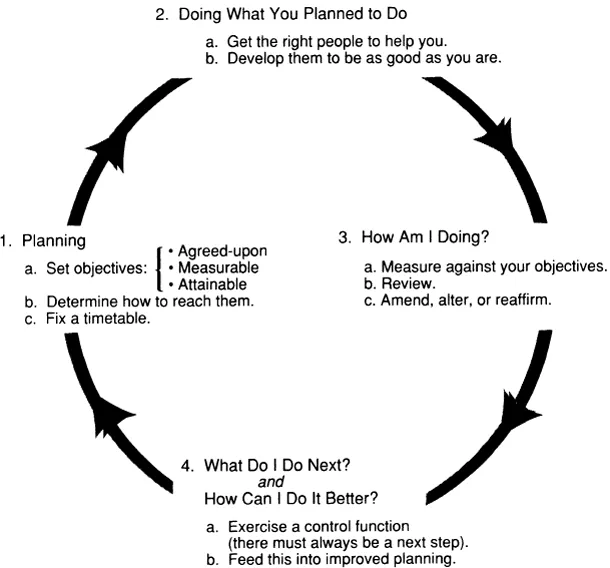
Someone has also said that good managing is planning and controlling, and out of this definition has grown the concept of the cycle of management. It applies to every person in an organization from the CEO down to the rep in the field. Perhaps it is an oversimplification to say that the cycle of management (Figure 1-1) is a complete definition of management, but when it is coupled with one of the above definitions, it comes mighty close. Let’s examine the components of the cycle.
The first step in any management job is to have a plan, but everyone must be in agreement as to what is meant by planning. Many sales managers are frustrated because what they mean by the word “planning” differs from their staff’s understanding of the word. To avoid any such confusion, I will explain exactly what I mean by planning.
Planning involves three steps. The first step is to set objectives. The second step is to determine how to reach those objectives. The third step is to decide when the job should be completed.
Most people plan every day of their lives. For example, you sit down with your spouse and say, “Honey, where should we go for our vacation this year?” After discussing a variety of places, you agree that you will drive out to the West Coast and visit the national parks on the way. You set an objective; you complete the first stage of planning. Then you talk over the cost of the trip and ask yourselves whether you can afford it. You decide whether to go by auto, rail, or plane. You decide whether to take the children. This is the second phase of planning. Finally, you decide when you will go, taking into consideration when you can get away from business and when you may expect good weather. You are now performing the third phase of the planning function.
Figure 1–1. The cycle of management.
With your vacation planned, nothing remains to be done but to carry out the plans you have already made. There is nothing burdensome about all this. It is actually a relief to have completed such a plan, and you experience feelings of satisfaction and pleasurable anticipation. Planning is a normal function of an orderly mind.
The next step is to act in accordance with the plan at the appropriate time. Like every field sales manager, you have probably had the following frustrating experience. You’ve planned an important sales interview with one of your reps. Perhaps you’ve both spent considerable time reviewing exactly what you were going to say, only to have the sales rep divert the discussion to an entirely different subject immediately upon meeting the prospect. While there are, of course, situations where a plan must be discarded, ordinarily the interview will be far more effective if it has been carefully planned and executed as planned. The same is true of plans for the development of individual sales reps, for the improvement of sales of a certain product line, or for the sale of products to a particular class of trade. Generally, it can be said that once you plan a course of action, you do it—you carry out the plan!
The third step in the cycle is to sit back and take a good look at what you have done. You have planned a course of action and implemented your plan with action. Did you accomplish the desired results? What would you do differently if you had to do it all over again? What parts did you do particularly well and in what areas could you have done better? In other words, you make a thorough evaluation of your performance.
This leads directly to the fourth step in the cycle. You have now appraised your performance. Even though you can’t turn back the clock, you can learn from the experience. This is perhaps the most important step in the entire cycle—and the one most often omitted. Looking ahead to the next time you will perform this function, you must decide how to make your planning more effective. Your experience, increased knowledge, and careful appraisal of past performance will enable you to make better plans for the next operation. Thus the cycle results in ever-improving performance.
Note that it is impossible to break the cycle and still manage. Management is the complete and continuous repetition of the cycle. Omit any step and you will have confusion instead of management. Applying this cycle to your task as field sales manager, we find that you must (1) determine what you want each of your reps to accomplish; (2) select the most qualified reps and see that the work gets done; (3) check periodically on their performance; and (4) develop methods that will help them to function more effectively. The cycle is equally applicable to the planning for and development of key accounts (see Chapter 2).
Attitude
Having a proper attitude is crucial to being an effective field sales manager. Thinking of yourself as a helper is key here. You are not only helping top management to achieve its goals; you are helping your salespeople to carry out the commitments both of you share. This is hard to do if your reps see you only as a “boss.”
A boss-underling relationship is a barrier to sound communications. When a salesperson reports to a boss, the inclination is to hide the real problems so as to look as good as possible. By contrast, when the sales rep looks upon the field sales manager as one who needs help and who can offer help in return, as part of a team in getting a common responsibility performed bett...
Table of contents
- Cover
- Half title
- Title
- Contents
- Preface to the Revised Edition
- 1. The Transition From Selling to Managing
- 2. Planning: The First Step
- 3. Implementing the Plan
- 4. The Appraisal Process
- 5. The Control Function
- 6. Effective Communications
- 7. District Sales Meetings
- 8. Recruiting, Selecting, and Training New Sales Reps
- Index
- Copyright
Trusted by 375,005 students
Access to over 1.5 million titles for a fair monthly price.
Study more efficiently using our study tools.
Frequently asked questions
Yes, you can cancel anytime from the Subscription tab in your account settings on the Perlego website. Your subscription will stay active until the end of your current billing period. Learn how to cancel your subscription
No, books cannot be downloaded as external files, such as PDFs, for use outside of Perlego. However, you can download books within the Perlego app for offline reading on mobile or tablet. Learn how to download books offline
Perlego offers two plans: Essential and Complete
- Essential is ideal for learners and professionals who enjoy exploring a wide range of subjects. Access the Essential Library with 800,000+ trusted titles and best-sellers across business, personal growth, and the humanities. Includes unlimited reading time and Standard Read Aloud voice.
- Complete: Perfect for advanced learners and researchers needing full, unrestricted access. Unlock 1.5M+ books across hundreds of subjects, including academic and specialized titles. The Complete Plan also includes advanced features like Premium Read Aloud and Research Assistant.
We are an online textbook subscription service, where you can get access to an entire online library for less than the price of a single book per month. With over 1.5 million books across 990+ topics, we’ve got you covered! Learn about our mission
Look out for the read-aloud symbol on your next book to see if you can listen to it. The read-aloud tool reads text aloud for you, highlighting the text as it is being read. You can pause it, speed it up and slow it down. Learn more about Read Aloud
Yes! You can use the Perlego app on both iOS and Android devices to read anytime, anywhere — even offline. Perfect for commutes or when you’re on the go.
Please note we cannot support devices running on iOS 13 and Android 7 or earlier. Learn more about using the app
Please note we cannot support devices running on iOS 13 and Android 7 or earlier. Learn more about using the app
Yes, you can access From Selling to Managing by Ronald Brown in PDF and/or ePUB format, as well as other popular books in Business & Management. We have over 1.5 million books available in our catalogue for you to explore.