To survive in today's hypercompetitive marketplace, leaders must find ways to elevate the performance of their employees. By continuously setting higher goals to strive for, strengthening employee competencies via coaching, and providing feedback to employees, leaders can create a positive performance cycle that leads to improved individual and team performance and, ultimately, stronger operating results for the organization. This action guide covers the three stages of performance management: goal-setting, coaching, and performance review. It includes step-by-step instructions and tips, the 10 elements of positive performance management, the five steps to preparing for a review, guidance on how to prepare the employees and engage them during the reviews, the most effective steps you can take to improve performance, and more.
- 49 pages
- English
- ePUB (mobile friendly)
- Available on iOS & Android
eBook - ePub
Powerful Performance Management
About this book
Information
Subtopic
Human Resource ManagementIndex
BusinessThe Basics of Positive Performance Management
Positive Performance Management (PPM) has three phases:
1. Performance Review and Goal Setting
2. Coaching
3. Review of Performance Goals
Each of these phases is critical for improving employee performance. Although the phases are presented in an independent manner, they are interrelated and each builds on the others, forming a cycle of appraisal, coaching, and review.
The Performance Appraisal Cycle
The performance appraisal cycle (see Figure 1) begins with the performance review and moves through coaching to subsequent performance reviews and additional coaching to reach the established goals. Here's a more detailed description of each of the three phases.
1. Performance Review consists of providing feedback to employees regarding their progress toward meeting objectives or goals and their skills and ability improvements. Goal setting involves “setting the course” in terms of objectives, responsibilities, and skills/ability development.
2. Coaching consists of mentoring employees and helping keep them along the course that has been set. As coaches, leaders ensure that employees maintain effective levels of performance while striving for performance improvement (later sections of this ebook detail significant coaching recommendations for executive coach/managers).
3. Review of Performance Goals consists of leaders and employees evaluating previous goals for current validity. As time passes, some goals may need to be revised or eliminated. Reviewing these performance goals also provides leaders and employees with an opportunity to determine if the employee is still on course.
Figure 1. Performance appraisal cycle for Positive Performance Management.
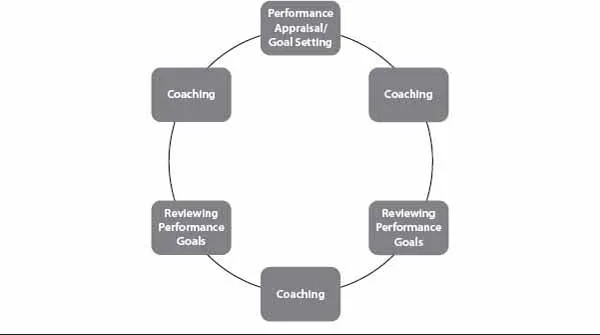
Note that Positive Performance Management is not a one-time process. Engaging in performance reviews and goal setting, coaching, and review of performance goals only once will not result in an improved workforce (i.e., one that is more capable, committed, and aligned). Leaders must be committed, and also gain commitment from their employees, to the importance of continuous improvement. However, one of the key tools that leaders have for improving their workforce is the PPM cycle. After reviewing the performance goals, leaders and employees are certainly not done with the process. Instead, the reviewed performance goals mark the beginning of another cycle.
To survive in today's hypercompetitive marketplace, leaders must find ways to steadily elevate the performance of their employees. By continuously setting higher goals, strengthening employee competencies via coaching, and providing feedback, leaders can create a positive-performance cycle whereby goals, coaching, and feedback lead to improved individual and team performance—and, ultimately, to stronger operating results for the organization.
How Does a Leader Execute Positive Performance Management (PPM)?
Implementing a Positive Performance Management system can be a daunting affair. The following is a breakdown of the key steps and corresponding guidelines.
Preparation
Although preparation may appear to be an obvious first step, it is often overlooked or intentionally bypassed. A haphazard or improperly prepared performance review conveys to employees the perception that their development is not a high priority. To avoid giving this message, be prepared.
There are five critical steps to prepare for a performance review: (1) schedule the meeting, (2) review the performance beforehand, (3) prepare the employee, (4) self-assess, and (5) set the agenda.
Scheduling is the first step and involves finding a time to meet. Taking the time to properly schedule a meeting is important because it conveys the message that the performance review is important enough to appear on an official schedule. After a meeting time has been established, the leader should review the employee's performance prior to the meeting. Leaders should have a coherent idea of what feedback they will give to their employees, with specific examples of their strengths and areas in need of development. One of the worse things a leader can do is go into the meeting without a clear idea of how the employee is performing. This vagueness conveys the perception that the leader does not care.
Leaders should also prepare their employees for their performance reviews. The review process should be a collaborative one. For the collaboration to work, however, employees need an idea of what is expected of them and what they need to contribute. Additionally, leaders should take the time to reflect upon themselves. People do not digitally and accurately record all of their experiences into memory. We can all fall victim to biases that affect our judgment and memory. By taking the time to reflect on any judgments prior to the meeting, leaders can potentially minimize the effects of bias.
Lastly, leaders should set the agenda for the meeting and determine the specific areas to focus on. Below is an outline of specific recommendations for this part in the cycle.
Schedule the Time and Place

Review the Employee's Performance Beforehand
Table of contents
- Cover Page
- Title Page
- Copyright Page
- Contents
- Introduction: Complete, Honest, and Timely Performance Reviews
- The Basics of Positive Performance Management
- The Roles and Responsibilities of Employees
- The Roles and Responsibilities of Leaders
- Coaching: A Leader's Contribution to Success
- About the Author
- Free Sample Excerpt from Talent Leadership by John Mattone
Trusted by 375,005 students
Access to over 1.5 million titles for a fair monthly price.
Study more efficiently using our study tools.
Frequently asked questions
Yes, you can cancel anytime from the Subscription tab in your account settings on the Perlego website. Your subscription will stay active until the end of your current billing period. Learn how to cancel your subscription
No, books cannot be downloaded as external files, such as PDFs, for use outside of Perlego. However, you can download books within the Perlego app for offline reading on mobile or tablet. Learn how to download books offline
Perlego offers two plans: Essential and Complete
- Essential is ideal for learners and professionals who enjoy exploring a wide range of subjects. Access the Essential Library with 800,000+ trusted titles and best-sellers across business, personal growth, and the humanities. Includes unlimited reading time and Standard Read Aloud voice.
- Complete: Perfect for advanced learners and researchers needing full, unrestricted access. Unlock 1.5M+ books across hundreds of subjects, including academic and specialized titles. The Complete Plan also includes advanced features like Premium Read Aloud and Research Assistant.
We are an online textbook subscription service, where you can get access to an entire online library for less than the price of a single book per month. With over 1.5 million books across 990+ topics, we’ve got you covered! Learn about our mission
Look out for the read-aloud symbol on your next book to see if you can listen to it. The read-aloud tool reads text aloud for you, highlighting the text as it is being read. You can pause it, speed it up and slow it down. Learn more about Read Aloud
Yes! You can use the Perlego app on both iOS and Android devices to read anytime, anywhere — even offline. Perfect for commutes or when you’re on the go.
Please note we cannot support devices running on iOS 13 and Android 7 or earlier. Learn more about using the app
Please note we cannot support devices running on iOS 13 and Android 7 or earlier. Learn more about using the app
Yes, you can access Powerful Performance Management by John Mattone in PDF and/or ePUB format, as well as other popular books in Business & Human Resource Management. We have over 1.5 million books available in our catalogue for you to explore.