![]()
Part One
Steak
![]()
Chapter 1
Your Audience Speaks
I always sit in the quick-exit seats, the ones right by the door. When I attend a presentation, I want the option of escaping the clutches of a boring speaker who’s wasting my time. I’m amazed at the number of people who will politely sit in their seats, trapped by a speaker from hell. Their minds scream, “Shut up!” while their bodies fidget in disgust.
Early in my career as a presentation skills coach, I was asked to provide some one-day programs for the Oregon State Bar Continuing Legal Education speakers. These were lawyers who were presenting programs to their peers. To research the task, and to find out all about these programs, I attended one of the organization’s standard training sessions. Approximately 350 attorneys were seated behind rows of tables at the Hilton Hotel in downtown Portland, Oregon. You couldn’t see many faces, because most of the attendees were reading their morning newspapers. The news must have been really captivating that day, because when the speaker started to talk, most of the newspapers remained in their upright positions. Wait a minute; something’s out of place here, I thought. The speaker has begun, and most of the audience is ignoring him. And if that’s not enough, the speaker is ignoring their apparent total lack of interest.
My mission for this organization, and for the remainder of my professional life, became quite clear. I would train presenters to be so outstanding that in a setting like this, those newspapers would come crashing down. My job would be to help speakers captivate the audience and hold their attention right up to the closing line.
Defining a Strategy
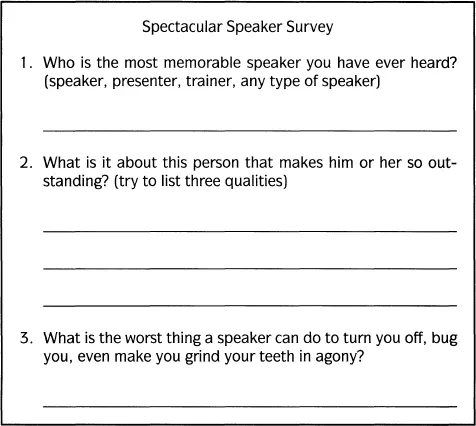
I had a lot of questions. By what magic can people hold an audience spellbound? I was interested in the best. What’s different about the top 5 percent? What presentation pitfalls must be avoided? How could I find the answers and then teach the required skills to my clients? I distilled my curiosity into three questions, given in Figure 1-1, which I posed to over 1,000 businesspeople throughout the United States. In this chapter, you will learn the secrets of spectacular speakers—from the audience’s viewpoint. Their simplicity might surprise you!
The audiences represented a wide variety of occupations, including certified public accountant, engineer, company vice president, sales director, hairdresser, pilot, dentist, programmer, technical writer, financial analyst, pharmacist, secretary, and health care technician.
Figure 1-1. Audience survey questionnaire.
I administered the questionnaire at the beginning of the session, before the audience had a chance to be influenced by my training. I elaborated on the first question, asking everyone to consider the full gamut of speakers, trainers, instructors—everyone who, in their experience, had stood before two or more persons with something to say. Their choice could be a nationally known figure, a coworker, or the leader of a local scout troop. It was not necessary to remember the person’s name; it was acceptable to identify the person in some other way, such as “the keynote speaker for last year’s sales convention.” I didn’t want to place any limits on their selection. The detailed responses to my questions are summarized in the Appendix.
From the more than 1,000 responses I received, I randomly selected 200 for more detailed analysis. This review revealed a surprising number of similar perceptions that have become the cornerstone of my Speakers Training Camp. I share these findings with you, and I am confident that with this information, you can become someone’s favorite speaker someday!
1. Listen to Your Audience
Get ready for the three most important things audiences like about their favorite speakers—and the three most important things you’ll learn in this book. The audience responses were overwhelmingly weighted toward some simple advice to presenters.
Ranked according to number of responses, audiences say:
1. Be enthusiastic.
2. Be interesting—use humor and stories.
3. Be knowledgeable—know your stuff.
The secret to great presentations is not complicated at all. Audiences want a speaker who is outwardly excited about the topic, who uses bursts of humor, fun, and personal stories and ex...