
- 112 pages
- English
- ePUB (mobile friendly)
- Available on iOS & Android
eBook - ePub
Successful Team Building
About this book
Working in teams brings benefits to both team members and organizations for which they work. If you are a team leader, you know that getting commitment isn't always easy. SUCCESSFUL TEAM BUILDING shows you how to motivate team members, and so reap the benefits. You'll learn how to build team commitment, deal with team conflict, use creativity in problem solving and decision making, and evaluate and reward team players. The result? Your team will respond favorably to your efforts. And your boss will notice too.
Information

PART I
THE NATURE AND BENEFITS OF A TEAM
CHAPTER 1
WHAT IS A TEAM?
The most distinguishing characteristic of a team is that its members have, as their highest priority, the accomplishment of team goals. They may be strong personalities, possess highly developed specialized skills, and commit themselves to a variety of personal objectives they hope to achieve through their activity; but, to them, the most important business at hand is the success of the group in reaching the goal that its members, collectively and with one voice, have set. The members support one another, collaborate freely, and communicate openly and clearly with one another.
Most nonteam groups, on the other hand, tend to be collections of personalities with their own agendas, which may be more valuable to those personalities than the agenda that the majority of the group members seek to fulfill. Discussions and relationships in such groups are often characterized by shifting agendas, power subgroups, a going along with decisions rather than a wholehearted commitment, and even a win-lose orientation: One person or subgroup gains its wishes over another.
Don’t let your vision get diluted, but don’t be afraid of teamwork.
—JAMES B. PATTERSON
CHAIRMAN, J. WALTER THOMPSON NORTH AMERICA
KINDS OF TEAMS
There are many kinds of groups that can evolve into closely knit teams. Some of the most common are:
• Committees, which usually serve as investigative or advisory bodies reporting to the person or agency that has appointed and organized them.
• Task forces, which, most often, are temporary problem-solving groups formed to deal with issues that cross functions or lines of authority. A task force may, for its life, be full- or part-time.
Characteristics of Effective and Ineffective Teams
Effective | Ineffective |
Information | |
Flows freely up, down, sideways | Flows mainly down, weak horizontally |
Full sharing | Hoarded, withheld |
Open and honest | Used to build power |
Incomplete, mixed messages | |
People relationships | |
Trusting Respectful Collaborative Supportive | Suspicious and partisan Pragmatic, based on need or liking Competitive Withholding |
Conflict | |
Regarded as natural, even helpful | Frowned on and avoided |
Destructive | |
On issues, not persons | Involves personal traits and motives |
Atmosphere | |
Open | Compartmentalized |
Nonthreatening | Intimidating |
Noncompetitive | Guarded |
Participative | Fragmented, closed groups |
Decisions | |
By consensus | By majority vote or forcing |
Efficient use of resources | Emphasis on power |
Full commitment | Confusion and dissonance |
Creativity | |
More options | Controlled by power subgroups |
Solution-oriented | Emphasis on activity and inputs |
Power base | |
Shared by all | Hoarded |
On competence | On politicking, alliances |
Contribution to team | Pragmatic sharing |
Contribution to power source | |
Motivation | |
Commitment to goals set by team | Going along with imposed goals |
Belonging needs satisfied | Coercion and pressure |
More chance for achievement through group | Personal goals ignored |
Individual achievement valued without concern for the group | |
Rewards | |
Based on contribution to group | Basis for rewards unclear |
Peer recognition | Based on subjective, often arbitrary appraisals |
• Quality circles, consisting of groups of employees and supervisors who search for ways to increase the effectiveness of their work groups through higher productivity and improved quality.
• Project groups, organized to work specifically on a project, such as a new product, a new facility, or a computer program. Like the task force, the project group may have a temporary existence. When its mission has been accomplished, the group disbands.
Probably the most ambitious and complex team-building effort involves an entire work section or department, if only because in an ongoing operation the objectives change, requiring periodic review and goal-setting sessions among those who must commit and recommit themselves.
DIAGNOSING YOUR GROUP
A logical place to start your team-building effort is to look carefully at the group you manage or participate in. How is the group characterized? Complete the following diagnosticator. How many of the statements are true about your team?
GROUP DIAGNOSTICATOR
Consider each statement in terms of whether it characterizes your group or not. If the description is relevant rarely, treat the statement as if it does not apply. If it does, indicate with a check whether you observe it frequently or just occasionally.
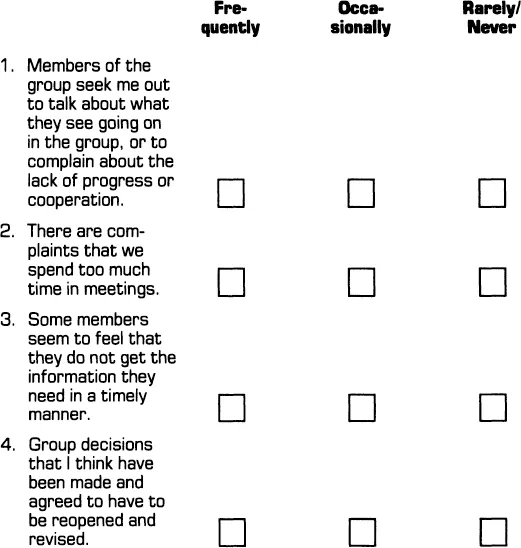
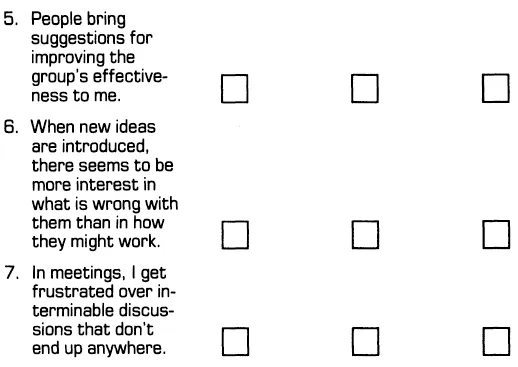
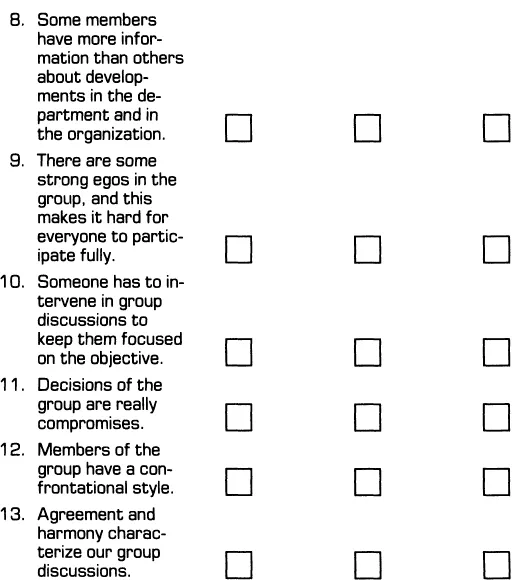
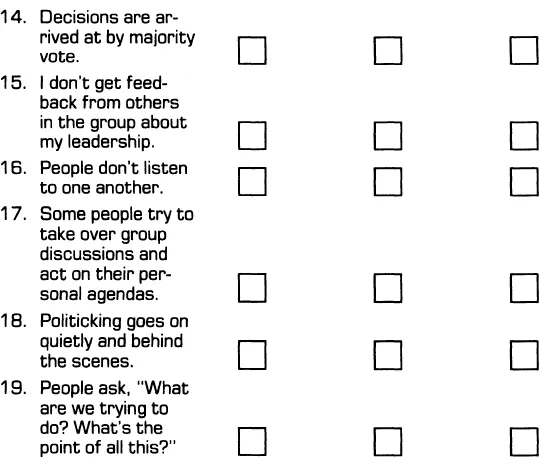
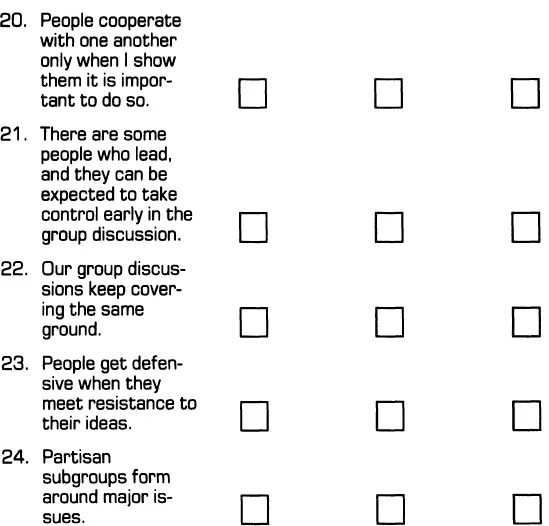
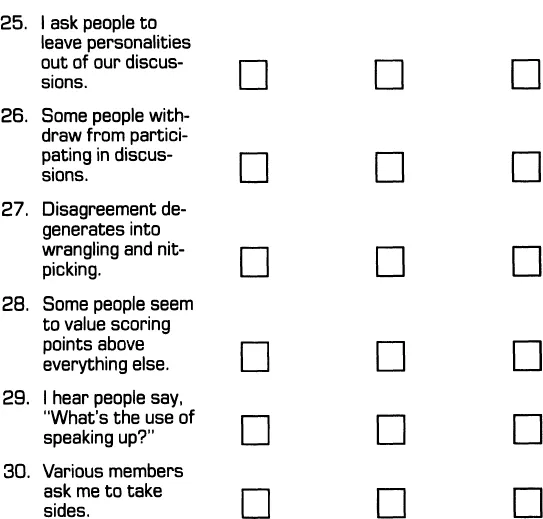
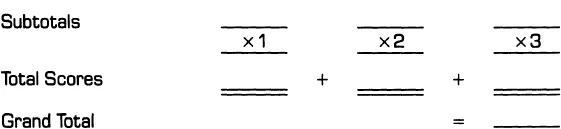
For each “frequently” that you checked, give yourself a score of 1. “Occasionally” merits 2, and “rarely/never” rates 3. Multiply each number by the total number of statements to which you applied it. To illustrate, if you checked “occasionally” 10 times, “frequently” 10 times, and “rarely/never” 10 times, your overall score would be 60.
ANALYZING YOUR DIAGNOSIS
The higher your score, the more advanced your group in building itself toward team status. If your score is the maximum of 90 (30 times 3), you can count yourself exceptional indeed—and fortunate to have such an effectively functioning group without any (or nearly any) indicators of impediments or barriers to successful team operation. Conversely, if your score is 30, by no means can you describe your group as a team. If your total falls between 60 and 90, you are well on your way, but you still have some distance to travel before you and your associates can enjoy the plentiful benefits of working as a team rather than as a mere group.
Here are some of the meanings behind each statement:
1. If other members of the group talk to you about what is or is not going on in the group, that means a great deal of communicating occurs outside the group. The group’s progress or lack of it, to members, is not a group issue, to be discussed in and dealt with by the group as a whole. Group issues in a team are handled by the team as a team, not by members of it in outside conferences.
2. The group has not yet learned how to conduct effective meetings in which, because of good formal and informal le...
Table of contents
- Cover
- Half title
- Title
- Contents
- Preface
- Part I. The Nature and Benefits of a Team
- Part II. How People Work Effectively in a Team
- Part III. Communication and Conflict in a Team
- Part IV. Creativity and Effectiveness in Team Meetings
- Part V. Evaluating and Rewarding Team Progress
- Copyright
Trusted by 375,005 students
Access to over 1.5 million titles for a fair monthly price.
Study more efficiently using our study tools.
Frequently asked questions
Yes, you can cancel anytime from the Subscription tab in your account settings on the Perlego website. Your subscription will stay active until the end of your current billing period. Learn how to cancel your subscription
No, books cannot be downloaded as external files, such as PDFs, for use outside of Perlego. However, you can download books within the Perlego app for offline reading on mobile or tablet. Learn how to download books offline
Perlego offers two plans: Essential and Complete
- Essential is ideal for learners and professionals who enjoy exploring a wide range of subjects. Access the Essential Library with 800,000+ trusted titles and best-sellers across business, personal growth, and the humanities. Includes unlimited reading time and Standard Read Aloud voice.
- Complete: Perfect for advanced learners and researchers needing full, unrestricted access. Unlock 1.5M+ books across hundreds of subjects, including academic and specialized titles. The Complete Plan also includes advanced features like Premium Read Aloud and Research Assistant.
We are an online textbook subscription service, where you can get access to an entire online library for less than the price of a single book per month. With over 1.5 million books across 990+ topics, we’ve got you covered! Learn about our mission
Look out for the read-aloud symbol on your next book to see if you can listen to it. The read-aloud tool reads text aloud for you, highlighting the text as it is being read. You can pause it, speed it up and slow it down. Learn more about Read Aloud
Yes! You can use the Perlego app on both iOS and Android devices to read anytime, anywhere — even offline. Perfect for commutes or when you’re on the go.
Please note we cannot support devices running on iOS 13 and Android 7 or earlier. Learn more about using the app
Please note we cannot support devices running on iOS 13 and Android 7 or earlier. Learn more about using the app
Yes, you can access Successful Team Building by Thomas L. QUICK in PDF and/or ePUB format, as well as other popular books in Business & Human Resource Management. We have over 1.5 million books available in our catalogue for you to explore.