eBook - ePub
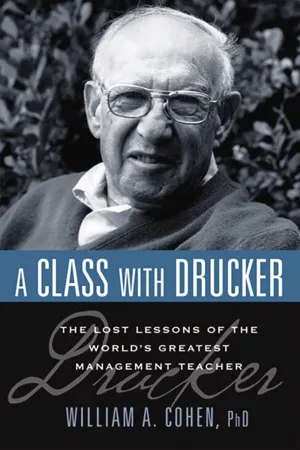
A Class with Drucker
The Lost Lessons of the World's Greatest Management Teacher
- 272 pages
- English
- ePUB (mobile friendly)
- Available on iOS & Android
eBook - ePub
About this book
From 1975 to 1979, author William Cohen studied under one of the greatest management educators and thought-leaders of all time: Peter Drucker. What Drucker taught him literally changed his life. Now, in this warm and inspiring read, Cohen shares the insights he gained as the first-ever graduate of Drucker's doctoral program and teaches readers how Druker's game-changing ideas stand the test of time in the face of real-world workplace challenges today. A Class with Drucker shares many of Drucker's teachings that never made it into his countless books and articles--ideas that were offered to his students in classroom or informal settings. Cohen expands on Drucker's lessons with personal anecdotes about his teacher's personality, lack of pretension, and interactions with students and others. Having gone on from Drucker's teachings to become an Air Force general and eventually professor, management consultant, multibook author, and university president, Cohen is a testament to the lifechanging impact of Drucker's teachings and friendship. Enlightening and intriguing, this book allows you, too, to learn and grow from the timeless wisdom of a most inspiring man.
Information
CHAPTER ONE
How I Became the Student of the Father of Modern Management
This book consists of wisdom that I learned in the classroom and in personal dialogue with Peter F Drucker, arguably the greatest management thinker of our time. It also describes how I applied these insights which he so generously imparted. However, this first chapter is mostly about me and how I came to my relationship with Peter Drucker. The lessons themselves were received over a thirty-year period, from when I first met Peter Drucker in 1975 until his death in 2005. His management approach continues to be taught at the Peter F. Drucker and Masatoshi Ito Graduate School of Management at Claremont Graduate University. I know that it gave him a great deal of satisfaction and pleasure that his university would continue the legacy of his work both in spirit and practice.
My lessons from Peter ended on November 11th, 2005. It was then that I received a most unwelcome e-mail announcement from Claremont Graduate University regarding this man from whom I learned so much, and who in so many ways changed my life. Peter F. Drucker, The “Father of Modern Management,” had died peacefully several hours earlier at age of 95, a couple of weeks before his 96th birthday.
While death at an advanced age does not come as a complete surprise, such an announcement cannot come without a profound sense of loss. This is because Peter was who he was and did the things he did, and because he made such major contributions to the lives and thinking of many generations of management practitioners, researchers, thinkers, and students. In my case, I felt this loss especially keenly because it was personal. Until not long prior to his death, I spoke with Peter by telephone often and saw him at least once a year. I was not a campus colleague, except twice when I taught at Claremont Graduate University as a part time adjunct professor. During one such period in the mid-1980’s, Peter allowed me to use his office as my own.
Peter Drucker was both my friend and mentor. He was more than a former professor with whom I had studied for my doctorate some thirty years earlier. But I hasten to add that many, perhaps thousands of students and non-students alike felt the same about him. Peter had a gift of making everyone he came into contact with feel as if he or she were an especially close friend. And he seemed to remember and have special affection for his former students. Many maintained contact with him.
The lessons I learned from Peter were extraordinary and significant to my thinking and practice, not just of management, but of life. One of the highest honors I have ever received came as a result of my teaching a challenging course in strategy, planning, and decision-making to a group of doctoral students at CETYS University in Ensenada, Mexico in 2005. One student representing the group was generous enough to say, “As you have quoted and furthered the ideas of Peter Drucker, in the future, as we progress in our careers, we will quote you and further your ideas.”
How I First Heard About Peter Drucker
In 1973, I had returned from Israel after living and working there for three years. Previous to that, my background was totally in the military, I was even born into a military family. I knew little outside of the military, and less about business and how it was practiced. I did know something about management and how to direct research and development activities since I had done this work in the Air Force and in Israel. Moreover, on my return to the U.S., I had become director of research and development for a company developing and manufacturing life support equipment, primarily for aviators and airplane passengers. This company was located in California, near Los Angeles. As a practicing manager, I decided that I had better learn something about business, so I committed to reading at least one business book every week.
I soon discovered Drucker. I read his classic works such as Concept of the Corporation and The Effective Executive. His book, Management: Tasks, Responsibilities, Practices, was published the same year as I began as an executive in industry, and I eagerly devoured the thick volume that I would later study as his student.
My First Drucker Lesson was Not from the Classroom
I received my first Drucker lesson before I even met Peter Drucker. As the senior manager heading up research and development, I attended the company’s annual off-site sales conference. One of the items on the agenda was a discussion of a Drucker concept developed in Management: Tasks, Responsibilities, Practices. In this book Peter had written that “the first task of any business management was to decide what business it was in.” I soon realized that it was not only a profound statement about business: it was true about every endeavor anyone might undertake in life.
Let me explain what I mean. I had at that point recently completed my first-ever job search. A few years later I became a headhunter. Both as a job seeker myself and as a facilitator in this field, I discovered that many job candidates fail to get hired by companies because they don’t know what they want to do. They want “to keep their options open.” Even some managers who have extensive experience in many industries make this mistake. They put together a very general resume which says that they have done many different things in many different areas and for different companies. They promote themselves as a “jack of all trades,” able to do anything. Unfortunately, their resumes do not emphasize what “business” they are really in. This comes across as the second part of that old saying “… and master of none.”
As a consequence, not infrequently, a job candidate with a lot less experience who makes it clear by the way his or her experience is presented that this is the one “business” that the person is really in, is the one who lands the job. This happens even though the candidate’s experience in the discipline is frequently far less than the one who tries to be everything to everybody.
The same is true when it comes to managing our time in order to achieve our goals, and Peter was a master time manager. Each of us has the same amount of time, 24 hours a day. But some fritter away and waste their time on work which has no bearing on what they would like to accomplish or where they would like to be one, five, or ten years in the future.
Once you decide on “your business,” the non-essential work that you do becomes obvious. Maybe you are in the wrong job for where you want to be in ten years or for what you want to become. If that job is supporting you as you struggle to gain knowledge or in other ways work toward your “real” professional goal, you probably have to stick with it for the time being. But you are much less likely to reach your goal than someone who knows what “business” he or she is in and focuses on that to the exclusion of other activity non-essential to this goal.
This doesn’t mean that you must avoid washing dishes or digging ditches to earn necessary money while you are preparing yourself in other ways to do what you really want. But it does mean that you need to decide what you want, and then stick to activities which support “your business” goals. From this first preliminary lesson I realized that this individual, Peter Drucker, had something to say which was very valuable indeed, and I applied it at once.
I Become Peter Drucker’s Student
I was heading up research and development for a company, but I felt I had much to learn. On the technical side, I was well-supported by some first-rate engineers. However, some of the business concepts I was dealing with were unfamiliar. I had only a BS degree from West Point and an MBA, so I decided the best solution was to further my academic education in business.
At first I just wanted to take some additional courses. However, I soon decided that what I really needed was a higher level of business education. That meant a doctorate in business. I called two well-known universities in my geographical area. Representatives at both institutions said that if I wanted a doctorate, I had to quit my job and work on the doctorate full-time. They told me that there was no such thing as studying for a doctorate without becoming a full-time student. This didn’t sound right to me then, and I am even more convinced today that it is not right.
What happens in most cases is that full-time students are forced to teach or assist the full-time professors in order to support themselves. This amounts to a full-time job. They are paid a small fraction of what they earned previously or could earn outside of the academic environment. Arguably, they are exploited, to one extent or another, by the universities that accept them as doctoral students. I suppose those who do this rationalize that this is how would-be doctorate candidates “learn their trade.” Fortunately for me, this situation turned out not to be true at Drucker’s university.
Seeing an advertisement in The Wall Street Journal by a university that claimed to offer doctoral degrees part-time for employed executives, I responded and was invited to meet the dean for an interview. Much to my surprise and disappointment, the “university” turned out to be a suite in a hotel. The “dean” told me that I could get a doctorate in any field I wanted, not just business but in engineering, psychology, or anything else. There were no courses. All I had to do was to write a “dissertation.” And of course pay several thousand dollars in tuition upfront.
“It has to be a real good dissertation,” the “dean” told me, “and it should take you about six months to complete.” The “dean” misread the look on my face and quickly added, “Of course, under special circumstances and if you work real hard, you can finish your dissertation and get your doctorate in a week.” I was aghast and terminated the interview.
On my return to my office, I immediately called the California State Board of Education. I was amazed to discover that this university was actually empowered by the State of California to grant these degrees. This was a type of school known as a “diploma mill.” It wasn’t a real university at all. In those days, California educational laws were very loose, and these so-called “universities,” all non-accredited, flourished. Fortunately, California law was tightened considerably in the late 1980’s and these phony universities have all but disappeared. Today, nonaccredited universities in California must be approved by the State, and in order to gain this approval they have to meet stringent standards, including site visitations. Soon after this incident, I received a printed advertisement at work promoting an MBA. In smaller letters at the bottom of the flyer were the words: “New PhD program for executives—call the dean’s office.” It gave a telephone number. The university was called Claremont Graduate School.
Not being from the Los Angeles area, nor having much dealing with academia, I had never heard of this university, and I even suspected that it might just be another diploma mill. I called the telephone number and was soon connected with Dean Paul Albrecht. I didn’t know Paul Albrecht when I called, but he was one of the leaders in higher education—an innovator who in many ways changed education as we know it.
Dean Albrecht told me that this new PhD for executives had just been approved by Claremont’s president and its academic council, and that a limited number of students would be admitted to the first class in the fall of 1975. He told me that this was not a program for specialists or those who wanted to become professors to teach and do research. It was designed for executives who wanted to reach the top levels as practicing managers. Potential students wanting to get into the program had to be practicing managers with a certain minimum number of people reporting to them as evidence of their management background and potential for further promotion.
Albrecht questioned me extensively about my background and about the research and development organization which I headed. Finally, he said: “If you are interested, you seem to meet the basic requirements. Why don’t you send me your curriculum vitae?” He had to explain to me that “a vita” was the academic way of saying “resume.” I sent it. Several weeks later his secretary, Lois, called to set up an interview for me at Claremont.
After a week or so I was heading toward the small town of Claremont, California, about thirty miles due east from my home in Pasadena. I wondered whether I was to be disappointed again with another diploma mill. I was much relieved when I arrived at the university and I found it to be one of a consortium of educational institutions called “The Claremont Colleges.” It looked real, but after my earlier experience, I was still somewhat suspicious of California schools.
I met Dean Albrecht and he explained what in academia we call “the theory construct” of his new doctoral program, the first class of which was just forming. It was based on an equally demanding MBA executive program begun several years earlier.
“Management is becoming more and more complex,” he said. “Even an MBA is no longer sufficient. Our new program differs substantially from our regular PhD program. Our regular program requires a high degree of specialization. For example, if you wanted a PhD in finance, you must take mostly finance courses and pursue this one discipline in some depth. Then, of course, you must do research and write a dissertation in that discipline.
“In this new executive PhD program, you will still be required to do research and write a dissertation on a specific business topic. You must also meet the requirements for traditional research tools, such as taking a qualifying examination and a proficiency examination in two foreign languages. The difference is that your doctoral courses will not be in one area, but will cover all of the various disciplines of business and economics.”
The requirement for two foreign languages was later changed to either one foreign language and one research tool, or two research tools. I understand that some years later the traditional requirement of mastery of a foreign language was finally dropped altogether.
“Also,” the dean continued, “You will be required to take several courses from Peter Drucker, as his management concepts are the basis of the program.”
The magical name, “Peter Drucker,” grabbed my immediate attention. I could not believe that the number-one managerial thinker and writer in the country, and probably the world, was teaching at the very university at which I was interviewing, one I had even suspected might be a diploma mill. I didn’t want to insult Dean Albrecht about my disbelief that this world famous professor could be at this university with which I had previously been totally unfamiliar. So, I asked, “Which “Peter Drucker” is this?” I guess it was a rather inane question, but it was all I could think of to ask at the time to confirm that we were talking about the same individual.
“I believe there is only one Peter Drucker,” Albrecht responded. I don’t recall now if he was smiling or not when he said this to me. As Paul described himself, he was a “taciturn German.” However, he was taciturn with a sense of humor. I recall thinking at the time that he seemed somewhat amused at my question. “Our new program has much to do with Drucker’s ideas and way of thinking, and if you join us, you will be required to take several courses from him as a minimum,” he repeated.
I decided right then that this was exactly what I wanted. I applied for Claremont’s new program and was eventually accepted. A couple of months later I was in a class with nine other executive PhD students with perhaps the greatest management thinker of our time, teaming up with the man behind the program, Dean Paul Albrecht. It was the first class of the new program, limited to ten new executive doctoral students, and conducted in a lounge room at the university faculty club. The class was completely informal, with both Paul Albrecht and Peter Drucker leading the class in discussing a number of important managerial issues of the day. I was off and running, learning Drucker lessons and wisdom first-hand.
The Oral Lessons and Lost Wisdom
Despite Peter Drucker’s extensive writing in books and articles and edited collections of his works, some of his wisdom has probably never been published, and much has been published incompletely. The reasons are not difficult to understand. An author focuses on the subject matter of the topic at hand. Thus Drucker wrote on “The Concept of Management;” Management: Tasks, Responsibilities, Practices; Innovation and Entrepreneurship; and more. But many important concepts are left out of the specific topics on which he writes. Moreover, much is probably imparted through voice intonations and gestures and in providing feedback, and his interaction with his students. What Drucker really wanted to emphasize is sometimes missing from any published material, even though Drucker was a master of the printed word.
Fortunately, while Drucker may have not have covered everything he wanted to get across through the single mode of communication of his writing, ...
Table of contents
- Cover Page
- Title Page
- Copyright Page
- Contents
- Acknowledgments and Dedication
- What Peter Drucker Wrote About Bill Cohen
- Foreword by Ira Jackson
- Introduction
- 1 How I Became the Student of the Father of Modern Management
- 2 Drucker in the Classroom
- 3 What Everybody Knows is Frequently Wrong
- 4 Self-Confidence Must be Built Step-by-Step
- 5 If You Keep Doing What Worked in the Past You’re Going to Fail
- 6 Approach Problems with Your Ignorance—Not Your Experience
- 7 Develop Expertise Outside Your Field to be an Effective Manager
- 8 Outstanding Performance is Inconsistent with Fear of Failure
- 9 The Objective of Marketing is to Make Selling Unnecessary
- 10 Ethics, Honor, Integrity and the Law
- 11 You Can’t Predict the Future, But You Can Create it
- 12 We’re All Accountable
- 13 You Must Know Your People to Lead Them
- 14 People Have No Limits, Even After Failure
- 15 A Model Organization that Drucker Greatly Admired
- 16 The Management Control Panel
- 17 Base Your Strategy on the Situation, Not on a Formula
- 18 How to Motivate the Knowledge Worker
- 19 Drucker’s Principles of Self-Development
- Afterword
- Notes
- Books by and About Peter Drucker
- Index
Trusted by 375,005 students
Access to over 1.5 million titles for a fair monthly price.
Study more efficiently using our study tools.
Frequently asked questions
Yes, you can cancel anytime from the Subscription tab in your account settings on the Perlego website. Your subscription will stay active until the end of your current billing period. Learn how to cancel your subscription
No, books cannot be downloaded as external files, such as PDFs, for use outside of Perlego. However, you can download books within the Perlego app for offline reading on mobile or tablet. Learn how to download books offline
Perlego offers two plans: Essential and Complete
- Essential is ideal for learners and professionals who enjoy exploring a wide range of subjects. Access the Essential Library with 800,000+ trusted titles and best-sellers across business, personal growth, and the humanities. Includes unlimited reading time and Standard Read Aloud voice.
- Complete: Perfect for advanced learners and researchers needing full, unrestricted access. Unlock 1.5M+ books across hundreds of subjects, including academic and specialized titles. The Complete Plan also includes advanced features like Premium Read Aloud and Research Assistant.
We are an online textbook subscription service, where you can get access to an entire online library for less than the price of a single book per month. With over 1.5 million books across 990+ topics, we’ve got you covered! Learn about our mission
Look out for the read-aloud symbol on your next book to see if you can listen to it. The read-aloud tool reads text aloud for you, highlighting the text as it is being read. You can pause it, speed it up and slow it down. Learn more about Read Aloud
Yes! You can use the Perlego app on both iOS and Android devices to read anytime, anywhere — even offline. Perfect for commutes or when you’re on the go.
Please note we cannot support devices running on iOS 13 and Android 7 or earlier. Learn more about using the app
Please note we cannot support devices running on iOS 13 and Android 7 or earlier. Learn more about using the app
Yes, you can access A Class with Drucker by William Cohen in PDF and/or ePUB format, as well as other popular books in Business & Business Skills. We have over 1.5 million books available in our catalogue for you to explore.