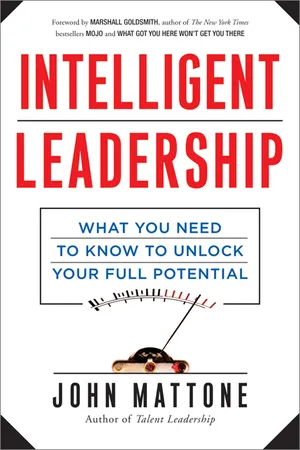
In today's business environment, leaders at all levels are facing enormous challenges when it comes to achieving and sustaining breakthrough operating results. Globalization, economic change, more stringent regulation, and tougher governance make realizing shareholder value increasingly difficult. Intelligent Leadership is written for leaders who want to become more effective, strategic, operationally focused, and balanced. It is for leaders who are striving to take control of their destiny and become the best they can be. In this groundbreaking book, leadership coach John Mattone—recently named to the "guru radar" by the prestigious Thinkers50—taps into his years of experience working with high-achieving professionals to give readers a roadmap for developing and mastering their executive maturity. Supplying three unique tools—the Wheel of Leadership Success, Map of Leadership Maturity, and the Leadership Enneagram—the book helps readers calibrate their abilities so they can simultaneously focus on their strengths and address their weaknesses. The goal is to improve key tactical competencies (such as critical and strategic thinking, decision-making, talent and team leadership, and communication) and integrate them with equally important inner traits like values, character, and beliefs in order to achieve their leadership potential. Featuring best practices, authoritative research, practical assessments, and enlightening examples of both good and bad leadership, this book equips readers with the knowledge, skills, and passion they need to become the leaders they were meant to be.
- 256 pages
- English
- ePUB (mobile friendly)
- Available on iOS & Android
eBook - ePub
Intelligent Leadership
About this book
Information
Subtopic
Business GeneralIndex
Business CHAPTER
1
Your Leadership Success Roadmap
In a breakthrough executive trends global research study that I conducted with my colleague, Bonnie Hagemann, we clearly confirmed that identifying and developing high-potential and emerging leaders is and will continue to be one of the top business issues facing CEOs. In most organizations, 40 to 70 percent of all executives will become eligible for retirement in the next five years.
In our increasingly knowledge-driven world economy, organizations are right to fear this imminent brain drain, suspecting that, when executives leave the firm, business may follow. Yet high-potentials and emerging leaders—those most likely to rise to fill those highest positions—account for less than 8 to 10 percent of the talent pool. That’s in the United States. In other countries, like Canada, Australia, the United Kingdom, Japan, and China, and in just about every country except India and various countries in Africa and South America, this issue is as pronounced as it is in the United States, if not more so. Therefore, identifying, developing, and retaining such rare talent truly is a mission-critical global challenge for CEOs, senior executives, managers, and HR directors.
Given this indisputable global business challenge, the implication for current and emerging leaders is clear: The demand for outstanding leaders will soon surpass the current supply, and therefore, if you are a current leader or emerging leader, you will be able to capitalize on substantial opportunities if you are poised and ready. In your own ascent up the ladder, you can be certain that all organizations will be asking more of their leaders; expectations, demands, and pressure will only increase, not decrease. The demand for truly outstanding leaders has never been higher, and organizations are raising the bar—as they must—in order to compete successfully on the global stage.
WHERE ARE THE OUTSTANDING BUSINESS LEADERS?
As I travel the globe, meeting with senior executive teams, coaching executives, and speaking to various management groups, it is clear to me that the world of business has very few outstanding leaders. There are many very good leaders. The distribution of outstanding leadership, like anything else, follows the shape of a bell-shaped curve. I always knew this. Everyone has always known this. But nobody really cared because being a good leader has always been good enough to keep a position and meet its basic requirements. But things are changing quickly. The bell-shaped curve needs to be shaped into a negatively skewed distribution, in which all organizations possess a larger percentage of very good and outstanding leaders just to be able to compete.
I had suspected the need for this critical shift for a couple of years, but it became very clear in 2011 as we were interviewing executives as part of our Trends in Executive Development Research Study (Pearson, 2011). Beyond the actual research, an interesting qualitative note emerged. When I ask executives to identify a great leader in their lives—someone who had a positive impact on them and helped shape their values—roughly 9 times out of 10, they mention a former teacher, coach, parent, grandparent, or friend, as opposed to a business leader. Unfortunately, the fact is that most of us in the business world can identify the poor managers we have had much more quickly than we can the great ones. Why is this?
There is no clear answer; however, it is pretty clear that many managers are promoted before they are ready to assume leadership roles. They are not adequately trained, coached, and mentored by more seasoned executives, who often can share stories and insights to dramatically shorten a manager’s learning curve. More than anything else, I believe the speed and pace of change in business—technology shifts, demographic shifts, and a more demanding operating environment—present daunting challenges to most leaders. Frankly, very few possess both the strong inner core of values, character, beliefs, thoughts, and emotions and the set of outer-core leadership competencies that are truly required to successfully overcome these challenges. In the end, too many executives are beginning to derail or have already derailed because of character flaws or perhaps just sheer immaturity.
Let’s look at a couple of real-world examples of outstanding leadership.
THE ROLE MODELS OF OUTSTANDING LEADERSHIP
Two CEOs (one current and one former) are recognized worldwide as leaders who possess strong character, a strong inner core, and superlative leadership skills. The current CEO of Amazon.com, Jeff Bezos, founded his company in 1994 as an online bookstore. Bezos has built Amazon into the largest retailer on the Web, selling everything from groceries to electronics to shoes. Amazon consistently succeeds with risky new ventures, a success that Bezos credits to tenacity and obsession with customer needs. Excerpts from an interview in U.S. News & World Report, which David LaGesse conducted with Bezos in 2011, contained numerous examples of his strong inner core (i.e., character, values, positive beliefs, positive emotions, self-concept) and outer core (i.e., leadership competencies) that, together, form the foundation of what I refer to as leadership maturity.
When Bezos was asked about the need for a long-term view, he replied:
My own view is that every company needs a long-term view. If you’re going to take a long-term orientation, you have to be willing to stay “heads down” and ignore a wide array of critics, even well-meaning critics. If you don’t have a willingness to be misunderstood for a long period of time, then you can’t have a long-term orientation. Because we have done it many times and have come out the other side, we have enough internal stories that we can tell ourselves. While we’re crossing the desert, we may be thirsty, but we sincerely believe there’s an oasis on the other side.
In this answer, Bezos reveals numerous examples of his leadership maturity:
• Strong statements of conviction;
• Character elements of diligence and focus
• The ability to handle uncertainty and ambiguity
• An understanding of the value of experience and “references” that are the foundation for creating strong and compelling beliefs about what is possible
• A powerful sense of optimism
Another great example of outstanding leadership is Anne Mulcahy, former CEO of Xerox. When Mulcahy took over Xerox in 2000, she delivered a blunt message to shareholders: “Xerox’s business model is unsustainable. Expenses are too high and profit margins too low to return to profitability.” Shareholders, wanting easy answers to complex problems, started to dump their shares, which drove Xerox’s stock price down 26 percent the next day. Looking back on that dark time, Mulcahy admitted she could have been more tactful; however, she had decided it would be more credible and authoritative if she had acknowledged that the company was broken and that dramatic actions were needed to fix it.
Although she had been with Xerox for 25 years and knew the company well, when Mulcahy was named CEO, she acknowledged her lack of financial expertise. She quickly enlisted the treasurer’s office to tutor her in the fine points of finance before meeting with the company’s bankers. Her advisors told her to file for bankruptcy to clear $18 billion in debt, but Mulcahy resisted, telling them, “Bankruptcy is never a win.” In fact, Mulcahy thought that using bankruptcy to escape debt would make it more difficult in the future for Xerox to compete seriously as a high-tech player. Instead, she chose a much more difficult and risky goal: “restoring Xerox to a great company again.” To gain support from Xerox’s leadership team, she met personally with the top 100 executives. She let them know honestly how dire the situation was and asked them whether they were ready to commit. A full 98 out of 100 decided to stay, and the bulk of them are still with the company today.
Like Bezos, Mulcahy’s actions reflect numerous examples of her executive maturity:
• Character elements of honesty, modesty, humility, and courage
• A powerful sense of vision
• Skill at empowering others
• Her passion, drive, and incredible zeal
THE OTHER END OF THE CONTINUUM: UNLEADERLIKE
CHARACTER AND BEHAVIOR
Scott Thompson is now the ex-CEO of Yahoo, Inc. One day, he was sitting on top of the world with a $1-million salary and $5.5 million in stock options. The next day, his board asked him to resign in shame and embarrassment for lying about a degree he said he had earned in the early 1980s from Stonehill College in Massachusetts. A few years ago, Dennis Kozlowski, then CEO of mammoth Tyco, was also asked to resign amid strong speculation he was siphoning company money for his personal use. The courts later determined that Kozlowski indeed saw Tyco’s checking account as an extension of his personal checking account to the tune of over $80 million. Kozlowski is currently in jail in a New York State correctional facility.
These are just two examples of extreme leadership immaturity. Character flaws clearly drove this unleaderlike and unquestioned illegal behavior. There are other numerous examples—executives, CEOs, senior executives, managers, and emerging executives (some of whom I have coached) who were skyrocketing one day and falling from grace the next. When character is involved—even the question of character—my experience is that the executive may never recover. When executives reach the pinnacle and then suddenly plummet, there are no limbs to break their fall; their drop is as swift as it is unforgiving.
One of the messages I deliver to executives when I coach them is this: Character doesn’t determine your destiny; it determines your ultimate destiny. Your character, or the lack of it, will strongly impact how you are viewed and talked about, and it ultimately determines how others will remember you. All of us retain total control over how we will be remembered. It is a conscious choice we make. The question I ask all executives is, “Will you make the right choice?”
AMANT’S DEFINITION OF CHARACTER
I am privileged to speak all over the globe to a variety of leadership audiences. Speaking is one of the great joys in my life. On occasion, close friends ask me to address a sports team, high school seniors, or middle school eighth-graders. I am honored to be asked because I love to connect with younger people in the hope that my message will have a positive impact on them as they grow and mature.
A close friend, Judy, who is the principal of a large middle school in greater Orlando, Florida, once asked me to address their 500 graduating eighth-graders along with their parents, grandparents, and friends—about 2,000 people in all. Judy wanted me to speak primarily to the young graduates about leadership and success. I was excited about the opportunity to share my thoughts on the topic of character as a key in driving our success and our ultimate destiny.
Following a wonderful introduction by Judy, I stood before the 500 graduates, prepared to share my own definition of character (more on this later). Then I decided to pose the question, “Does anyone want to propose a great definition of character?” After three or four seconds...
Table of contents
- Cover Page
- Title Page
- Copyright Page
- Contents
- Foreword
- Acknowledgments
- Introduction
- Chapter 1: Your Leadership Success Roadmap
- Chapter 2: The Wheel of Intelligent Leadership™: The Outer Core
- Chapter 3: The Wheel of Intelligent Leadership™: The Inner Core
- Chapter 4: Map of Leadership Maturity™—The Enneagram
- Chapter 5: Understanding Your Helper Leadership Trait
- Chapter 6: Understanding Your Entertainer Leadership Trait
- Chapter 7: Understanding Your Artist Leadership Trait
- Chapter 8: Understanding Your Thinker Leadership Trait
- Chapter 9: Understanding Your Disciple Leadership Trait
- Chapter 10: Understanding Your Activist Leadership Trait
- Chapter 11: Understanding Your Driver Leadership Trait
- Chapter 12: Understanding Your Arbitrator Leadership Trait
- Chapter 13: Understanding Your Perfectionist Leadership Trait
- Chapter 14: The Final Word
- Appendix A: Strategic-Tactical Leadership Index™ (STLI)
- Appendix B: The STLI Developmental Strategies
- Appendix C: The Mattone Leadership Enneagram Index (MLEI)
- Appendix D: The Assessment-Driven Leadership Individual Development Plan
- Appendix E: Sample Leadership Individual Development Plan
- Index
- About the Author
- Free Sample Excerpt from Talent Leadership
Trusted by 375,005 students
Access to over 1.5 million titles for a fair monthly price.
Study more efficiently using our study tools.
Frequently asked questions
Yes, you can cancel anytime from the Subscription tab in your account settings on the Perlego website. Your subscription will stay active until the end of your current billing period. Learn how to cancel your subscription
No, books cannot be downloaded as external files, such as PDFs, for use outside of Perlego. However, you can download books within the Perlego app for offline reading on mobile or tablet. Learn how to download books offline
Perlego offers two plans: Essential and Complete
- Essential is ideal for learners and professionals who enjoy exploring a wide range of subjects. Access the Essential Library with 800,000+ trusted titles and best-sellers across business, personal growth, and the humanities. Includes unlimited reading time and Standard Read Aloud voice.
- Complete: Perfect for advanced learners and researchers needing full, unrestricted access. Unlock 1.5M+ books across hundreds of subjects, including academic and specialized titles. The Complete Plan also includes advanced features like Premium Read Aloud and Research Assistant.
We are an online textbook subscription service, where you can get access to an entire online library for less than the price of a single book per month. With over 1.5 million books across 990+ topics, we’ve got you covered! Learn about our mission
Look out for the read-aloud symbol on your next book to see if you can listen to it. The read-aloud tool reads text aloud for you, highlighting the text as it is being read. You can pause it, speed it up and slow it down. Learn more about Read Aloud
Yes! You can use the Perlego app on both iOS and Android devices to read anytime, anywhere — even offline. Perfect for commutes or when you’re on the go.
Please note we cannot support devices running on iOS 13 and Android 7 or earlier. Learn more about using the app
Please note we cannot support devices running on iOS 13 and Android 7 or earlier. Learn more about using the app
Yes, you can access Intelligent Leadership by John Mattone in PDF and/or ePUB format, as well as other popular books in Business & Business General. We have over 1.5 million books available in our catalogue for you to explore.