- 112 pages
- English
- ePUB (mobile friendly)
- Available on iOS & Android
eBook - ePub
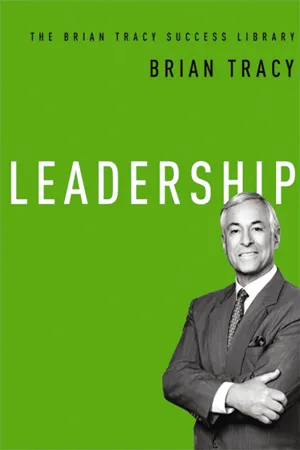
Leadership (The Brian Tracy Success Library)
About this book
Throughout your life, you've always recognized "it" when you saw it--that indescribable, appealing quality that tells you loud and clear this person is a leader, someone you should trust, follow, and learn from. And you've always told yourself, if only you had that "it factor" inside you that could inspire, motivate, and lead others in the same way. Well, you do . . . and you can!Nobody--not even the greatest you have ever seen--comes into the world a natural leader. But somewhere along the way, these people who entered the world in the same you did transformed into the kind of magnetic individuals who inspire others to follow their lead. Success expert Brian Tracy has spent years studying the world's greatest leaders and believes that everyone has it inside them to:• Inspire trust, confidence, and loyalty• Instill a sense of meaning and purpose in your organization• Tap into the motivation and enthusiasm that compels others to commit to your vision • Clearly communicate goals and strategies and gain buy-in• Build winning teams• Elicit extraordinary performance from ordinary people • Become the person seen as most likely to lead the organization to victory• And moreDon't fall for the lie that says some are born leaders and the rest of us are simply their followers. You are just as capable as anyone! Packed with practical, proven methods, Leadership, a indispensable little guide will help you unlock your leadership potential.
Information
Subtopic
Business CommunicationIndex
BusinessONE
Leaders Are Made, Not Born
I’VE BEEN STUDYING leadership for many years. I started when I was a teenager, and the first leader that I studied at length was Hannibal of Carthage. I read book after book about the Punic Wars, the capabilities of Hannibal’s elephants crossing the Alps, and the battles against the Romans. He was able to take a very small force, mold it into a powerful fighting force, take it thousands of miles, and almost defeat the greatest empire of his time.
After that, I studied Scipio, the general who defeated Hannibal. I studied the life of Napoleon and Wellington at great length as well, to understand the differences between the two men. I’ve also studied Washington and Lincoln and Generals George Patton, Dwight Eisenhower, and Omar Bradley, who were some of the great leaders of their time.
What I have found is that leaders are made, not born. Nobody comes into the world a natural leader. Even Alexander the Great studied (from the age of eight) to become a leader.
Study the Greats
The study of great leaders of the past and present is one of the fastest and surest ways to develop leadership qualities. The more you study what constitutes effective leadership, the more likely you will be to internalize the same values and behaviors. These values and behaviors will then be externalized in your actions and in your results.
Abraham Lincoln wrote, “That some have succeeded is proof that others can as well.” Bertrand Russell, the great philosopher, agreed, writing: “The very best proof that something can be done is the fact that others have already done it.”
Think about the men and women you know of who are leaders that you admire, and then begin to think about how you could emulate their behaviors. Think about how you could be more like them. And lo and behold, over a reasonable period of time, you actually begin to absorb their qualities and become a leader yourself.
The Story of Alexander
The story of Alexander the Great is very instructive for anyone who aspires to a high leadership position. By the age of fifteen, Alexander was convinced that it was his destiny to conquer the known world. He had a vision of uniting all mankind in a common brotherhood. With Aristotle as his teacher, he studied and prepared himself for many years. He learned the military arts from his father and his father’s best generals. He saw himself as a great king and had an unshakable belief in his ability to achieve any goal he ever set for himself.
Alexander was brilliant at both administration and execution. He showed great judgment in delegating and appointed the right officers in the right positions at the right time. He was able to plan, organize, think through, and execute brilliantly.
At the Battle of Arbela, he led his 50,000 men in a full frontal assault on the one-million-strong Persian army and routed them. He never entertained the possibility of defeat. He had complete trust in himself, in his men, and in their ability to overcome any difficulty, no matter how great the odds against them.
Alexander, like all great leaders, had the ability to organize his men and inspire them to exceed anything they had ever done before. He had the ability to concentrate on his strengths and to focus on the critical areas that were essential for victory. His life and history are an example of the blending together of all the great leadership qualities that have been identified in every study on the subject.
See Yourself as a Leader
In the introduction, I expressed the idea that there is a spectrum where, at the very bottom, we find people who haven’t the slightest idea what’s going on (and couldn’t care less), while at the very top there are the one or two percent of people in our society who really are the spark plugs in the engines of change. Every one of us is on that spectrum somewhere, moving up or down, depending on the things that we are doing and saying on a daily basis.
If you want to be a leader or a better leader, remember that it’s all up to you. It’s in your hands, or, even more important, in your mind. You are what you think you are. Your self-image determines your performance. You can become a much more effective leader by changing your self-concept—the way you think about yourself as a leader.
It all begins with the Law of Cause and Effect. It is the basic law of the universe; all other laws in the fields of mathematics or any of the sciences are subsets of this law, which says that for every effect there is cause. Nothing just happens. The implication of this law is powerful. It means that the success of every person has a cause or causes. So, if you want to be as successful as someone else, if you want to emulate successful people and how they acted and what they accomplished, then find out what they did and do the same! Do the same things successful people do, over and over again, and eventually you will get the same results.
A related law is the Law of Belief. It states that if you believe in something with conviction, what you believe in will become your reality. Or to put it another way, you are what you believe you are. Philosopher William James said, “Belief creates the actual fact.”
The purpose of this book is to enable you to become a leader—and if you are already a leader, to enable you to become a more effective leader. I’ll do that by describing to you some of the qualities, attributes, and behaviors of the most effective leaders in our society so that you can emulate those qualities and make them your reality.
TWO
A Sense of Mission
LEADERS HAVE a vision and a sense of mission that lifts up and inspires men and women to help achieve that mission. In fact, there is in every one of us a desire to commit to something bigger than ourselves; leaders have the ability to tap into that root of motivation, drive, and enthusiasm that allows us to commit ourselves to achieving that vision.
As a leader, then, you have to have a goal that excites and inspires. And the only goals that excite and inspire are goals that are qualitative. Nobody gets excited or inspired about raising the share price or making more money or getting a raise. But we do get inspired and excited about bringing a product or service to people who need it, and about being the best, and about winning great success in a competitive field.
Strive to Be the Best
As a leader, the most important vision you can have for yourself is to be the best. And that same vision must apply to your business or your organization. You will accept nothing less for yourself or your company than to be the best at what you do. In business, that means asking:
What quality about your product or service is most relevant or important to your customers?
Once you’ve identified that quality, focus all the energies and creativity of your employees and managers on achieving superior performance in that area.
We need to be the best. You won’t feel great or as good as you could feel, or capable of extraordinary performance, unless you are aligned with the best people in your field and doing the very best job that people are capable of.
Instill Meaning and Purpose
Being dedicated to a mission gives work meaning and purpose. As human beings, we need meaning and purpose as much as we need food and water and air. We need a sense of significance. And leaders are those people who make us feel significant. They make us feel important and remind us that what we are doing has value far beyond just the day-to-day work. They make us feel that we are an integral part of the mission team.
There are four ways to make people feel important, and they each start with the letter A. First is appreciation. Take every opportunity to thank people for the quality of their work and their role in making the company a success. Every time you thank individuals, they are going to feel more valuable and will be more motivated to justify your faith in them.
The second way to make people feel more important and valuable is by showing approval. Praise people at every opportunity, for any accomplishment, large or small. Praise them also for their suggestions and insight—for their thinking. People will take praise emotionally. Their self-esteem and self-worth rises. But it’s important to praise immediately and specifically, so that people know that it is genuine.
The third way you can build a sense of importance and value in a person is through admiration. Continually compliment people, whether it’s on their traits, such as persistence, on their possessions, such as clothes, or on their accomplishments.
Perhaps the most important way for people to feel important and valued is through attention. People aren’t going to be dedicated to the goals of the organization if they are continuously ignored. They are not going to feel like key players in the mission if they just receive commands without having any opportunity for input or feedback. Attention means listening to people, without interrupting. You don’t necessarily have to take their suggestions or agree to what they are saying. But give them a chance to say it.
A Common Cause
A good goal or a good mission gives a clear sense of direction not only to the organization, but to every person in the organization.
A good goal unifies everyone in a common cause. For example, IBM is one of the great industrial leaders of business history. One of its goals is to give the very best customer service of any company in the entire world. One of its missions is to be known as the company that cares for its customers. This mission, which involves a qualitative not a quantitative goal, excites and inspires people throughout the company because they think about it and talk about it all the time. They believe they’re the best and that nobody takes care of customers like they do at IBM. Everyone in the company knows that his job, one way or another, is related to taking care of customers, and this knowledge unifies everybody in a common cause.
The mission of a company will often be encapsulated in a mission statement. A mission statement is a clear statement of why the company exists in the first place and what its overarching goal or purpose is. Mission statements usually involve the customer in some way—for example, how your product or service is going to help make the customer’s life better. YouTube founder Chad Hurley wanted people to be able to send homemade videos over the Internet. Charles Schwab’s mission was to be the “most useful and ethical financial services company.” Google founders Larry Page and Sergey Brin wanted to make navigating the Internet easier.
Why does your company exist? What is its cause?
The Core Purpose of Every Business
For a business leader, there is one core purpose above all, and that is to acquire and serve a customer. Leaders make the customer of the organization the central focus. Take the example of Nordstrom, whose leaders think incessantly and continuously about their customers. IBM thinks and talks about only its customers. More and more companies are becoming obsessed with the customer. You see, once everybody agrees on who the customer is and agrees that the purpose of the company is to satisfy that customer the very best way possible, then it’s easy to get everybody pulling together.
As a matter of fact, I believe that you can tell how well led an organization is by applying a very simple test. When you’re in that organization, look at and listen to how people refer to the customer. In a good organization, the customers are always referred to with respect. They are always referred to with pride, as though they are really important. When a customer calls, it is an important occasion. And when a customer has a problem and is helped, it is a cause for celebration. When a customer calls and is happy or satisfied with a product or service, everybody takes on a tremendous feeling of pride and accomplishment.
In your organization, how do people talk about the customer?
Let’s say you run a department that services another department within the organization. That other department is your customer. Whoever has to use what you produce in your area of responsibility is your customer. And leaders have to be very much focused on satisfying that customer.
If you are going to be a business leader or a leader of a department or any organization, you have to sit down and t...
Table of contents
- Cover Page
- Title Page
- Copyright Page
- Contents
- Introduction
- 1. Leaders Are Made, Not Born
- 2. A Sense of Mission
- 3. Action Orientation
- 4. The Quality of Courage
- 5. The Leader As Strategist
- 6. The Ability to Inspire and Motivate
- 7. Commit to Winning
- 8. The Leader As Communicator
- 9. Learn from Adversity
- 10. Build a Championship Team
- 11. Focus On Results
- 12. The Desire to Lead
- 13. The Role of Self-Esteem In Leadership
- 14. Lead By Example
- 15. Self-Motivation for Leaders
- 16. Develop Leadership Qualities
- 17. Power Through Cooperation
- 18. Lead By Consensus
- 19. Leaders Are Listeners
- 20. Live Like a Leader
- 21. Integrity: The Essential Quality of Leadership
- Index
- About the Author
Trusted by 375,005 students
Access to over 1.5 million titles for a fair monthly price.
Study more efficiently using our study tools.
Frequently asked questions
Yes, you can cancel anytime from the Subscription tab in your account settings on the Perlego website. Your subscription will stay active until the end of your current billing period. Learn how to cancel your subscription
No, books cannot be downloaded as external files, such as PDFs, for use outside of Perlego. However, you can download books within the Perlego app for offline reading on mobile or tablet. Learn how to download books offline
Perlego offers two plans: Essential and Complete
- Essential is ideal for learners and professionals who enjoy exploring a wide range of subjects. Access the Essential Library with 800,000+ trusted titles and best-sellers across business, personal growth, and the humanities. Includes unlimited reading time and Standard Read Aloud voice.
- Complete: Perfect for advanced learners and researchers needing full, unrestricted access. Unlock 1.5M+ books across hundreds of subjects, including academic and specialized titles. The Complete Plan also includes advanced features like Premium Read Aloud and Research Assistant.
We are an online textbook subscription service, where you can get access to an entire online library for less than the price of a single book per month. With over 1.5 million books across 990+ topics, we’ve got you covered! Learn about our mission
Look out for the read-aloud symbol on your next book to see if you can listen to it. The read-aloud tool reads text aloud for you, highlighting the text as it is being read. You can pause it, speed it up and slow it down. Learn more about Read Aloud
Yes! You can use the Perlego app on both iOS and Android devices to read anytime, anywhere — even offline. Perfect for commutes or when you’re on the go.
Please note we cannot support devices running on iOS 13 and Android 7 or earlier. Learn more about using the app
Please note we cannot support devices running on iOS 13 and Android 7 or earlier. Learn more about using the app
Yes, you can access Leadership (The Brian Tracy Success Library) by Brian Tracy in PDF and/or ePUB format, as well as other popular books in Business & Business Communication. We have over 1.5 million books available in our catalogue for you to explore.