- 224 pages
- English
- ePUB (mobile friendly)
- Available on iOS & Android
eBook - ePub
About this book
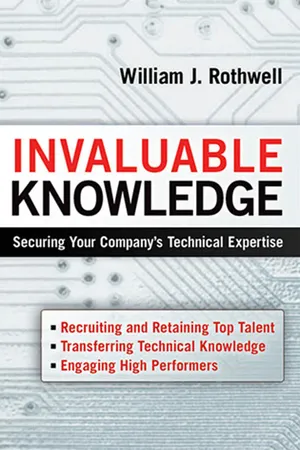
As organizations face a loss of people due to retirement, resignation, or disability, leaders are paying more attention to their talent management strategies, from grooming internal successors to aggressively recruiting from their competitors. The need is most acute in technical and other "knowledge" areas, where the loss of a particular skill set demands an equally focused response. Invaluable Knowledge clarifies the unique (and urgent) issues of attracting, developing, retaining, and transferring the knowledge of IT professionals, engineers, accountants, analysts, and other specialists. The book's structure follows a typical talent cycle, from identifying recruitment challenges, to hiring and training top talent, to building career development initiatives, and finally, to laying the groundwork for the next generation. Invaluable Knowledge makes an indisputable case for the importance of this specific facet of talent management, and offers practical examples, repeatable processes, and a multitude of specific tips to help any organization's talent strategists create seamless transitions and maintain critical knowledge functions indefinitely.
Information
Subtopic
Business SkillsIndex
Business 1.
Introducing Technical Talent Management
What is your organization doing about the special challenges of recruiting, developing, and retaining technical and professional talent, such as its engineers, IT professionals, accountants, and others who rely on specialized knowledge—knowledge that may be key to your organization’s strategic, competitive success? What is your organization doing to transfer the invaluable knowledge these people have to your new hires and to less experienced knowledge workers? Are you preparing for a possible future wave of retirements as the baby boomers leave your workforce? Are you preparing systematically for knowledge workers as your organization grows explosively? How well is your organization managing its knowledge transfer as part of its talent management and succession planning strategies?
Five Mini-Studies: Can You Solve These Problems?
Read the following mini-cases and describe how your organization would meet the challenges you find in each situation. If your organization has ways to solve all of these problems, then perhaps it already has an effective strategy for technical and professional talent management (abbreviated throughout this book as technical talent management, or TTM). If your organization could not solve the problems presented below, then your leaders may want to consider a technical talent management program as a means to solving them when they appear.
Mini-Study 1
You analyze the retirement eligibility of your organization’s engineering division. Shaking your head, you note that, in five years, about 40 percent of all the engineers in the division will be eligible for retirement. Considering the organization’s recent downsizing efforts and early retirement offers, you wonder where the next generation of engineers will come from. Hiring engineers is possible if the compensation is attractive enough—although you are keenly aware that some people believe there is a global shortage of engineers (an opinion not universally shared)—but you know that new hires will not have in their heads the special knowledge of the technical decisions that have been made to reach your company’s current generation of high-tech products. How, then, will the new hires be positioned to contribute to the next generation of products if these engineers have never had a chance to learn from experience?
Mini-Study 2
Medical researchers in your organization have spent years pursuing various research plans to perfect new drugs and find cures for many of humankind’s worst ills. But recently several of the most prominent medical researchers in your organization have given their supervisors notice that they plan to retire within one year. Your managers wonder how to retain and transfer the knowledge these researchers have before the scientists leave the organization. One idea that decision makers have offered is to keep the researchers on contract for a year or two while they train their replacements. However, the organization’s HR policies do not make that easy to do, nor do the retirement plans for which these researchers are eligible. And a one-year effort seems like a Band-Aid placed on an arterial hemorrhage. Even if it is possible—and that is by no means certain—how can a lifetime of learning be transferred in only one year?
Mini-Study 3
Lou Smith is one of those rare people on your company’s assembly line who knows every quirk about the machine he has operated for fifteen years. It has been easy to take Lou for granted, since he rarely takes a vacation or calls in sick. In fact, he has been first in line for all the overtime the company would give him. But, overnight you receive word that Lou is in the hospital, having suffered a massive heart attack. Nobody is sure whether he will make it. The supervisor of Lou’s assembly line is complaining that, while he has a backup for Lou, that person does not know as well the machine that Lou has made “sing” for years. You worry how much production might be lost while Lou is out sick.
Mini-Study 4
Martha Milhouse knows every decision maker in the high-tech companies she has sold to for over five years. She has been diligent about remembering their birthdays; she knows her stuff, too, and can sit in a product meeting with engineers and understand what they are talking about, even though she is not an engineer. Her combination of good interpersonal skills and grasp of the technical side of the products has made her a top salesperson for the technical products your organization produces. But Martha’s husband has just retired; he is pressuring her to do likewise. As sales manager, you wonder how you can find another person who knows the products—and customers—as well as Martha does. And you wonder how many sales will be lost if you do not find that person.
Mini-Study 5
Rhonda Yeager has been a systems analyst with the company for years. People feel that she knows everything about every IT system used by the organization. But Rhonda walked into her supervisor yesterday and, without warning, turned in her resignation. The IT manager was stunned. He shook his head, then he voiced dismay at the prospect of hiring or developing anyone else who could know even a fraction of what Rhonda knows about the IT systems. Some of the systems in IT, the manager knows, are “legacy systems” that have been around so long that nobody else remembers how they work, as there is such limited documentation.
Describing “Knowledge Workers”
Let’s be clear on definitions. What is a knowledge worker? And, more specifically, what is a technical or professional worker? A knowledge worker is usually understood to be those people who rely on professional judgment or specialized training to perform their work. According to the Bureau of Labor Statistics (BLS),
the professional, scientific, and technical services sector comprises establishments that specialize in performing professional, scientific, and technical activities for others. These activities require a high degree of expertise and training. The establishments in this sector specialize according to expertise and provide these services to clients in a variety of industries and, in some cases, to households. Activities performed include: legal advice and representation; accounting, bookkeeping, and payroll services; architectural, engineering, and specialized design services; computer services; consulting services; research services; advertising services; photographic services; translation and interpretation services; veterinary services; and other professional, scientific, and technical services. 1
Technical, scientific, and professional workers are, therefore, those who work in occupations that require specialized knowledge and training. For this sector, average wages are high—averaging $29.78 per hour in the United States in November 2009. According to BLS, 7,605,300 people were employed in this sector in the United States in December 2009, the most recent date for which statistics are available. The number of employers in the sector during the second quarter of 2009 was large: 1,010,967 in private industry, 906 in local government, 401 in state government, and 1,482 in the federal government in the second quarter of 2009.
Defining “Technical Talent Management”
As the mini-studies at the opening of the chapter illustrate, today’s leaders need to do more than merely plan for their own replacements. While leadership succession is undoubtedly important, it is just not enough in this current age, when what people know and what they can do are as important as how people can lead or manage. Real-world cases of organizations struggling to deal with an expected “brain drain” have figured prominently in the business press (see Appendix I).
Technical talent management (TTM) is the process that focuses on attracting, developing, and retaining the most talented technical and professional workers and transferring their specialized knowledge to less proficient or less experienced workers. Its goal is not so much to ready people for promotions or vertical mobility in the way management or leadership-oriented talent management does. Instead, it aims to transfer institutional memory, defined as the collective wisdom that an organization’s members have gained from their experience and that is embedded in its corporate culture.
Technical talent management also aims to transfer tacit knowledge, or what people carry around in their heads as a result of their experience and learning. TTM should not be confused with knowledge management (KM), an activity that treats knowledge as an important component of business and intellectual assets as critical to achieving business results. TTM can, however, be properly regarded as a subset of KM. Of particular importance to TTM is knowledge transfer, meaning the communication of practical business knowledge that has been learned from experience with the work, work processes, people, customers, and business challenges and problems with which the organization deals or has dealt with.
TTM at the organizational level should not stand alone. It should be combined with efforts to focus attention on daily practices by managers to attract, develop, retain, and transfer the knowledge of especially talented knowledge workers. Sophisticated IT-based knowledge management systems and software, while helpful, should not be the only means by which knowledge transfer is managed over time. TTM assumes that most “talent building” does (and should) occur in practical ways and in real time through experiences with people, work processes, customers, typical and special problems, and challenges stemming from the work, as well as any other specialized knowledge of key value to the business.
It is important to distinguish among data, knowledge, and information. As Boisot observes:
Think of data as being located in the world and of knowledge as being located in agents, with information taking on a mediating role between them. Data can be viewed as a discernible difference between different energy states only some of which have information value for agents. Where data are thus informative, it will modify an agent’s expectation and dispositions to act in particular ways—that is, what we call its knowledge base. 2
A TTM program is, therefore, a systematic effort to attract, develop, and retain the most knowledge-proficient people while, at the same time, seeking to identify, capture, distill, and transfer specialized knowledge from those who possess that valuable knowledge to others who do not possess it. The TTM focus is not so much on management continuity as it is on ensuring the continuity of knowledge essential to business operations and competitive success and on cultivating knowledge workers and in-house experts who possess special know-how.
Knowledge workers are individuals who have undergone specialized training and who possess unique knowledge that is of value to an organization. In that sense, many people are knowledge workers because participation in organizational life gives people some memory of what happened. And the collective memory of what has happened, and what was learned from it, amounts to institutional memory. At the same time, in-house experts—also called High Professionals (HiPros)—may not necessarily be promotable up the traditional organizational hierarchy but they are the recognized “go-to” people for solving myriad technical and professional problems. A HiPro can be the one person who knows the most about any one thing of critical value to business operations.
One aim of TTM is to transmit the institutional memory so that mistakes made in the past are not repea...
Table of contents
- Cover Page
- Title Page
- Copyright Page
- Contents
- Preface and Acknowledgments
- Advance Organizer: 50 Questions to Test Your Organization’s Technical Talent Management
- 1. Introducing Technical Talent Management
- 2. Conceptualizing the Issues in Technical Talent Management
- 3. Recruiting and Selecting Technical and Professional Workers
- 4. Developing Technical and Professional Workers
- 5. Retaining Technical and Professional Workers
- 6. Managing and Engaging Technical and Professional Workers
- 7. Transferring Valuable Knowledge: Theory and Models
- 8. Transferring Valuable Knowledge: Practical Strategies
- 9. Tackling Future Challenges
- Appendix I: Cases in Technical and Professional Talent Management
- Appendix II: An Instrument for Measuring the Strategic Framework for a Technical and Professional Talent Management Program
- Appendix III: An Instrument for Measuring Technical and Professional Talent Management as Enacted on a Daily (Tactical) Basis
- Notes
- Index
- About the Author
Trusted by 375,005 students
Access to over 1.5 million titles for a fair monthly price.
Study more efficiently using our study tools.
Frequently asked questions
Yes, you can cancel anytime from the Subscription tab in your account settings on the Perlego website. Your subscription will stay active until the end of your current billing period. Learn how to cancel your subscription
No, books cannot be downloaded as external files, such as PDFs, for use outside of Perlego. However, you can download books within the Perlego app for offline reading on mobile or tablet. Learn how to download books offline
Perlego offers two plans: Essential and Complete
- Essential is ideal for learners and professionals who enjoy exploring a wide range of subjects. Access the Essential Library with 800,000+ trusted titles and best-sellers across business, personal growth, and the humanities. Includes unlimited reading time and Standard Read Aloud voice.
- Complete: Perfect for advanced learners and researchers needing full, unrestricted access. Unlock 1.5M+ books across hundreds of subjects, including academic and specialized titles. The Complete Plan also includes advanced features like Premium Read Aloud and Research Assistant.
We are an online textbook subscription service, where you can get access to an entire online library for less than the price of a single book per month. With over 1.5 million books across 990+ topics, we’ve got you covered! Learn about our mission
Look out for the read-aloud symbol on your next book to see if you can listen to it. The read-aloud tool reads text aloud for you, highlighting the text as it is being read. You can pause it, speed it up and slow it down. Learn more about Read Aloud
Yes! You can use the Perlego app on both iOS and Android devices to read anytime, anywhere — even offline. Perfect for commutes or when you’re on the go.
Please note we cannot support devices running on iOS 13 and Android 7 or earlier. Learn more about using the app
Please note we cannot support devices running on iOS 13 and Android 7 or earlier. Learn more about using the app
Yes, you can access Invaluable Knowledge by William Rothwell in PDF and/or ePUB format, as well as other popular books in Business & Business Skills. We have over 1.5 million books available in our catalogue for you to explore.