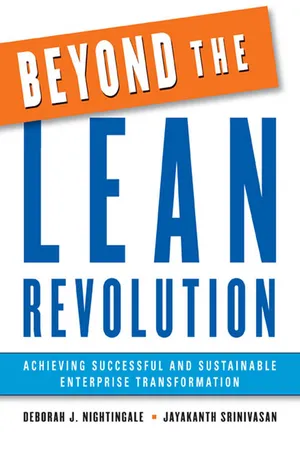
eBook - ePub
Beyond the Lean Revolution
Achieving Successful and Sustainable Enterprise Transformation
- 256 pages
- English
- ePUB (mobile friendly)
- Available on iOS & Android
eBook - ePub
Beyond the Lean Revolution
Achieving Successful and Sustainable Enterprise Transformation
About this book
Most organizations' change efforts focus solely on eliminating waste in specific departments. While this "lean paradigm" is a good place to start, true enterprise transformation goes much further. Based on years of research and implementation, Beyond the Lean Revolution provides a road map for achieving the kind of future-oriented results that enhance value to stakeholders. Authors Deborah Nightingale and Jayakanth help readers achieve this by asking them to address the big-picture questions like, What are the strategic objectives? How is the enterprise performing against those objectives? How should it be? Who are the stakeholders and what do they value? You'll then learn to strategically position your responses to move toward an audacious vision for the future--one where every cog in the complex enterprise system of people, processes, and is successful. Illuminating examples will teach you how to ensure senior leadership remains committed, how to assess your enterprise's current state, and how to analyze stakeholder values so you can plan for future growth. From inception to implementation and beyond, this book provides a holistic framework for bridging the gap from mere change--to genuine transformation.
Information
Subtopic
Business StrategyIndex
BusinessCHAPTER
–1–
Why Enterprise Transformation?
The whole is greater than the sum of its parts.
Aristotle1
PERHAPS YOU and your company are standing at the edge of the proverbial cliff. Challenges beset you from within and without. The competitive environment is changing. Your R&D organization has an idea that has great promise, but you just can’t find a way to capture the opportunity. Employees are finding it difficult to be heard when they have ideas for making the business run more efficiently. A supplier has advised you about a problem with providing your manufacturing organization what you need, and you can’t figure out where in the business that problem originates. How do you fix something you can’t find?
Or perhaps you and your company are not standing at the edge of the cliff. Maybe everything is humming along, but the general sense is that the organization is not coming close to meeting its potential. Even though you’ve been trying to improve your business processes, things aren’t making it to the next level. All those Six Sigma black belts are helping run projects, but the incremental changes don’t seem to amount to very much. You’re not achieving the kind of total benefit you thought you would.
We encounter businesses and organizations all the time that are facing one or all of these challenges. Many of them have been working hard to change. Again and again, though, they tell us they are failing to sustain change. They feel as if they are taking two steps forward and one step back. Their improvement projects suffer from false starts. Or they get only so far, and then whatever they were changing plateaus and cannot reach a higher level of efficiency or effectiveness. The bottom-line effects are just not happening.
Why do improvement efforts so often fail to provide all the benefits expected? Typically, it’s because businesses are trying to do things in a piecemeal fashion—in silos. They spend a lot of time on things that do not affect the bottom line or that are not linked to the company’s most important strategic objectives. They may not even know that their efforts are disconnected.
To be sure, you can make some improvements through these sorts of efforts, and your company might even realize some big benefits. However, the best opportunities to transform an organization are usually found somewhere other than in the silos. Often, they are found in the interfaces. They become clear only when you look at the entire enterprise—a complex, integrated, and interdependent system of people, processes, and technology that creates value as determined by its key stakeholders.* A stakeholder is any group or individual that can affect or that is affected by the achievement of the enterprise’s objectives. Value is the particular worth, utility, benefit, or reward that stakeholders expect in exchange for their respective contributions to the enterprise.
Enterprise transformation is the taking of an enterprise from its current state to an envisioned future state, a process that requires a significant change in mindset, the adoption of a holistic view, and execution to achieve the intended transformational goals and objectives. Transformation requires that you know the enterprise. You have to take a step back and look at the big picture. You need to gain a deep understanding of where things stand. What are your strategic objectives? How are you currently performing against those objectives? How should you be performing? How will you close the gap? What is the current state of the different key components and levers that comprise your enterprise?
We have seen many organizations undertake improvement projects with a lot of fanfare but with little or no sense of the big picture. We have seen them adopt lean —a term describing the philosophy centered on minimizing resources and eliminating waste to create value. We’ve seen improvement projects on the shop floor aimed at reducing overall company costs by, say, a stated goal of 20 percent. Only after later analysis did the businesses discover that less than 5 percent of company costs could be attributed to direct labor. Talk about failing to see the forest for the trees!
Why does this happen? It has to do with how the business world has embraced concepts from lean manufacturing. All too often, we hear senior business leaders talking as though all they have to do is figure out a way to adopt the Toyota Production System (TPS, to which lean traces its origins), and Toyota-like results will fall into place. This perspective is very narrow and tends to miss the strategic element. Many organizations embrace TPS but apply its concepts only to certain operations in the organization, such as manufacturing, but not to others, such as the leadership and enabling operations: Together, these constitute the whole organization. Still others apply lean principles and TPS to their manufacturing operations quite well, but they never look beyond their internal organizations to embrace a broader perspective that might include, for example, suppliers or other stakeholders. People in business also tend to think that TPS is a bottom-up miracle worker, missing the fact that it is driven strategically from the highest level of the Toyota enterprise. It is only a means to enact the enterprise’s strategy, not the strategy itself.
When we visit companies, we often see telltale signs that the focus of change efforts is askew. One day, when we were invited to visit Mega-Corp (a pseudonym for a company that makes aerostructure parts and components and that employs some ten thousand people), a group of managers presented the firm’s improvement plan. It sounded plausible enough, but there wasn’t a senior leader of the company in the room. That was the first clue that something was amiss. Then we were given a tour that began in the manufacturing area (a typical starting place, we’ve found). On bulletin boards, we found performance measures posted, but they were either not very current or partially obscured by other postings. In the office areas and elsewhere, we saw the same thing. It was obvious that these metrics —the objective, quantified data or information that an enterprise collects to support decision making—were not at the heart of people’s daily work lives. No one was paying much attention to them.
The types of metrics were telling too. Mega-Corp was measuring machine and operator utilization on its manufacturing line, as well as the quality of parts coming in from its suppliers. But where were the metrics about Mega-Corp’s performance with respect to its suppliers? When we visited the engineering department, we found nothing about how well the company was supplying specifications to its suppliers.
On top of all that, no one in manufacturing or engineering could explain how what he or she did on the job worked toward achieving any vision or strategic objective. Yet Mega-Corp had a full-blown set of improvement projects underway.
Build-Create Corp. (a pseudonym for a five-thousand-employee firm in southern California that makes space system components) told a different story. A worker on the manufacturing line described how his work was part of the larger process and how people in his organization had redesigned some of the process flow. He cited some specific reductions in costs and cycle times that had been achieved and explained where the company stood with respect to work-in-process. The worker put everything he told us in a context that sounded like a strategic objective that the enterprise expected to achieve four or five years down the road. A production manager introduced us to someone on his team who turned out to be a supplier. An engineer in Build-Create’s R&D group explained how they had reduced their cycle time for new product development.
The differences between Mega-Corp and Build-Create were palpable. At Build-Create, everyone was enthusiastic about transforming the enterprise. The employees used a similar vocabulary to talk about change and improvement, suggesting to us that they were all on the same page. They could share insights into processes, metrics, stakeholders, resources, and other aspects of their enterprise, implying that they had been part of figuring out analytically where things stand. With ease, they put what they were doing into a larger context and explained how it fit with a vision of the future.
At Mega-Corp, the senior leaders could go on and on about how they are transforming their enterprise. But we saw no evidence beyond some disconnected change initiatives related to lean.
Paradigms of Change
How do enterprises change? The classical model of organizational change comes from Lewin:2 a three-stage process of unfreezing the organization, introducing the desired change, and then refreezing the organization. Unfreezing prior to introducing a change provides the organization with a period to reflect on how it got to its current state and enables it to involve stakeholders in determining the right needed change or set of changes. The refreezing stage enables the organization to institutionalize the change.
There are two broad categories, or paradigms, of change in organizations: episodic change and continuous change. The first, episodic change, tends to focus on the organization as a whole and is aimed at changing the entire organization. It is deliberate, triggered at distinct moments by technological change or increased competition or by other major changes in the external or internal environment. These sorts of major change efforts are typically decided on by senior leadership, which opts to alter key processes or even restructure the organization as a whole. The underlying assumption is that senior leadership is able to perceive a divergence between what the triggers demand and what the enterprise can deliver and then make corrections with structural and behavioral changes that allow the enterprise to remain sustainable. This sort of episodic change is driven top-down, using a select few change agents.
The second paradigm, sometimes referred to as continuous change, may also be organization-wide, but specific changes are more focused on particular local work practices within the larger organization. Though the intent may be to change the organization as a whole as the specific efforts disperse within the organization, the specific efforts may not have organization-wide ramifications. In this paradigm, change efforts such as Six Sigma3 and Total Quality Management4 are often targeted at creating the capability to introduce change that is not necessarily intended to have organization-wide effects, often resulting in pockets of change that may even be suboptimal to the total enterprise. In this paradigm everyone is a change agent responsible for and empowered to make the changes needed. Underlying this paradigm is the view that cumulative change will eventually translate into enterprise-level change.
These two paradigms are sometimes not enough to effect the wider change, based on a holistic view of the enterprise, that is needed to meet the challenges an enterprise faces. Enterprise transformation combines both paradigms and takes them further. Two excellent “philosophies” underlie enterprise transformation as a change paradigm:

However, both philosophies fall short, even though they certainly speak to enterprise transformation. Neither provides specific methods and analytic approaches that enable you to actuate what the philosophies teach at a holistic, enterprise-wide level to make things actionable and drive genuine enterprise transformation.
Further, when transformation is framed as an adaptation of the enterprise as a whole to meet the needs of its stakeholders, we see that transformation requires both episodic change and continuous change that are aligned. It needs the top-down directive intervention of the senior leadership team, and at the same time it must empower stakeholders to make the required adaptations at the work-practice level. Enterprise transformation begins with the commitment of the senior leadership team, which must invest the resources needed to change the way the enterprise works on the large scale. At the same time, leadership must require the personal dedication of all stakeholders to make local changes on an ongoing basis.
In this book, we present an enterprise transformation paradigm that incorporates these ideas, overcomes the limitations described, and employs a Roadmap for ensuring that transformation is successful.
Going Beyond Lean
To be sure, we recognize the value of lean and lean principles. In fact, as you’ll read in more detail in Chapter 2, the principles of lean are part of the foundation of thinking in the enterprise context. Traditional lean, though, has many limitations. The classical lean “tool kit” doesn’t lead to success when it is applied at a broader, enterprise level.
Traditional lean tools—be it root cause analysis, or 5S, or value stream maps alone—tend to be applied in a rather prescriptive, cookie-cutter manner. They are effective in their own ways and at what they measure, but their scope is limited. People get hung up with their tool kits. They try to apply them everywhere. That is what Rockwell Collins learned.
Rockwell Collins is an aerospace and defense company based in Iowa that was using the classical lean tool kit to attack six hundred or more improvement projects. Senior leadership, though, was finding it difficult to see how all that activity was helping. Yes, they saw improvements, but the enterprise as a whole wasn’t really changing for the better. So Rockwell Collins tried broadening the application of the tool kit throughout the enterprise. The canvas was expanded, but the same brush was used. Only when the company adopted a holistic view, did an end-to-end analysis of all its processes, and mapped its value stream did it see the p...
Table of contents
- Cover Page
- Title Page
- Copyright Page
- Dedication
- Contents
- List of Figures and Tables
- Acknowledgments
- Chapter 1: Why Enterprise Transformation?
- Chapter 2: The Seven Principles of Enterprise Transformation
- Chapter 3: A Roadmap to Successful Enterprise Transformation
- Chapter 4: Transformation Leadership
- Chapter 5: The Stakeholder Lens
- Chapter 6: The Process Architecture Lens
- Chapter 7: The Performance Measurement Lens
- Chapter 8: The Integrative Lenses
- Chapter 9: Preparing to Transform
- Chapter 10: Transformation Planning
- Chapter 11: Executing the Transformation Plan
- Chapter 12: Enterprise Transformation from Inception to Implementation
- Appendix A: Lean Enterprise Self-Assessment Tool: Case Studies
- Appendix B: A Brief Comparison of Other Approaches to Process Analysis
- Endnotes
- Key Terms
- Index
Trusted by 375,005 students
Access to over 1.5 million titles for a fair monthly price.
Study more efficiently using our study tools.
Frequently asked questions
Yes, you can cancel anytime from the Subscription tab in your account settings on the Perlego website. Your subscription will stay active until the end of your current billing period. Learn how to cancel your subscription
No, books cannot be downloaded as external files, such as PDFs, for use outside of Perlego. However, you can download books within the Perlego app for offline reading on mobile or tablet. Learn how to download books offline
Perlego offers two plans: Essential and Complete
- Essential is ideal for learners and professionals who enjoy exploring a wide range of subjects. Access the Essential Library with 800,000+ trusted titles and best-sellers across business, personal growth, and the humanities. Includes unlimited reading time and Standard Read Aloud voice.
- Complete: Perfect for advanced learners and researchers needing full, unrestricted access. Unlock 1.5M+ books across hundreds of subjects, including academic and specialized titles. The Complete Plan also includes advanced features like Premium Read Aloud and Research Assistant.
We are an online textbook subscription service, where you can get access to an entire online library for less than the price of a single book per month. With over 1.5 million books across 990+ topics, we’ve got you covered! Learn about our mission
Look out for the read-aloud symbol on your next book to see if you can listen to it. The read-aloud tool reads text aloud for you, highlighting the text as it is being read. You can pause it, speed it up and slow it down. Learn more about Read Aloud
Yes! You can use the Perlego app on both iOS and Android devices to read anytime, anywhere — even offline. Perfect for commutes or when you’re on the go.
Please note we cannot support devices running on iOS 13 and Android 7 or earlier. Learn more about using the app
Please note we cannot support devices running on iOS 13 and Android 7 or earlier. Learn more about using the app
Yes, you can access Beyond the Lean Revolution by Deborah Nightingale,Jayakanth Srinivasan in PDF and/or ePUB format, as well as other popular books in Business & Business Strategy. We have over 1.5 million books available in our catalogue for you to explore.