eBook - ePub
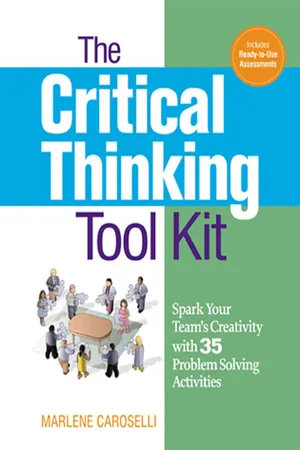
The Critical Thinking Toolkit
Spark Your Team's Creativity with 35 Problem Solving Activities
- 222 pages
- English
- ePUB (mobile friendly)
- Available on iOS & Android
eBook - ePub
The Critical Thinking Toolkit
Spark Your Team's Creativity with 35 Problem Solving Activities
About this book
Critical thinking--the ability to approach a problem both analytically and creatively--is the bedrock of success for companies and their people. Fortunately, it's a skill that can be learned. The Critical Thinking Toolkit gets employees thinking better and faster with training exercises that offer an invigorating departure from the everyday and the potential for big payoffs in the form of enhanced "on-your-feet" thinking, innovative problem-solving, and profitable idea generation from everyone on the team. Using hands-on activities and ready-to-use assessments, team members will learn how to challenge assumptions, brainstorm divergent ideas, and then pinpoint the ones that best benefit your organization. And they'll learn to do it in a way that not only increases their work quality, but also their productivity. Unimaginative. Risk-adverse. Prone to groupthink. These are not just empty complaints about today's employees. American businesses are suffering from systemic burnout resulting in a widespread lack of creativity. But this unimaginative thinking doesn't need to plague your workplace. With The Critical Thinking Toolkit, you and your team have everything you need to think quickly, analytically, and creatively.
Information
Creative Thinking
#13 Particular Virtues
#14 Perspicacious Perspectives
#15 Turnarounds
#16 Left Is Right. So Is Right
#17 Ms. Matches and Mr. Matches
#18 Cre8—Get N2It
#19 Thinking Outside the Locks
#20 Thinking Is an Art
#21 A Kin to Kinesthesia
#22 Low and High Logos
#23 Blues on Parade
#24 Scrambled Pegs
#13: Particular Virtues
| Overview: | Creative thought is new thought. With this activity, participants are encouraged to think new thoughts about the work being done in their organizations. Working in teams, they will critically examine current practices and ways to ameliorate them. |
| Objective: | To engage participants in the process of improving how individuals, teams, and organizations get things done. |
| Supplies: | • Transparency #13-1 • Overhead projector • Flipcharts (ideally, one per table group) |
| Time: | 15–20 minutes |
| Advance Preparation: | Download Transparency #13-1. Arrange seating, if possible, so participants can sit in table groups of five or six. |
| Participants/ Application: | This exercise can accommodate any number of participants. It works best either at the very beginning of the training as an over-arching framework for continuous learning/continuous improvement imperatives, or at the end of the training session, to summarize the need for lifelong learning. |
Introduction to Concept:
Educator Rudolph Flesch once commented, “Creative thinking may simply mean the realization that there is no particular virtue in doing things the way they have always been done.” There is, by contrast, a distinct virtue in doing things the way they have not always been done. Good examples can be found in the book by Robert Kriegel, If It Ain’t Broke, Break It: Unconventional Wisdom for a Business World.
In fact, the philosophy behind the popular Total Quality Management (TQM) movement is a philosophy that stresses continuous improvement. Continuous improvement means continuous change. If you do not possess the particular virtue of being able to break away from traditional thinking, you may be putting your job, your team, your department, and possibly even your organization in jeopardy. Quality advocates assure us that if you always do what you’ve always done, you’ll always have what you’ve already got. And what you’ve already got might not be enough to remain competitive in this mercurial business climate.
Examples:
The business world abounds with leaders for whom “good enough” simply was not. To cite but a few:
Jack Stack, CEO of Springfield Remanufacturing, author of The Great Game of Business, advocates letting every employee know exactly what he or she costs the company and exactly what they are adding to the company’s bottom line.
In Job Shift, author Bill Bridges talks about a “dejobbed future” and asserts that while there will always be work, there will not always be jobs as they have been defined in the past. He uses as an example the country’s largest producer of kayaks. This is a firm with only one employee, the owner, who “outsources” or turns over to other firms the various subprocesses that constitute the manufacture of these sleek canoes.
Author David Armstrong, by way of his book’s title, Managing by Storying Around, has coined a new term for managers and leaders everywhere. This “new” tool represents a simple, memorable, fun, and timeless means of informing people about business matters.
Procedure:
1. Form teams of five or six participants and ask each team to list on chart paper ten specific things (policies, procedures, philosophies, processes, paperwork, practices, meetings, etc.) that they (or their team, their department, their company) have been doing the same way for a long time.
2. Encourage brainstorming on any or all of the following [show Transparency #13-1]:
The opposite of those certain ways
An addition to those ten ways of doing things
A subtraction from those ten ways of doing things
An alteration of those ten ways of doing things
The elimination of at least one of those ten ways of doing things
(What would replace traditional meetings, for example?)
(What would replace traditional meetings, for example?)
A combination of some of those ten ways of doing things
3. Call on one person in each team to share some of the workable ideas that evolve from their working session.
Extending the Activity:
1. In corporate America, employees undergo 360° evaluations—assessments of their performance are made not only by their supervisors, but also by their co-workers, their customers, their subordinates (if they have any), and often by the employees themselves. A decade ago, such an appraisal reversal would have been unheard of. To encourage break-away-from-tradition thinking and to make participants realize that they have grown comfortable with procedures that truly were unheard of years ago, compile a list of ways things have changed radically.
Begin with such things as new smoking laws, which do not permit smoking on flights or in most offices. Add to the list the fact that in many workplaces, women were not permitted to wear slacks as recently as the 1970s. Self-directed work teams, benchmarking initiatives, and most of today’s organizational policies and procedures are relatively new, to say nothing of the technology we find so indispensable.
To make the exercise more interactive, use prompts such as, “When was the first time you used a fax machine?” “What year do you remember first having a woman as a supervisor?”
2. Have available copies of books (such as those cited in this activity) that promote the idea of breakaway thinking, an integral element in critical thought. Periodically pass a book to a participant, ask him or her to skim the book to find one workable idea or one valuable quote, and continue with the lesson. Five minutes later, return to the person and ask him or her to share the idea he or she has found.
Workplace Connections:
1. Thomas Alva Edison forced himself to come up with ten new ideas each month and one invention every six months. Ask participants to form informal think tanks when they return to work. The collective goal would be to generate at least ten new ideas each month, the best of which will be shared with supervisors once every six months.
2. Suggest that employees keep a simple journal in which they log the improvements, however minor, that they have made to the work and work processes in which they are engaged. Then, a week or so before their annual performance review, they will extract the most significant of those improvements, type them up, and have them ready to share with their supervisor during the appraisal meeting.
Questions for Further Consideration:
1. What do you think is meant by Tom Peters’ claim, “If you have gone a whole week without being disobedient, you are doing your organization and yourself a disservice”?
2. How are those who defy tradition treated in your organization?
3. Historically, how have tradition-defiers been treated?
4. Would you agree with the statement that leaders are change agents? Tell why or why not.
5. What can you do to increase your co-workers’ willingness to find a better way of doing the work they do?
6. Think about your own work area. What are some improvements that are needed? Which improvement would have the best payoff?
7. What are the first steps you would need to undertake in order to create the improved reality?
8. What, if anything, may be preventing you from taking these steps?
9. How would you, your co-workers, the department, and the organization itself each benefit from this improvement?
10. How would you interpret this observation by author Roger Dawson: “If Edison had been a CEO of a conglomerate, he probably would have insisted upon the invention of the world’s best oil lantern instead of inventing the light bulb.”?
Alternatives to Tradition
• The opposite of those certain ways
• An addition to those ten ways
• A subtraction from those ten ways
• An alteration of thos...
Table of contents
- Cover Page
- Title Page
- Copyright Page
- Contents
- Preface
- Introduction
- Quick Thinking
- Creative Thinking
- Analytical Thinking
- Appendixes
- Bibliography
- Index
Trusted by 375,005 students
Access to over 1.5 million titles for a fair monthly price.
Study more efficiently using our study tools.
Frequently asked questions
Yes, you can cancel anytime from the Subscription tab in your account settings on the Perlego website. Your subscription will stay active until the end of your current billing period. Learn how to cancel your subscription
No, books cannot be downloaded as external files, such as PDFs, for use outside of Perlego. However, you can download books within the Perlego app for offline reading on mobile or tablet. Learn how to download books offline
Perlego offers two plans: Essential and Complete
- Essential is ideal for learners and professionals who enjoy exploring a wide range of subjects. Access the Essential Library with 800,000+ trusted titles and best-sellers across business, personal growth, and the humanities. Includes unlimited reading time and Standard Read Aloud voice.
- Complete: Perfect for advanced learners and researchers needing full, unrestricted access. Unlock 1.5M+ books across hundreds of subjects, including academic and specialized titles. The Complete Plan also includes advanced features like Premium Read Aloud and Research Assistant.
We are an online textbook subscription service, where you can get access to an entire online library for less than the price of a single book per month. With over 1.5 million books across 990+ topics, we’ve got you covered! Learn about our mission
Look out for the read-aloud symbol on your next book to see if you can listen to it. The read-aloud tool reads text aloud for you, highlighting the text as it is being read. You can pause it, speed it up and slow it down. Learn more about Read Aloud
Yes! You can use the Perlego app on both iOS and Android devices to read anytime, anywhere — even offline. Perfect for commutes or when you’re on the go.
Please note we cannot support devices running on iOS 13 and Android 7 or earlier. Learn more about using the app
Please note we cannot support devices running on iOS 13 and Android 7 or earlier. Learn more about using the app
Yes, you can access The Critical Thinking Toolkit by Dr. Marlene Caroselli in PDF and/or ePUB format, as well as other popular books in Business & Decision Making. We have over 1.5 million books available in our catalogue for you to explore.