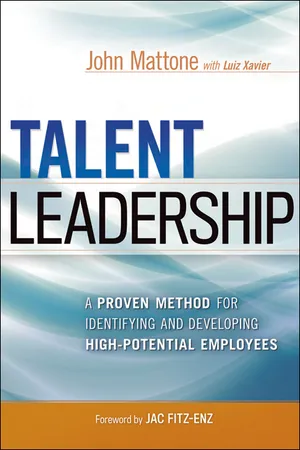
Great leaders drive the bottom line, which is why organizations pour money into leadership development. But most companies have no real way to gauge whether their endeavors are paying off-much less where they are falling short. Talent Leadership shows how to set up a world-class leadership-development program-and have the metrics to prove it! Packed with research findings, best practices, case studies, proprietary assessments, and more, this innovative book explains how to: * Employ assessments to benchmark current and future executive talent * Use the resulting data to identify leaders with potential based on their capabilities, commitment, and alignment with organizational goals * Leverage analysis to target training and coaching where they will have the greatest impact on individual performance and overall operating success By measuring, calibrating, and recalibrating the leading indicators that directly predict organizational health and the ability of leaders to meet those needs, HR and OD professionals will bring a much-needed numbers focus to their crucial talent development efforts. This book is for leaders of HR, Talent Management, OD/MD professionals, and the vast population of operating managers who are charged with identifying, managing and developing high-potential and emerging leaders.
- 304 pages
- English
- ePUB (mobile friendly)
- Available on iOS & Android
eBook - ePub
Talent Leadership
About this book
Information
CHAPTER 1
What Is Talent Leadership?
In today’s global economy, it is critically important that organizations optimize their investment in human capital. Only the human capital asset can provide an organization with any real hope for meaningful market differentiation, positive branding, superior execution, and ultimate operating success. Business strategies that are overly weighted toward developing new technologies or cost controls—for example, without the proper weighting of the human capital assets required to execute strategy—will result in a disastrous, short-lived plan that will lead to doom. All assets, except the human capital asset, eventually become commodities. Beyond this, a host of external factors—an aging baby boomer population, job market instability, declining birthrates, and worker “migration”—are combining to make it extremely challenging for organizations to optimize their investment in human capital. For most organizations, it is just plain difficult to find and keep good talent. Shifting world demographics, the aging workforce, and global mobility, as well as a myriad of internal challenges (i.e., limited resources, skill gaps, insufficient leadership skills, etc.) are forcing organizations to rethink their human capital management strategy. Talent shortages at the leader level are exacting a heavy toll on growth and costs. Some organizations are literally sitting on capital, unable to expand into new markets or make critical acquisitions, due to a lack of leadership talent. Other organizations are spending millions on recruitment as they scramble to fill key positions. The cost of training new managers and executives is equally taxing. Of greatest concern are the costs of poor decision making as organizations are forced to place less qualified individuals into leadership positions. Poor leadership can translate into millions in lost profits and missed opportunities.
The Search for Solutions
What can be done to reverse these trends? Clearly, organizations need outstanding high-potential identification and development programs. Every process from succession planning to leadership development must be world-class. The market is too competitive for anything less. More than anything else, however, an organization’s ability to successfully reverse these trends is in direct proportion to the health and vibrancy of their talent management systems, that is, the four D’s:
• Deployment—selecting and promoting talent
• Diagnosis—continuously assessing leader, individual contributor, and team capability
• Development—continuously developing leader, individual contributor, and team capability
• Demarcation—differentiating and rewarding performance
None of this will occur, however, unless organizations and their leaders demonstrate talent leadership. Specifically:
• Organizations (and their leaders) must believe that the human capital asset is the most critical variable in driving operating excellence. Everyone must be enlisted, coached, and cajoled (if needed) in support of this belief.
• Organizations and their leaders encounter numerous challenges—external and internal—that are tied to the four D’s. If unresolved, these challenges will exact a significant toll on the health and vibrancy of an organization’s performance.
• Clear, convincing, and powerful relationships exist between an organization’s operating results and the relative strength of their four D’s. Top-performing firms and their leaders understand, respect, and act on these relationships.
• There are also clear and proven predictive relationships between certain human capital Leading Indicators and their impact on individual and team performance as well as operating results. Likewise, the top firms and leaders understand, respect, and act on these relationships.
• The foundation for continuously improving these Leading Indicators consists of assessment and calibration. Organizations that excel in selecting, promoting, and developing talent will rigorously and passionately assess Leading Indicators. Assessments geared to leaders, individual contributors, and teams enable calibration and recalibration on the Leading Indicators so that they can course-correct and improve their ability to predict and realize operating success.
Elements of a Winning Human Capital Mindset
At the core of creating a winning mindset and strategy is a core belief: Accurate information drives effective strategies. This is good news for most organizations because they already have a great appreciation for accurate information. Operating metrics, financial ratios, and a variety of other analytic tools receive intense attention by boards and senior leadership. Unfortunately, most of these metrics are lagging indicators—after-the-fact metrics that tell a story of what happened (e.g., cost per hire and turnover). They are important because they can lead to course correction as the organization strategizes for the future; however, they are not as important as Leading Indicators—like leader capability and quality of hire/promotion—which are proven predictors of operating results. Early measurement of Leading Indicators enables an organization to course-correct much earlier if necessary to ensure operating goals are met.
Being accurate (only as a result of assessment) must begin with the end in mind. Organizations and their leaders need to define the desired future state along with the competencies required to execute both the current and future strategy. Organizations that excel in human capital/talent management practices are passionately and diligently focused on operational targets as well as the knowledge, skills, and abilities (i.e., competencies) required to meet those targets for every position—CEO, senior leaders, leaders, managers, individual contributors, and teams. And that’s just the beginning. From there, it is critical to be calibrated on the competencies that both incumbents (from CEO to individual contributor) and external candidates possess (only as a result of assessment). Ultimately, only accurate targets and talent/team diagnostics enable an organization to make the best selection and promotion decisions, training decisions, succession planning decisions, and reward decisions.
All assessment—whether directed at isolating competencies, determining CEO and senior leader readiness, determining potential, or determining team effectiveness and engagement levels—needs to be focused on providing better information, that is, Leading Indicator information, as a basis for improved decision making. Not unlike the field of medicine, in the field of talent management, it is not too far from the truth to state, “Prescription before diagnosis is malpractice.” If leaders can lead their managers and teams on a rewarding journey—characterized by a passionate and diligent focus on assessment and the power that assessment information yields—such a journey will provide a solid foundation for other critical beliefs and practices to emerge. These beliefs and practices are shared by organizations with superior human capital/talent management processes:
• Better talent = competitive advantage.
• The human capital mindset is the catalyst for action.
• Strengthening the talent pool is every leader’s job.
• The talent gold standard has been established (by means of role modeling).
• Leaders must be held accountable for identifying and developing talent.
• Real money must be invested in talent management.
• Talent review processes, including the C-suite, are critical.
All of these beliefs should be the catalyst for action—positive action. According to McKinsey’s War for Talent Research, however, the actual percentage of organizations engaged in positive human capital practices is very startling—and is easily traceable to a relatively weak human capital mindset and poor execution. Here are the percentages of senior leaders who strongly agreed their own organization did the following:
| • Attracts talented people | 19 percent |
| • Develops talent | 3 percent |
| • Retains talent | 8 percent |
| • Removes poor performers | 3 percent |
| • Knows the A, B, and C players | 16 percent |
External and Internal Challenges
Aging baby boomers, declining birthrates, and volatility in the job market are combining to raise the stakes in the human capital market. Global competition for talent, especially leadership talent, is intense. Leadership shortages are more pronounced in growing markets such as India and China. Finding leaders in these markets with experience in Western corporate culture is proving difficult, with many organizations competing for the same small population of individuals. On the flip side, finding U.S. leaders with global experience is proving almost as challenging. In one recent study conducted by Executive Development Associates, globalization was rated fourth as a cause for today’s leadership shortages. The first? A lack of needed skills. By extension, talent shortages clearly exist at every level of an organization, both in quantity and quality. Beyond the external factors, significant internal challenges make it extremely difficult for CEOs, the senior team, managers, individual contributors, and human resources to believe in and execute a winning human capital/talent management system. As stated earlier, these challenges are tied to the four D’s of your human capital/talent management processes: Deployment, Diagnosis, Development, and Demarcation. The following challenges, if left unresolved, will exact a significant toll on your organization’s performance. That said, an organization’s ability to successfully combat these issues is in direct proportion to the strength of their human ca...
Table of contents
- Cover Page
- Title Page
- Copyright Page
- Contents
- Foreword
- Acknowledgments
- Introduction
- Chapter 1: What is Talent Leadership?
- Chapter 2: The Stealth Fighter Needs a Target: The Importance of Competencies
- Chapter 3: The Leadership Wheel of Success™: The Outer Core
- Chapter 4: The Leadership Wheel of Success™: The Inner Core and Coaching from the Inside Out
- Chapter 5: The Nuts and Bolts of Positive Performance Management (PPM)
- Chapter 6: Succession Planning: Using Assessment to Calibrate Performance, Potential, and Readiness
- Chapter 7: Psychodynamic Model of Executive Maturity: The Enneagram
- Chapter 8: Understanding the Heart Leader Triad: Helpers, Entertainers, and Artists
- Chapter 9: Understanding the Head Leader Triad: Thinkers, Disciples, and Activists
- Chapter 10: Understanding the Gut Leader Triad: Drivers, Arbitrators, and Perfectionists
- Chapter 11: Integrating Assessment Results and Executive Coaching: Development
- Appendix A: Diagnosing the Health of Your Human Capital/Talent Management Practice
- Appendix B: Diagnosing the Health of Your Succession Management Program
- Appendix C: The Mattone Leadership Enneagram Index (MLEI)
- Bibliography
- Index
- About the Author
Trusted by 375,005 students
Access to over 1.5 million titles for a fair monthly price.
Study more efficiently using our study tools.
Frequently asked questions
Yes, you can cancel anytime from the Subscription tab in your account settings on the Perlego website. Your subscription will stay active until the end of your current billing period. Learn how to cancel your subscription
No, books cannot be downloaded as external files, such as PDFs, for use outside of Perlego. However, you can download books within the Perlego app for offline reading on mobile or tablet. Learn how to download books offline
Perlego offers two plans: Essential and Complete
- Essential is ideal for learners and professionals who enjoy exploring a wide range of subjects. Access the Essential Library with 800,000+ trusted titles and best-sellers across business, personal growth, and the humanities. Includes unlimited reading time and Standard Read Aloud voice.
- Complete: Perfect for advanced learners and researchers needing full, unrestricted access. Unlock 1.5M+ books across hundreds of subjects, including academic and specialized titles. The Complete Plan also includes advanced features like Premium Read Aloud and Research Assistant.
We are an online textbook subscription service, where you can get access to an entire online library for less than the price of a single book per month. With over 1.5 million books across 990+ topics, we’ve got you covered! Learn about our mission
Look out for the read-aloud symbol on your next book to see if you can listen to it. The read-aloud tool reads text aloud for you, highlighting the text as it is being read. You can pause it, speed it up and slow it down. Learn more about Read Aloud
Yes! You can use the Perlego app on both iOS and Android devices to read anytime, anywhere — even offline. Perfect for commutes or when you’re on the go.
Please note we cannot support devices running on iOS 13 and Android 7 or earlier. Learn more about using the app
Please note we cannot support devices running on iOS 13 and Android 7 or earlier. Learn more about using the app
Yes, you can access Talent Leadership by John Mattone in PDF and/or ePUB format, as well as other popular books in Business & Human Resource Management. We have over 1.5 million books available in our catalogue for you to explore.