![]()
Section 1
We Are Alive
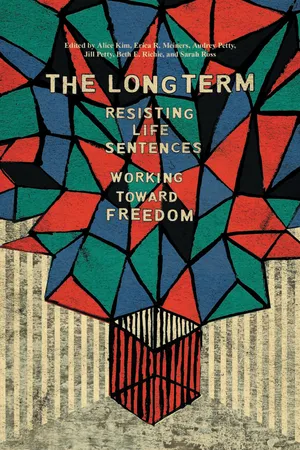
“There are no criminals here at Rikers Island Correctional Institution for Women.”1 These words from Assata Shakur written from her prison cell in 1978 resonate with the opening contributions of The Long Term. There are no criminals here either—just a declaration, a simple yet profound rejection of the state’s classification of all incarcerated people. This refusal is compelled by what Assata termed a “fierce determination to move on closer to freedom.” Similarly, in this book’s first section, the writers and artists on the inside and outside of prison reflect on the resistance strategies they have been forced to devise or improvise, and also insist “We Are Alive.”
Contributors ask, What are the costs of “serving the long term”? And how do we bear them? In her essay “On Leaving Prison: A Reflection on Entering and Exiting Communities,” Monica Cosby remembers “Survival Day,” a day to mark the resilience of the poor and working-class Chicago neighborhood she grew up in. “The whole of Uptown would gather on the mall to celebrate another year of our community’s survival,” writes Cosby. Other contributors recount events, relationships, activities, and connections that have sustained them while incarcerated and free, including cooking, singing, reading, making art, and writing. And, most urgently, they document their insistence to be seen and heard in spite of the master narratives and master machinery that seek to disappear them.
Lyle May, a student and writer on death row in Raleigh, North Carolina, shares the same sense of supreme urgency with this assembled collective. For May, writing has been an instrument to claim space and recognition. In a 2016 essay published in Scalawag, he observes, “Writing is a way of seeing the world and communicating that experience with others. Whether it occurs in a letter to a loved one or an essay in a magazine, writing is an essential tool I use to connect with society and express my humanity.” And May says his writing is fueled by his “desire to understand and be understood by others.”2
Like May, in “We Are Alive” writers and artists press for visibility and connection. Even as the carceral state attempts to engineer their erasure and their removal to the margins, they declare their right to sovereignty, friendship, love, respect, education, and self-expression: every day, every day, every day.
Prison Is Not Just a Place
■ Raul Dorado
The months of October and November 2016 brought sudden and unexpected changes. Approximately one thousand people from behind the walls at Stateville Correctional Center and three hundred from its Northern Reception Center were transferred to various facilities located in the southern region of the state.1 These moves were mostly a result of the closing of the notorious F House, the country’s last operational panopticon-style cell house, also known as the roundhouse. While a few prisoners welcomed change, the redistribution of our brethren was dreaded by the rest of us. None of us knew who was leaving or staying until the day before shipments, when lists were read over the loudspeaker along with the orders “Pack up, you’re leaving.” Although very impersonal, to us it was as if the ghostly voice of death were holding roll call. With few exceptions, people in prison abhor change. We prefer the hell we know to the one we don’t. Decades’ worth of friendships are instantly destroyed as fellow prisoners are torn out of our prison community like meat from a carcass. Our crude displacement also strains family ties; the farther south we are transferred, the more difficult it is for our loved ones to visit and support us.
Prison is not just a place; it is our life. A maximum-security facility houses mostly long-term offenders, many of whom have already served twenty years and have no foreseeable release date. Behind these walls we form concrete bonds of brotherhood and just about every other imaginable relationship common to ordinary people. There are even blood relatives here. It’s not unusual for a father and son or for brothers to find themselves as cellmates. There have been instances where fathers and sons have met for the first time in prison. More commonly we are coworkers: barbers, cooks, janitors, and so forth. We are classmates in adult basic education, pre-GED, GED, and a variety of educational programs. We are a church and choir members. We work and study side by side, eat and pray together; we coexist. In The Narrative of the Life of Frederick Douglass, Douglass describes his closest relationships with those he mentored in Sabbath school and those he labored with, side by side, in wheat fields. Slavery was unaccommodating to family ties; relatives were routinely separated, knowledge and sweat became the bonding agents in the formation of new relationships. These conditions prompted Douglass to write, “I loved them with a love stronger than anything I have ever experienced.”2
Complete strangers become brothers over the course of ten, fifteen, twenty years of fighting the same fight, wrestling against similar feelings of despair and hopelessness. Time binds us as appeal after appeal for freedom is struck down by panels of black-robed judges slamming their gavels with the same conviction and finality that the reaper swings his scythe. I shared a cell for three years with someone I now consider a brother. On the outside we would have been mortal enemies separated by neighborhood boundaries, colors, and the flash of crooked fingers. On the inside we were joined by ethnicity, culture, and the realization of being very much alike. I knew the name, age, and birth dates of his children and siblings. When I called home, I would hand him the phone and he would speak to my brother. On visits, we would greet each other’s family. We collaborated on meals, artwork, and letters to loved ones. When it came to meals, each one of us contributed whatever commissary food items we could. It didn’t matter how little it may have been; the other put in the rest and we took turns cooking. He was a better cook and made a prodigy out of me, and now I cook for others. When it came to artwork, I would craft clever greeting cards with moving and pop-out parts, and he would decorate them with colorful designs using pens, markers, and colored pencils. We are both bilingual, but Spanish is his primary language and I am more fluent in English. When writing in our second language, we would help each other better articulate our thoughts. We were each other’s Spanish/English dictionary. I can remember a time when this brother received a letter from a reviewing court informing him that his appeal had been denied. Of all the convoluted legal jargon, he mostly understood the word “denied.” I was tasked with explaining to him the court’s rationale for crushing his hopes and shaking his faith, if not in God then certainly in our judicial system. Having had multiple appeals denied myself, I was able to sympathize with him and knew exactly how he felt. It’s a visceral feeling that leaves you in a fog for the next couple of days or so until you are able to shake it off. The level of trust we learned to place in each other is remarkable given that prison is a place where men are purposeful in guarding their innermost thoughts with the mental engineering of an Acropolis wall.
Recently, and for no apparent reason, this brother and I were separated. One afternoon I was on the yard exercising while he was at work in the inmate commissary. A guard approached the fence, called out eight names, and informed us we had to be escorted to our cells to pack our property because we were being moved. Immediately a herd of emotions stampeded inside of me, and muffled voices whispered dark conspiracies in the hallways of my mind. When I got to my cell, my cellmate was already there. The guard rolled the cell bars closed behind me and said, “You got thirty minutes to pack it up!” We soon learned he would be sent one way and I another. We were given half an hour to sort through our belongings and the last three years of our lives. In this regard, plantations and prisons are not much different. They are two forms of the same callous system—a heartless machine that sorts out men the same way the US Postal Service mechanically sorts mail.
The parallels of the slave trade and contemporary mass incarceration are much too similar to be coincidental: both slaves and modern-day prisoners manufacture their own food and clothing and perform many of the services that keep institutions functional. Whereas slaves once harvested wheat for plantations owners, prisoners now fill the barn; where forced labor once generated profits, our idleness now generates hourly wages. People of color are the coal and wood burning in the furnace of greed and hatred. The years of our life fuel this industry of mass incarceration. Am I a slave? If I concede that I am a slave, then I admit to things I am not yet ready to admit to—for instance, that I no longer belong to myself. If I resist the notion of being a slave, I risk misplacing my resistance.
Douglass bewailed separation as being final, as causing unbearable pain. He asserted that he himself was ready for anything other than separation. Indeed, Douglass gave an account of a heartrending event where a fellow slave was sold to a Georgia trader for finding fault with his master: “He was immediately chained and handcuffed; and without a moment’s warning, he was snatched away, and forever sundered from his family and friends, by a hand more unrelenting than death.”3
I’m serving a life sentence without the possibility of parole. I have been ostracized from my family and community. I don’t get to decide who I share a cell with or who my neighbors are. At any moment I can be relocated from one place to another like an interchangeable part. Frederick Douglass was eventually able to flee his captor and become the leading abolitionist of his time. For obvious reasons, I can’t flee my captors, but I seek freedom from ignorance and psychological slavery through my efforts of self-education and rehabilitation. I’m not sure whether these efforts will ever abolish my life sentence or the parallels of slavery inherent in our justice system; nevertheless, I resist because it is the one thing within my power to do. If I allow myself to become despondent and complacent, I will remain in a state of slavery. However, if I peacefully resist, every book I read and every word I write will work to loosen the grip of the unrelenting hand that snatched me away from my family and community.
Larger Than Life
Building a Movement across Prison Walls to Abolish Death by Incarceration
■ Felix Rosado, David Lee, and Layne Mullett
We believe this systemic negation of the human capacity for redemption is a crime against humanity.
—Right 2 Redemption
Ironically it is common to call death behind bars “life.” Why? The truth is, for the more than fifty thousand people in US prisons serving the sentence known as “life without parole” and another forty-four thousand serving “virtual life” (fifty years or more), growing old and dying behind a wall or razor-wire-draped fence is no life at all.
Decades of resistance to racism and state repression, led by formerly and currently incarcerated people, fuels a growing consensus that mass incarceration is a problem. While there are many avenues from which to challenge mass incarceration, we believe there is a particular strategic importance to ending the practice of condemning people to die behind bars.
In 2014 three Philadelphia-based organizations gathered to discuss launching a campaign to end the practice of death by incarceration in Pennsylvania. Comrades who were currently serving death-by-incarceration sentences contributed to the meeting by mail. These organizations—Decarcerate PA, Fight for Lifers, the Human Rights Coalition, and Right 2 Redemption (an organization based inside the Pennsylvania State Correctional Institution [SCI] at Graterford)—went on to become the anchoring organizations of the Coalition to Abolish Death by Incarceration (CADBI), a statewide effort to pass legislation that would retroactively abolish the state’s ability to condemn people to die in prison.
CADBI’s founding members behind the prison walls insisted on the importance of changing the narrative. Words shape—and reshape—our reality, both as individuals and as a society. Words have power, and we have the power to use words to make change. Because language matters, instead of using the phrase “life without parole,” we set out to popularize the phrase “death by incarceration.” Using language that names the real nature of a “life” sentence provides an avenue for the listener to understand how the sentence conflicts with a fundamental value. Change starts with us, with the words we use.
Although popularity for state-sanctioned killing in the United States has waned over the years, death by incarceration has skyrocketed, to little fanfare. While the death penalty is supposedly reserved for the “worst of the worst,” a life sentence is for the “more deserving.” This misnomer places death by incarceration neatly across an imaginary line from death by lethal injection. Compounding the problem, many death penalty abolitionists advocate vigorously for death by incarceration as a viable, more humane alternative to a gurney, needle, and heart-stopping three-drug cocktail. Upon closer examination, however, the boundary between death by injection and death by incarceration withers away. The fact remains: both sentences begin and end with a human being dragged in vertically and carried out horizontally. Today, one in seven incarcerated people will die in prison while serving their sentence.
The Supreme Court has determined that “death is different,” which has led to higher levels of scrutiny and constitutional protections for capital punishment: a bifurcated trial with distinct guilt and penalty phases, automatic appeals, lax application of appellate time limits, and so on. Skilled attorneys who believe it’s morally wrong for the state to murder as punishment for crime rush to file appeals and pleas for clemency on the eve of death warrant execution dates. These resources and mechanisms are not available to those serving death by incarceration.
Yet dozens of men in one state prison alone—SCI Graterford in Pennsylvania—are killed by decades of incarceration each year. This sentence is not life. This is an in-house death sentence. We believe that no human being, whether on death row or in the prison’s general population, should be denied the possibility of redemption. Imagine if we were all defined by—and punished for—the worst act we’ve ever committed, forever. Would we want this for ourselves? How about for our children? The idea of “another chance” has always been central to the human condition since the beginning.
Abolition from the Plantation to the Prison Cell
The movement to end death by incarceration did not start with this current campaign. W...