- 182 pages
- English
- ePUB (mobile friendly)
- Available on iOS & Android
eBook - ePub
Metrics for Service Management:
About this book
This title is the sister book to the global best-seller Metrics for IT Service Management. Taking the basics steps described there, this new title describes the context within the ITIL 2011 Lifecycle approach. More than that it looks at the overall goal of metrics which is to achieve Value. The overall delivery of Business Value is driven by Corporate Strategy and Governance, from which Requirements are developed and Risks identified. These Requirements drive the design of Services, Processes and Metrics. Metrics are designed and metrics enable design as well as governing the delivery of value through the whole lifecycle.
The book shows the reader how do achieve this Value objective by extending the ITIL Service Lifecycle approach to meet business requirements.
Information
Topic
EducationSubtopic
Architecture General1 Introduction
This book is designed to be practical; it avoids diagrams, process flows and detailed definitions where these are obvious. What managers need is a view of the goals and objectives of a project or program, and then an understanding of what methods, tools, resources, processes and so on are required to get it working. This book is primarily about design Ð the design of metrics for Service Management, which includes designing end-to-end service metrics. To measure services end-to-end, it is necessary to design process metrics, including Service Management process, technical and other supporting metrics.
1.1 Background knowledge
Ideally the reader of this book will already be familiar with Service Management, ITIL®, and ISO/IEC 20000 as well, perhaps, as PRINCE2, M_o_R and, perhaps, ISO/IEC 15504 (SPICE), CMMI, Six Sigma, Cobit and other relevant areas. The book only includes the smallest possible top-level introduction to any of the above for those readers who might not be familiar with a particular area. Anybody intending to achieve a level of maturity in Service Management is advised to read the books recommended in the bibliography - in particular, the five ITIL® lifecycle books - and to take a structured approach to professional development.
If you have not worked with metrics before, then it would be worthwhile reading the first chapters of this book to avoid some of the more common and dangerous pitfalls. Even if you have worked with metrics, it is probably wise to review these, as mistakes can be subtle and difficult to rectify later. Designing metrics is not simple or quick Ð if it seems so, then the metrics are likely to be at best inadequate and, at worst, dangerous and counter-productive.
Many organizations have suffered from severe unexpected consequences - directly as a result of applying metrics that were easy to measure and control, but not actually in line with business requirements. A well known example was the use of one metric ‘waiting list time’ to define improvements to the UK National Health Service Ð the result was that everybody met the metric, but the actual waiting lists remained, or, in fact, became longer and less fair. The overall result was a reduced quality of service and increased dissatisfaction even as the metric was reported as a success.
1.2 How to use this book
Mostly this book is designed to be used as a practical tool during workshops:
• Where services, business and technical, with their processes, are designed.
• Where organizational improvement must be addressed urgently.
• Where a merged, or re-organized, service delivery team can decide what measures can enable results to be achieved quickly to support longer-term improvement and deviations measured accurately.
Use this as a tool, for guidance. If a suggestion suits you, use it. If you need to modify it for your own situation, go ahead; this is not supposed to be a stone tablet! If you’ve got a tricky issue to discuss, take it along, so you can explore some possible metrics Ð at least that should provide a common starting point for discussion and, maybe, some ideas for ways forward.
The layout is uncluttered, designed to be easy to navigate quickly Ð to find an idea, for example, during a meeting. Where possible, repetition is avoided.
Each metric described includes a paragraph giving some context. This is a reminder that metrics do not stand in isolation. Often this context will include warnings of possible misinterpretation, and suggestions for refining the metric. With any luck, in the heat of the moment, these will be some of the most helpful parts. They’re better read when actually designing a metric, rather than all the way through.
All metrics should include, for example, a RACI (Responsible, Accountable, Consulted, Informed) matrix to allow proper design of the metric to include the people accountable for it being achieved, those responsible for measuring and managing it and those consulted about its design, improvement or interpretation as well as those informed, through reports, dashboards, alerts or other means.
The Appendix contains the full form for recording a metric. Space does not permit the inclusion of all this detail for all metrics, so only the main descriptors of each metric appear in a table at the end of each chapter. The full set of electronic metrics is best used electronically, as an on-line Metrics Register that links to your Requirements, Continual Service Improvement (CSI) and Risk Registers and to the relevant Service Design Packages.
The flow of the book is contained in Figure 1.1 below. Notice that Design forms a major part of the book.
The book is organized as follows:
– Introduction (this chapter), explaining the purpose and structure of this book
– Managing, metrics and perspectives: key principles of metrics
– Governance: the metrics required for effective governance
– Service Strategy: the metrics required for the first phase of the service lifecycle
– Service Design: the metrics required for the second phase of the service lifecycle
– Chapters exploring Service Design-related topics in more detail:
ο Classifications of metrics
ο Outsourcing and emerging technologies
ο Cultural and technical considerations
ο Tools and tool selection
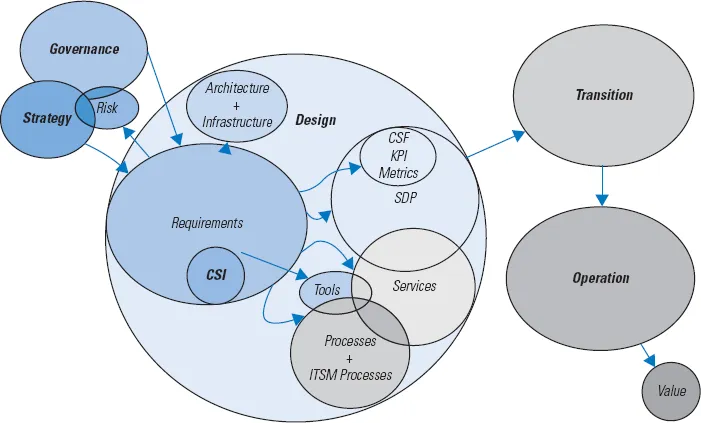
Figure 1.1 Metrics book topic flow
– Service Transition: the metrics required for the third phase of the service lifecycle
– Chapter exploring Service Transition-related topic in more detail: Service Transition and management of change
– Service Operation: the metrics required for the fourth phase of the service lifecycle
– Continual Service Improvement: the metrics required for the final ongoing phase of the service lifecycle
– Appendices]
The ultimate aim of Service Management is to produce Value; this is delivered during Service Operation and measurements facilitate in the definition and scoping of Continual Service Improvement. Corporate Strategy and Governance give rise to new requirements that drive the design of Services, Processes and Metrics. The design of metrics is critical to assuring the efficacy of the Service Lifecycle processes and in governing the delivery of value.
2 Managing, metrics and perspective
2.1 Managing
As with a lot of folklore, there are wise sayings on both sides of the question about how to use metrics as part of management:
‘You can’t manage what you can’t measure’ [attributed to Tom DeMarco developer of Structured Analysis]
‘A fool with a tool is still a fool’ [attributed to Grady Booch, developer of the Unified Modeling Language]
Both of these are true. Managing requires good decision-making and good decision-making requires good knowledge of what is to be decided. ITIL®’s concept of Knowledge Management is designed to avoid this pitfall.
2.2 Perspective
Relying simply on numbers given by metrics, with no context or perspective, can be worse than having no information at all, apart from ‘gut feel’. Metrics must be properly designed, properly understood and properly collected, otherwise they can be very dangerous. Metrics must always be interpreted in terms of the context in which they are measured in order to give a perspective on what they are likely to mean.
To give an example: a Service Manager might find that the proportion of emergency changes to normal changes has doubled. With just that information, most people would agree that something has gone wrong – why are there suddenly so many more emergency changes? This could be correct, but here are some alternative explanations of why this is the case:
• If the change process is new, this may reflect the number of emergency changes that the organization actually requires more accurately. Previously these changes might have been handled as ordinary changes without proper recognition of the risk.
• In a mature organization, a major economic crisis might have intensified the risk of a number of previously low-risk activities. It would be the proper approach for the Service Manager, recognizing changes related to these, to make them emergency changes.
• The change management process might have been improved substantially in the current quarter, so much so that the number of ordinary changes that have been turned into standard changes has led to a halving of the number of normal changes. The number of emergency changes has stayed exactly the same, but the ratio is higher because of the tremendous improvement in the change process.
Even a very simple and apparently uncontroversial metric can mean very different things. As with most management, there is no ‘silver bullet’. Metrics must be properly understood, within context, in order to be useful tools. To ensure that they are understood, metrics must be designed. For best results, service metrics should be designed when the Service itself is designed, as part of the Service Design Package, which is why the ‘Design’ section in this book is the largest.
The metric template used in this book includes the field ‘Context’ specifically to allow e...
Table of contents
- Cover
- Title
- Colophon
- Acknowledgements
- Contents
- 1 Introduction
- 2 Managing, metrics and perspective
- Section Break: Governance
- Section Break: Service Strategy
- Section Break: Service Design
- Section Break: Service Transition
- Section Break: Service Operation
- Section Break: Continual Service Improvement
- Appendices
Trusted by 375,005 students
Access to over 1.5 million titles for a fair monthly price.
Study more efficiently using our study tools.
Frequently asked questions
Yes, you can cancel anytime from the Subscription tab in your account settings on the Perlego website. Your subscription will stay active until the end of your current billing period. Learn how to cancel your subscription
No, books cannot be downloaded as external files, such as PDFs, for use outside of Perlego. However, you can download books within the Perlego app for offline reading on mobile or tablet. Learn how to download books offline
Perlego offers two plans: Essential and Complete
- Essential is ideal for learners and professionals who enjoy exploring a wide range of subjects. Access the Essential Library with 800,000+ trusted titles and best-sellers across business, personal growth, and the humanities. Includes unlimited reading time and Standard Read Aloud voice.
- Complete: Perfect for advanced learners and researchers needing full, unrestricted access. Unlock 1.5M+ books across hundreds of subjects, including academic and specialized titles. The Complete Plan also includes advanced features like Premium Read Aloud and Research Assistant.
We are an online textbook subscription service, where you can get access to an entire online library for less than the price of a single book per month. With over 1.5 million books across 990+ topics, we’ve got you covered! Learn about our mission
Look out for the read-aloud symbol on your next book to see if you can listen to it. The read-aloud tool reads text aloud for you, highlighting the text as it is being read. You can pause it, speed it up and slow it down. Learn more about Read Aloud
Yes! You can use the Perlego app on both iOS and Android devices to read anytime, anywhere — even offline. Perfect for commutes or when you’re on the go.
Please note we cannot support devices running on iOS 13 and Android 7 or earlier. Learn more about using the app
Please note we cannot support devices running on iOS 13 and Android 7 or earlier. Learn more about using the app
Yes, you can access Metrics for Service Management: by Jan Schilt,Jan van Bon,Peter Brooks in PDF and/or ePUB format, as well as other popular books in Education & Architecture General. We have over 1.5 million books available in our catalogue for you to explore.