![]()
Undesirable Elements
![]()
Notes on Production
A NOTE ON THE USE OF LANGUAGE
Undesirable Elements was originally conceived around the idea of the sound of multiple languages at play, and Ping Chong sought out participants who spoke multiple languages for this purpose. In many versions, cast members introduce themselves in the language of their birth at the top of the production, and then reintroduce themselves in English at the end. This structure intentionally creates an initial feeling of distance and alienation in the audience, and then a subsequent sense of recognition and familiarity, after life stories have been revealed, and identities claimed onstage.
In productions that focus on issues of cultural identity, performers often recite a poem or sing a song in their traditional language. Again, these sections are deliberately not translated, and are instead used as transitions in the narrative, and an aural respite from the march of personal history. These moments are lyrical, haunting and mysterious for the audience (unless they happen to speak the same language as a performer, in which case it becomes a moment of secret understanding).
For this volume, songs and poems have been noted in the stage directions, but not printed. Original languages and alphabets are used in the introductory sections without translation, to replicate the experience in the theater. Elsewhere in the scripts, lines are printed in either the original language, for longer phrases, or in transliteration when the English translation is repeated immediately after, for shorter phrases.
A NOTE ON STAGING
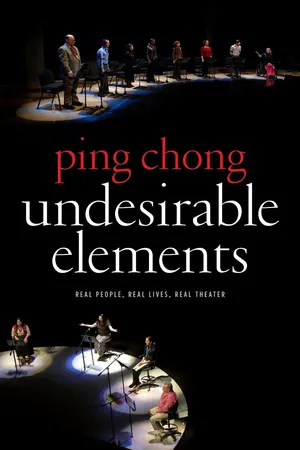
All Undesirable Elements productions use the same basic production concept, with artistic variations incorporated into specific productions. The scenic elements consist of music stands, chairs and microphones for the performers, arranged around a semicircular “half-moon” of white rock salt or a white painted floor. Each chair is situated in a “pool” of light, which can highlight individual speakers or the entire cast of performers. Additional lighting includes atmospheric color washes on the floor and on the cyc, as well as a blue circular “moon” of light focused above the performers on a cyc or projection screen. The early performances used projection sequences of outlines of unidentified countries within an enclosed circle. Each country appeared the same size within the circle, regardless of actual geographic scale (i.e., China appeared to be the same size as Sri Lanka). As the production themes have evolved beyond national/cultural identities, some productions now include more elaborate projection sequences that incorporate personal imagery from cast members, historic maps and archival images from local communities.
Undesirable Elements productions are spare, elegant and primarily static. Once the performers enter the space, they do not leave until the conclusion of the show. With the exception of the occasional orchestrated seat change, or moment of dance shared by a performer, the true sense of movement in the production comes not from physical movement, but from the rapid aural movement of the language and dialogue of the script itself. For this reason, Ping Chong describes Undesirable Elements as “a seated opera for the spoken word.”
Embedded within the script are sequences of claps that provide punctuation, rhythm and momentum to the spoken dialogue, as well as adding emphasis to key moments. When the stage directions indicate “all clap,” the cast is clapping one time, sharply, in unison. In other instances, the cast may clap two, five or ten times, as indicated in the stage direct...