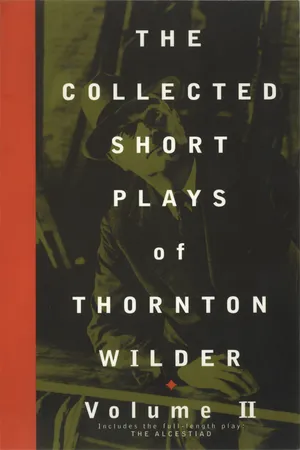
The publication of volume two of this landmark collection celebrates the close of the centennial year of Thornton Wilder's birth. This volume collects 17 plays from the author's three-minute and five-minute plays for five actors series and includes the full-length play The Alcestiad, a major work by the author of Our Town and The Skin of Our Teeth which has long been unavailable.
- 360 pages
- English
- ePUB (mobile friendly)
- Available on iOS & Android
eBook - ePub
The Collected Short Plays of Thornton Wilder, Volume II
About this book
Information

PART
I
The Angel That Troubled the Waters and Other Plays
THREE-MINUTE PLAYS FOR THREE PERSONS
and
The Marriage We Deplore
FOREWORD
by Thornton Wilder
Wilder wrote this Foreword to The Angel That Troubled the Waters and Other Plays in June 1928, soon after receiving the Pulitzer Prize for The Bridge of San Luis Rey. At the time, to devote more time to writing, he was about to step out of his life as a French teacher and as the dormitory master of Davis House at the Lawrenceville School in New Jersey.
IT IS A DISCOURAGING business to be an author at sixteen years of age. Such an author is all aspiration and no fulfillment. He is drunk on an imaginary kinship with the writers he most admires, and yet his poor overblotted notebooks show nothing to prove to others, or to himself, that the claim is justified. The shortest walk in the country is sufficient to start in his mind the theme, the plan and the title, especially the title, of a long book; and the shortest hour when he has returned to his desk is sufficient to deflate his ambition. Such fragments as he is finally able to commit to paper are a mass of echoes, awkward relative clauses and conflicting styles. In life and in literature mere sincerity is not sufficient, and in both realms the greater the capacity the longer the awkward age. Yet strange lights cross that confusion, authoritative moments that all the practice of later maturity cannot explain and cannot recapture. He is visited by great depressions and wild exhilarations, but whether his depressions proceed from his limitations in the art of living or his limitations in the art of writing he cannot tell. An artist is one who knows how life should be lived at its best and is always aware of how badly he is doing it. An artist is one who knows he is failing in living and feeds his remorse by making something fair, and a layman is one who suspects he is failing in living but is consoled by his successes in golf, or in love, or in business.
Authors of fifteen and sixteen years of age spend their time drawing up title pages and adjusting the tables of contents of works they have neither the perseverance nor the ability to execute. They compass easily all the parts of a book that are inessential. They compose dignified prefaces, discover happy quotations from the Latin and the French, and turn graceful dedications. This book is what is left of one of these projects.
The title was to have been Three-Minute Plays for Three Persons. I have lately found one of my early tables of contents for it, written in the flyleaves of a First Year Algebra. Quadratics in those days could be supported only with the help of a rich marginal commentary. Usually these aids to education took the shape of a carefully planned repertory for two theatres, a large and a small. Here my longer plays were to alternate with The Wild Duck and Measure for Measure and were cast with such a roll of great names as neither money nor loyalty could assemble. The chapter on Combinations and Permutations ended short by several inches, and left me sufficient space to draw up a catalog of all the compositions I had heard of that were the work of Charles Martin Loeffler. This list of Three-Minute Plays was drawn up in Berkeley, California, in the spring of 1915. It contains several that have since been rejected, two that are in the present volume, Brother Fire and Proserpina and the Devil, and the names of many that were unwritten then and that still, through the charm of their titles, ask to be written.
Since then I have composed some forty of these plays, for I had discovered a literary form that satisfied my passion for compression. Since the time when I began to read I had become aware of the needless repetition, the complacency in most writing. Who does not know the empty opening paragraphs, the deft but uninstructive transitions, and the closing paragraphs that summarize a work and which are unnecessary to an alert reader?
Moreover, their brevity flatters my inability to sustain a long flight, and the inertia that barely permits me to write at all. And finally, when I became a teacher, here was the length that could be compassed after the lights of the House were out and the sheaf of absurd French exercises corrected and indignantly marked with red crayon. In time the three minutes and the three persons became a habit, and no idea was too grandiose—as the reader will see—for me to try and invest it in this strange discipline.
There were other plans for this book. There was to have been a series of Footnotes to Biographies, suggested by Herbert Eulenberg’s Schattenbilder, represented here by the Mozart [Mozart and the Gray Steward], the Ibsen [Centaurs], and the St. Francis play [Brother Fire]. There were hopes of a still more difficult series. Dürer’s two sets of woodcuts illustrating the Passion were to serve as model for a series of plays that would be meditations on the last days of Our Lord. Two of them are in this book [Now the Servant’s Name Was Malchus, Hast Thou Considered My Servant Job?]. There was to have been a series illustrating the history of the stage, and again, two of them are in this book [Fanny Otcott, Centaurs]. How different the practice of writing would be if one did not permit oneself to be pretentious. Some hands have no choice: they would rather fail with an oratorio than succeed with a ballad.
During the years that these plays were being written I was reading widely, and these pages are full of allusions to it. The art of literature springs from two curiosities, a curiosity about human beings pushed to such an extreme that it resembles l...
Table of contents
- Cover
- Title Page
- Copyright
- Dedication
- Contents
- Preface
- Introduction
- Part I: The Angel That Troubled The Waters and Other Plays – Three-Minute Plays for Three Persons and The Marriage We Deplore
- Part II: The Unerring Instinct – A Play in One Act
- Part III: “THE EMPORIUM”
- Part IV: The Alcestiad – With Its Satyr Play – The Drunken Sisters
- Some Thoughts on Playwriting
- Bibliographic and Production Notes
Trusted by 375,005 students
Access to over 1.5 million titles for a fair monthly price.
Study more efficiently using our study tools.
Frequently asked questions
Yes, you can cancel anytime from the Subscription tab in your account settings on the Perlego website. Your subscription will stay active until the end of your current billing period. Learn how to cancel your subscription
No, books cannot be downloaded as external files, such as PDFs, for use outside of Perlego. However, you can download books within the Perlego app for offline reading on mobile or tablet. Learn how to download books offline
Perlego offers two plans: Essential and Complete
- Essential is ideal for learners and professionals who enjoy exploring a wide range of subjects. Access the Essential Library with 800,000+ trusted titles and best-sellers across business, personal growth, and the humanities. Includes unlimited reading time and Standard Read Aloud voice.
- Complete: Perfect for advanced learners and researchers needing full, unrestricted access. Unlock 1.5M+ books across hundreds of subjects, including academic and specialized titles. The Complete Plan also includes advanced features like Premium Read Aloud and Research Assistant.
We are an online textbook subscription service, where you can get access to an entire online library for less than the price of a single book per month. With over 1.5 million books across 990+ topics, we’ve got you covered! Learn about our mission
Look out for the read-aloud symbol on your next book to see if you can listen to it. The read-aloud tool reads text aloud for you, highlighting the text as it is being read. You can pause it, speed it up and slow it down. Learn more about Read Aloud
Yes! You can use the Perlego app on both iOS and Android devices to read anytime, anywhere — even offline. Perfect for commutes or when you’re on the go.
Please note we cannot support devices running on iOS 13 and Android 7 or earlier. Learn more about using the app
Please note we cannot support devices running on iOS 13 and Android 7 or earlier. Learn more about using the app
Yes, you can access The Collected Short Plays of Thornton Wilder, Volume II by Thornton Wilder in PDF and/or ePUB format, as well as other popular books in Literature & American Drama. We have over 1.5 million books available in our catalogue for you to explore.