Conner explains the background, organization, and workings of the National War Labor Board, created by President Wilson in April 1918. She analyzes the board’s struggle to succeed and reveals how both labor and business attemted to use this partnership to further their own special interests. The author shows how, when dissatisfied private employers refused to cooperate voluntarily, the Wilson administration was forced to make compliance mandatory.
Originally published in 1980.
A UNC Press Enduring Edition — UNC Press Enduring Editions use the latest in digital technology to make available again books from our distinguished backlist that were previously out of print. These editions are published unaltered from the original, and are presented in affordable paperback formats, bringing readers both historical and cultural value.
eBook - ePub
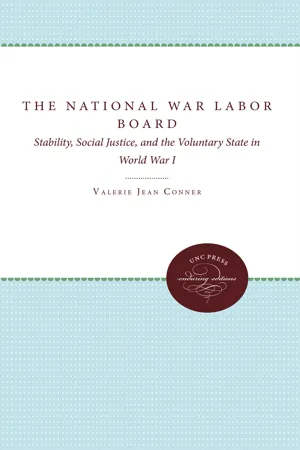
The National War Labor Board
Stability, Social Justice, and the Voluntary State in World War I
- 248 pages
- English
- ePUB (mobile friendly)
- Available on iOS & Android
eBook - ePub
The National War Labor Board
Stability, Social Justice, and the Voluntary State in World War I
About this book
Trusted by 375,005 students
Access to over 1.5 million titles for a fair monthly price.
Study more efficiently using our study tools.
Information
1 Business, Labor, and Government in the Prewar Years: Prelude to Wartime Voluntarism
So far as employers in distant places do come into competition with each other, their interests . . . may often be promoted by the coalescence of the local unions of their men: It tends to the establishment of uniform conditions throughout the industry, and thus moderates the severity of competition between employers. This effect is most marked when wide-spreading organizations of employers are also found . . . and when they settle wages, hours, and other conditions by direct agreement with the unions.
—United States Industrial Commission, 1902
Wartime voluntarism was a natural, if not inevitable, development. Since the 1890s, national business and labor organizations had turned to the federal government for help in achieving their organizational goals. Yet, even as they worked to scuttle laissez faire, those organizations reflected the fear of federal coercion that had characterized American society since the eighteenth century. They clung fiercely to their own independence and to the traditional belief that democracy thrives best under limited government. At the turn of the century, there emerged within both groups a “vital center,” committed to stabilization and standardization in industrial affairs. Many of these moderates also wrestled with a separate problem, which was how to achieve industrial democracy without destroying economic freedom. The means that they chose to resolve both matters was the means through which they believed political democracy had flourished, voluntary cooperation. The federal government could act as watchdog, establish certain guidelines for industrial behavior, and provide occasional forums for debate. But the real work of harmonizing the relations among businessmen and between employers and employees was best left to private interests. Such ideas, so prevalent in 1918, were embryonic in 1898 when the United States Industrial Commission investigated the conditions of labor and capital.
The fear of federal coercion permeated the Industrial Commission’s final report. After four years of investigation, it recommended a program to promote industrial justice and efficiency with a minimum of federal interference. Government, nonetheless, had a vital role to play in industrial affairs. Its primary function, so the report implied, was to bolster the drive toward nationally uniform conditions already begun by the private organizations of the 1890s. Unwilling to see the powers of Congress revolutionized to that end, the commission looked more to the states. Congress should, of course, strengthen existing labor regulations for industries engaged in interstate commerce and for federal employees. But to increase dramatically the scope of federal action, the commission believed, was unacceptable. Clearly, cooperation in the passage of uniform state laws was the more democratic alternative.1
Ideally, however, the commission envisioned a society in which labor legislation would be all but superfluous. Repeatedly throughout its final report, it suggested that the enactment of needed reform by law, even nationally uniform law, was less desirable than securing the same ends without governmental intervention. Differences in state constitutions limited the potential of uniformity through state action. Confusions over the extent of the police powers of the states not only weakened the prospect of uniformity but also negated the possibility of legislation on vital questions in industrial relations. Finally, even uniform laws sustained by the courts were sure to be evaded unless laboring men could force compliance with them. If labor was that strong, the commission reasoned, the laws themselves would become unnecessary.2
The best way to achieve a just and efficient industrial society was through what the commission called “industrial democracy.” Introduced in 1897 by Beatrice and Sidney Webb, British Fabian reformers, the phrase was interpreted loosely to include a variety of means through which laborers could acquire some measure of control over the terms of their employment.3 Although the commission took notice of such plans as stock purchasing and cooperative production, it dismissed both as ineffective tools for the democratic reorganization of industry. “By the organization of labor, and by no other means,” the report concluded, “it is possible to introduce an element of democracy into the government of industry.” Only through organization could workers “effectively take part in determining the conditions under which they work.” This became “true in the fullest and best sense only when employers frankly meet the representatives of the workmen, and deal with them as parties equally interested in the conduct of affairs.”4 Simply put, the Industrial Commission equated “industrial democracy” with “collective bargaining,” another term that it noted was only just coming into use.5
The organization of labor was thus the cornerstone on which the Industrial Commission built its comprehensive program for national industrial reform. The national trade unions worked for the standardization of production costs and working conditions in major industries. When persuaded to cooperate for that purpose, business associations and powerful labor unions could eliminate the fragmented conditions that had caused industrial unrest. Such cooperation could not only prevent disruptive strikes but also end abuse of employees by employers and ease the competition among employers for competent workmen. Even local industries would profit from the national organization of craft unions, for their efforts to set national standards would increase the mobility of the work force. Finally, standardized conditions would erase the competitive disadvantage of states with advanced labor legislation. For all these reasons, the commission believed, “legislation is needed only where organization fails.”6
Significantly, the report endorsed union goals in language that anticipated both the practical and the humanitarian tendencies in the Progressive ethos. The right to organize was essential to counterbalance the “growth of great aggregations of capital under the control of single groups of men.”7 In general, since wage earners were the weakest economic component in America, successful union efforts to strengthen their relative economic position strengthened the nation as a whole. More specifically, evidence indicated that shorter hours made for more on-the-job efficiency. Higher wages boosted the economy by increasing consumer buying power. More leisure time and a better standard of living encouraged workingmen to better their skills and to develop the qualities essential for constructive citizenship. Equal pay for women and limitations on the employment of children not only aided the unions but also furthered the welfare of the women and children themselves, and hence of the community at large.8
Most important, the growth of organized labor symbolized for the commission the best insurance for the future of capitalism and the American system of government. The national trade unions, already a brake against socialism, further protected the existing economic and political systems because the leaders of large organizations tended necessarily to be responsible and conservative men. Even persons out of sympathy with the labor movement had testified to the high “general character and ability” of the national union chiefs. This was especially true when the organizations themselves reflected democratic principles, such as the AFL’S affiliates did.9
In sum, the commission report mirrored an America awakening to new socioeconomic realities but committed to old political values. It preached national uniformity and endorsed the essence of virtually every proposal for the reform of labor relations that would receive serious consideration in the next twenty years. Clearly, the commission envisioned collective solutions to national problems, even as it clung to Jeffersonian concepts of individualism and limited government. “Industrial democracy,” in these circumstances, became the logical means to achieve both ends.
Theoretically, the commission’s logic betrayed no flaw: Voluntary associations such as the trade-union affiliates and business organizations of the 1890s themselves eschewed coercion and preserved the image of individual freedom for the workers and employers who joined them. Voluntary cooperation between the representatives of both groups would extend the methods of political democracy into the national industrial arena. As cooperation succeeded, the need for governmental intervention would decrease. In reality, however, the harmony of the commission’s scheme with popularly held Jeffersonian ideals was strained. The scheme did preserve the ideal of limited government, but the fundamental thrust of the report was that industrial democracy—a necessary correlative to political democracy in the modern state—demanded the sacrifice of economic individualism to the actions of formal, organized interest groups of equal strength.
On the practical level, therefore, the commission’s emphasis on voluntarism and collective agreement appealed to important groups of elites, be they associations of business, labor, or reform. Such a program was ideally suited to “enlightened” businessmen, who thought in terms of a national economy and were both willing and able to make concessions to the work force in return for future harmony. Likewise, the program suited conservative labor leaders who accepted capitalism and were willing to work piecemeal toward increased political and economic power for their constituents. Finally, it offered hope to those middle-class reformers whose conception of the ideal society included little more than the capitalist state stripped of obvious inequities. For all those groups, voluntary collective action, supplemented by appropriate legislative guidelines, suggested the potential for change without the threat of revolution. In fact if not in theory, “industrial democracy” provided for the sharing of power among already powerful organizations.
For others, however, the thrust of the commission’s report was noxious. Socialists took little comfort in proposals designed to strengthen an economic system that they abhorred. Local-minded businessmen, meanwhile, saw potential ruin in the triumph of voluntarism, collectivism, and legislated uniformity. For socialists, the commission’s recommendations fell short of meaningful reform; for small businessmen, they moved the locus of power too far from home. This dissent from the left and from the right threatened the very heart of the commission’s moderate program, for it belied the consensus upon which the commission predicated reform.
In actual fact, consensus had broken down even within the commission itself. Several members refused to sign the report. Fearing equally their large competitors and governmental intervention, these spokesmen for small business interests had retreated behind a wall of individualism in defense of their economic future. Two vice-presidents of the recently organized National Association of Manufacturers protested against both the ideal of standardized working conditions and the congeniality that their colleagues encouraged between large labor and large capital.10 Climatic conditions, as well as differing kinds and status of industry, they insisted, made uniformity impracticable. They argued, moreover, against “any iron-clad rule adopted or suggested from a central power” and supported “the inalienable right of private contract” in order to fulfill America’s destiny as the “leading manufacturing nation of the world.” The report, one dissenting commissioner noted, catered to “unrestricted and uncontrolled organization of special classes of labor,” which in cooperation with large-scale employers could demand and exact tributes from less powerful segments of the economy.11
Within months after the Industrial Commission’s report was issued, voluntarism broke down in Pennsylvania. The long and bitter struggle in the anthracite coalfields ended only after President Theodore Roosevelt appointed a commission, which then settled the dispute and mandated voluntary cooperation for the life of the award. Although the United Mine Workers failed to win recognition per se, Roosevelt did appoint a labor leader to the commission, and the mine workers were represented equally with the operators on the board of conciliation created to implement the settlement.12 The settlement lent important support to the ideas advanced by the Industrial Commission. It also set a precedent for presidential action in times of national crisis, even as it provided organized labor with its first measure of real power under the auspices of the federal government.
But the coal strike graphically demonstrated the imperfections of voluntarism as a tool for reform. Historically, the concept of voluntary cooperation had been devised to perpetuate democracy in a relatively small and homogeneous society. It assumed a fundamental commonality of interests and a basic equality of power among citizens.13 In the United States, such a society had reached its apogee in colonial New England. In the twentieth century, voluntarism merely perpetuated the existing power structure. What voluntarism obviously could not do was equalize the power of business and labor. The coal strike had required the intervention of the federal government because the operators had seen no common interests with their employees. In 1902, the miners got a Square Deal only because the operators were forced to share power with them.
The coal strike and its aftermath also helped to clarify the divisions within the business community which had appeared within the Industrial Commission and which hindered the orderly progress of labor relations throughout the Progressive era. On the one hand, the business-dominated National Civic Federation, organized in 1900, recognized the organization of labor as a permanent fact of industrial life and endorsed the concept of collective bargaining. During the strike, the NCF had worked unsuccessfully to bring the miners and the operators together.14 The National Association of Manufacturers, however, found a “great danger” in the NCF’S conciliatory approach to trade unionism and resented the government’s method of restoring peace to the anthracite fields.15 Like the NCF, the NAM believed that private interests could best solve industrial problems and that businessmen should organize to that purpose. Yet, while the NCF accepted the implications of the emerging collectivist society, the NAM steadfastly refused to see the irony of its attempts to organize American employers for the preservation of individualism.16
The program of the National Civic Federation between 1900 and 1904 harmonized perfectly with the Industrial Commission’s majority report. A b...
Table of contents
- Cover Page
- Title Page
- Copyright Page
- Contents
- Preface
- 1 Business, Labor, and Government in the Prewar Years: Prelude to Wartime Voluntarism
- 2 A New Deal for American Labor
- 3 Attack on Industrial Autocracy
- 4 Toward a Living Wage
- 5 A Moderate Advance
- 6 Meeting the Government’s Necessity
- 7 Democratizing Industry
- 8 The War Labor Board in Autumn
- 9 The Mothers of the Race
- 10 From War to Peace
- 11 Whither Industrial Cooperation?
- Notes
- Selected Bibliography
- Index
Frequently asked questions
Yes, you can cancel anytime from the Subscription tab in your account settings on the Perlego website. Your subscription will stay active until the end of your current billing period. Learn how to cancel your subscription
No, books cannot be downloaded as external files, such as PDFs, for use outside of Perlego. However, you can download books within the Perlego app for offline reading on mobile or tablet. Learn how to download books offline
Perlego offers two plans: Essential and Complete
- Essential is ideal for learners and professionals who enjoy exploring a wide range of subjects. Access the Essential Library with 800,000+ trusted titles and best-sellers across business, personal growth, and the humanities. Includes unlimited reading time and Standard Read Aloud voice.
- Complete: Perfect for advanced learners and researchers needing full, unrestricted access. Unlock 1.5M+ books across hundreds of subjects, including academic and specialized titles. The Complete Plan also includes advanced features like Premium Read Aloud and Research Assistant.
We are an online textbook subscription service, where you can get access to an entire online library for less than the price of a single book per month. With over 1.5 million books across 990+ topics, we’ve got you covered! Learn about our mission
Look out for the read-aloud symbol on your next book to see if you can listen to it. The read-aloud tool reads text aloud for you, highlighting the text as it is being read. You can pause it, speed it up and slow it down. Learn more about Read Aloud
Yes! You can use the Perlego app on both iOS and Android devices to read anytime, anywhere — even offline. Perfect for commutes or when you’re on the go.
Please note we cannot support devices running on iOS 13 and Android 7 or earlier. Learn more about using the app
Please note we cannot support devices running on iOS 13 and Android 7 or earlier. Learn more about using the app
Yes, you can access The National War Labor Board by Valerie Jean Conner in PDF and/or ePUB format, as well as other popular books in History & World War I. We have over 1.5 million books available in our catalogue for you to explore.