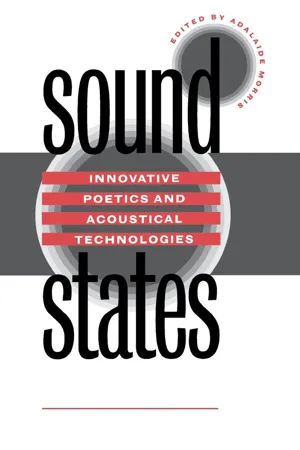
By investigating the relationship between acoustical technologies and twentieth-century experimental poetics, this collection, with an accompanying compact disc, aims to 'turn up the volume' on printed works and rethink the way we read, hear, and talk about literary texts composed after telephones, phonographs, radios, loudspeakers, microphones, and tape recorders became facts of everyday life.
The collection’s twelve essays focus on earplay in texts by James Joyce, Ezra Pound, H.D., Samuel Beckett, William Burroughs, Amiri Baraka, Bob Kaufman, Robert Duncan, and Kamau Brathwaite and in performances by John Cage, Caribbean DJ-poets, and Cecil Taylor. From the early twentieth-century soundscapes of Futurist and Dadaist 'sonosphers' to Henri Chopin’s electroacoustical audio-poämes, the authors argue, these states of sound make bold but wavering statements — statements held only partially in check by meaning.
The contributors are Loretta Collins, James A. Connor, Michael Davidson, N. Katherine Hayles, Nathaniel Mackey, Steve McCaffery, Alec McHoul, Toby Miller, Adalaide Morris, Fred Moten, Marjorie Perloff, Jed Rasula, and Garrett Stewart.
- 368 pages
- English
- ePUB (mobile friendly)
- Available on iOS & Android
eBook - ePub
About this book
Information
PART ONE: SOUNDINGS
Radio and Tape Transmissions
RADIO FREE JOYCE
Wake Language and the Experience of Radio
In The Human Use of Human Beings: Cybernetics and Society, Norbert Wiener spoke of the uses of improbability in communication: “Messages are themselves a form of pattern and organization. Indeed, it is possible to treat sets of messages as having an entropy like sets of states of the external world. Just as entropy is a measure of disorganization, the information carried by a set of messages is a measure of organization. In fact, it is possible to interpret the information carried by a message as essentially the negative of its entropy, and the negative logarithm of its probability. That is, the more probable the message, the less information it gives” (21). If you think about it, this makes a kind of strange linguistic sense. If you could predict the contents of a message beforehand, why would it need to be sent? How useful could such a message be? But Wiener means something more than this. What he is saying is that up to a point, chaos itself increases information by increasing the possibilities of that information’s content, up to the point when the very randomness of the signal makes it less and less able to bear meaning. If you graph this change, as did Claude Shannon in his “Mathematical Theory of Communication,” it forms a bell curve, with information rising to a point, then dropping off at an equal rate.
Long before Shannon put this complex insight into the large, economy-size mathematics of information theory, modernist poets, painters, musicians, and novelists were experimenting with concrete examples. Cubists “opened up” three-dimensional objects to give impossible views of ordinary things. Dadaists experimented with pure sound. Novelists such as William Faulkner and James Joyce experimented with shifting points of view, multiple voices, and direct readings of thoughts. This is especially true of Joyce’s last, arguably his greatest, and certainly his strangest novel, Finnegans Wake, which seems, at first glance, to be nearly pure chaos but is, slyly, not so. Here is a text that stands at the top of Shannon’s bell curve, halfway between pure order and pure chaos, constructed, and yet constructed in such a way that it packs a measure of improbability into every line.
How could they have come up with such an idea? Something was in the air with these modernists, something to which they were responding, something that opened their ears, if not also their eyes, to a new way of communicating. This essay suggests that something, at least for Finnegans Wake, was radio. In those days radio signals were as far from our kind of digital stability as the Wright brothers’ plane was from Apollo 11. Radio air was full of noises, wandering signals, high altitude skips, and super-heterodyne screeches, and anyone who listened to it had to gradually attune themselves to a cacophony of voices all speaking at once. For Joyce the exile, Joyce the aficionado of popular culture, radio air was not something to be ignored.
Voices All at Once: Early Radio
In the early twentieth century, radio had more influence on cultural change than did most other technological developments. For the first time, people living hundreds, sometimes thousands of miles apart had instant contact on a mass scale. This quantum jump in communication radically reduced the cost of influencing large numbers of people. It did not require paper or ink. It did not require a large distribution network. It only required a transmitter, a studio, some entertainment, and an audience, who paid for their own receivers and license fees for the privilege of listening. Capitalism had a new tool powerful enough to colonize the very art forms that produced it. Like Samuel Beckett with the tape recorder or William Butler Yeats with radio, Joyce was attuned to the technologies around him. First in Ulysses and then in Finnegans Wake he reformulated the language of advertising and the structure of technology and reset them in an older form, the novel. In so doing, he increased the amount of information that could be passed from one place to another with language. In a real sense he reset the linguistic level of entropy.
Irish radio was an early player in the development of radio. Having its roots in the uprising of 1916, when a group of republicans carried a radio set from one building to another in order to evade the British news blackout, the first Irish commercial station came on the air from Dublin on the first of January 1926 (Mink 459). Broadcasting from Little Denmark Street, the transmitter was moved in the early 1930s to a spot two miles east of Athlone. At first it was not a very powerful station—on the average of i kilowatt (Gorham 9)—paltry by today’s standards but average in those days, with a range of little more than a hundred miles.1 “The evening programme began with a Stock Exchange List, News Bulletin, and Market Reports, and closed with a Weather Forecast” (Gorham 45), but there was a station trio, which eventually became an orchestra, and an overload of ballad singers.2 And of course there were speeches. The opening address was given by Dr. Douglas Hyde, the founder of the Gaelic League, a fact that did not stop the league from condemning the station at least once a year for years to come.
The call sign for Radio Eireann, which Joyce referred to as “Radio Athlone,” was 2RN, chosen to echo the final words of “Come back to Erin” (Gorham 25). Although the station relied heavily on relays from the BBC, Seamus Clandillon, the first director, emphasized Irish language programming. Broadcasts were informal affairs, done on the cheap.3 By 1933, however, the Athlone station began to broadcast at 60 kilowatts (Gorham 86), so that on still nights, without much interference from sunspots, its signal reached Paris, where Joyce picked it up—an immediate connection with home, with its tidbits of news, weather, drama, and poetry. Although the airwaves were not nearly as crowded in the early 1930s as they are today, Radio Athlone had to compete for the most efficient frequencies, but it was the single channel where an Irish expatriate could hear Irish voices, not anglicized, and pick up Irish news. For a man who “each day, and each hour of the day” thought of Ireland, and each day, each hour of the day “lived and relived his memories” (Soupault 116), such a radio link must have been like water in the desert.
The power of radio in the lives of people in the 1930s cannot be overstated. Night after night entire families—if they were affluent—sat mesmerized around a large speaker. Others sat alone beside a crystal set, wearing headphones, their hands clutched over their ears, their faces screwed up with concentration as they picked out their station through all the noise. Noise was always a problem. And worse, transmissions were never steady— they appeared and disappeared like desert highways. These were the days before adjustable frequency stabilizers (my father invented the first one in 1950).4 Blocks had to be put in or taken out to hold the frequency and keep it steady. Moreover, signals from the other side of the world sometimes bounced off the Heaviside layer and overrode more local signals so that an Abbey Theatre broadcast could be interrupted by a snow report from Minsk or a farm journal from Chicago.5
Factors like temperature drift also varied frequency. As a transmitter warmed up, its signal meandered off course, so that a listener would have to constantly tune and retune the receiver. What is more, if someone at the transmitter opened the door to the radio room, the transmitter tubes cooled suddenly and the frequency would stray again, so that everyone would have to try to follow. Then, on top of all this, there were squeals and whistles, howls like banshees keening through the airwaves. If any two radio frequency signals are close to each other, the difference between them becomes an audial signal, an eerie wail on the headphones, like the voice of a poor dead soul bouncing up and down along the Heaviside layer.6 These voices—moving, shifting, piling on top of one another, settling, whistling, humming, and screeching—must have sounded in all their constant flux like the coils of hell.
In radiospeak, taken together these noises are called static, a term with two basic meanings: (i) generic radio interference, including words and unintelligible sounds—pops, whistles, squeals, and what have you—and (2) that hissing sibilant white noise, close to pure chaos, that is sometimes quiet enough to be ignored, sometimes loud enough to drown out everything else. While frequency shifts fade signals in and out, without the proper filters, the radio frequency hiss would be a nearly constant irritation. Any kind of electrical machinery causes man-made static, or QRN. Power lines and electric motors, generators, and automobiles are common culprits.7 Natural static, or QRM (why these last letters are reversed, why M and not N for “natural” I don’t know), is caused by sunspots and attendant atmospheric discharges, especially the aurora borealis.
The experience of radio in the 1930s, then, was a wondrous, often mysterious jumble of signal and noise. Benjamin’s observation about the work of art in an age of technological reproduction also applies to the utterance, which like the work of art lost its uniqueness, its singular place in time and space (220). The word “spread out” over the landscape. The hearer and the speaker could be halfway across the world from each other. Moreover, the fact that a single utterance could be “reproduced” in so many homes in so many different places, at such great distance, and could be so altered along the way by so many electromagnetic forces meant that the spoken word was set into the world in an entirely new way. This new way is what Walter Ong calls “secondary orality,” like and yet decidedly unlike the ancient primary orality of Homer (136).
At the same time that radio was becoming commonplace, Joyce was experimenting with language that reproduced its audial characteristics. Joyce himself admitted that in his Work in Progress “there is not even a chronological ordering of the action. It is a simultaneous action, represented by the novel’s circular construction” (Hoffmeister 132). Simultaneous action, everything happening at once—what could be a better description of radio before digital dials, noise filters, and stereophonic sound? The language of the Wake flows and shifts, is noisy and hard to grasp, much like competing radio signals, so that a reader must listen with the same intensity as a radio hound in 1933. Joyce was, of course, aware of this connection, for as Michael Begnal points out, “Within the text are constant allusions to a wireless or short-wave radio as a central symbol or unifying device, and the basic problem in an understanding of the action is the recognition on the part of the reader of the individual voices of the characters” (Begnal and Eckley 26). A number of dreamers and a number of voices—HCE, ALP, Issy, Shem and Shaun, the Four Old Men—communicate across space like dream radios.
In book II, chapter 3, the Four are speaking, sitting on the posts of the bed. The dreamers are connected by a “high fidelity daildialler, as modern as tomorrow afternoon.” Their “supershielded umbrella antennas” are “for distance getting” and are “capable of capturing skybuddies, harbour craft emittences, key clickings, vaticum cleaners, due to woman formed mobile or man made static and bawling the whowle hamshack and wobble” (309.14ff). These dreamers give and receive radio signals. They capture sky-buddies, experience skip off the Heaviside layer, hear key clickings of Morse code and man-made static. They hear “bawling the whowle [‘howl’ and ‘whole’] hamshack [ham radio shack] and wobble.” Radio is everywhere in their dreams, for it is the medium of their communication.
John Gordon, following Margaret Solomon, points out that the radio is actually the body of the sleeper: “The radio introduced at the start of the chapter is also the sleeper’s head and trunk, his cranium (‘a howdrocephalous enlargement’), brain (‘harmonic condenser enginium’), mouth (‘vitaltone speaker’), eyes (‘circumcentric megacycles’), heart (‘magazine battery’), arteries (‘twintriodic singulvalvulous pipelines’) front and back (‘up his corpular fruent and down his reuctionary buckling’)—and the most prominent feature is the ears, the ‘umbrella antennas for getting distance’” (194–95). Throughout the Wake the bodies of HCE and ALP are at once flesh and land and river, city and waterway—the world is linked to the body, the body to the world in a tradition that goes back to Leonardo da Vinci’s Man in a Circle and Square, to the Roman umbilicus mundi, to the primitive omphalos or “navel of the world” (Edgerton 11) — but for Joyce this old image takes on a new, more technological form. While the dreamers are connected by dream radio, their bodies are themselves bound into the circuit; there are no headsets, no wires that are not already parts of their bodies. Machines and flesh share functions. The dreamer does not merely listen. The dreamer is the signal, the message, and the noise. The dreamer sends and receives.8
Much of book II, chapter 3, is mingled with radio transmissions. According to Gordon the downstairs radio plays throughout: “In fact, there are two main broadcasts being recalled here, often overlapping—a result of the reception’s wandering from frequency to frequency and the interference which is especially bad at night, when as Shaun’s inquisitors later say, anyone with a wireless can ‘peck up bostoons’ (489.36–490.01). (The radio does in fact get signals from Norway and Czechoslovakia)” (196). The chapter opens with the “tolvtubular high fidelity daildialler” (309.14) mentioned above, a two-way radio in which gossip about HCE passes back and forth (Tindall 189), then returns to the story of the Norwegian Captain, a story about Earwicker that was left off in chapter 2. Weaving in and out of this is a sermon, which begins pleasantly enough, until the volume on this “low frequency amplification” signal is turned up (312.33). Not only is the signal wandering, but dials are being manipulated. With its volume raised, the sermon becomes a tub thumper and a hell raiser—“Sets on [the radio set is on] sayfohrt [say it forth]! Go to it, agitator!” (313.4). In the midst of the sermon are words that sound like background static — a thousand faint signals, indiscernible noises that come through the speakers: “Bothallchoractorschumminaroundgansumuminarumdrumstrumtruminahumptadumpwaultopoofoolooderamaunsturnup ¡”(314.8–9).
This linguistic monster is at first composed of individual words strung together—“Both all characters chummin around”—then fades into an onomatopoeic thrumming ...
Table of contents
- Cover Page
- Title Page
- Copyright Page
- Epigraph
- Contents
- Illustrations
- Acknowledgments
- Introduction. Sound States
- Part I. Soundings: Radio and Tape Transmissions
- Part II. Groundings: Performance/Ritual/Event
- Part III. Surroundings: Hearing Theories
- Bibliography
- Notes on the Contributors
- Index
Trusted by 375,005 students
Access to over 1.5 million titles for a fair monthly price.
Study more efficiently using our study tools.
Frequently asked questions
Yes, you can cancel anytime from the Subscription tab in your account settings on the Perlego website. Your subscription will stay active until the end of your current billing period. Learn how to cancel your subscription
No, books cannot be downloaded as external files, such as PDFs, for use outside of Perlego. However, you can download books within the Perlego app for offline reading on mobile or tablet. Learn how to download books offline
Perlego offers two plans: Essential and Complete
- Essential is ideal for learners and professionals who enjoy exploring a wide range of subjects. Access the Essential Library with 800,000+ trusted titles and best-sellers across business, personal growth, and the humanities. Includes unlimited reading time and Standard Read Aloud voice.
- Complete: Perfect for advanced learners and researchers needing full, unrestricted access. Unlock 1.5M+ books across hundreds of subjects, including academic and specialized titles. The Complete Plan also includes advanced features like Premium Read Aloud and Research Assistant.
We are an online textbook subscription service, where you can get access to an entire online library for less than the price of a single book per month. With over 1.5 million books across 990+ topics, we’ve got you covered! Learn about our mission
Look out for the read-aloud symbol on your next book to see if you can listen to it. The read-aloud tool reads text aloud for you, highlighting the text as it is being read. You can pause it, speed it up and slow it down. Learn more about Read Aloud
Yes! You can use the Perlego app on both iOS and Android devices to read anytime, anywhere — even offline. Perfect for commutes or when you’re on the go.
Please note we cannot support devices running on iOS 13 and Android 7 or earlier. Learn more about using the app
Please note we cannot support devices running on iOS 13 and Android 7 or earlier. Learn more about using the app
Yes, you can access Sound States by Adalaide Morris in PDF and/or ePUB format, as well as other popular books in Literature & Literary Criticism Theory. We have over 1.5 million books available in our catalogue for you to explore.