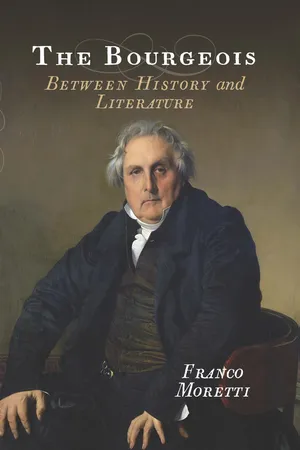
"The bourgeois ... Not so long ago, this notion seemed indispensable to social analysis; these days, one might go years without hearing it mentioned. Capitalism is more powerful than ever, but its human embodiment seems to have vanished. 'I am a member of the bourgeois class, feel myself to be such, and have been brought up on its opinions and ideals,' wrote Max Weber, in 1895. Who could repeat these words today? Bourgeois 'opinions and ideals'-what are they?"
Thus begins Franco Moretti's study of the bourgeois in modern European literature-a major new analysis of the once-dominant culture and its literary decline and fall. Moretti's gallery of individual portraits is entwined with the analysis of specific keywords-"useful" and "earnest," "efficiency," "influence," "comfort," "roba"-and of the formal mutations of the medium of prose. From the "working master" of the opening chapter, through the seriousness of nineteenth-century novels, the conservative hegemony of Victorian Britain, the "national malformations" of the Southern and Eastern periphery, and the radical self-critique of Ibsen's twelve-play cycle, the book charts the vicissitudes of bourgeois culture, exploring the causes for its historical weakness, and for its current irrelevance.
- 224 pages
- English
- ePUB (mobile friendly)
- Available on iOS & Android
eBook - ePub
About this book
Information
Topic
Scienze socialiSubtopic
Critica letteraria europea1
A Working Master
1. ADVENTURE, ENTERPRISE, FORTUNA
The beginning is known: a father warns his son against abandoning the ‘middle state’—equally free from ‘the labour and suffering of the mechanick part of mankind’, and ‘the pride, luxury, ambition and envy of the upper part’—to become one of those who go ‘abroad upon adventures, to rise by enterprise’.1 Adventures, and enterprise: together. Because adventure, in Robinson Crusoe (1719), means more than the ‘strange surprising’ occurrences—Shipwreck . . . Pyrates . . . un-inhabited Island . . . the Great River of Oroonoque . . .—of the book’s title-page; when Robinson, in his second voyage, carries on board ‘a small adventure’2 the term indicates, not a type of event, but a form of capital. In early modern German, writes Michael Nerlich, ‘adventure’ belonged to the ‘common terminology of trade’, where it indicated ‘the sense of risk (which was also called angst)’.3 And then, quoting a study by Bruno Kuske: ‘A distinction was made between aventiure trade and the sale to known customers. Aventiure trade covered those cases in which the merchant set off with his goods without knowing exactly which market he would find for them.’
Adventure as a risky investment: Defoe’s novel is a monument to the idea, and to its association with ‘the dynamic tendency of capitalism . . . never really to maintain the status quo’.4 But it’s a capitalism of a particular kind, that which appeals to the young Robinson Crusoe: as in the case of Weber’s ‘capitalist adventurer’, what captures his imagination are activities ‘of an irrational and speculative character, or directed to acquisition by force’.5 Acquisition by force is clearly the story of the island (and of the slave plantation before it); and as for irrationality, Robinson’s frequent acknowledgments of his ‘wild and indigested notion’ and ‘foolish inclination of wandring’6 is fully in line with Weber’s typology. In this perspective, the first part of Robinson Crusoe is a perfect illustration of the adventure-mentality of early modern long-distance trade, with its ‘risks that [were] not just high, but incalculable, and, as such, beyond the horizon of rational capitalist enterprise.’7
Beyond the horizon . . . In his legendary lecture at the Biblioteca Hertziana, in Rome, in 1929, Aby Warburg devoted an entire panel to the moody goddess of sea trade—Fortuna—claiming that early Renaissance humanism had finally overcome the old mistrust of her fickleness. Though he recalled the overlap between Fortuna as ‘chance’, ‘wealth’, and ‘storm wind’ (the Italian fortunale), Warburg presented a series of images in which Fortuna was progressively losing its demonic traits; most memorably, in Giovanni Rucellai’s coat of arms she was ‘standing in a ship and acting as its mast, gripping the yard in her left hand and the lower end of a swelling sail in her right.’8 This image, Warburg went on, had been the answer given by Rucellai himself ‘to his own momentous question: Have human reason and practical intelligence any power against the accidents of fate, against Fortune?’ In that age ‘of growing mastery of the seas’, the reply had been in the affirmative: Fortune had become ‘calculable and subject to laws’, and, as a result, the old ‘merchant venturer’ had himself turned into the more rational figure of the ‘merchant explorer’.9 It’s the same thesis independently advanced by Margaret Cohen in The Novel and the Sea: if we think of Robinson as ‘a crafty navigator’, she writes, his story ceases to be a cautionary tale against ‘high-risk activities’, and becomes instead a reflection on ‘how to undertake them with the best chance of success’.10 No longer irrationally ‘pre’-modern, the young Robinson Crusoe is the genuine beginning of the world of today.
Fortune, rationalized. It’s an elegant idea—whose application to Robinson, however, misses too large a part of the story to be fully convincing. Storms and pirates, cannibals and captivity, life-threatening shipwrecks and narrow escapes are all episodes in which it’s impossible to discern the sign of Cohen’s ‘craft’, or Warburg’s ‘mastery of the sea’; while the early scene where ships are ‘driven . . . at all adventures, and that with not a mast standing’11 reads like the striking reversal of Rucellai’s coat of arms. As for Robinson’s financial success, its modernity is at least as questionable: though the magic paraphernalia of the story of Fortunatus (who had been his main predecessor in the pantheon of modern self-made men) are gone from the novel, the way in which Robinson’s wealth piles up in his absence and is later returned—‘an old pouch’ filled with ‘one hundred and sixty Portugal moidores in gold’, followed by ‘seven fine leopards’ skins . . . five chests of excellent sweetmeats, a hundred pieces of gold uncoined . . . one thousand two hundred chests of sugar, eight hundred rolls of tobacco, and the rest of the whole account in gold’—is still very much the stuff of fairy tales.12
Let me be clear, Defoe’s novel is a great modern myth; but it is so despite its adventures, and not because of them. When William Empson, in Some Versions of Pastoral, offhandedly compared Robinson to Sinbad the Sailor, he had it exactly right;13 if anything, Sinbad’s desire ‘to trade . . . and to earn my living’14 is more explicitly—and rationally—mercantile than Robinson’s ‘meer wandring inclination’. Where the similarity between the two stories ends is not on the sea; it’s on land. In each of his seven voyages, the Baghdad merchant is trapped on as many enchanted islands—ogres, carnivorous beasts, malevolent apes, murderous magicians . . .—from which he can only escape with a further leap into the unknown (as when he ties himself to the claw of a giant carnivorous bird). In Sinbad, in other words, adventures rule the sea, and the terra firma as well. In Robinson, no. On land, it is work that rules.
2. ‘THIS WILL TESTIFY FOR ME THAT I WAS NOT IDLE’
But why work? At first, to be sure, it’s a matter of survival: a situation in which ‘the day’s tasks . . . seem to disclose themselves, by the logic of need, before the labourer’s eyes’.15 But even when his future needs are secure ‘as long as I lived . . . if it were to be forty years’,16 Robinson just keeps toiling, steadily, page after page. His real-life model Alexander Selkirk had (supposedly) spent his four years on Juan Fernandez oscillating madly between being ‘dejected, languid, and melancholy’, and plunging into ‘one continual Feast . . . equal to the most sensual Pleasures’.17 Robinson, not even once. In the course of the eighteenth century, it has been calculated, the number of yearly workdays rose from 250 to 300; on his island, where the status of Sunday is never completely clear, the total is certainly higher.18 When, at the height of his zeal—‘You are to understand that now I had . . . two plantations . . . several apartments or caves . . . two pieces of corn-ground . . . my country seat . . . my enclosure for my cattle . . . a living magazine of flesh . . . my winter store of raisins’19—he turns to the reader and exclaims, ‘this will testify for me that I was not idle’, one can only nod in agreement. And, then, repeat the question: Why does he work so much?
‘We scarcely realize today what a unique and astonishing phenomenon a “working” upper class is’, writes Norbert Elias in The Civilizing Process: ‘why submit itself to this compulsion even though it is . . . not commanded by a superior to do so?’20 Elias’s wonder is shared by Alexandre Kojève, who discerns at the centre of Hegel’s Phenomenology a paradox—‘the Bourgeois’s problem’—whereby the bourgeois must simultaneously ‘work for another’ (because work only arises as a result of an external constraint), yet can only ‘work for himself’ (because he no longer has a master).21 Working for himself, as if he were another: this is exactly how Robinson functions: one side of him becomes a carpenter, or potter, or baker, and spends weeks and weeks trying to accomplish something; then Crusoe the master emerges, and points out the inadequacy of the results. And then the cycle repeats itself all over again. And it repeats itself, because work has become the new principle of legitimation of social power. When, at the end of the novel, Robinson finds himself ‘master . . . of above five thousand pounds sterling’22 and of all the rest, his twenty-eight years of uninterrupted toil are there to justify his fortune. Realistically, there is no relationship between the two: he is rich because of the exploitation of nameless slaves in his Brazilian plantation—whereas his solitary labour hasn’t brought him a single pound. But we have seen him work like no other character in fiction: How can he not deserve what he has?23
There is a word that perfectly captures Robinson’s behaviour: ‘industry’. According to the OED, its initial meaning, around 1500, was that of ‘intelligent or clever working; skill, ingenuity, dexterity, or cleverness’. Then, in the mid-sixteenth century, a second meaning emerges—‘diligence or assiduity . . . close and steady application . . . exertion, effort’, that soon crystallizes as ‘systematic work or labour; habitual employment in some useful work’.24 From skill and ingenuity, to systematic exertion; this is how ‘industry’ contributes to bourgeois culture: hard work, replacing the clever variety.25 And calm work, too, in the same sense that interest is for Hirschmann a ‘calm passion’: steady, methodical, cumulative, and thus stronger than the ‘turbulent (yet weak) passions’ of the old aristocracy.26 Here, the discontinuity between the two ruling classes is unmistakable: if turbulent passions had idealized what was needed by a warlike caste—the white heat of the brief ‘day’ of battl...
Table of contents
- Cover
- Title
- Dedication
- Contents
- Note on Sources
- Introduction: Concepts and Contradictions
- I. A Working Master
- II. Serious Century
- III. Fog
- IV. ‘National Malformations’: Metamorphoses in the Semi-Periphery
- V. Ibsen and the Spirit of Capitalism
- Illustration Credits
- Index
- Copyright
Trusted by 375,005 students
Access to over 1.5 million titles for a fair monthly price.
Study more efficiently using our study tools.
Frequently asked questions
Yes, you can cancel anytime from the Subscription tab in your account settings on the Perlego website. Your subscription will stay active until the end of your current billing period. Learn how to cancel your subscription
No, books cannot be downloaded as external files, such as PDFs, for use outside of Perlego. However, you can download books within the Perlego app for offline reading on mobile or tablet. Learn how to download books offline
We are an online textbook subscription service, where you can get access to an entire online library for less than the price of a single book per month. With over 1.5 million books across 990+ topics, we’ve got you covered! Learn about our mission
Look out for the read-aloud symbol on your next book to see if you can listen to it. The read-aloud tool reads text aloud for you, highlighting the text as it is being read. You can pause it, speed it up and slow it down. Learn more about Read Aloud
Yes! You can use the Perlego app on both iOS and Android devices to read anytime, anywhere — even offline. Perfect for commutes or when you’re on the go.
Please note we cannot support devices running on iOS 13 and Android 7 or earlier. Learn more about using the app
Please note we cannot support devices running on iOS 13 and Android 7 or earlier. Learn more about using the app
Yes, you can access The Bourgeois by Franco Moretti in PDF and/or ePUB format, as well as other popular books in Scienze sociali & Critica letteraria europea. We have over 1.5 million books available in our catalogue for you to explore.