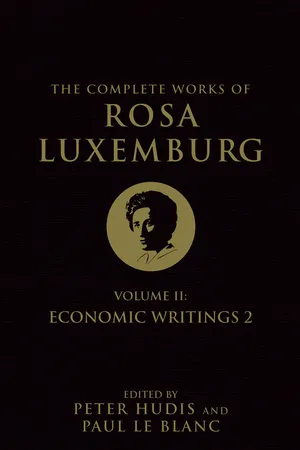
The second volume in Rosa Luxemburg's Complete Works, entitled Economic Writings 2, contains a new English translation of Luxemburg's The Accumulation of Capital: A Contribution to the Economic Theory of Imperialism, one of the most important works ever composed on capitalism's incessant drive for self-expansion and the integral connection between capitalism and imperialism. This new translation is the first to present the full work as composed by the author. It also contains her book-length response to her critics,The Accumulation of Capital, Or, What the Epigones Have Made Out of Marx's Theory-An Anti-Critique. Taken together, these two works represent one of the most important Marxist studies of the globalization of capital.
Also included is an essay on the second and third volumes of Marx's Capital, which had originally appeared as an unattributed chapter in Franz Mehring's book Karl Marx.
Thank you to David Gaharia for helping to support the translation of this book.
eBook - ePub
The Complete Works of Rosa Luxemburg, Volume II
Economic Writings 2
- 576 pages
- English
- ePUB (mobile friendly)
- Available on iOS & Android
eBook - ePub
The Complete Works of Rosa Luxemburg, Volume II
Economic Writings 2
About this book
Information
Part I
What My Book Was About*
Habent sua fata libelli—books have destinies of their own. When I was writing my Accumulation I was disheartened from time to time by a particular thought: all supporters of Marx’s doctrine who take an interest in theory would make the pronouncement that the points I was trying so exhaustively to demonstrate and substantiate were actually self-evident already. Nobody would voice a different opinion: my solution of the problem would be the only one possible or conceivable.
Things turned out quite differently: a whole series of critics in the Social Democratic press declared that my book was totally misguided in its very conception and that such a problem calling for a solution did not exist at all. I had become the pitiful victim of a pure misunderstanding.†
There were events connected with the publication of my book that must be called rather unusual. The “review” of Accumulation [by Gustav Eckstein], which appeared in Vorwärts on February 16, 1913,‡ was striking in tone and content even to the less involved reader; and this was all the more astonishing because the criticized book is purely theoretical and strictly objective, nor was it aimed against any living Marxist. But that was not good enough.
Against those who had published a favorable review of my book a highhanded official campaign was initiated, and the central newspaper* pursued this campaign with particularly notable warmth.†
________________
*First published in 1921 by Frankes Verlag in Leipzig, the German original of the Anti-Critique was divided into two untitled parts, with the second part divided into five untitled subsections. The earlier English edition, translated by Rudolf Wichman and Kenneth J. Tarbuck (The Accumulation of Capital—An Anti-Critique [New York and London: Monthly Review Press, 1972]) divided the work into six sections, with the titles chosen by the editor. We have retained the two-part division of the German original while introducing several subsections to Part I, for which we have also supplied titles.
†For the critics of Luxemburg’s Accumlation of Capital, see Anonymous, “Die Akkumulation des Kapitals” (The Accumulation of Capital), in Dresdner Volkszeitung (Dresden People’s Paper), Nos. 16 and 17, January 21 and 22, 1913; Anton Pannekoek, “Rosa Luxemburg, Die Akkumulation des Kapitals: Ein Beitrag zur ökonomischen Erklärung des Imperialismus” (The Accumulation of Capital: A Contribution to the Economic Theory of Imperialism), in Bremer Bürger-Zeitung (Bremen Citizens’ Paper), January 29 and 30, 1913; Anonymous, “Die Akkumulation des Kapitals” (The Accumulation of Capital), in Frankfurter Volksstimme (People’s Voice of Frankfurt), February 1, 1913; Gustav Eckstein, “Rosa Luxemburg, Die Akkumulation des Kapitals: Ein Beitrag zur ökonomischen Erklärung des Imperialismus” (The Accumulation of Capital: A Contribution to the Economic Theory of Imperialism), in Vorwärts, No. 40, February 16, 1913; Otto Bauer, “Die Akkumulation des Kapitals,” in Die Neue Zeit, Year 31, 1912–13, Vol. 1, pp. 831–8, 862–74; Max Schippel, “Das Grundgeheimnis des Imperialismus” (The Underlying Secret of Imperialism), in Sozialistische Monatshefte (Socialist Monthly Notebooks), Year 17, 1913, No. 1, pp. 147–52.
‡For an English translation, see Gustav Eckstein, “The Accumulation of Capital: A Critique,” in Discovering Imperialism: Social Democracy to World War I, translated, edited, and introduced by Richard B. Day and Daniel Gaido (Leiden, NL: Brill, 2011), pp. 695–712.
There was an unparalleled, and in its way rather comical, sequel: With regard to my purely theoretical work about a complicated issue involving abstract scientific analysis, the entire Editorial Board of a political daily paper came forward—although two members, at the most, might have read the book—and as an official body handed down a collective judgment against it. In the process they denied that men like Franz Mehring and S. Karski [Julian Marchlewski] possessed any expertise on questions of political economy. Only those who had torn my book apart were to be designated as “experts.”‡
Such a fate has befallen no other party publication as far as I know, and over the decades Social Democratic publishers have certainly not produced all gold and pearls. All these events clearly indicate that, in one way or another, there have been passions at work other than those of “pure science.” The fact is that in order to judge this series of events correctly, one must first become acquainted with the subject, at least in its main outlines.
This book, which has been fought against so fiercely—what is it actually about? To the reading public some external accessories like frequently used mathematical formulas seem to be a great deterrent. In the criticism of my book these formulas are especially the focus. Some of the esteemed critics have undertaken to teach me a lesson by constructing new and even more complicated formulas. The mere sight of them brings quiet horror to the ordinary mortal. We shall see that my critics’ preference for these formulas is not a matter of chance, but is linked very closely to their points of view on the subject. Yet the problem of accumulation is itself purely economic and social; it does not have anything to do with mathematical formulas, and one can demonstrate and comprehend the problem without them. If Marx, in [the last] part of Volume 2 of Capital about the reproduction of total social capital, constructed some mathematical schemas,§ as had been done a hundred years before him by [François] Quesnay, leading figure among the Physiocrats and founder of economics as an exact science, this served, for both of them, merely as a way of facilitating understanding and clarifying their presentations.¶ These schemas also assisted Marx, as they had Quesnay, in highlighting the fact that economic processes in capitalist society follow law-governed regularities more or less like the physical processes in nature, despite the chaotic turmoil on the surface and the apparently dominant role of individual caprice.
________________
*Luxemburg is referring to Vorwärts, the main publication of the German Social-Democratic Party (SPD).
†Franz Mehring submitted a positive review of Luxemburg’s Accumulation to the Press Bureau of the SPD, and the review was reprinted by twenty-five Social Democratic newspapers. Thereupon, the SPD Executive (Vorstand) and the Editorial Board of the party’s main newspaper Vorwärts censured Mehring for supposedly “taking improper advantage” of the Press Bureau. See Vorwärts, No. 36, February 12, 1913, No. 38, February 14, 1913, and No. 40, February 16, 1913.
‡See Gustav Eckstein, “Überflüssige Aufregung” (Unnecessary Disturbance and Upset), in Vorwärts, No. 46, February 23, 1913.
§This is often referred to as Marx’s “reproduction schemas.”
¶See Capital, Vol. 2 (New York: Penguin Books, 1978), translated by David Fernbach, Part III, “The Reproduction and Circulation of Total Social Capital,” pp. 427–600. See especially Chapter 21, Section 3, “Schematic Presentation of Accumulation,” pp. 581–97.
Well now, my explanations and commentaries about accumulation are partly based on Marx’s presentation but at the same time disagree with, and are critical of, that presentation—especially because he did not go any further into the question of accumulation than to devise a few schemas and suggest an analysis. This is where my critique begins, and so I must naturally refer to schemas. I could not arbitrarily skip over them, especially when I wanted to show what was inadequate in his line of argument.
Let us now try to grasp the problem in its simplest form:
The capitalist mode of production is governed by the profit motive. Production only makes sense to the capitalist if it fills his pockets with “net revenue,” i.e., with profit that remains after all his investments. But the basic law of capitalist production is not only profit in the sense of shiny pieces of gold, but constantly growing profit. This is where it differs from any other economic system based on exploitation. For this purpose the capitalist—again in contrast to other types of exploiters in history—uses the fruits of exploitation not exclusively, and not even primarily, for personal luxury, but more and more to increase exploitation itself. The largest part of the profit gained is put back into capital and used to expand production. The capital thus mounts up, or to use Marx’s term, “accumulates.” As the precondition, as well as the consequence, of accumulation, capitalist production expands more and more, widens progressively.
For this to take place, the will of the [individual] capitalists, however well-meaning, is not enough. The process is tied to objective social conditions, which can be summed up as follows.
First of all, to make exploitation possible, labor-power must be present and available in sufficient quantity. Capital sees to it that this is the case—after the capitalist mode of production has come into existence historically and has been more or less consolidated—and it does this through its own mechanism of production. It does this (1) by making possible the fact that employed workers, with the wages they receive, can maintain themselves in some fashion (whether poorly or well), so that they will be available for future exploitation, and will increase their number through natural propagation—but making possible only this much; and (2) by creating a permanently available reserve army of the industrial working class through the continual proletarianization of the middle strata, and by confronting workers with the competition of machinery in large-scale industry.
After these conditions are fulfilled, i.e. the proletariat is securely available for exploitation and the mechanisms for exploitation are governed by the wage system, a new basic condition of capital accumulation emerges—the necessity of selling the commodities produced by the workers in order to recover, in money form, the capitalist’s original outlays as well as the surplus value extracted from the labor force. “The first condition of accumulation is that the capitalist must have contrived to sell his commodities, and to reconvert into capital the greater part of the money received from their sale.”*
Steadily increasing possibilities for selling the commodities [produced under capitalism] are indispensable in order to maintain accumulation as a continuous process. Capital itself (as we have seen) creates the basic condition for exploitation. Volume 1 of Marx’s Capital analyzed and described this process in detail. But what about the possibilities for realizing the fruits of this exploitation? What about markets? What do they depend on? Can capital itself, or its production mechanisms, expand markets according to need, in the same way that capital adjusts the number of workers according to its own requirements? Not at all. Here capital depends on social conditions. Capitalist production has this in common with all other historical forms of production, in spite of fundamental differences between them. Objectively it has to meet the material needs of society, although subjectively only the profit motive matters. The subjective goal [of profit-making] can only be attained as long as capital fulfills its objective task. The goods can be sold and the incoming profit turned into money only if those goods satisfy the requirements of society. So the continuous expansion of capitalist production, i.e. the continuous accumulation of capital, is linked to the equally continuous growth of social needs.
But what is social need? Can it be defined in some more exact fashion? Is it measurable in any way? Or must we make do here solely with this vague concept?
If one views the situation as it presents itself at first sight on the surface of economic life in everyday practice—that is, from the standpoint of the individual capitalist—it is in fact incomprehensible. A capitalist produces and sells machines. His customers are other capitalists, who buy his machines from him in order to, once again, use them to produce other commodities on a capitalist basis. The more the latter expand their production, the more the former can find a sales outlet for his commodities. Thus he can accumulate all the more quickly, the more successful the others are at accumulating in their branches of production. Here the “social need” to which our capitalist is tied would be the [market] demand from other capitalists, and the precondition for his own expansion of production would be the expansion of theirs.
Another capitalist produces and sell means of subsistence for the workers. The greater the number of workers who are employed by other capitalists (and by himself as well), in other words, the more the other capitalists produce and accumulate, the more the first capitalist can sell and the more he can therefore accumulate. But for “the others” to expand their businesses—what does that depend on? Apparently it depends, once again, on whether one group of capitalists, for example, the producers of machines or of means of subsistence, can sell their commodities at an increasing rate* to still others. Thus on closer inspection, the “social need” on which capital accumulation depends seems to be capital accumulation itself. The more capital accumulates, the more it accumulates. Closer observation seems to lead to this hollow and inane tautology, or rather, to this dizzying vicious cycle. Here it is impossible to make out where the beginning is supposed to be, the impulse that initiates the whole process. Evidently we are going around in circles and the problem is slipping through our fingers. And in fact that is what is happening, but only as long as we try to investigate the matter from the superficial standpoint of the market, i.e. from the point of view of the individual capitalist, the platform that the vulgar economists love to stand on.1
________________
*Karl Marx, Capital, Vol. 1, translated by Ben Fowkes (New York: Penguin, 1976), p. 709.
But the matter immediately takes on form and distinct outline if we look at capitalist production as a whole, from the standpoint of total social capital, that is, from the standpoint that is ultimately the decisive and correct one. This is precisely the standpoint that Marx developed systematically, and for the first time, in Volume 2 of Capital. This approach, however, lay at the basis of his entire theory. The autonomous and “private” existence of indiv...
Table of contents
- Cover Page
- Halftitle Page
- Title Page
- Dedication
- Copyright Page
- Contents
- Introduction: Rosa Luxemburg and the Global Violence of Capitalism
- The Accumulation of Capital: A Contribution to the Economic Theory of Imperialism
- Translator’s Remarks on Terminology
- Foreword
- Section I: The Problem of Reproduction
- Section II: Historical Exposition of the Problem
- Section III: The Historical Conditions of Accumulation
- The Accumulation of Capital, Or, What the Epigones Have Made Out of Marx’s Theory—An Anti-Critique
- Translator’s Note on Terminology
- Part I
- Part II
- The Second and Third Volumes of Capital
- Notes
- A Glossary of Personal Names
- Index
Trusted by 375,005 students
Access to over 1.5 million titles for a fair monthly price.
Study more efficiently using our study tools.
Frequently asked questions
Yes, you can cancel anytime from the Subscription tab in your account settings on the Perlego website. Your subscription will stay active until the end of your current billing period. Learn how to cancel your subscription
No, books cannot be downloaded as external files, such as PDFs, for use outside of Perlego. However, you can download books within the Perlego app for offline reading on mobile or tablet. Learn how to download books offline
Perlego offers two plans: Essential and Complete
- Essential is ideal for learners and professionals who enjoy exploring a wide range of subjects. Access the Essential Library with 800,000+ trusted titles and best-sellers across business, personal growth, and the humanities. Includes unlimited reading time and Standard Read Aloud voice.
- Complete: Perfect for advanced learners and researchers needing full, unrestricted access. Unlock 1.5M+ books across hundreds of subjects, including academic and specialized titles. The Complete Plan also includes advanced features like Premium Read Aloud and Research Assistant.
We are an online textbook subscription service, where you can get access to an entire online library for less than the price of a single book per month. With over 1.5 million books across 990+ topics, we’ve got you covered! Learn about our mission
Look out for the read-aloud symbol on your next book to see if you can listen to it. The read-aloud tool reads text aloud for you, highlighting the text as it is being read. You can pause it, speed it up and slow it down. Learn more about Read Aloud
Yes! You can use the Perlego app on both iOS and Android devices to read anytime, anywhere — even offline. Perfect for commutes or when you’re on the go.
Please note we cannot support devices running on iOS 13 and Android 7 or earlier. Learn more about using the app
Please note we cannot support devices running on iOS 13 and Android 7 or earlier. Learn more about using the app
Yes, you can access The Complete Works of Rosa Luxemburg, Volume II by Rosa Luxemburg, Peter Hudis,Paul Le Blanc, Nicholas Gray,George Shriver in PDF and/or ePUB format, as well as other popular books in Política y relaciones internacionales & Historia europea. We have over 1.5 million books available in our catalogue for you to explore.