- 288 pages
- English
- ePUB (mobile friendly)
- Available on iOS & Android
eBook - ePub
About this book
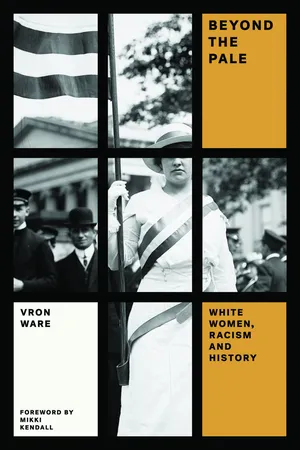
How have ideas about white women figured in the history of racism? Vron Ware argues that they have been central, and that feminism has largely developed as a political movement within racist societies. Dissecting the different meanings of femininity and womanhood, Beyond the Pale examines the political connections between black and white women, both in contemporary society and in history, including the anti-slavery movement. A major contribution to anti-racist work, Beyond the Pale confronts the historical meanings of whiteness as a way of overcoming the moralism that so often infuses anti-racist movements.
Trusted by 375,005 students
Access to over 1.5 million titles for a fair monthly price.
Study more efficiently using our study tools.
Information
Part One
The White Woman’s Burden?
Race and Gender in Historical Memory

Dak bungalow, Memsahib’s bed
There is a story circulating in London about a white English woman who decided to stay in New York as part of her vacation. Nervous about travelling as a single woman and alarmed at the prospect of being in a city renowned for violent crime, she booked into an expensive hotel where she thought she would be safe. One day she stepped into an empty elevator to go up to her room, and was startled when a tall black man accompanied by a large ferocious-looking dog came in and stood beside her just as the lift doors were closing. Since he was wearing shades she could not be sure whether he was looking at her, but she nearly leapt out of her skin when she heard his voice: ‘Lady, lie down’. Terrified, she moved to obey him, praying that someone would call the elevator and rescue her in time. But instead of touching her the man stepped back in confusion. ‘I was talking to my dog,’ he explained, almost as embarrassed as she was. Fortunately, the elevator had reached her floor and she was able to scramble out without further explanation. The following day, the English woman was due to leave the city. She went to check out of her hotel and was astonished to be told not only that her bill had already been paid but there was also a huge bunch of flowers waiting for her. There must be a mistake she told them, but the hotel official assured her that they were meant for her. She took the flowers and read the card: ‘Thank you for the most memorable event of my life, Lionel Ritchie.’
This is more or less the version of the story that I first heard, related by a reliable friend about a friend of a friend. The details made it sound plausible – the woman in question was a social worker in her early sixties who was travelling on her own for the first time. I was even told where she lived in London. I discussed the anecdote with another friend, who recounted it at a party, only to be told by another woman present that she had read a similar version in a book about urban myths. The name of the singer and the age of the woman varied, but the structure of the story remained basically the same, involving a white woman from England encountering a black man in New York.
Urban myths presumably circulate as long as they correspond to contemporary preoccupations and fears, allowing for different emphasis in the telling and retelling. This story turns on the white woman’s racist fantasies, but in the version that I first heard the listener was invited to sympathize or even identify with her up to the moment of her humiliation. The intimidating demeanour of the innocent black man is offset by his charm and generosity, which is in turn transformed by the knowledge that he is a rich and famous singer of romantic soul ballads, thus occupying an entirely different class position from the one the woman had supposed. His dog, a Dobermann pinscher, although first encountered as an extension of his masculinity, turns out to have been tamed and feminized by him. The location is significant because while it removes the object of the racist fantasy to a foreign city associated with black crime, the protagonist carried with her fears nurtured in her own society.
What makes this story work, enough to elevate it to the status of a myth whose origins are lost in the sands of time? Why is the woman white and the man black, and what is it about the way that racism works that makes the relationship between these two figures fraught with sexual and racial tension? This essay is an attempt to address these and other related questions and to dissect the imagery brought to life in this story from a feminist perspective. I shall argue that the mythic quality of this anecdote can only be fully understood in the light of the long histories first of slavery and then of colonialism which have produced ideologies about race, gender and class that continue to affect social relations between black and white, male and female, in post-industrial societies. I hope to demonstrate that the construction of white femininity – that is, the different ideas about what it means to be a white female – can play a pivotal role in negotiating and maintaining concepts of racial and cultural difference. This particular couplet figuring the vulnerable white woman and her fantasy of the aggressive black man represents one important facet of an ideological relationship, expressed most effectively in the politics of crime and public order. In this context, particular ideas about white and black femininity work against each other in relation to black and white masculinity to legitimate different types of power and domination which affect everyone. However, in other political arenas white femininity can take on altogether different meanings which contradict those I have already described; later in this section I explore contemporary debates in education to demonstrate some of the ways in which gender and race intersect to reinforce notions of cultural difference and cultural superiority.
White Woman as Victim
‘Eight years ago in a respectable street in Wolverhampton a house was sold to a negro. Now only one white (a woman old-age pensioner) lives there. This is her story …,’1 In 1968, Enoch Powell’s historic ‘Rivers of Blood’ speech gave new power to the image of the vulnerable, elderly, white woman, victimized and bullied by an alien people. Throughout the next two decades the picture of this woman, her face distorted by fear, continued to be one of the most potent symbols of British racism – a sign that the black presence in the inner cities was an unwanted intrusion on a sacred but fragile way of life.
Nearly fifteen years after Powell’s speech, a small unobtrusive-looking pamphlet was published by the Salisbury Group, which represented the so-called New Right, a political formation that emerged after the 1979 Tory election victory. Called The Old People of Lambeth, it was an illustration of the continuing resilience of this particular set of racist imagery.2 Interviews with elderly white men and women on subjects such as ‘crime’, ‘the police’, ‘immigration’ and ‘politics’ returned again and again to the same lament: that since the war these people had suffered a dramatic change in the quality of life, particularly since blacks had been allowed to come and terrorize them in their own neighbourhoods: ‘The native population of Lambeth feels little natural sympathy with the West Indian arrivals. Without having any arrogant or dogmatic theory of racial superiority, the old people of Lambeth can see with their own eyes that they are surrounded by people more primitive than they, who lack their respect for law and privacy.’ A truly English and harmonious way of life had apparently given way to a constant state of siege. ‘They are afraid all the time they are awake; and many of them cannot sleep because they are frightened.’ The final paragraph of the pamphlet stressed the patriotism of the old people interviewed, their devotion to the Royal Family, their memories of not one but both world wars, and their readiness to work, raise families and to obey the law. ‘And yet, without any provocation on their part, they find most of the things they value neglected or taken away. As one old man said simply, “It’s our country and our Queen. Why should we be afraid to go out?” ’
In both these examples of racist imagery the combination of old age and femininity works to convey the powerlessness and physical frailty of a white community threatened by the barbarism of the unwanted black ‘immigrants’ who neither understand nor have respect for the values of civilization. Both sets of images reinforce the idea that white people – the nation – share a consensus about a way of life which is threatened by close contact with outsiders. The language in which this type of racism is expressed is often infused with metaphors of rape, the assault of the helpless victim, the invasion of defenceless property, the ever-present threat of violence that intimidates the physically weak. In this discourse England reverts to being an island besieged by aliens and the violence begins at the point of immigration. When, for example, many families from the Indian subcontinent attempted to enter Britain before the new visa restrictions came into effect in November 1986, papers like the Sun, the Star and the Mail fell back on the same wartime analogies which had been evoked during previous immigration crises in the early 1960s: the situation at Heathrow airport was variously described as a siege or an invasion, with floods or hordes of immigrants trying to pour into the country on false pretences.
Where crime is concerned – particularly crimes involving violence – the racist vocabulary of the press is similarly precise. Words like ‘savage’, ‘monster’, ‘beast’, ‘fiend’, nearly always accompanied by photos, combine to evoke a particular response from the white reader. Brutal attacks on white women, old or young, which have been allegedly committed by a black man, often employ these epithets and visual images to suggest innate savagery and evil tendencies. The more horrific the incident, and the greater the violence inflicted on the woman or child, the more the reader is drawn into sharing a racist consensus about black men, and consequently black people generally. Crimes against black women or black children carried out by white men rarely receive much attention in the media, while violence allegedly inflicted on black women or children by black men is frequently relayed to the public as further proof of black deviancy. These kinds of images are further influenced by the wider political climate in which particular types of crime can become symbols of crime in general; if there is a heightened awareness of rape, child abuse or street robbery, for example, this will also affect the social meaning and implications of an individual incident. I am not disputing that such crimes take place, but emphasizing that in Britain today the race, gender and class of both the victims and the perpetrators are likely to become significant factors both in the way that crime is reported and in the manner in which it is handled throughout the legal institutions. In fact this would be true in almost every society that I can think of since the dynamics of race, class and gender are to be found everywhere. My concern here is to interrogate the significance attached to race and gender in an attempt to find the connections between racism and male dominance in the society in which I live.
Nor do I intend to suggest that ideas about women’s safety are derived purely from ideology without regard to women’s actual experience. It is worth looking in some detail at different interpretations of women’s vulnerability in relation to men. The threat to women’s safety stems from the idea that women are more likely to be victims of male aggression and less likely to be able to defend themselves. This is a complex subject which continues to provoke intense discussion among feminists. Women are told repeatedly from childhood by parents, school, the media and other influential sources that it is unsafe for them to be in certain places at certain times, unless they are accompanied by a man, despite the evidence that suggests that they are actually more at risk from violence in the home. While women deal with this threat to their safety in many different ways, often depending on their mobility, race, income, class, age, sexuality and other aspects of their personal experiences, surveys show that on the whole women are vastly more afraid than men to go out, particularly at night.3 Women’s ability to move around freely at all times is severely restricted by the knowledge that they might be risking their lives in doing so – and, if an attack does happen, be blamed for inviting it. This means that the majority of women are simply denied access to a range of activities which most men take for granted.
One of the problems in quantifying the actual threat to women’s safety in public places is that fear itself cannot be measured and is a factor in its own right, whether or not it corresponds to the likelihood of being attacked. Crime statistics, particularly relating to rape and street crime, play a significant role in increasing levels of fear, and they are frequently sensationalized by the media. In fact in this case statistical calculation is a poor guide because if women do not go out because they are scared, they are therefore less at risk from certain types of attack. The images of vulnerability and defencelessness involved in many discussions about women’s safety in the city often feed into racist assumptions about who are the victims and who are the perpetrators of crimes against women. Sensational and sometimes inaccurate reporting in the press has given the impression that areas where there are sizeable black populations are particularly dangerous for women, especially the elderly. That is not to say that crime does not happen there, but it is often represented in such a way that it confirms stereotypes of unruly black criminals preying on helpless white women.
One of the major connections between crime and public order is the struggle for control of public space. Throughout the 1980s racist ideology fixed the idea that the inner cities were unsafe because that was where most blacks lived, and the phrase ‘the inner city’ became shorthand for ‘the race problem’. This was particularly evident during the election coverage of 1987 when the expression was on almost every politician’s lips. Turning on the TV one night, we were treated to a wordless definition of ‘inner city’, expressed through images of Handsworth, an area of Birmingham associated with controversial policing practices and local resistance. Dramatic documentary footage showed buildings being set alight (blacks rioting) followed by a picture of an elderly white woman who had been beaten about the face (blacks mugging). Where the imagery of the decaying heart of the city suggests the breakdown of community life, the crime and lawlessness that appears to have taken its place demands tough action from the police to restore a sense of order. What I am interested in here is the way that certain ideas about white femininity work to legitimate that ‘tough action’ which can then lead to a greater repression of the population as a whole, regardless of race, gender or class.
A political broadcast for the Labour Party, made in 1986 at the height of a wave of public concern about law and order, demonstrated how an image of white female vulnerability could be used to convey a specific political agenda on crime and police protection. It provided an example of the way that racism can lurk like the proverbial mugger behind the murky shadows of political discourse without ever seeming to show its face. A young white woman – a girl, in fact, seen later (or is it earlier?) in school uniform in the bosom of her nuclear family outside their newly built home – walks hurriedly along a deserted street at night, passing under an unlit bridge. The sound of approaching footsteps, belonging unmistakably to a man, imply that she is being pursued. As the tension builds up, the girl passes a street sign which signifies that she is in southeast London. Just as you think that she is about to be attacked, she runs straight into the arms of a man. (We see his legs before we see his face.) Like her we almost cry with relief, he is a policeman, a friendly, cheery sort who will take her back to the station for a cup of tea while he rings her parents. Or perhaps he will escort her home, telling her mum and dad t...
Table of contents
- Cover
- Title Page
- Copyright
- Dedication
- Contents
- Foreword by Mikki Kendall
- Acknowledgements
- Introduction
- Part One: The White Woman’s Burden?: Race and Gender in Historical Memory
- Part Two: An Abhorrence of Slavery: Subjection and Subjectivity in Abolitionist Politics
- Part Three: Britannia’s Other Daughters: Feminism in the Age of Imperialism
- Part Four: ‘To Make the Facts Known’: Racial Terror and the Construction of White Femininity
- Part Five: Taking the Veil: Towards a Partnership for Change
Frequently asked questions
Yes, you can cancel anytime from the Subscription tab in your account settings on the Perlego website. Your subscription will stay active until the end of your current billing period. Learn how to cancel your subscription
No, books cannot be downloaded as external files, such as PDFs, for use outside of Perlego. However, you can download books within the Perlego app for offline reading on mobile or tablet. Learn how to download books offline
Perlego offers two plans: Essential and Complete
- Essential is ideal for learners and professionals who enjoy exploring a wide range of subjects. Access the Essential Library with 800,000+ trusted titles and best-sellers across business, personal growth, and the humanities. Includes unlimited reading time and Standard Read Aloud voice.
- Complete: Perfect for advanced learners and researchers needing full, unrestricted access. Unlock 1.5M+ books across hundreds of subjects, including academic and specialized titles. The Complete Plan also includes advanced features like Premium Read Aloud and Research Assistant.
We are an online textbook subscription service, where you can get access to an entire online library for less than the price of a single book per month. With over 1.5 million books across 990+ topics, we’ve got you covered! Learn about our mission
Look out for the read-aloud symbol on your next book to see if you can listen to it. The read-aloud tool reads text aloud for you, highlighting the text as it is being read. You can pause it, speed it up and slow it down. Learn more about Read Aloud
Yes! You can use the Perlego app on both iOS and Android devices to read anytime, anywhere — even offline. Perfect for commutes or when you’re on the go.
Please note we cannot support devices running on iOS 13 and Android 7 or earlier. Learn more about using the app
Please note we cannot support devices running on iOS 13 and Android 7 or earlier. Learn more about using the app
Yes, you can access Beyond the Pale by Vron Ware in PDF and/or ePUB format, as well as other popular books in Social Sciences & Social History. We have over 1.5 million books available in our catalogue for you to explore.