eBook - ePub
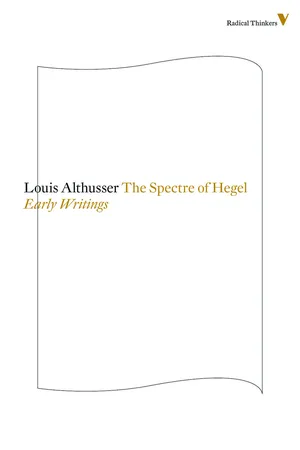
The Spectre of Hegel
Early Writings
- 272 pages
- English
- ePUB (mobile friendly)
- Available on iOS & Android
eBook - ePub
The Spectre of Hegel
Early Writings
About this book
Louis Althusser is remembered today as the scourge of humanist Marxism, but that was his later incarnation, an identity formed by years grappling with the intellectual inheritance of Hegel and Catholicism. The Spectre of Hegel collects the writings of the young Althusser, before his final epistemological break with the philosopher's work in 1953. The Spectre of Hegel gives a unique insight into Althusser's engagement with a philosophy he would later renounce.
Information
Topic
PhilosophySubtopic
Philosophy History & Theory1
The International of Decent Feelings (1946)
All of us have taken André Malraux’s words to heart: ‘At the end of the last century, Nietzsche proclaimed the death of God. Now it is for us to ask ourselves whether, today, man is not dead.’1 I am quoting from memory; those were perhaps not his exact words. I will not forget the emptiness we felt within us then. The crowd watching from the steps of the Sorbonne as this tragic actor2 struggled in solitude suddenly saw that it was itself this solitude, and that in this desert of the conscience* a small, gesticulating man was wrestling with the death of man. ‘We must reconstruct an image of man that man can recognize as his own.’ Malraux’s pathos lay, not in the death whose imminence he proclaimed, but in this desperate consciousness of imminent death haunting someone still alive. Even those who did not share his fears could not help but feel a profound apprehensiveness: one does not watch a man treat his destiny as an enemy with impunity.
But in this world that provides us shelter, it is becoming a little clearer every day that men are, in ever increasing numbers, breaking the ties which silently bound them to their fate, and cursing it. Two years after the most atrocious of wars, on this earth covered with peace and ruins, in the mists of the winter that is drawing nigh, silent assemblies are taking place. The murmurs stifled by the clamour of arms, the protests that went unheard amidst the din of war – we can hear them now that calm has been restored. Remarkably, it is from the old lands of Europe that the plaints of peacetime arise. To the east, the. immense Russian people has gone back to work, and is reconciling itself to history through work. ‘Anguish is a bourgeois state of mind. We are rebuilding’ (Ehrenburg).3 To the west, America, intact, counts its dead and its victories, tests its future strength in the air and on the seas, takes up its place in the world as it settles into its future: the American century lies before it, stretching outward to the horizon, like a long summer holiday: ‘our destiny is to be free Americans.’ To be sure, the optimism of effort and freedom continues to mean something to the French and British, most of whom seek in it the justification4 for the hard life they are leading.5 Yet it is in the midst of the ‘Western’ ruins that men are beginning to see that the war waged with arms has not brought the war for souls to an end, that the peace is as murderous as the war, and still more terrible; for now, in peacetime, murder no longer has the clamour of arms for an excuse.
In France we have Malraux, whose tragic discourse has already been mentioned; we have the Camus† of the articles in Combat,6 in which fate seizes men as they murder and releases them only in death; we have Gabriel Marcel, bitterly opposed to the modernity of the world and its ‘techniques of debasement’;7 we have the movement called the ‘Human Front’,8 which thinks it can avert the fatality of war by conducting an international moral campaign; we have examples of commercially minded agitation, like the issue of Franchise about Le Temps des assassins.9 In England, Koestler10 denounces the way totalitarian regimes enslave men, feeding his contemporaries’ resentment of their history with novels. The extraordinary success of his work proves11 that the curses of these modern prophets are finding a broad public response. And certain echoes from Germany give us reason to believe that the defeated ask nothing better than to join the voice of their all too untroubled conscience to that of the victors’ bad conscience – that they too are ready to curse the recent peace and conclude a holy alliance of protest against it. We must ask ourselves what this alliance really signifies. For we are confronted with a phenomenon that is international in scope, and with a diffuse ideology which, though it has not yet been precisely defined, is capable of assuming a certain organizational form: it is said that Camus envisages creating protest groups bent on denouncing crimes against humanity before the conscience of the world, while the ‘Human Front’ is contemplating the use of cinema or radio12 to induce humanity to abandon war. One senses, in these attempts, a mentality in search of itself, an intention13 eager to embody itself in concrete form, an ideology seeking to define itself, entrench itself, and also furnish itself with means of action. If this mentality is international, and in the process of taking institutional form, then a new ‘International’ is in the making. There is perhaps something to be gained from trying to discover what it conceals.
This ‘International’ of humane protest against destiny rests on a growing awareness that humanity is threatened, and has become, in the face of the threat, a kind of ‘proletariat’ of terror. Whereas the labouring proletariat is defined by sociological, economic, and historical conditions, this latter-day ‘proletariat’ would seem to be defined by a psychological state: intimidation and fear. And, just as there is proletarian equality in the poverty and alienation of the workers, so too this implicit proletariat is said to experience equality, but in death14 and suffering. According to our authors, the latest inventions, whether in the domain of atoms or torture, are now and will henceforth be the human condition in which all men are equal. This is a de facto equality, which governs all our acts, in which we live and move unawares, just as a man lives and moves unawares in gravity. And, just as the unity of the proletariat existed before Marx, but only became consciousness [sic]15 with Marx, so this unity in terror of the humanity-proletariat exists for us in consciousness thanks only to the revelations of our modern prophets. In their appeals, we hear the same historical pathos (they, at any rate, think we do) that transpires in Marx’ and Engels’ famous slogans, the pathos common to all appeals to conscience (this conscience which, as Malraux shows, is our sole glory and sole good in the ‘night’ in which we are plunged); we sense the tragic overtones of the words in which men are summoned to be born to the truth, to come to know their condition and master it. Man, know thyself: your condition is death (Malraux), is to be a victim or an executioner (Camus), is to draw steadily closer to the world of prisons and torture (Koestler), or to nuclear war, your total destruction, or to the end of what makes you man and is more than your life: the gaze of your brothers, your freedom, the very struggle for freedom. Humanity, says Camus, is racing towards the abyss like a train hurtling ahead at full speed, while the passengers pursue their petty quarrels. We are madmen grappling on the brink of the abyss, unaware that death has already reconciled us to one another. What sensible man, seeing humanity about to perish, can still put faith in class struggle and revolution? What good is it for an activist in a modern workers’ party to know that he is threatened by the bourgeoisie, if he does not realize that he is threatened by death as a man before being threatened by servitude as a worker, if he does not realize that this threat overshadows all others, and that the proletariat of the class struggle is an historical diversion? We have only one recourse left, they bluntly tell us, in the face of catastrophe: an holy alliance against destiny. Let men learn, if there is still time, that the proletariat of class struggle can only divide them, and that they are already united unawares in the proletariat of fear or the bomb, of terror and death, in the proletariat of the human condition.
The old proletariat having been ‘reduced’ by the new, we need to examine the essential nature of the latter. What is the ‘proletariat’ of the human condition? Camus says in Combat16 that the condition of modern man is fear, and, in a certain sense, this is incontestable. It is of the order of everyday experience; and, whatever the reason, that humanity currently lives in fear may be regarded as an historical fact. But it is also noteworthy that the causes of this authentic phenomenon are hard to identify: if this fear strikes observers because it so plainly exists, it also disconcerts them by virtue of a kind of inherent irrationality. There is a paradox to fear: if human reason has no control over it, it offers little resistance to the reason that examines it and can be defined without‡ difficulty.17
Let us note that fear is, first of all, a psychological context of a very general sort. It is neither inscribed in law codes nor entrenched in institutions; it does not even haunt, as fear, the domains over which it holds sway – the prisons, the death camps. Fear haunts the rich man and the poor, the free man and the prisoner, it holds the soul of every man in its grip, whatever his legal or social status, from the moment he looks his destiny in the face and sees that his destiny awaits him. There are powerful reflections in Bossuet on the proletariat of death, whom the Middle Ages brought together in the stone of the cathedrals and whom history reconciled in the brotherhood of dust. What unites men is not today, where the rich are not attired like the poor, but tomorrow, where they will lie down together in the same death, or be subjected to the same torture. What unites them is the fact that they await a common fate which will make them all equals. The proletariat of the human condition is a proletariat of the morrow. We could quibble with words here, and say that, at this level of abstraction, if human unity is defined by the imminence of a common destiny, it is hard to see why the destiny of daily routine should not also be taken into account: since it ‘rains on the good and the evil alike’,18 there is also a proletariat of the rain and another of good weather, and, since the sun shines upon all, a proletariat of daytime and another of night, a proletariat of Sunday, and Monday, and Tuesday – but we will not play the Preacher’s§ game any longer.19 If fear were in reality nothing but a psychological context, an expectation with no object, it would be an abstraction with no escape. But fear is more than a context; it is also a psychological reaction in the face of a certain real threat. Here the object of fear draws closer to it – and the paradox of fear bursts into view: however intense the obsession, the object of fear always lies outside it, and ahead of it. It is this which distinguishes the labouring proletariat from the proletariat of fear. The worker is not a proletarian by virtue of what-will-happen-to-him-tomorrow, but by virtue of what happens to him every minute of the day. As Camus said so well, not long ago, ‘There is no tomorrow’; the labouring proletariat is an everyday reality, like our daily bread. The proletariat is that which has no future, not even the future of fear: poverty, in the proletariat, is not the fear of poverty, it is an actual presence that never disappears, it is on the walls, on the table, in the sheets, in the air the worker breathes and the water he drinks, in the money that he makes and that is made from his poverty, in the very gestures that conjure fear; proletarians are in poverty the way one is in the night, the way certain sick people are in their suffering, which is so closely bound up with them that it becomes part of their nature. The man who is afraid lives with his back to a wall,20 says Camus, but we do not want to live like dogs. The wall is a horizon, the only horizon, but at least there is a horizon.21 The fearful man lives with his back to the wall; the proletarian is walled in. Thus he does not see his destiny before him, he does not take the corning war or the bombs that chum the seas at the other end of the world for signs of Fatality, he does not fear the peace he has conquered; his condition is his labour, his needs, his daily struggle. He knows that tomorrow will be a today, and that the proletariat of the morrow is, today, a smoke-screen for the proletariat of every day.
Let us add that fear and its object are not things of the same kind, which suggests that a dialectic of fear is inconceivable. The fearful man is at one with his fear, but the object of his fear is not present to him the way his fear is: I am not afraid of another as other, I am afraid of the destiny that awaits me in the other. I am not afraid of the war as war, but of being the wounded man, the invalid, the man in pain the war will make me. The war does not really enter into my fear, in which I find only my body mutilated by war. The true object of my fear is myself imagined as suffering pain at some point in the future; that is, not another, but I myself, and not a real, but an imaginary I. The content of fear is something imaginary, non-existent: that is why, unlike the proletarian, who finds in the proletariat the means of emancipating himself from the proletariat, the man who is afraid cannot convert the object of his fear into the abolition of his fear.22 Prisoners can escape, because theirs is an objective condition, because the bars are real; real bars can be smashed: freedom now! The man who is afraid is a prisoner without a prison and without bars; he is his own prisoner, and threats stand guard in his soul. This is an adventure from which there is no escape, because there is no fleeing a prison without bars: fear is captivity without possibility of flight.
Servitude, however, does have a content: the master and labour. Whereas the object of fear is merely imaginary, the workers’ condition involves appropriating, amidst the domination of the capitalist world, a real object that grounds the real dialectic of proletarian emancipation and provides the means of achieving it. In other words, servitude can transform itself into freedom by reflecting on its own content and transcending its content through action. There can be no emancipation from fear through the consciousness of fear.23 Servitude, in contrast, is...
Table of contents
- Cover
- Title Page
- Copyright
- Contents
- Translator’s Note
- Introduction
- Preface
- 1 The International of Decent Feelings (1946)
- 2 On Content in the Thought of G. W. F. Hegel (1947)
- 3 Man, That Night (1947)
- 4 The Return to Hegel: The Latest Word in Academic Revisionism (1950)
- 5 A Matter of Fact (1949)
- 6 Letter to Jean Lacroix (1949–1950)
- 7 On Conjugal Obscenity (1951)
- Appendix: On Marxism (1953)
- Notes
Trusted by 375,005 students
Access to over 1.5 million titles for a fair monthly price.
Study more efficiently using our study tools.
Frequently asked questions
Yes, you can cancel anytime from the Subscription tab in your account settings on the Perlego website. Your subscription will stay active until the end of your current billing period. Learn how to cancel your subscription
No, books cannot be downloaded as external files, such as PDFs, for use outside of Perlego. However, you can download books within the Perlego app for offline reading on mobile or tablet. Learn how to download books offline
Perlego offers two plans: Essential and Complete
- Essential is ideal for learners and professionals who enjoy exploring a wide range of subjects. Access the Essential Library with 800,000+ trusted titles and best-sellers across business, personal growth, and the humanities. Includes unlimited reading time and Standard Read Aloud voice.
- Complete: Perfect for advanced learners and researchers needing full, unrestricted access. Unlock 1.5M+ books across hundreds of subjects, including academic and specialized titles. The Complete Plan also includes advanced features like Premium Read Aloud and Research Assistant.
We are an online textbook subscription service, where you can get access to an entire online library for less than the price of a single book per month. With over 1.5 million books across 990+ topics, we’ve got you covered! Learn about our mission
Look out for the read-aloud symbol on your next book to see if you can listen to it. The read-aloud tool reads text aloud for you, highlighting the text as it is being read. You can pause it, speed it up and slow it down. Learn more about Read Aloud
Yes! You can use the Perlego app on both iOS and Android devices to read anytime, anywhere — even offline. Perfect for commutes or when you’re on the go.
Please note we cannot support devices running on iOS 13 and Android 7 or earlier. Learn more about using the app
Please note we cannot support devices running on iOS 13 and Android 7 or earlier. Learn more about using the app
Yes, you can access The Spectre of Hegel by François Matheron,Louis Althusser, François Matheron, G. M. Goshgarian in PDF and/or ePUB format, as well as other popular books in Philosophy & Philosophy History & Theory. We have over 1.5 million books available in our catalogue for you to explore.