On March 16, 1998, the CIA's Inspector General, Fred Hitz, finally let the cat out of the bag in an aside at a Congressional Hearing. Hitz told the US Reps that the CIA had maintained relationships with companies and individuals the Agency knew to be involved in the drug business. Even more astonishingly, Hitz revealed that back in 1982 the CIA had requested and received from Reagan's Justice Department clearance not to report any knowledge it might have of drug-dealing by CIA assets.
With these two admisstions, Hitz definitively sank decades of CIA denials, many of them under oath to Congress. Hitz's admissions also made fools of some of the most prominent names in US journalism, and vindicated investigators and critics of the Agency, ranging from Al McCoy to Senator John Kerry.
The involvement of the CIA with drug traffickers is a story that has slouched into the limelight every decade or so since the creation of the Agency. Most recently, in 1996, the San Jose Mercury News published a sensational series on the topic, "Dark Alliance", and then helped destroy its own reporter, Gary Webb.
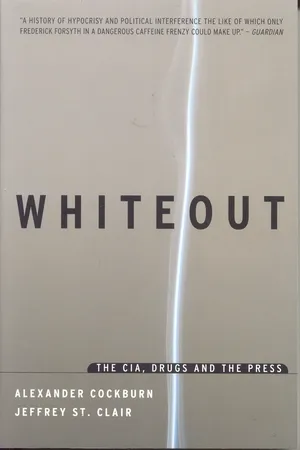
In Whiteout, Alexander Cockburn and Jeffrey St. Clair finally put the whole story together from the earliest days, when the CIA's institutional ancestors, the OSS and the Office of Naval Intelligence, cut a deal with America's premier gangster and drug trafficker, Lucky Luciano.
They show that many of even the most seemingly outlandish charges leveled against the Agency have basis in truth. After the San Jose Mercury News series, for example, outraged black communities charged that the CIA had undertaken a program, stretching across many years, of experiments on minorities. Cockburn and St. Clair show how the CIA imported Nazi scientists straight from their labs at Dachau and Buchenwald and set them to work developing chemical and biological weapons, tested on black Americans, some of them in mental hospitals.
Cockburn and St. Clair show how the CIA's complicity with drug-dealing criminal gangs was part and parcel of its attacks on labor organizers, whether on the docks of New York, or of Marseilles and Shanghai. They trace how the Cold War and counterinsurgency led to an alliance between the Agency and the vilest of war criminals such s Klaus Barbie, or fanatic heroin traders like the mujahed in in Afghanistan.
Whiteout is a thrilling history that stretches from Sicily in 1944 to the killing fields of South-East Asia, to CIA safe houses in Greenwich Village and San Francisco where CIA men watched Agency-paid prostitutes feed LSD to unsuspecting clients. We meet Oliver North as he plotted with Manuel Noriega and Central American gangsters. We travel to little-known airports in Costa Rica and Arkansas. We hear from drug pilots and accountants from the Medillin Cocaine Cartel. We learn of DEA agents whose careers were ruined because they tried to tell the truth.
The CIA, drugs ... and the press. Cockburn and St. Clair dissect the shameful way many American journalists have not only turned a blind eye on the Agency's misdeeds, but helped plunge the knife into those who told the real story.
Here at last is the full saga. Fact-packed and fast-paced, Whiteout is a richly detailed excavation of the CIA's dirtiest secrets. For all who want to know the truth about the Agency this is the book to start with.
- 408 pages
- English
- ePUB (mobile friendly)
- Available on iOS & Android
eBook - ePub
About this book
Information
1
Webb’s Big Story
Sunday, August 18, 1996, was not a major news day for most American newspapers. The big story of the hour was the preview of the Democratic convention in Chicago.
About 2,500 miles west of Chicago lies Silicon Valley. Its big newspaper is the San Jose Mercury News, which has a solid reputation as a good regional paper. Like other Knight-Ridder properties, such as the Philadelphia Inquirer and the Detroit Free Press, it has a middle-of-the-road political cast slightly tilted to the Democratic side.
As the citizens of Santa Clara County browsed through their newspaper that Sunday morning, many of them surely stopped at the first article of a three-part series, under the slightly sinister title “Dark Alliance,” subtitled “The Story Behind the Crack Explosion.” The words were superimposed on a murky picture of a black man smoking a crack pipe, said image overlaid on the seal of the Central Intelligence Agency. The first day’s headline was “America’s Crack Plague Has Roots in Nicaraguan War,” just above the byline of the author of the series, a reporter in the Mercury News Sacramento bureau named Gary Webb.
Within a couple of weeks, the story that Webb laid across August 18, 19 and 20 in the San Jose Mercury News would convulse black America and prompt the Central Intelligence Agency first to furious denials and then to one of the most ruthless campaigns of vilification of a journalist since the Agency went after Seymour Hersh in the mid 1970s. Within three weeks, both the Justice Department and the CIA bowed to fierce demands by California Senator Barbara Boxer and Los Angeles Representative Maxine Waters for thorough a investigation. By mid-November, a crowd of 1,500 locals in Waters’s own district in South Central Los Angeles would be giving CIA director John Deutch one of the hardest evenings of his life. In terms of public unease about the secret activities of the US government, Webb’s series was the most significant event since the Iran/Contra affair nearly blew Ronald Reagan out of the water.
From the savage assaults on Webb by other members of his profession, those unfamiliar with the series might have assumed that Webb had made a series of wild and unsubstantiated charges, long on dramatic speculation and short on specific data or sourcing. In fact, Webb’s series was succinct and narrowly focused.
Webb stuck closely to a single story line: how a group of Nicaraguan exiles set up a cocaine ring in California, establishing ties with the black street gangs of South Central Los Angeles who manufactured crack out of shipments of powder cocaine. Webb then charted how much of the profits made by the Nicaraguan exiles had been funneled back to the Contra army – created in the late 1970s by the Central Intelligence Agency, with the mission of sabotaging the Sandinista revolution that had evicted Anastasio Somoza and his corrupt clique in 1979.
The very first paragraph of the series neatly summed up the theme. It was, as they say in the business, a strong lead, but a justified one. “For the better part of a decade, a San Francisco Bay Area drug ring sold tons of cocaine to the Crips and Bloods street gangs of Los Angeles and funneled millions in drug profits to a Latin American guerrilla army run by the CIA.” That San Francisco drug ring was headed by a Nicaraguan exile named Norwin Meneses Cantarero, who served “as the head of security and intelligence” for the leading organization in the Contra coalition, the FDN or Fuerza Democrático Nicaragüense. The FDN was headed by Enrique Bermúdez and Adolfo Calero, who had been installed in those positions under the oversight of the CIA. Meneses came from a family intimately linked to the Somoza dictatorship. One brother had been chief of police in Managua. Two other brothers were generals in the force most loyal to Somoza, the National Guard. While his brothers were assisting Somoza in the political dictatorship that darkened Nicaragua for many decades, Norwin Meneses applied his energies mostly to straightforwardly criminal enterprises in the civil sector. He ran a car theft ring and was also one of the top drug traffickers in Nicaragua, where he was known as El Rey del Drogas (the king of drugs). Meneses worked with the approval of the Somoza clan, which duly received its rake-off.
In 1977, Norwin Meneses felt it necessary to register his disquiet at a Nicaraguan customs probe into his smuggling of high-end North American cars from the US into Nicaragua. The Meneses gang murdered the chief of customs. Owing to Norwin’s powerful family, the case was never prosecuted.
The US Drug Enforcement Agency and other agencies had been keeping files on Meneses since at least 1974. Yet he was granted political refugee status in July 1979, when he and other members of Somoza’s elite fled to the US. Meneses landed in San Francisco as part of what became known locally as the Nicaraguan “gold rush.” Here he lost no time in rebuilding his criminal enterprises in stolen cars and drugs.
Meneses’s contact in Los Angeles was another Nicaraguan exile, Oscar Danilo Blandón. Blandón had left Managua in June 1979, a month before Meneses, on the eve of Somoza’s downfall. The son of a Managua slumlord, Blandón had earned a master’s degree in marketing from the University of Bogotá in Colombia and had headed Somoza’s agricultural export program. Agricultural exports were an important component of the country’s mainly ranching- and coffee-based economy, with the Somoza family itself owning no less than a quarter of the nation’s agricultural land.
In his position as head of the export program, Blandón had developed close ties to the US Department of Commerce and the US State Department. He secured $27 million in USAID funding and was well known to the US military and the Central Intelligence Agency, both of which had a commanding presence in Somoza’s Nicaragua. (Somoza had sent his officer corps for training in the US, and the CIA station chief was the most powerful foreigner in Managua.)
Blandón’s wife, Chepita, also came from a powerful clan, the Murillo family. One of her relatives was the mayor of Managua. Like many other Somoza supporters, both the Blandón and Murillo families lost most of their fortunes in the 1979 revolution and burned with the desire to evict the popular government headed by the Sandinista commanders.
Blandón and his wife settled in Los Angeles, where he started a usedcar business. He also began to involve himself in Nicaraguan émigré politics. Testifying on February 3, 1994 as a government witness before a federal grand jury investigating the Meneses family’s drug ring in San Francisco, Blandón said he drove to San Francisco for several meetings with Norwin Meneses “to start the movement, the Contra revolution.” Blandón had known the Meneses family in Nicaragua. In fact, Blandón said, his mother shared Meneses’s last name of Cantarero, “so we are related.” He said he and Meneses “met with the politics people,” but couldn’t find a way to raise big sums of cash.
In the spring of 1981, Blandón got a phone call from an old friend and business associate from Managua named Donald Barrios. Barrios, then living in Miami, was moving in high-level Nicaraguan émigré circles. This group included General Gustavo Medina, once an important intelligence officer in Somoza’s National Guard, a position in which he had long-standing ties to the CIA. Blandón later testified that Barrios “started telling me we had to raise some money and send it to Honduras.” Barrios instructed Blandón to go to Los Angeles International Airport to meet Meneses. Blandón and Meneses then flew to Honduras and, in the capital city of Tegucigalpa, met with Enrique Bermúdez, former National Guardsman and military commander of the FDN.
In Somoza’s final days, President Jimmy Carter had made a last-ditch effort to maintain a US-backed regime in Nicaragua even if Somoza should be forced to quit. The plan was to preserve the bloodthirsty National Guard as the custodian of US interests. When this plan failed and the Sandinistas swept to power, Carter ordered the initial organization of what later became known as the Contras, operating out of Honduras. The CIA mustered Argentinian officers fresh from their own death squad campaigns, and these men began to organize the exiled National Guardsmen into a military force.
Bermúdez was key to this CIA-organized operation from the start. He had been a colonel in the National Guard, had trained at the US National Defense College outside Washington, D.C., and had served from 1976 to July 1979 as Somoza’s military attaché in Washington. Furnished with $300,000 in CIA money, Bermúdez took command of the fledgling Contra force in Honduras. In the summer of 1981, at the dawn of the Reagan administration, Bermúdez held a press conference in Honduras. In language drafted by his CIA handlers, Bermúdez announced the formation of the FDN and his own position as commander of its military wing. The CIA script later installed Adolfo Calero, formerly the Coca-Cola concessionaire in Managua, as the FDN’s civilian head, operating mainly out of the United States, where he was under tight CIA supervision.
Blandón and Meneses arrived to meet Bermúdez at a moment of financial strain for the Contra army, then in formation. The CIA had provided seed money, but it wasn’t until November 23, 1981 that Reagan approved National Security Directive 17, which provided a budget of $19.3 million for the Contras, via the CIA. The Contras, Bermúdez said, needed money urgently, and, Blandón later testified to a US federal grand jury, it was at this meeting that the need for drug money to finance the Contras was proposed. “There’s a saying,” Blandón testified, “that ‘the ends justify the means.’ And that’s what Mr. Bermúdez told us in Honduras.”
Bermúdez was not repelled by the moral implications of drug smuggling. In fact, evidence gathered during congressional hearings in the mid-1980s suggests that Bermúdez himself had previously had a hand in the drug trade. “Bermúdez was the target of a government-sponsored drug sting operation,” said Senator John Kerry, who chaired a committee that investigated charges of Contra cocaine smuggling. “He has been involved in drug running.” Kerry charged that the CIA had protected Bermúdez from arrest. “The law enforcement officials know that the sting was called back in the interest of protecting the Contras,” Kerry concluded.
Back in San Francisco, Meneses began educating Blandón, the graduate in marketing, on the finer points of cocaine wholesaling. Trained in accountancy, Blandón did some work on Meneses’s books and rapidly became aware of the substantial scale of his cocaine operation. In 1981 alone, Blandón later testified, the Meneses ring moved 900 kilos of cocaine. At that time the wholesale price of a kilo of cocaine was $50,000. The cocaine was coming from Colombia via Mexico and Miami and then to the Bay Area, where it was stashed in about a dozen warehouses. Meneses was also keeping cocaine at the house of his mistress, Blanca Margarita Castaño, who lived near the old Cow Palace in the Hunters Point area. Eventually Meneses’s romantic complications prompted him to relocate his wife and young children to Los Angeles, with Mrs. Meneses ensconced in a silk-screening business under the eye of Blandón, who also set up a restaurant for Mrs. Meneses called Chickalina. Both the silk-screen shop and the restaurant became fronts for the drug business. As Blandón put it, “It was marketing, okay? Marketing.”
As a cocaine wholesaler in Los Angeles, Blandón got off to a slow start. He’d pick up a couple of kilos from Meneses, along with a list of local buyers, and he’d do the rounds in his white Toyota. But business remained static until he made a fateful contact with a young black fellow living in South Central named Rick Ross. Ross was born in Troup, Texas and as a young child moved to Los Angeles with his mother. He’d shown promise as a tennis player in high school and had set his sights on a college scholarship, when his coach found he could neither read nor write and dropped him. Ross went to Los Angeles Trade Technical College, was number three on the tennis team, and entered a course in bookbinding. To make some money he started selling stolen car parts, was arrested, and had to quit school.
Ross first heard about cocaine, at the time a middle-class drug, from a college friend, and it wasn’t long before he made a connection with a Nicaraguan dealer named Henry Corrales. Corrales gave Ross a good price, and he was able to make a decent profit in reselling to the Crips gang in South Central and Compton.
As we shall see, the economics of cocaine became a bitter issue in the uproar over Webb’s series. Was it true that the cocaine prices set by the Nicaraguans rendered the drug affordable to poor people for the first time? Arguably, this was the case – and indeed there is more evidence to substantiate such a thesis than Webb was able to offer in his tightly edited series. Cheap cocaine began to appear in South Central Los Angeles in early 1982. Ross got it from Corrales, who worked for Meneses and Blandón, and it wasn’t long before Ross went directly to Blandón.
As Ross later told Webb, the prices offered by Blandón gave him command of the Los Angeles market. He was buying his cocaine supplies at sometimes $10,000 less per kilo than the going rate. “It was unreal,” Ross remembered. “We were just wiping everyone out.” His connections to the Bloods and Crips street gangs solved the distribution problems that had previously beleaguered Blandón. By 1983, Ross – now known as “Freeway Ricky” – was buying over a 100 kilos of cocaine a week and selling as much as $3 million worth of crack a day.
Drugs weren’t the only commodity Blandón was selling to Ross. The young entrepreneur was also receiving from the Nicaraguan a steady stream of weapons and surveillance equipment, including Uzi submachine guns, semi-automatic handguns, miniature videocameras, recording equipment, police scanners and Colt AR-15 assault rifles. Ross told Webb that Blandón even tried to sell his partner a grenade launcher.
Blandón’s source for this equipment was a man named Ronald J. Lister. Lister, who figures prominently in the story, was a former Laguna Beach police detective who at that time was running two security firms – Mundy Security and Pyramid International Security Consultants. Blandón testified at Rick Ross’s trial in March 1996 that Lister would attend meetings of Contra supporters in Southern California to demonstrate his arsenal. Lister had worked as an informant for the DEA and FBI, and boasted of his ties to the CIA during the 1980s, when the Reagan administration was waging war in Central America.
Business was indeed booming. In 1981 Meneses had, according to Blandón’s reading of his account books, been moving 900 kilos a year. Two years later the numbers had surged to around 5,000 kilos a year – and the latter figure represents just the amount Blandón’s LA operation was handling. Ross was a brilliant businessman. His greatest coup was to recognize the potential in recent technological innovations for the mass marketing of cocaine. Ross didn’t invent the process whereby powder cocaine was converted into the “rocks” of crack that could be sold at affordable street prices; crack had first appeared in poor city neighborhoods on the West Coast in 1979. But Ross was the first to take full advantage. Crack could be bought for $4 to $5 a hit. It gave an intense, although brief, high, and was highly addictive. Consequently, as the furious black reaction to the Webb series tells us, crack engendered social disaster in neighborhoods such as South Central. Families were ravaged by addiction. Addicts stole and robbed to buy the next hit. Gangs fought bloody battles for control of turf. The plague elicited a savage response from the state. Prison sentences were a hundred times more severe for crack-related offenses than for powder cocaine.
By 1985, Ross and his affiliates in the street gangs had begun exporting their crack operation to what the DEA reckoned to be at least a dozen other cities. Obviously, the sums accruing to Danilo Blandón in the drug trade were enormous, and he testified at Ross’s trial that “whatever we were running in LA, the profit was going to the Contra revolution.” Duane “Dewey” Clarridge, the CIA officer in charge of covert operations in Latin America, has denied, both in the press and in his memoir, allegations that the CIA would have sanctioned or turned a blind eye to Contra drug shipments for funding reasons. The CIA’s Contra operation, said Clarridge, “was funded by the US government. There was enough money to fund the operation. We didn’t need, and neither did the Contras need the money from anybody else.”
But from the beginning, Clarridge’s plans for the Contras were much more ambitious than the initial scheme of the Reagan administration, which was to use them as part of an effort to seal off Nicaragua and try to stop it from aiding guerrilla struggles in neighboring countries. Clarridge wanted a covert war. In the summer of 1981, a week after becoming head of the CIA’s Latin American operations, he took his recommendations to CIA chief William Casey: “My plan was simple. 1. Take the...
Table of contents
- Cover
- Title Page
- Copyright
- Preface
- Contents
- 1. Webb’s Big Story
- 2. Counterattack
- 3. The History of “Black Paranoia”
- 4. Introducing the CIA
- 5. Lucky’s Break
- 6. Paperclip: Nazi Science Heads West
- 7. Klaus Barbie and the Cocaine Coup
- 8. Dr. Gottlieb’s House of Horrors
- 9. The US Opium Wars: China, Burma and the CIA
- 10. Armies and Addicts: Vietnam and Laos
- 11. Making Afghanistan Safe for Opium
- 12. The CIA, Drugs and Central America
- 13. The Arkansas Connection: Mena
- 14. The Hidden Life of Free Trade: Mexico
- 15. The Uncover-up
Trusted by 375,005 students
Access to over 1.5 million titles for a fair monthly price.
Study more efficiently using our study tools.
Frequently asked questions
Yes, you can cancel anytime from the Subscription tab in your account settings on the Perlego website. Your subscription will stay active until the end of your current billing period. Learn how to cancel your subscription
No, books cannot be downloaded as external files, such as PDFs, for use outside of Perlego. However, you can download books within the Perlego app for offline reading on mobile or tablet. Learn how to download books offline
Perlego offers two plans: Essential and Complete
- Essential is ideal for learners and professionals who enjoy exploring a wide range of subjects. Access the Essential Library with 800,000+ trusted titles and best-sellers across business, personal growth, and the humanities. Includes unlimited reading time and Standard Read Aloud voice.
- Complete: Perfect for advanced learners and researchers needing full, unrestricted access. Unlock 1.5M+ books across hundreds of subjects, including academic and specialized titles. The Complete Plan also includes advanced features like Premium Read Aloud and Research Assistant.
We are an online textbook subscription service, where you can get access to an entire online library for less than the price of a single book per month. With over 1.5 million books across 990+ topics, we’ve got you covered! Learn about our mission
Look out for the read-aloud symbol on your next book to see if you can listen to it. The read-aloud tool reads text aloud for you, highlighting the text as it is being read. You can pause it, speed it up and slow it down. Learn more about Read Aloud
Yes! You can use the Perlego app on both iOS and Android devices to read anytime, anywhere — even offline. Perfect for commutes or when you’re on the go.
Please note we cannot support devices running on iOS 13 and Android 7 or earlier. Learn more about using the app
Please note we cannot support devices running on iOS 13 and Android 7 or earlier. Learn more about using the app
Yes, you can access Whiteout by Alexander Cockburn,Jeffrey St. Clair in PDF and/or ePUB format, as well as other popular books in Politics & International Relations & Intelligence & Espionage. We have over 1.5 million books available in our catalogue for you to explore.