The essays collected in this volume develop the theoretical perspective initiated in Laclau and Chantal Mouffe's classic Hegemony and Socialist Strategy.
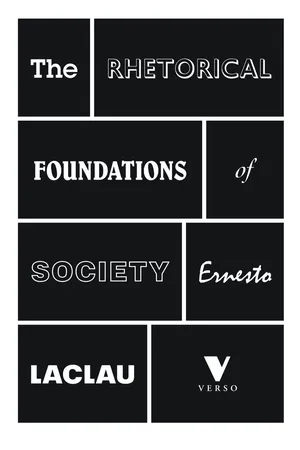
Central to the argument of The Rhetorical Foundations of Society is the establishment of rhetorical tropes-such as metaphor, metonymy and catachresis-as the "non-foundational" grounds of society. From this basis, Laclau explores the state of social relations in today's heterogeneous society. Employing analytical philosophy from both phenomenological and structuralist traditions, he seeks to locate an ontological terrain for interpersonal relationships. Further, he investigates the definition of social antagonism in an increasingly globalized world, where the proliferation of conflicts and points of rupture erodes crucial links between the social subjects postulated by classical social analysis.
- 240 pages
- English
- ePUB (mobile friendly)
- Available on iOS & Android
eBook - ePub
The Rhetorical Foundations of Society
About this book
Information
Topic
PhilosophySubtopic
Critical TheoryCHAPTER 1
The Death and Resurrection of the Theory of Ideology
I
In a recent essay on theories of ideology,1 Slavoj Žižek describes contemporary approaches by distributing them around the three axes identified by Hegel: doctrine, belief and ritual – that is, ‘ideology as a complex of ideas (theories, convictions, beliefs, argumentative procedures); ideology in externality, that is, the materiality of ideology, the Ideological State Apparatus; and finally, the most elusive domain, the “spontaneous” ideology at work at the heart of social existence itself.’2 He gives as an example the case of liberalism: ‘[L]iberalism is a doctrine (developed from Locke to Hayek) materialised in rituals and apparatuses (free press, elections, markets, etc and active in the “spontaneous” (self-)experience of subjects as “free individuals”’.3 In the three cases Žižek finds an essential symmetry of development: at some stage the frontier dividing the ideological from the non-ideological is blurred and, as a result, there is an inflation of the concept of ideology that loses, in that way, all analytical precision. In the case of ideology as a ‘system of ideas’, the unity of that system depends on the possibility of finding a point external to itself from which a critique of ideology might proceed – for example, by showing through a symptomal reading the true interests to which a given ideological configuration responded. But, as Žižek illustrates with examples taken from the works of Barthes, Paul de Man, Ducrot, Pêcheux, and from my own, it is precisely the assumption of this ‘zero level’ of the ideological of a pure extra-discursive reality that constitutes the ideological misconception par excellence. In the case of ‘Ideological State Apparatuses’ – or, in the Foucauldian version, the disciplinary procedures operating at the level of micro-power – we find symmetrical versions of the same petitio principii: does not the unity of the State Apparatuses require the very cement of the ideology they supposedly explain? Or, in the case of the disciplinary techniques: Does not their dispersion itself require the constant recomposition of their articulation, so that we have to appeal to a discursive medium that makes the very distinction between the ideological and the non-ideological collapse? And the case is even clearer when we move to the realm of beliefs: here, from the very beginning, we are confronted with a supposedly ‘extra-ideological’ reality whose very operation depends on mechanisms belonging to the ideological realm:
[T]he moment we take a closer look at those allegedly extra-ideological mechanisms that regulate social reproduction, we find ourselves knee-deep in the … obscure domain in which reality is indistinguishable from ideology. What we encounter here, therefore, is the third reversal of non-ideology into ideology: all of a sudden we become aware of a For-itself of ideology at work in the very In-itself of extra-ideological actuality.4
Here Žižek correctly detects the main source of the progressive abandonment of ‘ideology’ as an analytical category: ‘this notion somehow grows’ too strong; it begins to embrace everything, including the very neutral, extra-ideological ground supposed to provide the standard by means of which one can measure ideological distortion. That is to say, is it not the ultimate result of discourse analysis that the order of discourse as such is inherently ‘ideological’?5 We see, thus, the logic governing the dissolution of the terrain classically occupied by the theory of ideology. The latter died as a result of its own imperialistic success. What we are witnessing is not the decline of a theoretical object as a result of a narrowing of its field of operation, but rather the opposite: its indefinite expansion, consequent on the explosion of the dichotomies that – within a certain problematic – confronted it with other objects. Categories such as ‘distortion’ and ‘false representation’ made sense as long as something ‘true’ or ‘undistorted’ was considered to be within human reach. But once an extra-ideological viewpoint becomes unreachable, two effects necessarily follow: first, discourses organizing social practices are both incommensurable and on an equal footing with all others; and, second, notions such as ‘distortion’ and ‘false representation’ lose all meaning.
But where does this leave us? Are we supposed to put aside entirely notions such as ‘distortion’, ‘false consciousness’, and so on? The difficulty is that if we simply do so, we enter into a vicious circle whereby the conclusions of our analysis negate its premises. Let us for a moment consider the reasons for the decline of the ‘critique of ideology’ approach – as expressed in its purest terms by classical Marxism, and prolonged today by Habermas’s regulative ideal of undistorted communication. The bedrock of such a critique is to postulate access to a point from which – at least tendentially – reality would speak without discursive mediations. The full positivity and graspability of such a point gives a rationale to the whole critical operation. Now, the critique of this approach starts from the negation of such a metalinguistic level, from showing that the rhetorico-discursive devices of a text are irreducible and that, as a result, there is no extra-discursive ground from which a critique of ideology could proceed. (This does not mean, of course, that ideological critique is impossible – what is impossible is a critique of ideology as such; all critiques will necessarily be intra-ideological.)
What is not usually perceived, however, is that this critique of the ‘critique of ideology’ can advance in two different directions that lead to contradictory results. The first leads to what we could call a new positivism and objectivism. If we entirely do away with the notion of ‘distortion’ and assert that there are only incommensurable ‘discourses’, we merely transfer the notion of a full positivity from an extra-discursive ground to the plurality of the discursive field. This transference retains entirely the idea of a full positivity. In the same way that we have a naturalistic positivism, we can have a semiotic or a phenomenological one. If, on the other hand, what we are asserting is that the very notion of an extra-discursive viewpoint is the ideological illusion par excellence, the notion of ‘distortion’ is not abandoned but is instead made the cornerstone of the dismantling of any metalinguistic operation. What is new in the latter is that what now constitutes a distorted representation is the very notion of an extra-discursive closure. I will discuss later the ways in which the concept of ‘distortion’ has to be reformulated in order to fulfil this new role. Let us just say for the time being that this reformulation is the starting point for a possible re-emergence of a notion of ideology that is not marred by the stumbling blocks of an essentialist theorization.
Let us concentrate for a moment on the Althusserian theory of ideology. Ideology is, for Althusser, eternal. The mechanisms producing the subject through misrecognition are inscribed in the very essence of social reproduction. We have no hope of escaping the mirroring game involved in ideological interpellation. For him, however, ideology constitutes itself as an object through its opposition to science: the determination of the distortion brought about by ideological representations and the alienated character of the subject depend on the analyst’s knowledge of what social reproduction actually is – a knowledge that includes an understanding of the mirroring mechanism. We know that History is a process without a subject, precisely because we are able to go scientifically beyond subjective alienation.
This leaves us, however, with an apparently intractable problem. Everything depends on what is being misrecognized – or, rather, on the nature and extent of the misrecognition. If what is misrecognized is a particular type of social relation, we could easily imagine a different one in which no misrecognition at all occurs. This is what was assumed by the classical notion of emancipation. But what Althusser argues is different: it is that we are dealing with a necessary misrecognition that is independent of any type of social configuration. In this case, however, what is misrecognized is the principle of social structuration as such, the closure operated by any symbolic system. This launches us into a new problem: if closure as such requires misrecognition (in other words, its opposite) it is the very idea of closure that constitutes the highest form of misrecognition. Either misrecognition is reducible to an objective function by a neutral gaze, or that gaze is not neutral but part of the universal misrecognition – in which case what presents itself as the opposite of misrecognition belongs to the essence of the latter. I can maintain a strong frontier between closure (the auto-reproduction of social relations) and the necessary forms of misrecognition accompanying it only insofar as there is a metalinguistic vantage point from which closure shows itself without any subjective passage through misrecognition. But if that vantage point proves to be illusory, misrecognition contaminates closure; and, given that misrecognition, distortion, is universal, its other (closure, self-transparency) becomes the main form of misrecognition. In that case, distortion is constitutive of social objectivity. But what might be a form of distortion that remains such while the distinction between the distortion and what is distorted is obliterated? This is the next problem that we have to address.
II
The notion of a constitutive distortion is apparently a contradictio in adjecto. A distortion, it seems, cannot be constitutive: it is only if there is a more primary meaning which is not itself distorted that a distortive effect can become visible at all. But does this conclusion exhaust all the logical possibilities that a relation of distortion opens? Let us consider the matter carefully. It is certainly inherent to all distortion that a ‘primary’ meaning is presented under a ‘false’ light. The operation this presentation involves – concealment, deformation, or whatever – is something that we can leave indeterminate for the time being. What is essential to distortion is, first, that a primary meaning is presented as something different from what it is, and, second, that the distortive operation – not only its results – has to be somehow visible. This last point is crucial: if the distortive operation does not leave any traces in its result, it will fully succeed in constituting a new meaning. But what we are dealing with is a constitutive distortion. That is, we are both positing an originary meaning (as is required by any distortion) and withdrawing it (for the distortion is constitutive). In that case, the only logical possibility of pulling together these two apparently antinomic dimensions is if the original meaning is illusory and the distortive operation consists precisely in creating that illusion – that is, projecting into something that is essentially divided the illusion of a fullness and self-transparency that it lacks. Let us say something about what is being projected, and about the visibility of the projection as such.
In my previous discussions I have used three necessarily interrelated notions – ‘originary meaning’, ‘self-transparency’ and ‘closure’. It is time to say something more about the nature of this link. Something is originary insofar as it does not have to go outside itself in order to constitute what it is; it is self-transparent insofar as its internal dimensions are in a relation of strict solidarity between themselves; and it is closed in itself as far as the ensemble of its ‘effects’ can be determined without going beyond its original meaning. As we see, each of these notions (without exactly being synonymous with the other two) requires the latter’s presence in order to actualize its own meaning. And it is precisely this full meaning that is dislocated by the postulation of a constitutive distortion: in the first and third cases, both the ‘originarity’ and internality of the ‘effects’ are upset by discursive mediation, and the opacity of the internal dimensions of the self-enclosed entity interrupts its self-transparency.
This would only show, however, that dislocation is constitutive, and that the very notion of a metaphysical closure has to be put into question.6 But the notion of distortion involves something more than mere dislocation – namely, that a concealment of some sort takes place in it. Now, as we have seen, what is concealed is the ultimate dislocation of what presents itself as a closed identity, and the act of concealment consists in projecting onto that identity the dimension of closure that it ultimately lacks. This has two chief consequences:
1.The first is that that dimension of closure is something that is actually absent – if it was ultimately present there would be revelation rather than projection, and no concealment would be involved. In that case what we are dealing with is, the presence of an absence, and the ideological operation par excellence consists of attributing that impossible role of closure to a particular content that is radically incommensurable with it. In other terms: the operation of closure is impossible but at the same time necessary – impossible because of the constitutive dislocation lying at the heart of any structural arrangement; necessary because, without that fictitious fixing of meaning, there would not be meaning at all.7 Here we can start seeing the way in which ideology as ‘misrepresentation’ might be eternal: not, as Althusser thought, because the alienation of the subject is the necessary complement of an objective History whose meaning might be located elsewhere, but because the notion of that ‘objective meaning’ is itself the very form of misrepresentation through which any identity acquires its fictitious coherence. The crucial point is to realise that it is this dialectics between necessity and impossibility that gives ideology its terrain of emergence.
2.This dialectics creates in any ideological representation – and at this stage it should be clear that ideology is one of the dimensions of any representation – an insurmountable split that is strictly constitutive. On the one hand, closure as such, being an impossible operation, cannot have a content of its own and only shows itself through its projection in an object different from itself. On the other hand, this particular object, which at some point assumes the role of incarnating the closure of an ideological horizon, will be deformed as a result of that incarnating function. Between the particularity of the object that attempts to fulfil the operation of closure and this operation, there is a relationship of mutual dependency in which each of the two poles is required, and at the same time, each partially limits the effects of the other. Let us suppose that, at some point in a Third World country, nationalization of the basic industries is proposed as an economic panacea. Now, this is just a technical way of running the economy, and if it remains so it will never become an ideology. How does the transformation into the latter take place? Only if the particularity of the economic measure starts to incarnate something more and different from itself – for instance, the emancipation from foreign domination, the elimination of capitalist waste, the possibility of social justice for excluded sections of the population, and so on; in short, the possibility of constituting the community as a coherent whole. That impossible object – the fullness of the community – appears here as depending on a particular set of transformations at the economic level. This is the ideological effect strictu senso: the belief that there is a particular social arrangement that can bring about the closure and transparency of the community.8 There is ideology whenever a particular content shows itself as more than itself. Without this dimension of horizon we would have ideas or systems of ideas, but never ideologies.
With this we have answered our first question: what an ideological distortion projects on a particular object is t...
Table of contents
- Cover Page
- Halftitle Page
- Title Page
- Copyright Page
- Contents
- Introduction
- Chapter 1: The Death and Resurrection of the Theory of Ideology
- Chapter 2: On the Names of God
- Chapter 3: Articulation and the Limits of Metaphor
- Chapter 4: The Politics of Rhetoric
- Chapter 5: Antagonism, Subjectivity and Politics
- Chapter 6: Ethics, Normativity and the Heteronomy of the Law
- Chapter 7: Why Constructing a ‘People’ Is the Main Task of Radical Politics
- Chapter 8: An Ethics of Militant Engagement
- Chapter 9: Bare Life or Social Indeterminacy?
- Acknowledgements
- Index
Trusted by 375,005 students
Access to over 1.5 million titles for a fair monthly price.
Study more efficiently using our study tools.
Frequently asked questions
Yes, you can cancel anytime from the Subscription tab in your account settings on the Perlego website. Your subscription will stay active until the end of your current billing period. Learn how to cancel your subscription
No, books cannot be downloaded as external files, such as PDFs, for use outside of Perlego. However, you can download books within the Perlego app for offline reading on mobile or tablet. Learn how to download books offline
Perlego offers two plans: Essential and Complete
- Essential is ideal for learners and professionals who enjoy exploring a wide range of subjects. Access the Essential Library with 800,000+ trusted titles and best-sellers across business, personal growth, and the humanities. Includes unlimited reading time and Standard Read Aloud voice.
- Complete: Perfect for advanced learners and researchers needing full, unrestricted access. Unlock 1.5M+ books across hundreds of subjects, including academic and specialized titles. The Complete Plan also includes advanced features like Premium Read Aloud and Research Assistant.
We are an online textbook subscription service, where you can get access to an entire online library for less than the price of a single book per month. With over 1.5 million books across 990+ topics, we’ve got you covered! Learn about our mission
Look out for the read-aloud symbol on your next book to see if you can listen to it. The read-aloud tool reads text aloud for you, highlighting the text as it is being read. You can pause it, speed it up and slow it down. Learn more about Read Aloud
Yes! You can use the Perlego app on both iOS and Android devices to read anytime, anywhere — even offline. Perfect for commutes or when you’re on the go.
Please note we cannot support devices running on iOS 13 and Android 7 or earlier. Learn more about using the app
Please note we cannot support devices running on iOS 13 and Android 7 or earlier. Learn more about using the app
Yes, you can access The Rhetorical Foundations of Society by Ernesto Laclau in PDF and/or ePUB format, as well as other popular books in Philosophy & Critical Theory. We have over 1.5 million books available in our catalogue for you to explore.