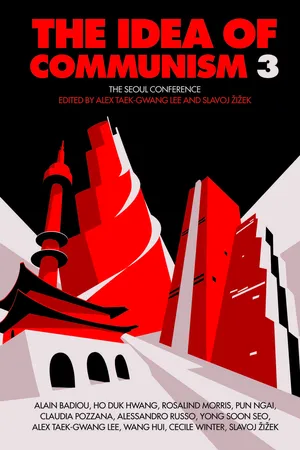
In 2009 Slavoj Zizek brought together an acclaimed group of intellectuals to discuss the continued relevance of communism. Unexpectedly the conference attracted an audience of over 1,000 people.
The discussion has continued across the world and this book gathers responses from the conference in Seoul. It includes the interventions of regular contributors Alain Badiou and Slavoj Zizek, as well as work from across Asia, notably from Chinese scholar Wang Hui, offering regional perspectives on communism in an era of global economic crisis and political upheaval.
1The Crisis of Representativeness and Post-Party Politics
Wang Hui
The Decline of Representation in Global Politics
The decline of representation in contemporary politics is the result of a unique, multilayered political crisis.1 First of all, its core aspect, a crisis of party politics, is a fracture of representativeness, a discursive failure of established political values in actual political processes, and consequently a crisis of legitimacy. Party politics took its modern shape in nineteenth-century Europe. In China, it was the most important political innovation of the twentieth century. The party politics of the Xinhai Revolution period, especially between 1911 and 1915, attempted to emulate the multiparty parliamentary system developed in the framework of European constitutional politics. Faced with the challenges of secessionism, monarchical restoration, and the crisis of republicanism, the revolutionaries and many political elites began to shift away from their original political objectives.
The leading party as vanguard
There were three prerequisites for the formation of the uniquely Chinese modern party politics. First, after the establishment of the Republic of China, regional secessionism, military separatism and partisanship interlocked with one another, leading to the formation of a new national politics crucial in early Republican-period political thinking. Second, during World War I, many political parties in the West participated in nationalist war mobilization and supplied a political impetus for the war. Consequently, reflection on traditional modes of party politics peaked among European intellectuals after World War I. The reconstruction of Chinese party politics occurred in this intellectual atmosphere. Lastly, when the Russian Revolution erupted during World War I, some Chinese revolutionaries believed that Bolshevism as a political model could overcome the limits of bourgeois party politics. (Debates and reflections on Bolshevism and its party structure also began in this period, but I do not have enough space to elaborate on this issue.) In other words, the crisis and failure of party politics gave birth to the party system that was the political nucleus of this revolutionary century. In contrast to the parties in crisis, this new model of political parties, influenced by the Russian Revolution and the Comintern, bore the dual features of a super-political party (
) and a ‘supra party’ (
). The term ‘super-political party’ indicates that both competing parties, the Guomindang (GMD) and the Chinese Communist Party (CCP), were obliged to adopt some of the elements or forms of party politics and claim themselves to be political parties, but neither of them intended to form a competitive party politics within the structure of a parliamentary system. Instead, both aimed to become a hegemonic party, or ‘leading party’. The term ‘supra party’ implies that the political representation of both parties was different from the multi- or dual-party structure of a parliamentary system, and was much more similar to the Gramscian concept of a ‘modern prince’ who represents the people and the future. In the case of the CCP, the role of party is that of the vanguard of the proletariat. The theory and praxis of ‘people’s war’ that was developed in the late 1920s and expanded during the war against the Japanese invasion (1931–45) and the civil war (1945–49) generated a new form of party politics. It consolidated military struggle, land revolution, base-area building, and the construction of a revolutionary constitutional state into an unprecedented practice, the core of which was political strategies – namely, military struggle, the mass line, and the united front. With its class politics based on the proletariat, the union of workers and peasants, and the united front for national liberation, the CCP eventually overtook the GMD, which gradually deviated from the peasant movement and mass politics towards state politics.
The detachment of the political system from social forms
In both the multiparty system in the West and the system of multiparty cooperation under one-party rule in China, the representativeness of political parties has become increasingly obscure. In the case of China, the representativeness and the politics of the party have mutated drastically as categories such as the proletariat, the union of workers and peasants, and the united front have lost their clarity.2 After the PRC was established, the Communist Party searched for a new path for its own renovation under the conditions following people’s war. The failure of the Cultural Revolution signified the end of this search, as well as the beginning of the full integration of the party into the framework of the state. In my view, the decline or rupturing of representation is the consequence of depoliticization, the most severe symptom of which is the statification of the party: the party has submitted itself increasingly to the logic of the state, depriving itself of its essence, which should be a form of political organization and political movement, as both its function and form of organization have been assimilated to the state apparatus. This process implies the end of the mass line that had engendered the political dynamism of the CCP. Two interrelated forms of the statification of the party can be identified: first, the bureaucratization of the party in the early days before the economic reform, which became one of the pivotal reasons why the Cultural Revolution was launched; second, the marriage between the party and capital in the process of the corporationalization of government during the market reforms. For the party, the rupture of representativeness manifests itself most intensely in the incongruity between the party’s claim to general representativeness as it transcends previous class categories and its increasing distance from the people, especially those from lower social strata. There are of course policies protective of workers and peasants; however, we can barely find any organic connection between party politics and the politics of workers and peasants.
The detachment of the political system from social forms happens not only in socialist or post-socialist countries, but also in European and American parliamentary party systems, as well as in other political systems based on them. In China, the relationship between the party and its class base has become ever more vague, just as among Western political parties the distinction between the left and the right has blurred. In the contemporary world, the fracture of representativeness has so intensified that it leads to the belief that the type of party politics that flourished in the nineteenth and the twentieth centuries has already disappeared, or persists merely in confined areas; it is transforming or has already transformed into a state-party politics – that is, one that serves as a structure of state power. Unlike in the nineteenth and early twentieth centuries, it is hard to find in contemporary party politics political movements with a clear agenda. The growing scale of the political party and its monopoly of state power are normally interpreted as the expansion of party politics. However, if we investigate whether it is political parties that control the state, or the converse – the logic of the state that controls parties – the latter may be the proper answer. The boundary between party and state is vanishing, the outcome of their assimilation being precisely the dissolution of political representativeness, which in turn renders power relations in the political sphere no longer capable of balancing or reducing the inequality in the socioeconomic sphere, but instead only of providing institutional support for such inequality. Under the conditions of the fracture of representativeness, the political rhetoric of politicians degrades into a performance aimed at grabbing power, while technocratic bureaucrats inevitably gain higher political positions. In the Western multiparty or dual-party structure, the role of political parties is fundamentally that of voter mobilization, pivoting on elections that take place every four or five years. This is more like a state apparatus for the rotation of leaders.
In the twentieth century, the super-political party in China originally possessed an intense politicalness sustained by rigorous organization, a straightforward value orientation, and mass movements mobilized through the vigorous interaction between theory and political practice. However, under the contemporary mode of political parties, party organization almost equals administrative organization. The party has become a component of the management apparatus, its function of mobilization and supervision increasingly identical with the state mechanism as its bureaucratic features intensify and its politicalness diminishes. The crisis of representativeness in party politics is a crisis for ruling parties as well as for non-ruling parties. In China nowadays, the representativeness of the democratic parties has become unprecedentedly elusive.
The waning of the representativeness of public institutions that mediate between state and society (parliaments in the West; in China, the National People’s Congress and the Chinese People’s Political Consultative Conference) echoes the above-mentioned process. In parliamentary democracy, seats in the parliament usually centre on political parties. There are theoretical debates regarding whether parliament functions as part of the state or as an institutionalization that includes certain public spheres. But with the statification of political parties, the connection between parliament and society is gradually being severed. During a visit to India, I noted that grassroots social movements prospered there. Even the most active types of social movement, however, could not play a parallel role in the making of public policy, because political parties monopolized parliamentary power. In contrast, in terms of theoretical orientation, the social representation system used by the People’s Congress of China seems more removed from party politics than does party-centred parliamentary politics. In practice, this social representation model needs to be buttressed by politics centred on the so-called mass line, the decline or the transformation of which will undermine the process of selecting people’s representatives and the role of the People’s Congress in the political life of China. The ratio of representatives in the People’s Congress – for instance, the percentage of workers and peasants whose numbers in the People’s Congress are disproportionate to their contribution to Chinese society – has often been criticized in the past. The homology between a system of representation and social power relations is a symptom of the crisis of representative politics, and a consequence of depoliticization.
The second aspect of the decline of representation relates to the fact that typical public spheres, such as the media, are experiencing a crisis of publicity. The large-scale expansion of the media entails the contraction of the public sphere: freedom of the media industry has replaced the freedom of speech of citizens; the media are not only unprecedentedly allied with capital, power and the media’s own interests, but in some cases even attempt to take over the role of political organizations, the party among them. In Italy, Silvio Berlusconi’s media group propagates values that enabled him, a criminal suspect, to be elected prime minister repeatedly. The media, especially massive media groups – regardless of whether they are private or state-owned – cannot be simplistically reckoned as an independent vehicle for citizen and public opinion. They should rather be seen as a network of interests disguised as a public vehicle. The permeation of media influence in political and other public spaces cannot be considered as part of a process of democratization either; rather, it is the colonization of these spheres. On the surface, we can say that the media are controlled by politics. But, in reality, the political sphere is also being gradually colonized by the media – political figures cajole the public with claptrap, and it is not unusual that they adopt discourses structured by the logic of the Eastern and Western media. The Chinese media have been industrialized and corporationalized since the 1990s because of the new political and economic strategies of the party aimed at adapting to marketization and globalization. But with the statification of the political party, the corporatization of the government, and the partification of the media, the relationship between the media and the party has turned into a contest between two entangled sets of interests that, in their games of strategic conflict or cooperation, resort to pretensions either to democracy and liberty, or to stability, rule of law and situation awareness. The confrontation between the editorial department of South Weekend and the Guangdong Provincial Party Committee in the early spring of 2013, for example, was absolutely not a struggle between public opinion and the state, but an entanglement that arose as both sides hijacked public demands – in other words, a confrontation that emerged in the process of the contemporary redistribution of power. The two sides had different interests, but their political discourses were nearly identical.
In China today, censorship is a deep-rooted problem. The realm of public speech is crying out for true reform. But any reform based on the established structure will become merely a struggle for power that disguises itself as a demand for a free press. Today, the methods used to suppress public opinion have changed: the media have often served as one of the mechanisms to muzzle public opinion. Such a power struggle evinces the political competition between partified media and the traditional political party that generated them. The former possess more political energy and features; the latter resembles an entrapped power apparatus deprived of its ideological function, no longer a political organization in the classical sense. Ironically, these two sides are nonetheless parabiotic. They replace and conceal the problems of political debates and freedom of speech with games of strategic conflict and cooperation.
The third aspect of the decline of representation is the crisis of law. Under depoliticization, legal procedures are often manipulated by interest groups. This manipulation is seen not only in general legal procedures, but also permeates the process of legislation. Hence, instead of simply asserting proceduralist opinions, it is an urgent and unavoidable necessity for the legal reforms of our day to reconsider the relationship between law and politics.
The problems in the three above-mentioned areas constitute the essence of today’s political transformation.
Hence, I raise the following questions: As party politics has degenerated into the politics of a state-party or state-parties, is a post-party politics possible? While modern political parties are still widespread around the world, the post-party politics alluded to here refers not to politics after political parties disappear, but to the fact that the political party has already taken up new features in the context of depoliticization. The political party was established in nineteenth-century Europe on the basis of a political movement. In twentieth-century China, party politics – especially Communist Party politics – was largely reshaped by people’s war and its political aftermath. On the one hand, the term ‘post-political party’ indicates that, although parties still act as leading political entities, in reality they have lost the representativeness held by parties in the nineteenth and twentieth centuries, and have parted from their original logic. At the same time, political forms have stabilized – major political institutions were built upon the principle of the representativeness of party politics. Consequently, the fracture of representativeness has become the main symptom of today’s political crisis. On the other hand, the term ‘post-party politics’ indicates the necessity of devising a new form, and corresponding practice, beyond the framework of party politics. The key issues for post-party politics are how and on what level to reconstruct representativeness, or even whether we should think differently about representativeness itself. In the political practice of twentieth-century China, elements of post-party politics were active, but only as the practice of a super-political party – namely, as people’s war, the mass line, and the united front. All these practices of representativeness attempted to move beyond conventional relations of representation. Although it partly evolved from such super-party politics, present-day party politics in China has also been generated by the degradation of a super-party into a state-party system. In order to overcome the crisis of representation, we need to reconstruct representativeness and explore new avenues of post-party politics.
Today, representativeness cannot be reconstructed by repeating old slogans or praxis. We have to face the problems of representative politics and the detachment of social structure from the political system. From this perspective, two dimensions of post-party politics need to be tackled: we should re-examine the principles of representative politics in twentieth-century China, and explore the conditions and possibilities of post-party politics.
Rethinking the Principles of Representative Politics of Twentieth-Century China
The problems of representativeness, as well as the related problem of a system of representation, were the core issues facing modern political systems. In the nineteenth and twentieth centuries, the content of representative politics consisted of categories such as political party and social class, as well as their actual application in the framework of state politics. After monarchy declined, representative politics became connected with problems of democracy. Political principles of representative politics in China differ fr...
Table of contents
Cover Page
Halftitle Page
Title Page
Copyrigt Page
Contents
Editors’ Note
Foreword: Why Communism Today?
General Introduction to the Seoul Conference
1. The Crisis of Representativeness and Post-Party Politics
2. Chinese Communism Revisited: Still a Class Perspective, but Why?
3. Liberating Dictatorship: Communist Politics and the Cultural Revolution
4. Althusser and Mao: A Political Test for Dialectics
5. Communism, the Void
6. The Affirmative Dialectics
7. The Sixties and Us
8. Manifestos without Words: The Idea of Communism in South Korea – The Case of the Gwangju May
9. Stairs of Metaphor: The Vernacular Substitution- Supplements of South Korean Communism
10. Unpopular Politics: The Collective, the Communist and the Popular in Recent Thai History
11. No Way Out? Communism in the New Century
Notes
Index
Trusted by 375,005 students
Access to over 1.5 million titles for a fair monthly price.
Study more efficiently using our study tools.
Frequently asked questions
Yes, you can cancel anytime from the Subscription tab in your account settings on the Perlego website. Your subscription will stay active until the end of your current billing period. Learn how to cancel your subscription
No, books cannot be downloaded as external files, such as PDFs, for use outside of Perlego. However, you can download books within the Perlego app for offline reading on mobile or tablet. Learn how to download books offline
Perlego offers two plans: Essential and Complete
Essential is ideal for learners and professionals who enjoy exploring a wide range of subjects. Access the Essential Library with 800,000+ trusted titles and best-sellers across business, personal growth, and the humanities. Includes unlimited reading time and Standard Read Aloud voice.
Complete: Perfect for advanced learners and researchers needing full, unrestricted access. Unlock 1.5M+ books across hundreds of subjects, including academic and specialized titles. The Complete Plan also includes advanced features like Premium Read Aloud and Research Assistant.
Both plans are available with monthly, semester, or annual billing cycles.
We are an online textbook subscription service, where you can get access to an entire online library for less than the price of a single book per month. With over 1.5 million books across 990+ topics, we’ve got you covered! Learn about our mission
Look out for the read-aloud symbol on your next book to see if you can listen to it. The read-aloud tool reads text aloud for you, highlighting the text as it is being read. You can pause it, speed it up and slow it down. Learn more about Read Aloud
Yes! You can use the Perlego app on both iOS and Android devices to read anytime, anywhere — even offline. Perfect for commutes or when you’re on the go. Please note we cannot support devices running on iOS 13 and Android 7 or earlier. Learn more about using the app
Yes, you can access The Idea of Communism 3 by Alex Taek-Gwang Lee, Slavoj Zizek, Alex Taek-Gwang Lee,Slavoj Zizek in PDF and/or ePUB format, as well as other popular books in Philosophy & Political Philosophy. We have over 1.5 million books available in our catalogue for you to explore.