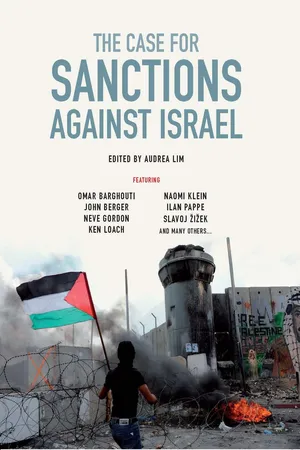
In July 2011, Israel passed legislation outlawing the public support of boycott activities against the state, corporations, and settlements, adding a crackdown on free speech to its continuing blockade of Gaza and the expansion of illegal settlements. Nonetheless, the campaign for boycott, divestment, and sanctions (BDS) continues to grow in strength within Israel and Palestine, as well as in Europe and the US.
This essential intervention considers all sides of the movement-including detailed comparisons with the South African experience-and contains contributions from both sides of the separation wall, along with a stellar list of international commentators.
- 248 pages
- English
- ePUB (mobile friendly)
- Available on iOS & Android
eBook - ePub
The Case for Sanctions Against Israel
About this book
Information
Part I ISRAEL/PALESTINE
1 FREEDOM IN OUR LIFETIME
Mustafa Barghouthi
I have lived my entire adult life under occupation, with Israelis holding ultimate control over my movement and daily life.
When young Israeli police officers force me to sit on the cold ground and soldiers beat me during a peaceful protest, I smolder. No human being should be compelled to sit on the ground while exercising rights taken for granted throughout the West.
Irrespective of what political settlement is ultimately embraced, Palestinians need a unified strategy for confronting and overcoming Israeli racism, apartheid, and oppression.
Javier Solana, just prior to completing his stint as European Union foreign policy chief, claimed Palestinian moves toward statehood “have to be done with time, with calm, in an appropriate moment.” But he also added, “I don’t think today is the moment to talk about that.” When, precisely, is a good time for Palestinian freedom? If Israel insists on hewing to antiquated notions of determining the date of another people’s freedom, then it is incumbent on Palestinians to organize ourselves and highlight the moral repugnance of such an outlook.
Palestinians have only two choices before them: either 1) continue to evade the struggle, as some have been trying to do, or 2) summon the collective national resolve to engage in it.
The latter option does not necessarily entail a call to arms. Clearly, Israel has the overwhelming advantage in this respect, in both conventional and unconventional (nuclear) weapons. Just as obviously, neighboring Arab countries have neither the will nor the ability to go the military route. However, the inability to wage war does not automatically mean we have to surrender and eschew other means of struggle.
As powerful as it is militarily, Israel has two major weak points. First, it cannot impose political solutions by force of arms on a people determined to sustain a campaign of resistance. This has been amply demonstrated in two full-scale wars against Lebanon and in the 2009 assault against Gaza. Second, the longer the Palestinians have remained steadfast, and the greater the role the demographic factor has come to play in the conflict, the more clearly Israel has emerged as an apartheid system hostile to peace. If the ethnic cleansing of 1948 and colonialist expansionism describe the circumstances surrounding the birth of the Israeli state, the recent bills regarding the declaration of allegiance to a Jewish state and prohibiting the Palestinian commemoration of the Nakba more explicitly underscore its essentially racist character.
Ironically, just as Israel has reached the peak in its drive to fragment the Palestinian people—with geographical divides between those in Israel and those abroad, between Jerusalem and the West Bank, between the West Bank and Gaza, and between one governorate and the next in the West Bank, by means of ring roads, walls and barriers—Palestinians have become reunified in their hardship and in the challenges that confront them. Regardless of whether or not they bear Israeli citizenship, or whether they are residents of Jerusalem, the West Bank, or Gaza, they all share the plight of being victims of Israel’s systematic discrimination and apartheid order.
If the only alternative to evading the struggle is to engage in it in order to resolve it, we must affirm that our national liberation movement is still alive. We must affirm, secondly, that political and diplomatic action is a fundamental part of managing the conflict, as opposed to an alternative to our struggle to resolve it. In fact, we must elevate it to our primary means for exposing the true nature of Israel, isolating it politically, and pressing for international sanctions against it.
In this context, we must caution against the plan of building state institutions under the occupation. An administration whose security services would be consuming 35 percent of the public budget—that would be constantly pressured to act as the occupation’s policeman while furthering Benjamin Netanyahu’s scheme for economic normalization as a substitute for a political solution—is clearly an entity geared to promoting the acclimatization to the status quo, not change.
The building of Palestinian governing institutions and promotion of genuine economic development must occur within the framework of a philosophy of “resistance development.” Such a philosophy is founded on the dual principles of 1) supporting the people’s power to withstand the hardships of occupation, and 2) reducing dependency on foreign funding and foreign aid. The strategic aim of the Palestinian struggle, under this philosophy, must be to make the costs of the Israeli occupation and its apartheid system so great as to be unsustainable.
If we agree on this course for conducting the struggle, then the next step is to adopt a unified national strategy founded upon the four following pillars.
1. RESISTANCE
In the face of European and American inaction, it is crucial that we continue to revive our culture of collective activism by vigorously and nonviolently resisting Israel’s domination over us. These are actions that every man, woman, and child can take.
Through decades of occupation and dispossession, 90 percent of the Palestinian struggle has been nonviolent, with the vast majority of Palestinians supporting this method of struggle. Today growing numbers of Palestinians are participating in organized nonviolent resistance.
Models for this type of resistance already exist. Of particular note is the brave and persistent campaign against the separation or apartheid wall, which has spread across several towns and villages. The campaign has become increasingly adamant regardless of the high price people have to pay, including the killing of twenty Palestinian peaceful activists by the Israeli army. The resistance by the people of East Jerusalem, including in Silwan and Sheikh Jarrah, against Israeli home demolitions and the drive to Judaize the city presents another heroic model.
This strategy must retain its peaceful, grassroots character. If it does, it will revive the culture of collective activism among all sectors of the Palestinian people. This will keep the struggle from becoming the preserve or monopoly of small cliques, and will promote its growth and momentum.
President Barack Obama, perhaps unwittingly, encouraged this effort when he called for Palestinian nonviolence in his 2009 Cairo speech. “Palestinians,” he said, “must abandon violence … For centuries, black people in America suffered … the humiliation of segregation. But it was not violence that won full and equal rights. It was a peaceful and determined insistence upon the ideals at the center of America’s founding.”
Yet without public American complaint, the Israeli military has killed and injured many nonviolent Palestinians during Obama’s term as president, most notably Bassem Abu Rahme in April 2009, killed by an Israeli high-velocity tear gas canister. American citizen Tristan Anderson was critically injured by the Israeli army the previous month by a similar projectile. Both men were protesting illegal Israeli land seizures and Israel’s wall. Hundreds more are unknown to the outside world.
Another key aspect of resistance has been the movement to boycott Israeli goods and to encourage the consumption of locally produced goods. In addition to preventing the occupation power from deriving profits by marketing locally produced goods, this form of resistance can engage the broadest swath of the population—from old to young, both men and women—and revive the culture and spirit of communal collaboration. The campaigns to break the blockade against Gaza, as exemplified by the protest ships, the supply caravans, and the pressures on Israel to lift its economic stranglehold, are another major type of resistance.
A new generation of Palestinian leaders is attempting to speak to the world in the language of a nonviolent campaign of boycott, divestment, and sanctions (BDS), precisely as Martin Luther King Jr. and thousands of African Americans did in the Montgomery bus boycott in the mid-1950s. We are equally justified in using this tactic to advance our rights. The same world that rejects all use of Palestinian violence, even in clear self-defense, surely ought not to begrudge us the nonviolence employed by men such as King and Gandhi.
2. SUPPORTING NATIONAL STEADFASTNESS
The importance of this pillar of resistance is its focus on strengthening the demographic power of the Palestinian people, so as to transform their millions of individuals into an effective grassroots force. It entails meeting their essential needs to enable them to remain steadfast in their struggle, and developing Palestinian human resources as the foundation for a strong and independent Palestinian economy.
However, in order to achieve these aims, the Palestinian Authority (PA) economic plan and budget must be altered so as to put their weight behind the development of education, health, agriculture, and culture, rather than squandering a third of the budget on security. For example, the passage and immediate implementation of the bill for the national higher education fund would serve the educational needs of hundreds of thousands of young adults. In addition to elevating and developing the standards of university education, it would also help sustain the effectiveness of development aid and eventually reduce reliance on foreign support. The fund would also alleviate the school tuition burdens on more than 150,000 families, put an end to nepotism in the handling of study grants and loans, and provide equal opportunity for academic advancement to all young men and women regardless of their financial circumstances.
Equally innovative and dynamic ideas could be applied to other areas of education, and to stimulating the fields of public health, agriculture, and culture, with the overall aim of meeting Palestinian needs as autonomously as possible, and hence increasing our capacity to weather enormous pressures.
3. NATIONAL UNITY AND A UNIFIED NATIONAL LEADERSHIP
This strategic aim entails restructuring the Palestine Liberation Organization on a more demographically representative basis, and putting into effect agreements that have been previously reached in the Palestinian national dialogues held in Cairo. Over the past few years, Israel’s greatest advantage and the thrust of its assault have centered around the rift within the Palestinian movement and the weakness of the disunited Palestinian leadership. In order to redress this flaw, Palestinians must adopt a new mentality and approach. Specifically, they must relinquish the practice of vying for power over a meaningless governing authority that is still under the thumb of the occupation, whether in the West Bank or in Gaza; give up the illusion that any single Palestinian party, however great it might become, is capable of leading the Palestinian struggle alone; adopt democracy and pluralistic democratic activities and processes as a mode of life, and peaceful decision-making as the only acceptable means to resolve our differences and disputes; and resist all outside pressures and attempts (particularly on the part of Israel) to intervene in our internal affairs and to tamper with the Palestinian popular will. We have no unity because the United States and Israel have done everything they could to break down the unity government we established following democratic elections. There must be a firm and unshakable conviction of Palestinians’ right to independent national self-determination.
The most difficult task that we face today is that of creating a unified leadership and strategy binding on all, from which no political or military decisions will depart, and within whose framework no single group or party has a monopoly on the decision-making process. Only with a unified leadership and strategy will we be able to fight the blockade as one, instead of evading unity for fear of the blockade. With a unified leadership and strategy we will be able to seize the initiative instead of simply reacting, and we will be able to assert our unified will instead of squandering our energies on internal power struggles in which various parties seek outside assistance to strengthen their hand against internal opponents. Only then will we be able to shift the equation that has subordinated the national liberation movement to the narrow concerns of the PA (both in the West Bank and Gaza) and turn the PA into an instrument in the service of the national liberation movement.
4. ENHANCING PRO-PALESTINIAN SOLIDARITY
That such a movement already exists and is steadily growing is heartening. However, it will take enormous efforts to organize it and coordinate its activities properly, so as to ensure that it has the greatest possible influence upon decision-makers, especially in Europe and the West. Palestinian, Arab, and Muslim communities will need to be orchestrated towards the realization of the same goals. The solidarity movement has scored significant successes with the organization of a boycott of Israeli products, including the decision by the British University and College Union to boycott Israeli academics; the amazing decision of fifty-two labor unions in Britain, with a membership of more than 7 million people, to join the BDS campaign; the decision taken by Hampshire College and some US churches to refuse to invest in the Israeli occupation; and the decision of Norway and Denmark to divest from Israeli military companies. Much work has yet to be done to expand the scope of such activities and build up the momentum of the solidarity movement.
It is with deepening concern that I recognize that the Obama administration is not yet capable of standing up to Israel and the pro-Israel lobby. Hilary Clinton, speaking in February 2011, could only summon the term “illegitimate” to describe Israel’s illegal settlements.
The Palestinian plight, which Nelson Mandela has described as the foremost challenge to the international humanitarian conscience, strongly resembles the state of South Africa at the outset of the 1980s. It took years of a concerted campaign before the South African liberation movement finally succeeded in bringing governments around to their cause. The tipping point came when major companies realized that the economic costs of dealing with the apartheid regime in Pretoria were unsustainable. In the Palestinian case, the success of an international solidarity movement is contingent upon three major factors: 1) careful organization and detailed planning, a high degree of discipline, and tight coordination; 2) a rational, civilized rhetoric that refuses to play into Israel’s tactics of provocation; and 3) the recruitment of progressive movements and peoples in societies abroad, including anti-Zionist Jews and Jews opposed to Israeli policies.
None of the foregoing is new, by any means. However, these ideas have yet to be put into practice. The logical springboard for their implementation is to operate on the principle that, while the Palestinian cause is a Palestinian, Arab, and Muslim one, it is above all a humanitarian cause that cries out to all in the world who cherish humanitarian principles and values. The successes of the freedom fighters of South Africa, the anti–Vietnam War movement, and the campaigners for the independence of India stemmed primarily from their ability to forge a universal appeal. And this is precisely what we must do. Our mottos for the solidarity movement with the Palestinian people must be “the fight against the new apartheid and systematic racism” and “the fight for justice and the right to freedom.” The International Court of Justice’s ruling on the separation wall, and on the illegality of Jewish settlements and of altering the face of Jerusalem, is a valuable legal precedent that Palestinian governing institutions have ignored for five years. This ruling, as well as the Goldstone Report on Israel’s attack on Gaza (despite Goldstone’s later reversal), should now become our platform for a drive to impose sanctions against Israel, just as the UN re...
Table of contents
- Cover
- Title Page
- Copyright
- Contents
- Part I ISRAEL/PALESTINE
- Part II THE BOYCOTT MOVEMENT
- Part III INTERSECTIONS
- Part IV CASE FOR SANCTIONS AGAINST ISRAEL
- CHRONOLOGY
- RESOURCES
- ACKNOWLEDGMENTS
- CONTRIBUTORS
Trusted by 375,005 students
Access to over 1.5 million titles for a fair monthly price.
Study more efficiently using our study tools.
Frequently asked questions
Yes, you can cancel anytime from the Subscription tab in your account settings on the Perlego website. Your subscription will stay active until the end of your current billing period. Learn how to cancel your subscription
No, books cannot be downloaded as external files, such as PDFs, for use outside of Perlego. However, you can download books within the Perlego app for offline reading on mobile or tablet. Learn how to download books offline
Perlego offers two plans: Essential and Complete
- Essential is ideal for learners and professionals who enjoy exploring a wide range of subjects. Access the Essential Library with 800,000+ trusted titles and best-sellers across business, personal growth, and the humanities. Includes unlimited reading time and Standard Read Aloud voice.
- Complete: Perfect for advanced learners and researchers needing full, unrestricted access. Unlock 1.5M+ books across hundreds of subjects, including academic and specialized titles. The Complete Plan also includes advanced features like Premium Read Aloud and Research Assistant.
We are an online textbook subscription service, where you can get access to an entire online library for less than the price of a single book per month. With over 1.5 million books across 990+ topics, we’ve got you covered! Learn about our mission
Look out for the read-aloud symbol on your next book to see if you can listen to it. The read-aloud tool reads text aloud for you, highlighting the text as it is being read. You can pause it, speed it up and slow it down. Learn more about Read Aloud
Yes! You can use the Perlego app on both iOS and Android devices to read anytime, anywhere — even offline. Perfect for commutes or when you’re on the go.
Please note we cannot support devices running on iOS 13 and Android 7 or earlier. Learn more about using the app
Please note we cannot support devices running on iOS 13 and Android 7 or earlier. Learn more about using the app
Yes, you can access The Case for Sanctions Against Israel by Audrea Lim in PDF and/or ePUB format, as well as other popular books in Politics & International Relations & 21st Century History. We have over 1.5 million books available in our catalogue for you to explore.