"The essential public good that Margaret Thatcher, Tony Blair and now Cameron sell is not power stations, or trains, or hospitals. It's the public itself. it's us."
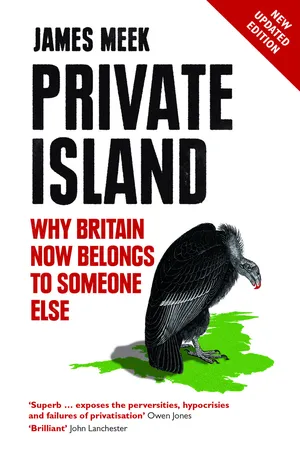
In a little over a generation the bones and sinews of the British economy - rail, energy, water, postal services, municipal housing - have been sold to remote, unaccountable private owners, often from overseas. In a series of brilliant portraits the award-winning novelist and journalist James Meek shows how Britain's common wealth became private, and the impact it has had on us all: from the growing shortage of housing to spiralling energy bills.
Meek explores the human stories behind the incremental privatization of the nation over the last three decades. He shows how, as our national assets are sold, ordinary citizens are handed over to private tax-gatherers, and the greatest burden of taxes shifts to the poorest. In the end, it is not only public enterprises that have become private property, but we ourselves.
Urgent, powerfully written and deeply moving, this is a passionate anatomy of the state of the nation: of what we have lost and what losing it cost us - the rent we must pay to exist on this private island.
- 240 pages
- English
- ePUB (mobile friendly)
- Available on iOS & Android
eBook - ePub
About this book
Information
1. In the Sorting Office
Privatised mail
Somewhere in the Netherlands a postwoman was in trouble. Bad health, snow and ice and a degree of chaos in her personal life had left her months behind on her deliveries. She rented a privatised ex-council flat with her partner and so many crates of mail had built up in the hallway that it was getting hard to move around. Twice a week one of the private mail companies she worked for, Selektmail, dropped off three or four crates of letters, magazines and catalogues. She sorted and delivered the fresh crates but the winter backlog was tough to clear. She thought her employers were getting suspicious. I counted sixty-two full mail crates stacked up in the hall when I visited. There was a narrow passageway between the wall of crates and her personal pile of stuff: banana boxes, a disused bead curtain, a mop bucket. One of the crates had crept into the study, where the postwoman’s computer reared up out of her own archival heaps of newspapers and magazines. Were those two streams of paper to merge they would not have been easily separated. The postwoman hadn’t given up. She’d had a similar problem with the other private mail company she worked for, Sandd, a few years earlier. ‘When I began at Sandd in 2006 I delivered about fourteen boxes of mail every time,’ she said. ‘I couldn’t cope and at Christmas 2006 I had about ninety of these boxes in the house. By New Year’s Day we had ninety-seven. There were even boxes in the toilet.’ The postwoman was paid a pittance to deliver corporate mail. She hadn’t done her job well, yet so few people had complained about missed deliveries that she hadn’t been found out.
Across the world, postal services are being altered like this: optimised to deliver the maximum amount of unwanted mail at the minimum cost to businesses. In the Internet age private citizens are sending less mail than they used to, but that’s only part of the story of postal decline. The price of driving down the cost of bulk mailing for a handful of big organisations is being paid for by the replacement of decently paid postmen with casual labour and the erosion of daily deliveries.
I agreed not to name the Dutch postwoman or to give away any detail that would identify her. Even if she hadn’t been sitting on months of undelivered mail Sandd or Selekt could have sacked her in a heartbeat. She worked, she reckons, about thirty hours a week for the two companies, earning about five euros an hour, although the legal minimum wage in the Netherlands is between eight and nine euros an hour. She had no contract. She got no sick pay, no pension and no health insurance. One of the companies gave her a dribble of holiday pay. Selekt gave her a jacket and a sweatshirt but she got no other clothing or footwear and had to pay to maintain her own bike. The company was able to offer such miserable conditions because of loopholes in Dutch employment law. The postwoman was paid a few cents for each item of mail she delivered. The private mail firms controlled their delivery people’s daily postbag to make sure they never earned more than €580 a month, the level at which the firms were obliged to give them a fixed contract. Somehow Selekt hadn’t noticed it was getting fewer empty crates back than it sent full crates out. When I followed the postwoman to the kitchen, I saw, like some recurring nightmare, twenty more crates filled with letters.
Selekt’s crates were yellow and stamped with the black hunting horn logo of Deutsche Post, the former German state mail monopoly that, like its Dutch counterpart, was privatised long ago. For years the two had been locked in a struggle for business on the streets of the Netherlands, part of a fratricidal postal war across northern Europe into which Britain’s newly privatised Royal Mail has been drawn. Privatising old state post companies doesn’t necessarily make it easier for rivals to compete with them. Privatisation isn’t the same as liberalisation. But in Holland privatisation and liberalisation combined have altered the post in a way far beyond anything Britain has so far seen.
At the time I visited the Netherlands, Dutch households and businesses were visited by postmen and postwomen from four different companies each week. There were the ‘orange’ postmen of the privatised Dutch mail company, trading as TNT Post but about to change its name to PostNL; the ‘blue’ postmen of Sandd, a private Dutch firm; the ‘yellow’ postmen of Selekt, owned by Deutsche Post/DHL; and the ‘half-orange’ postmen of Netwerk VSP, set up by TNT to compete cannibalistically against itself by using casual labour that is cheaper than its own (unionised) workforce. TNT delivered six days a week, Sandd and Selekt two, and VSP one. From the point of view of an ardent free marketeer, it sounded like healthy competition. Curiously, however, none of the competitors was prospering. TNT was being forced by the hedge funds and other transnational shareholders who controlled its destiny to split up, even as it tried to beautify its bottom line by replacing reasonably paid jobs with badly paid ones. Deutsche Post was pulling out of the Netherlands and selling Selekt to Sandd – a company that had never made a profit.
Sandd, set up by a group of ex-TNT managers, pioneered the distinctive Dutch style of private mail delivery. ‘Sandd’ stands for ‘Sort and deliver’. In Britain, as in many other countries with big postal networks, private companies can now collect and sort mail, but delivery, the so-called ‘final mile’ of a letter’s journey, has remained until very recently a Royal Mail monopoly. Mail is delivered from distribution centres to local delivery offices, where salaried Royal Mail postal workers sort it into individual rounds and deliver it by van, bike and on foot. Under the Sandd system, crates of mail are delivered to casual workers’ houses. These workers sort the mail, on whatever flat surface they can find, then deliver it on set days at a time of their choosing. Besides slashing the mail companies’ overheads, the system has the advantage, from the management’s point of view, that there is little danger of the postmen and postwomen meeting each other to swap grievances or talk about joining a union.
I watched the postwoman sorting mail in her kitchen, dividing it up into piles on the steel counter on either side of the sink, carefully dried after the evening’s washing-up. It seemed to be mainly Ikea catalogues, the cover showing an exquisitely lit arrangement of blond, cheerful furniture. The Ikea ideal did not include any obvious area for the sorting of mail. As the greasy slap of the catalogues’ plastic covers hitting the counter became monotonous, my eye kept being drawn to a row of Smurfs balanced on the copper pipe above the sink. They were covered in a thick layer of black dust. The postwoman knew things were not going well. In an anguished email she sent me after my visit, she wrote: ‘Many tears are dropping.’
Another private postman, Joris Leijten, who quit Sandd a few months earlier, told me he used to sort mail on his bed. In a café among the grand villas of Bussum, near Hilversum, he handed me the flyer that Sandd put through his door after he resigned, advertising his job: a picture of four smiling white people in Sandd blue, striding down the road with light sheaves of paper, grinning. ‘Keep busy outdoors, in charge of your own time,’ it read. ‘Ideal for students, housewives and pensioners’ He showed me a day’s work from just after Christmas: three rounds, sorting and delivering 323 pieces of mail, weighing a total of 81.4 kilograms, to 279 addresses. Sandd claimed this should take six hours; Leijten said it took eight. For this he was paid a little over twenty-seven euros – not much more than three euros an hour.
Sandd promotes the job as a ‘bijbaan, a bit of work on the side for somebody who wants fresh air and exercise and already has a state pension, is studying or has a salaried husband. But Leijten, thirty-two and unable to get the museum job he’s trained for, is not alone in relying on several poorly paid bijbaans for his livelihood. I asked whether Sandd had given him anything besides eight cents a letter. Normally, he said, workers had to pay for their uniforms out of their wages. But the company also hands out points’ every so often, which can be redeemed against a blue Sandd jacket.
In the Netherlands, as in Britain, the postal market has been liberalised in the name of the consumer, as Europe’s former citizens are now known: competition, it is said, will benefit everybody. But competition, as Leijten noted, only really exists for large organisations. Private citizens can’t post letters in Sandd or Selekt mailboxes. There aren’t any. Ordinary Dutch people still had to pay forty-six cents to send a PostNL letter. The Dutch government, meanwhile, had negotiated a deal with Sandd to deliver some of its mail at eleven cents a pop. ‘For ordinary people, there’s no choice, there’s only TNT,’ Leijten said. ‘The postal system is sick.’
On the eve of my journey to Holland, David Simpson, the earnest Ulsterman who was Royal Mail’s chief spokesman, took me to one of the facilities the company is most proud of, the Gatwick mail centre in Sussex. Despite its name, it has nothing to do with the nearby airport. It’s a giant mail processing plant, built in 1999, that sucks in and shoots out every letter, packet and small parcel posted from or sent to every address in six hundred square miles of England, from the M25 down to the south coast, from Eastbourne in the east to Littlehampton at the westernmost edge of the county. They sort two and a half million items a day.
Michael Fehilly, Gatwick’s manager, strode around in a grey pinstripe suit, brown loafers and an open-necked pink shirt. He’s second-generation Irish. ‘My dad tells me I’m a plastic Paddy, not a real one,’ he said. He grew up on a council estate in Peckham and joined the Post Office as an apprentice postman in 1987, aged seventeen. He hated the early starts and was ready to quit after a few months. Instead they made him a trainee manager. Twenty-four years later he is a company star. Under Fehilly, Gatwick has embraced the philosophy of the Japanese management consultant Hajime Yamashina, which Royal Mail is trying to propel throughout the company. Yamashina visits Gatwick all the time. He was at the mail centre on the day the earthquake and tsunami struck his homeland. Fehilly’s eyes shone as he preached the Yamashina way. It starts with safety. All over the mail centre there are cute cartoons of an animal in a white coat and glasses: the Safety Mole.’ “Don’t be safety blinded, be safety minded,”‘ Fehilly said. ‘When I started the programme I could guarantee twenty-eight accidents a year – a knock, a bump or a bruise. Last year we had zero accidents’
The vast industrial space, made of breeze blocks and galvanised steel and filled with trolleys and sorting machinery, is neat and clean, enabling Fehilly to practise his kaizen powers of vision. He stopped suddenly and pointed to a bit of floor that looked spotless to me. ‘I can see three rubber bands and a label,’ he said. ‘That’s a defect to me now. Five years ago I would just have accepted that. Now my eyes have improved, that’s a defect to me.’ Fehilly has worked with the staff to find solutions to problems they didn’t know were problems. The Gatwick workforce saved a million pounds a year just by hiring an electric truck to replace the laborious heaving of mail trolleys from one side of the plant to the other. They discovered that certain electric conveyor belts were slowing down the people who worked on them and invented a simple, unpowered device that let gravity do the work instead. They found that, for more than a century, nobody had questioned the number of pigeonholes in the frames that mail sorters use to sort letters by region. Why were there fifty-six? Because there’d always been fifty-six. It turned out that entire man-years of pain and muscle strain, not to mention wasted time, could be saved just by reducing the number of pigeonholes to fifteen and cutting openings at the back as well as the front.
Yet even with such ingenuity and co-operation, even with the closure of post offices and mail centres and the whittling down of the company workforce from 230,000 to 165,000 in nine years, even at relative peace with the union, even earning £9 billion a year, the Royal Mail was struggling, competing for a shrinking quantity of mail with aggressive competitors, first among them Hollands TNT.* Unlike its competitors, it was – and is – obliged to hand-deliver to every home and business in the country, from Lerwick to Penzance, six days a week. It couldn’t make more money without modernising faster, and it couldn’t modernise faster without more money. Hence the main official justification for privatisation, a familiar one – that a private Royal Mail would be able to borrow money for itself, privately, whereas a publicly-owned Royal Mail couldn’t be allowed to borrow and add to the government’s debt.
I wondered what Fehilly thought of the Sandd system, and told him I was on my way to the Netherlands to see how their private postmen operated. Fehilly didn’t see why it couldn’t work in Britain. ‘We can prepare the mail for delivery,’ he said. ‘We can go and deliver a sack of mail to some mother’s house who’s just dropped her kids at school, she can spend two or three hours delivering mail in her area – it’s a model we’re aware of and would like to use. We’re stuck with a large workforce... [the Dutch model] is a model we’ve spoken of and would like to do in the future.’
I sensed Simpson, standing at my shoulder, prickling nervously. ‘We’d certainly have to agree that with the unions,’ he said.
‘Of course, yes. But why not?’ Fehilly persisted. ‘I’d say, in the future, why not look at these models if they’re more efficient?’
It’s not easy to understand what happened to turn the Netherlands into a test bed for a private postal service. In privatising their own royal mail the Dutch, who for some reason have an image in Britain and America as vaguely hippyish lefty liberals, went one step further than Margaret Thatcher ever did. The Dutch establishment weaves a subtle web of complicity and patronage that binds its members together over generations, discouraging discussion of the past with outsiders. Ruud Lubbers, who as prime minister from 1982 to 1994 led the free-market charge, declined my interview request. Neelie Kroes, who pushed through the privatisation of the Dutch post office under Lubbers in 1989, had the excuse that she is a European commissioner.
One morning I went in search of the last left-winger to run the Dutch mail, Michel van Hulten, who had the post office in his portfolio until 1977 in the government of Joop den Uyl. I boarded one of the yellow double-decker trains that tick across the Dutch countryside and set out for van Hulten’s home in the town of Lelystad. At some point a change in the light made me look up from my book. The landscape had altered. To the right of the train was a flat plain dotted with rows of boxy houses. There was something raw and fresh about the land, like some stretch of the American prairie that had only just been settled by Europeans, and something strangely familiar about the low-rise, flat-roofed, cuboid form of the houses, even the way they were spaced: it looked like Milton Keynes.
To the left, towards the sea, the view was disorientatingly different. It reminded me of an illustration in a book I had as a child of how the north European plain would have looked at the end of the Pleistocene era. Under a grey sky, the flatlands stretched off towards the bright horizon, dotted with isolated trees, bent over by the prevailing wind, like some Friesian veldt. The spring grass, sprouting bright green out of the cold soil, was being cropped by huge herds of deer, shaggy, long-horned kine and wild ponies. It was a primeval scene, a few minutes northeast of Amsterdam; only the mammoths were missing.
This, as van Hulten explained to me in the kitchen of his Lelystad bungalow, was Flevoland. It’s artificial, the result of perhaps the most grandiose act of intervention in nature by a twentieth-century government: the creation of new land out of the sea in the form of two great polders, together about the size of South Yorkshire. The kitchen where we sat eating toast and cheese and drinking coffee was, when van Hulten was born in the Dutch East Indies in 1930, several metres under the salt water of the Zuiderzee. The deer, ponies and cattle I saw had been imported and left to run wild in a nature reserve, the Oostvaardersplassen. And Milton Keynes? ‘The English new towns were an inspiration for us,’ van Hulten said, and he smiled at me kindly as though I were a long-lost relative. He was one of the architects of Flevoland, and one of its early inhabitants. He and his wife were among the first four hundred settlers of this new world in 1972, as his brief political career began. The virgin lands he helped to create are a memorial to the era of government intervention, of belief that the state had the power, the right and the duty to make a better world for its citizens. The building of the dam across the Zuiderzee began as a Great Depression work programme, and the appearance of the polders above the waves coincided with the high-water mark of progressive socialist optimism in the 1960s and 1970s.
‘In the beginning, the state did everything,’ van Hulten said. ‘It was a state enterprise and fully paid from the state budget. When you needed money no one in the Hague was interested why: you got it.’ Marxist and New Testament ideas mingled in van Hulten and the spirit of Paris was palpable in Holland in 1968, when the non-aligned group he was one of the leaders of, the Christian Radicals, became a political party, the Political Party of Radicals or PPR. A series of accidents led to his getting a seat in parliament and in 1973 he found himself, to his surprise, the minister for transport in a left-leaning coalition government, responsible for, among other things, the Dutch post office.
In the 1970s the Dutch, like the British, experienced high inflation, rapid industrial decline, strikes, a vague sense of national failure and a reaction against the dirigiste, technocratic governments that built new towns or summoned a Flevoland out of the sea. Locked in a fractious coalition cabinet where the prime minister’s trump card was his ability to stay awake in late-night meetings longer than any of his quarrelling ministers, van Hulten saw the growing ideological polarisation of Dutch politics, but didn’t realise that the same intellectual currents driving Thatcherite and Reaganite thinkers were at work in the Netherlands. When he took charge of the Dutch post office, it was losing money. His solution was straightforward: he doubled the price of stamps. He still sounds surprised that he was attacked for it from the opposition benches by Neelie Kroes, who accused him of hurting business. His idealism brought him up against the rightist finance minister, Wim Duisenberg, over the post office bank.
‘It was one of the richest banks in the Netherlands, 100 per cent owned by the Dutch people,’ van Hulten said. ‘It was my opinion that we should use the money for social purposes... That was a fight I lost. Duisenberg already favoured making the post bank independent of the post office. I did not understand this at the time as a move to privatisation.’ Van Hulten left government and parliament after the 1977 election. His successor, Kroes, set about preparing the ground for the privatisation of the Dutch post office. Not long afterwards, a curious sequence of Nazi-related scandals felled Lubbers’s Christian Democrat rivals – one of them, the ex-postal worker Wim Aantjes, forgot to tell anyone that he had joined the SS during the war in order to get out of forced labour as a postman in Nazi Germany – and Lubbers became prime minister, pushing through postal privatisation with Kroes in 1989. Seven years later the privatised company bought the Australian parcels company TNT and took its name.
Van Hulten, now in his eighties, is still an activist, an...
Table of contents
- Cover
- Title Page
- Copyright
- Dedication
- Contents
- Introduction
- 1. In the Sorting Office
- 2. Signal Failure
- 3. Not a Drop to Drink
- 4. Taking Power
- 5. Multiple Fractures
- 6. No Vacancies
- 7. Farageland
- Afterword
- Acknowledgements
Trusted by 375,005 students
Access to over 1.5 million titles for a fair monthly price.
Study more efficiently using our study tools.
Frequently asked questions
Yes, you can cancel anytime from the Subscription tab in your account settings on the Perlego website. Your subscription will stay active until the end of your current billing period. Learn how to cancel your subscription
No, books cannot be downloaded as external files, such as PDFs, for use outside of Perlego. However, you can download books within the Perlego app for offline reading on mobile or tablet. Learn how to download books offline
Perlego offers two plans: Essential and Complete
- Essential is ideal for learners and professionals who enjoy exploring a wide range of subjects. Access the Essential Library with 800,000+ trusted titles and best-sellers across business, personal growth, and the humanities. Includes unlimited reading time and Standard Read Aloud voice.
- Complete: Perfect for advanced learners and researchers needing full, unrestricted access. Unlock 1.5M+ books across hundreds of subjects, including academic and specialized titles. The Complete Plan also includes advanced features like Premium Read Aloud and Research Assistant.
We are an online textbook subscription service, where you can get access to an entire online library for less than the price of a single book per month. With over 1.5 million books across 990+ topics, we’ve got you covered! Learn about our mission
Look out for the read-aloud symbol on your next book to see if you can listen to it. The read-aloud tool reads text aloud for you, highlighting the text as it is being read. You can pause it, speed it up and slow it down. Learn more about Read Aloud
Yes! You can use the Perlego app on both iOS and Android devices to read anytime, anywhere — even offline. Perfect for commutes or when you’re on the go.
Please note we cannot support devices running on iOS 13 and Android 7 or earlier. Learn more about using the app
Please note we cannot support devices running on iOS 13 and Android 7 or earlier. Learn more about using the app
Yes, you can access Private Island by James Meek in PDF and/or ePUB format, as well as other popular books in Politics & International Relations & Social History. We have over 1.5 million books available in our catalogue for you to explore.