- 144 pages
- English
- ePUB (mobile friendly)
- Available on iOS & Android
eBook - ePub
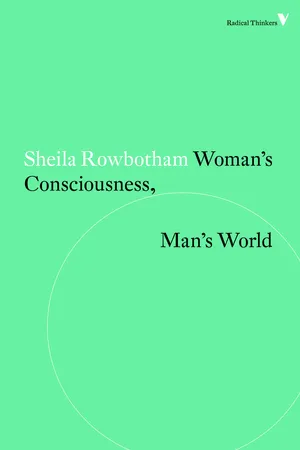
Woman's Consciousness, Man's World
About this book
A groundbreaking contribution to debates on women's oppression and consciousness, and the connections between socialism and feminism. Examining feminist consciousness from various vantage points - social, sexual, cultural and economic - Sheila Rowbotham identifies the social conditions under which it developed, showing how the roles women take on within the capitalist economy have shaped ideas about family and sexuality.
Information
PART 1
Through the Looking-Glass
They have learnt to examine how capitalism is oppressing them … it helps them to understand the relationship between their struggles and the struggles of other groups in our society. The deepest awareness of the evils of the capitalist system and the most unshakeable commitment to overthrowing that system is attained, not by studying socialist classics nor by working for someone else’s ’cause’, but by people examining the features of their own specific oppression. Women learnt not to wait for liberation to be won for them by radical (white) males, but to create their own issues and do it themselves. In the process of destroying the ‘myth of inactivity’ they are not only developing their own potentials as revolutionaries, but the movement itself will contribute to the struggle against capitalism.
Gill Simms, I.S. Women’s
Newsletter, no. 4.
Newsletter, no. 4.
the guiding thread: no
generalizations about man or woman
any distinctions are: irrelevant,
the choice merely between images
at least, that’s what it thought
until a beastie glared back from
the mirror; and suddenly
back from the cradle jumped
the giant and Baba Yaya
in her three-legged chicken hut
and the pike who always got the perch
it all shudders so furiously
that no hand can steady it
for fear momentum
will disrupt the fingers
tiny tiny
pieces of glass
jagging in different parts
of the planet; jeering, but there’s
no blood
she did suffer, the witch;
trying to peer round the looking
glass, she forgot
someone was in the way.
Michelene, ‘Reflexion’,
Shrew, May 1971
CHAPTER 1
The Problem without a Name
Just what was this problem that has no name? What were the words women used when they tried to express it? Sometimes a woman would say “I feel empty somehow … incomplete.” Or she would say “I feel as if I don’t exist.”
Betty Friedan,
The Feminine Mystique
The Feminine Mystique
Why did it take us so long to make a movement like women’s liberation? To start with we had consciously to recognize our femaleness and see through the existing versions of femininity which surrounded us. This was very difficult. There were distorting mirrors everywhere. People like me who were 17 in 1960 inherited a political feminist hiatus. Throughout the previous decade it had been as if there were no longer any reason to complain. Women were taught to regard themselves as satisfied. There was an enormous barrage of propaganda which served to create what Betty Friedan called ‘the feminine mystique’. Dissatisfaction must be a personal failure. They faced their own experience completely alone. This made it very difficult for women to write about liberation in this period without having first to prove that there wasn’t something wrong with them. Inevitably this restricted how far they could think. This was of course related to the general political climate of the cold war which made any form of radical activity difficult and lonely. But it was also because on the surface it looked as if women in the western capitalist countries were quite happy with things as they were. The tone of things was very much ‘We’re sitting pretty thank you’. The fifties was an era of elaborate hair-dos, constraining clothes and Dr Spock. Letters appeared in the papers from women saying they didn’t want to have careers. The child psychologists stressed breast-feeding. Women with husbands who had been in the war went through paroxysms of guilt at the thought of leaving their small children. The bogy of mother deprivation was let loose.1 The nurseries closed up. Immediately after the war women had left the skilled jobs they had had in the factories. Draughtswomen became housewives. Pastel colours were everywhere. In England the young queen and her family reinforced the idyll of love and marriage. Women were soon reabsorbed back into industry doing women’s work. But the guilt about working mothers and latch-key children persisted. Propaganda for domestic bliss did not only come from the right. ‘Left-wing’ sociologists stood firm on the sanctity of the family.
The communist and Trotskyist movements retained theoretical commitment to the emancipation of women. But it was phrased in terms of the need to involve women in production and it was in a language which could not really express the feelings of women in post-war capitalism. Similarly the tone of the kind of feminism which had survived the movement for the vote, with its gritty get-in-and-at-them note was somehow off-key. The good-brick kind of girl like Katharine Hepburn in The Rainmaker was being superseded by the sexual-little-girl-lost-who-gets-the-nice-feller-with-glasses-who-conveniently-happens-to-be-a-millionaire. When people talked about equal rights there was a curious feeling that the record had stuck somewhere.
Betty Friedan’s The Feminine Mystique came out of this period. It must have been a very difficult book to write because she started by pursuing an apparently completely submerged discontent. She graphically describes a sense of isolation. The atmosphere is of a suburban coffee meeting in an American city at the end of the decade. You can almost hear the chink of the cups on the saucers, and the slight brushing of stockinged legs as they cross and uncross with the restrained restlessness of women who have been reasonable and nice all their lives.
The problem lay buried, unspoken for many years in the minds of American women. It was a strange stirring, a sense of dissatisfaction, a yearning that women suffered in the middle of the twentieth century in the United States. Each suburban wife struggled with it alone. As she made the beds, shopped for groceries, matched slip cover material, ate peanut butter sandwiches, chauffeured Cub Scouts and Brownies, lay beside her husband at night, she was afraid to ask even of herself the silent question: ‘Is this all?’2
Betty Friedan calls it ‘the problem that has no name’3 because it did not fit into the same categories as the problems which had already been given names when she was writing. These women were not economically exploited, they did not sell their labour power, they were not hard up. They did not lack things. On the contrary, they often had too many things. But they felt that their lives were empty. They did not know who they were or what they wanted to become. It was by no means apparent that their situation could be understood politically. How could you organize round a sense of emptiness? In fact the strength of the book comes from the dauntless way in which she unravels and tracks down the origins of the mystique before any political implications were apparent. She uncovers the shift in women’s magazine stories, the uses of popular anthropology and psychology, the changing emphasis in higher education, early marriages, anxiety about sexual performance. Her book was a revelation to many women because it was so determinedly about everyday matters. And most of our lives are ‘everyday’. It included all those little things which became so important because women encountered them over and over again.
The weakness of the book was its remedies. She sees more and better education as the answer; there is vague reference to a ‘new life plan’ and the glimpse of a movement, but it’s a movement which can only see itself shuffling about within capitalism. She excludes working-class women from the terms of reference and never penetrates the manifestations of women’s oppression through to the material structure of society, so the ‘feminine mystique’ retains its mystery. But she still peeled off important layers of confusion.
In the chapter on ‘The Functional Freeze, The Feminine Protest, and Margaret Mead’ she describes how Margaret Mead’s extremely popular anthropological work tended to be used to justify the perpetuation of existing male and female ‘roles’. The vision of bare-breasted women in the South Seas ‘where a woman succeeds and is envied by man just by being a woman’ was tempting to American women struggling off to work in the rush hour. The romance of being a career girl began to wear thin. The gloss of small-town girl makes good in big city only just concealed the real exploitation of female white-collar workers. Behind the enthusiasm for discovering a distinct role and the natural-childbirth breast-feeding movement was undoubtedly a dissatisfaction with life in a modern capitalist society. But as Betty Friedan points out it assumed a most reactionary form. ‘The yearning is for a return to the Garden of Eden: a garden where woman need only forget the divine discontent born of education to return to a world in which male achievement becomes merely a poor substitute for child-bearing.’4
The reasoning went like this. The function of women in our society is to reproduce. Our system of higher education operates in contradiction to this, and thus creates a situation of imbalance which makes women unhappy. Feminism is the product of this frustration. If we were to educate women to fulfil their role as reproducers all would be well. This was handy reasoning with a female labour force that had to be sent home or taught its place doing women’s work at low pay. It was useful stuff to all manner of gentlemen in high places paid large sums to devise educational reports to enable young women to keep tight budgets and cook good dinners. It was ignored that it was rather naïve to expect women to fulfil some abstracted ‘natural’ function in a most unnatural society particularly when contraceptives were reducing the time women were spending in childbirth. There were apparently no prospects either for the women who were already educated. Their aspirations were not considered to be important. The idea of female ‘roles’ served to give a spurious modernity to an old conservatism. Just as the eighteenth-century bishops had fulminated against the idea of working-class education because it conflicted with the notion of station and their own class interest, which needed the ‘hewers of wood’ in their place, social science contributed towards a notion of femininity in which baby-doll became a new natural-savage substitute. As it became less and less possible politically to sentimentalize workers, blacks, or the colonized as representatives of the primitive, the yearning of the bourgeois for animality which did not shatter the repression and work-discipline essential to capitalism focused completely on women.5
Ironically all this was completely at variance with Margaret Mead’s own life and work. She and her friend and close colleague Ruth Benedict were intellectual pioneers in anthropology when it was very unusual for women to study the subject. Both of them were emphatic on the need for both sexes to develop their full potential. But they reacted against the tendency in feminism which refused to admit and examine the actual difference between men and women. They both believed that by accumulating more data on women they would be able to throw light on what were essential aspects of femininity rather than forcing women into a masculine mould. Ruth Benedict wrote in her journal in the early 1920s, ‘The emotional part of woman’s life – that part which makes her a woman – must be brought out of the dark and allowed to put forth its best.’6 She wanted the ‘thorough-going differences between men and women’, which were ‘both deeper in some respects and shallower in others than are today generally recognized’, to be carefully studied. She believed external changes were necessary, but that ‘the ultimate objective remains an inward affair, a matter of attitude.’7 Later she wrote about her inability to realize her sense of personal experience, ‘that sees existence under the form of eternity … that fire upon our flesh shall burn as a knife that cuts to the bone, and joy strip us like a naked blade’8 in the external world of work and obligation. Even when she was satisfied with her work, ‘It’s always busy work I do with my left hand, and part of me watches grudging the waste of life time.’ It was not evident to her that the aim of life should be activity. She wished she had been born in a time when contemplation was the end of life. But both this sense of dislocation with the inner and outer world and the commitment to the growth of the specific nature of women were eclipsed. In the 1960s Margaret Mead was left wondering about the ‘retreat into fecundity’.9 It was evident that the mere existence of social data was not enough to reveal what a woman was. The political force of the need to keep women within the ‘role’ capitalism had assigned to them was sufficiently strong to turn any discoveries about the position of women in completely different cultures into a justification for the existing structure of sexual relationships.
The notion of female destiny which came from anthropology combined with the ‘anatomic destiny’ of a vulgarized Freudianism to make the distinction between anatomic and cultural possibility even harder to disentagle. Freud’s own rather odd ideas about female sexuality assumed a religious quality in the hands of his followers. They were apparently not unrelated to his personal attitudes. Betty Friedan quotes a letter he wrote in 1883 criticizing J. S. Mill which was reactionary within its own time. ‘If I imagined my gentle sweet girl as a competitor, it would only end in my telling her, as I did seventeen months ago, that I am fond of her and that I implore her to withdraw from the strife into the calm, uncompetitive activity of my home.’10
He recognized that different upbringings would equip women to go into the outside world men had made but that this would destroy the most ‘delightful thing the world can offer us – our ideal of womanhood’. It didn’t occur to him to criticize the economic basis of competitive capitalism. Despite his cautious conservatism in a complicated and self-doubting way he realized from his researches in the nineties into the prevalent hysteria of Viennese upper-class women the supreme importance of sexuality in the lives both of men and women. He repeatedly stressed the tragic implication for human beings of thwarted sexuality and pointed out how women especially were doomed frequently to unhappiness simply because of inadequate contraceptive measures. These were radical and liberating discoveries at the time. However, later, though he was critical about the use of ‘masculine’ and ‘feminine’ as scientific terms, he made extremely loaded statements based on inadequate evidence which were accepted subsequently. His main ideas about female psychology were developed when he was already ill from cancer and could not test them with case history material. He was not unaware of this himself. ‘In his last years Freud stated with increasing frequency the significance of the gaps and obscurities in his own theories: one that preoccupied him was the meaning of being a woman, the nature of femininity. Simply what is it? “I cannot discover what it is, to be feminine.” ’11
His preoccupation with the question was important but unfortunately it has only been spasmodically followed up by attempts to distinguish between biology, psychology and history.12 In the case of women all three still remain in considerable obscurity. The psychoanalytic work of Karen Horney is particularly valuable for this reason. Karen Horney studied psychoanalyis in Berlin before the First World War. Both the political climate of Berlin after the war and less deterministic ideas of science meant that she was inclined to stress the need to account for the effects of the environment as well as the internal psychological state of the patient. Later when she went to America to escape the rise of fascism in Germany she became familiar with anthropological work and ideas of cultural relativism. As early as 1922 in a paper ‘On the Genesis of the Castration Co...
Table of contents
- Cover
- Title Page
- Copyright
- Contents
- Acknowledgements
- Introduction
- Part 1: Through the Looking-Glass
- Part 2: What Did You Do Today, Dear?
Trusted by 375,005 students
Access to over 1.5 million titles for a fair monthly price.
Study more efficiently using our study tools.
Frequently asked questions
Yes, you can cancel anytime from the Subscription tab in your account settings on the Perlego website. Your subscription will stay active until the end of your current billing period. Learn how to cancel your subscription
No, books cannot be downloaded as external files, such as PDFs, for use outside of Perlego. However, you can download books within the Perlego app for offline reading on mobile or tablet. Learn how to download books offline
Perlego offers two plans: Essential and Complete
- Essential is ideal for learners and professionals who enjoy exploring a wide range of subjects. Access the Essential Library with 800,000+ trusted titles and best-sellers across business, personal growth, and the humanities. Includes unlimited reading time and Standard Read Aloud voice.
- Complete: Perfect for advanced learners and researchers needing full, unrestricted access. Unlock 1.5M+ books across hundreds of subjects, including academic and specialized titles. The Complete Plan also includes advanced features like Premium Read Aloud and Research Assistant.
We are an online textbook subscription service, where you can get access to an entire online library for less than the price of a single book per month. With over 1.5 million books across 990+ topics, we’ve got you covered! Learn about our mission
Look out for the read-aloud symbol on your next book to see if you can listen to it. The read-aloud tool reads text aloud for you, highlighting the text as it is being read. You can pause it, speed it up and slow it down. Learn more about Read Aloud
Yes! You can use the Perlego app on both iOS and Android devices to read anytime, anywhere — even offline. Perfect for commutes or when you’re on the go.
Please note we cannot support devices running on iOS 13 and Android 7 or earlier. Learn more about using the app
Please note we cannot support devices running on iOS 13 and Android 7 or earlier. Learn more about using the app
Yes, you can access Woman's Consciousness, Man's World by Sheila Rowbotham in PDF and/or ePUB format, as well as other popular books in Social Sciences & Radicalism. We have over 1.5 million books available in our catalogue for you to explore.