- 272 pages
- English
- ePUB (mobile friendly)
- Available on iOS & Android
eBook - ePub
About this book
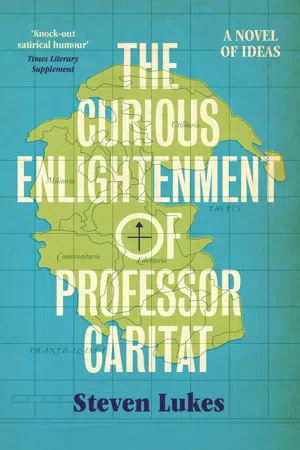
The Curious Enlightenment of Professor Caritat is a brilliant fictional journey through Western political philosophy by one of our most original thinkers. Professor Caritat, a middle-aged Candide, walks naively through the neighbouring countries of Utilitaria, Communitaria and Libertaria, in his quest to find the best of all possible worlds. Cut loose from the confines of his ivory tower, this wandering professor is made to confront the perplexed state of modern thinking in this dazzling comedy of ideas.
Information
Topic
LiteratureIndex
Literature1
Arrest
The worst thing about Professor Nicholas Caritat’s arrest was that they smashed his spectacles. It was the thing he most feared and least expected. They strengthened their control over reality by weakening his control over appearances.
Nicholas had been reading peacefully in his study, wrapped in the black velvet cloak lined and edged with silver-white fur that he always wore during his nightly debates with the thinkers of the Enlightenment. He had gone to bed late and was sleeping fitfully, uneasily aware that, judging by the fate of many of his friends, his days of freedom were numbered. Yet he had not gone into hiding. He had always avoided compromising political involvements. He was a scholar, a historian of ideas and a philosopher – and thus a person, he hoped, of no significance.
There was a sudden sharp rap at the front door. He sat up in bed and listened. There was certainly no hope of escape: they would have surrounded the building and would shoot him on sight. He could see flashing lights outside the window. There was more violent knocking on the door. He rose from his bed, put on his spectacles and silk dressing gown, and walked in measured steps in the darkness towards it along the narrow carpeted hall. Before he could reach the door, he heard a loud crash and the splintering of the wood of the door frame. Another crash, the lock gave way and before him in the dim light of the hallway stood what were plainly four silent soldiers in plain clothes. They entered the flat and, without speaking, switched on the lights and marched forward to his study at the far end of the hall. Nicholas followed them into the room. Their boyish leader, the youngest of the lot, looked at him with menacing indifference.
‘Go and get dressed!’ he ordered.
Then came the gratuitous assault on his spectacles. As he turned to go into the bedroom, one of the soldiers, burly, sweating and snorting, came close to him, ripped them from his face, flung them on the carpet and crushed them with both feet. Nicholas found the crunching of the glass and the indistinct sight of the twisted frames peculiarly distressing.
Without them the world was a shimmering blur. He recalled James Thurber’s encouraging thoughts about the strange pleasure of going blind. As one’s eyesight fails, the role of the external world in fixing what one sees declines while that of interpretation increases, so you only have to be optimistic for women to be attractive, buildings to be elegant, the sun to shine. Yet there was scant reason to be optimistic about his present situation or, indeed, about the state of things in Militaria.
The latest coup had been the worst. The new Junta had unleashed a new terror campaign. Their declared aim was to exterminate the guerrilla movement the Visible Hand, whatever the cost. You never knew who was responsible for which outrage, guerrillas or government agents provocateurs. Until recently, the Hand had been divided into two factions: the Left Visible Hand and the Right Visible Hand. Invariably, each blamed the other for the killings and the bombings. All that seemed certain was that neither Hand knew what the other was doing, and that there was blood on both. Railway stations were bombed; bank raids were daily occurrences. Two months ago the Central Police Station in the Capital had been set ablaze. The guerrillas were kidnapping businessmen; the military were killing lawyers. Thousands of people had ‘disappeared’, some of them thrown out of helicopters into the sea. Most of his friends and former students were in hiding. Grey Ford Falcon cars without number plates roamed the streets. Hit men and death squads ranged freely. Different elements of the army, the navy, the air force and the military police pursued different strategies and different enemies. In short, the various arms of the military were as out of control as the Hands of the guerrillas.
But now the new Junta’s terror was more systematic and the guerrillas united. Both supporters and opponents of the regime were in danger. He had long feared that, if seized, his absence would go wholly unnoticed, especially in the outside world. His own academic contacts had long since faded, ever since his colleagues abroad had, out of solidarity, declared an academic boycott. As for his son and daughter, they were both unavailable to help. Marcus was in some guerrilla camp fighting for the Hand, and doubtless one of the reasons, or excuses, for his arrest. Eliza was also beyond reach, working underground as a human rights activist. She would certainly contact foreign governments and journalists once she heard of his seizure and campaign for his release, but, with so many arrests, disappearances and tortures, who would listen?
The order to get dressed came from the young, baby-faced officer with the commanding presence. His three oversized companions were clearly in awe of him and stood, twitching and quivering like nervous bulldogs with suppressed and menacing energy under the control of their Trainer. All four intruders followed Nicholas into his bedroom. As he slowly dressed in front of them, he decided to ask the Trainer the obvious question.
‘Why are you arresting me?’
Without expression, the Trainer said, ‘Why are we arresting you?’
Was this question an answer? Or was he repeating it the better to understand it? Or to make it clear to his bulldogs? Or was the answer a question? Was he to answer his own question? Or was the Trainer mocking the question? After all, why should he not be arrested? And why should there be a reason for his arrest? In Militaria, these days, the military did not need reasons.
He continued to dress, as elegantly as he could (the chance was not likely to recur soon) and waited to see what else might be said.
The Trainer replied, ‘We are not arresting you.’
This was not much help. Of course they had no warrant for his arrest, but such warrants were meaningless, since the courts had ceased to function. He, Nicholas Caritat, was about to disappear into some black hole, unnoticed and unlamented, his life unfulfilled, his life’s work incomplete.
His work had, so far, been what sustained him. The study of eighteenth-century ideas of progress had been, for three decades, the focus of his research and his teaching. He was obsessed with the study of past ideas about the future to the exclusion of a close interest in the present. What had it been like to have convincing reasons for hope about the future of mankind? Were any of these reasons still valid? Could one any longer have such hopes after all the horrors of this century? Were his favourite thinkers just purveyors of dangerous illusions that blinded true believers and armed cynical manipulators with rationalist dogmas that had, ever since the Jacobin Terror, wreaked havoc upon mankind? Optimism, in short, was both his subject and his object.
At his captors’ insistence, Nicholas started to pack a travelling bag. He neatly folded his cloak, for future evening discussions with Diderot and d’Alembert, Leibniz and Kant, Helvétius and Voltaire, and the others. He also packed a shaving bag, two pairs of trousers, a jacket, some shirts and ties and, optimistically, his empty spectacles case.
As the Trainer led him down the hall, Nicholas took a long last look into his study, the framework and cocoon of his daily researches and his nightly conversations, storing in his memory a final blurred image: the large deep red oriental carpet that almost covered the entire floor, the bay window over-looking his well-cultivated garden, the book-lined walls, his rolltop desk and cane rocking chair, the mahogany bookcase with its rows of mottled brown eighteenth-century volumes behind protective crisscrossed wire netting.
The Trainer pointed to the open doorway. Once outside, he heard the sound of three bulldogs, now unleashed, as they carried out the order to search and destroy his inner sanctum.
2
Prison
The Trainer took hold of him by the shoulders and threw him into the back seat of a car and two more soldiers moved in on either side of him. As the Trainer joined the driver in the front and the car moved off, he was blindfolded and handcuffed. The blindfold was something of a relief, sparing him the strain of trying to see through a dark, myopic fog. The handcuffs marked the beginning of his physical confinement and were doubtless only a mild inconvenience in comparison with what he was about to suffer.
The car sped on for something like an hour. It finally stopped at what Nicholas imagined to be a military prison. He could hear muffled voices and clanking doors and even, though he could not be sure, a distant cry of pain, or was it despair, or anger? He was hustled out of the car and pushed down two flights of stone steps and then along a long passage. Then, without warning, he was thrust into what was obviously a cell. The door slammed closed with a metallic clang that echoed down the corridor as the clumping of footsteps receded. Nicholas sat in total darkness and silence on a hard, narrow bunk with his hands between his knees. With every movement the handcuffs became tighter and his claustrophobia more intense. He had read of this moment in countless novels and prison memoirs but never imagined its chilling sense of finality or that he might himself experience it. No longer able to protect himself from immediate physical danger, he thought of poor Condorcet, the finest and the noblest philosopher of the Enlightenment, captured and imprisoned while on the run from the Revolutionary Terror, disguised as a worker on his own estate. No longer the Marquis Jean-Marie-Antoine-Nicolas Caritat de Condorcet, he died two days later in prison as plain ‘Pierre Simon’. Had he really died from ‘natural causes’ or had he taken poison from his aristocrat’s ring?
Suddenly the door clanked open, and his handcuffs were brusquely removed and his blindfold ripped off. As his eyes adjusted to the thin electric light, he could see that he had joined the Prisoners of Conscience club.
For a crazy moment, it even occurred to him to thank the remover of his blindfold and handcuffs. A closer look instantly dissuaded him from such misplaced courtesy, for he could see that the person he would have thanked was exceptionally unpleasant to behold. His jailer bore the standard marks of villainy – a tattoo on the arm, a scar on the cheek, a leer on the lips and a bald bullet head – and was clearly a specialist in intimidation. Brandishing a pistol near Nicholas’s face, he set forth the basic rules of the establishment: no reading, no writing, no talking.
What about thinking? the scholar wanted to ask, but then thought better of it.
‘You’re some kind of a professor, aren’t you?’ said Bullet Head. He spat out the words in a rough, loud, hoarse voice, as though describing something truly nauseating. ‘Well, don’t think you can outsmart us!’ he bellowed, slamming the cell door behind him.
Now, Nicholas realized, it was not only possible to think, it was necessary. Two lines of thought stretched indefinitely before him. One concerned the Great Question: how to conceive the future of Humankind? The other was no less urgent: how to preserve the future of Nicholas Caritat?
He started to plot these two itineraries of reflection. Yet, as he did so, he was overcome by an overwhelming feeling of loneliness. He had lost most of the social relations that had made him a person. He was a displaced unperson, a disengaged particle, a moleculeless atom. Not only had the military terror robbed him of the sustaining company and comfort of friends and colleagues, it had also split apart the protective nucleus of his family, whose bonds had become all the tighter after his wife Susanna’s death in childbirth. All of them, Susanna, Marcus, Eliza and Nicholas himself, had always tried to be reasonable, and all had reasonably insisted that they knew what was reasonable in the most unreasonable of situations.
When Susanna died, because of medical neglect in a hospital against which all complaints were unavailing, the arbitrariness and terrorism of the regime were still at an early stage. Nicholas still often visualized her pallid, troubled, tight-lipped face, her soft brown eyes admonishing him for his scholarly escapism, her tiny, tense body always elegantly clothed with a shawl round her shoulders. It was her fierce passions, and indeed their very ferocity, that had first drawn him to her: for painting, music, literature, friends, travel, having and enjoying children. Yet even before Eliza’s birth the darkening political situation had begun to make intimidation and insecurity a reality in their lives, and her passions had coalesced into one overriding superpassion: that of caring for her own, like an anxious bird cowering over her nest. By the time of her death her reason had become the slave of that passion. She would do anything that would protect them from the threatening world of military policemen, informers and suspect friends. For Susanna to be reasonable was to be prudent.
For Marcus to be reasonable was to solve problems. From his earliest years he had exhibited a marked impatience with the world’s complexities. If a problem looked soluble, he would quickly seize its essentials; if it did not, he would avoid or ignore it. As a child, he loved to take things apart to repair them, but he always found social relations more baffling and therefore tended to shun them. Throughout his adolescence, he was on the lookout for a map that might reduce the world’s complexity to some manageable order and, after the briefest of temptations, decided that religion did not offer it. From that experience and a summary perusal of the alternatives, he soon concluded that the point of religion was to make difficult questions seem impossible by offering unintelligible or paradoxical or contradictory mysteries instead of explanations, objects of faith instead of reasons for belief. Marcus hated mysteries, which, being neither true nor false, did not even qualify as illusions, which were at least false. Nicholas recalled his fond pride at his son’s ruthless rationalism – at how, when a schoolboy, Marcus, tall and lanky with shiny black hair and his deep, assured voice, would declaim over the family lunch-table against the exploitation of popular credulity by the pliant priests who served the military regime. Yet his recollection was rueful, for, on going to university, Marcus had fallen into the grip of the Hand, a decision doubtless responsible for Nicholas’s present captivity.
For Eliza to be reasonable was to live by principles, and by one principle in particular: that to use people was to misuse them, that no-one should be treated as a means to someone else’s end or to serve some larger social purpose. Her determination so to live did not derive from reading Kant or any other philosopher but from direct sympathy, observation and experience. Petite and pale like Susanna, she had also inherited all her mother’s passionate intensity, which she combined with her brother’s bold, indeed reckless, assertiveness and with Nicholas’s compulsive urge to envisage how the world could be in the absence of the evils that disfigured it. But unlike her father, she sought to realize that vision immediately, in the here and now, by focusing on and fighting against the most glaring of those evils. She never criticized Marcus’s joining the Hand, though she was worried. ‘Beware,’ she warned him, ‘the Hand manipulates.’ She also disliked all his Handist talk of ‘social forces’ and ‘structures’ and ‘mechanisms’. For her, every individual victim of oppression had an immediate claim on her attention and energies; she became a self-generating dynamo for defending the persecuted. She organized the mothers of those who had ‘disappeared’, arranged escapes for those in danger and cultivated international contacts to publicize individual cases. As the situation in Militaria worsened, Eliza ...
Table of contents
- Cover
- Title Page
- Copyright
- Contents
- Foreword
- Introduction
- 1. Arrest
- 2. Prison
- 3. The Eye Test
- 4. Preparations
- 5. Resistance
- 6. Confrontations
- 7. Travelling Light
- 8. Entry
- 9. Calcula
- 10. The Maximands
- 11. The Great Debate
- 12. Justice
- 13. The Collection
- 14. Mediation
- 15. Arrival
- 16. Neighbourhoods
- 17. Celebration
- 18. The Rock Star’s Tale
- 19. Malvolians and Stalactites
- 20. The Unidiversity
- 21. Malcontents
- 22. The Body of Gender
- 23. Freedom Bound
- 24. Freedom Unbound
- 25. Money
- 26. Psychiatrists
- 27. Porter
- 28. On the Street
- 29. On the Road
- Afterword
- Further Reading
Trusted by 375,005 students
Access to over 1.5 million titles for a fair monthly price.
Study more efficiently using our study tools.
Frequently asked questions
Yes, you can cancel anytime from the Subscription tab in your account settings on the Perlego website. Your subscription will stay active until the end of your current billing period. Learn how to cancel your subscription
No, books cannot be downloaded as external files, such as PDFs, for use outside of Perlego. However, you can download books within the Perlego app for offline reading on mobile or tablet. Learn how to download books offline
Perlego offers two plans: Essential and Complete
- Essential is ideal for learners and professionals who enjoy exploring a wide range of subjects. Access the Essential Library with 800,000+ trusted titles and best-sellers across business, personal growth, and the humanities. Includes unlimited reading time and Standard Read Aloud voice.
- Complete: Perfect for advanced learners and researchers needing full, unrestricted access. Unlock 1.5M+ books across hundreds of subjects, including academic and specialized titles. The Complete Plan also includes advanced features like Premium Read Aloud and Research Assistant.
We are an online textbook subscription service, where you can get access to an entire online library for less than the price of a single book per month. With over 1.5 million books across 990+ topics, we’ve got you covered! Learn about our mission
Look out for the read-aloud symbol on your next book to see if you can listen to it. The read-aloud tool reads text aloud for you, highlighting the text as it is being read. You can pause it, speed it up and slow it down. Learn more about Read Aloud
Yes! You can use the Perlego app on both iOS and Android devices to read anytime, anywhere — even offline. Perfect for commutes or when you’re on the go.
Please note we cannot support devices running on iOS 13 and Android 7 or earlier. Learn more about using the app
Please note we cannot support devices running on iOS 13 and Android 7 or earlier. Learn more about using the app
Yes, you can access The Curious Enlightenment of Professor Caritat by Steven Lukes in PDF and/or ePUB format. We have over 1.5 million books available in our catalogue for you to explore.