- 376 pages
- English
- ePUB (mobile friendly)
- Available on iOS & Android
eBook - ePub
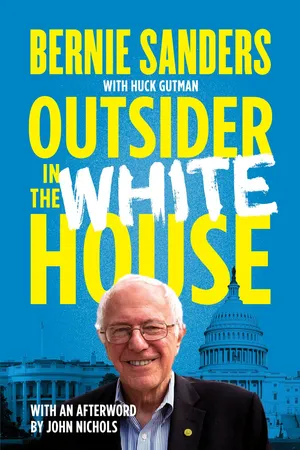
Outsider in the White House
About this book
In this book, Senator Bernie Sanders explains where he comes from. He describes in detail how, after cutting his teeth in the Civil Rights movement, Sanders helped build an extraordinary grassroots political movement in Vermont, making it possible for him to become the first independent elected to the U.S. House of Representatives in forty years and now the longest-serving independent in U.S. political history. An extensive afterword by The Nation's National Affairs correspondent John Nichols continues the story with Sanders's entrance into the Senate, the drama of the 2016 Democratic Primary, his ongoing resistance to Trump, and the thrilling launch of his 2020 bid for the White House. A new foreword by Nina Turner, former president of Our Revolution and co-chair of the Sanders for President campaign, provides a rare glimpse of Bernie as a person. Outsider in the White House tells the story of a passionate and principled political life.
Information
1
You Have to Begin Somewhere
May 20, 1996. I’m tired. It was too hot last night and I didn’t sleep well. All night a raccoon chattered in the attic of the house, finally waking me up for good at 6:30 a.m., after only four hours’ sleep. All night I worried about the impact of Dick Armey’s visit to the state of Vermont.
Armey, Newt Gingrich’s number-two man and the type of reactionary who makes even Gingrich look like a liberal, came to Vermont to endorse Susan Sweetser, my opponent in the upcoming congressional election. More importantly, he came to raise money for her. Sweetser probably made a big mistake by inviting him, since Armey, the majority leader in the House, epitomizes the congressional right wing that is every day sinking lower in the public’s estimation. About thirty Vermonters demonstrated at the hotel where Armey was speaking at a $500-a-plate dinner. They are not great fans of the Gingrich-Armey “Contract with America.”
The article in the Burlington Free Press, the largest paper in the state, gave decent coverage to the demonstrators’ protest against the savagery of the Republican cuts in Congress. The press coverage raised important issues about the Republican agenda, with its attacks on the poor, the elderly, and women, and in doing so tied Sweetser to that unpopular agenda. It even quoted someone from the local chapter of the National Organization of Women (NOW), a definite plus. Still, Sweetser ended up raising $30,000 in one night, which is a helluva lot of money, especially in a small state like Vermont.
Sweetser had advertised the Armey event as a “private briefing by the Majority Leader.” I wondered if Armey was going to share his wisdom with rich Vermont Republicans about how we should eliminate Social Security, Medicare, Medicaid, and the concept of the minimum wage, ideas he had voiced in the past. Or maybe he was just going to talk about the “Republican Revolution.” In any case, in Vermont $500 is a lot of money for dinner. I hope these rich folks enjoyed themselves.
I feel in my gut that this is going to be a very, very tough campaign. I won the last election by only three points, and Sweetser is much better organized than my previous opponent. She has started her campaign much earlier and is going to raise a lot more money than he did. I also fear that it will be a nasty campaign, with personal attacks that will become increasingly ugly. It’s going to be a brutal six months, and frankly I’m not looking forward to it.
What is really distressing is not only the negative campaigning—the lies and distortions that have already begun—but the enormous amount of time I am going to have to spend raising money and dealing with campaign operations, rather than doing the work I was elected to do in Congress. Sweetser began her campaign in November— less than halfway into my two-year term. That’s crazy. That means that I have to keep my mind on an election for twelve months, rather than focusing on my real work.
The last couple of weeks I played a leading role in opposing the Republican Defense Authorization Bill, which supplied $13 billion more for defense than Clinton’s budget had allocated. And Clinton’s budget was already way too high. But now, instead of concentrating on the important issues facing Vermont and America, I will have to devote more and more energy to the campaign. I am going to have to start getting on the phone and raising money. I’m going to have to think about polling, and TV ads, and a campaign staff. I’m going to have to make sure that we don’t repeat the many mistakes that we made in the last campaign. Basically, I’m going to have to be more political. It’s too early for that, and I don’t like it.
Most people don’t realize how far Newt Gingrich, Rush Limbaugh, and their friends have shifted the debate about where the country should be moving. In terms of the defense budget, 75 House Democrats—out of 197— supported the outrageous boost in military expenditures. Of course, almost all of the Republicans (including those fierce “deficit hawks”) backed the increase. The Cold War is over, we spend many times more than all of our “enemies” combined and, with very little fanfare, the defense budget is significantly raised.
In the Armed Forces Committee, the vote for increased military spending was almost unanimous. Only two members, Ron Dellums and Lane Evans, out of the fifty-five members of the committee, voted against it. That’s pathetic. A little pork for my district, a little pork for yours—and taxpayers end up spending tens of billions more than is needed.
Ditto for the intelligence budget. Major Owens of New York, Barney Frank of Massachusetts, and I have been trying to cut the CIA and other intelligence agency budgets for the last five years. This year, while introducing an amendment to trim their budget by 10 percent, I read into the record a New York Times article that described how the National Reconnaissance Office, one of the larger intelligence agencies, had lost $4 billion. That’s right. They lost the money. They simply could not account for $4 billion, and their financial records were a complete shambles. No problem. The intelligence agencies got their increase anyhow.
Meanwhile, the Republican Congress, with many Democrats in agreement, are cutting back on every social program that people need—for the elderly, for children, for the sick and disabled, for the homeless, for the poor. That’s called “getting our priorities straight.”
I always feel anxious at the beginning of a campaign, but I feel more so this time. It’s bad enough to be on the hit list of Gingrich and Armey, and to have the chairman of the Republican National Committee come to Vermont to announce he will give Sweetser the maximum allowable under the law, $153,000. What is most worrying, however, is that we progressives are not generating the excitement and support we need. That’s the situation even in Vermont, where independent progressive politics is as advanced as any place in the country.
I have no illusions. This is my fifth race for Congress. I lost in 1988, won in 1990, ’92, ’94. People are not as excited as they were when I first ran. “Reelect Bernie—Again” is not an especially stirring slogan. And there simply aren’t enough progressives committed to making the electoral struggle. The activities of most progressives revolve around specific issues and action groups. Many are not really in touch with their communities, nor do they appreciate the hard work involved in winning a congressional seat, a governorship, or even a mayoralty. Theory and ideas are exciting, but the practical work of capturing and holding public office—that’s another story. So I’m concerned about running into the same problem we saw two years ago: lack of motivation among our core supporters.
One difficulty we’re up against is that, to a large degree, modern American politics is about image and technique. In case you haven’t noticed, elections do not have much to do with the burning issues facing our society. Ideas. Vision. Analysis. Give me a break! Most campaigns are about thirty-second TV ads, getting out the vote, polling, and reaching undecided voters.
It is six months before the election, and the Republicans have already done their focus groups. How do I know? I can hear it in their “message,” which they repeat over and over again like a mantra: “Bernie Sanders is ineffective. Bernie Sanders is out of touch. Bernie Sanders is a left-wing extremist. Bernie Sanders rants and raves on the House floor and still no one listens to him. Susan Sweetser, on the other hand, is a sensible moderate who can work with everyone.” They think that’s how they can beat me. Maybe.
It is very frustrating that, because modern electoral politics is driven by technique, one needs more and more sophisticated “experts” in order to compete in the big league of congressional campaigns. But how far does one go in this direction? Was I elected to Congress as the first Independent in forty years so that I could hire a slick Washington insider consultant who will tell me what to say and do? Not very likely. Am I going to be shaped and molded by a Washington insider? Not while I have a breath in my body.
On the other hand, is it against some law of nature for a progressive and democratic socialist to present effective television ads, or is that just something that Republicans and Democrats are allowed to do? No. In my view we should do our TV well. Shouldn’t we be prepared to respond immediately to TV ads from my opponent which distort my record? Yes. Are we betraying the cause of socialism because we don’t communicate with mimeographed leaflets and pictures of Depression-era workers in overalls and caps? No. The world has changed, and it’s appropriate to use the tools that are available.
Still, I have reservations. From my first day in Vermont politics, I prided myself on never once having gone to an outside consultant. We did everything within the state of Vermont, everything “in-house,” usually in my house. You should have seen how we wrote the radio ads—around my kitchen table. John Franco, a former Assistant City Attorney in Burlington, loud, brilliant, occasionally vulgar. George Thabault—my assistant when I was mayor, imaginative, funny. David Clavelle, a local printer who had also worked in my administration. Huck Gutman and Richard Sugarman—college professors. Jane and me. Quite a crew. A helluva way to write a radio ad.
As for our television ads, we always went with my close friends and wonderful Burlington filmmakers, Jimmy Taylor and Barbara Potter. They were always good, sometimes brilliant, and they knew Vermont. My wife, Jane, who is the most visual person that I know, was also in the middle of things. In 1990, when I won my first congressional race, Jimmy, Barbara, and Jane produced an ad that received rave reviews. It was taped in Jimmy and Barbara’s living room in Burlington. For two hours, with the camera pointed straight at my face, Barbara and I chatted informally about why I was involved in politics and what issues were of greatest concern to me. Jimmy and Barbara then edited the content down, and we aired a five-minute spot.
At a time when the vast majority of TV commercials were thirty seconds or less, this ad was not only well received for its straightforward focus on the issues, but for the novelty of its length. Later, we cut the ad into one-minute and thirty-second sections, reinforcing what the voters had already learned from the original.
In 1990, local talent was enough. It helped us win an election that most people thought we would lose. And it was more than effective in 1992 and ’94. But now, in 1996, we are taking on the Republican National Committee, probably the most sophisticated political organization in the world, with money to burn. I know that we are not as prepared for the Republican assault as we should be, that we are facing the fight of our lives and we need all the help we can get.
So, for the first time, I went out of state to a real, grown-up “consultant.” I figured that we really didn’t have to do what they said, but that it wouldn’t hurt to listen. But more on that later.
Plainfield, Vermont, fall 1971. I had just moved from Stannard, a tiny town in that remote section of Vermont we call the Northeast Kingdom, and was living in Burlington, which, with less than 40,000 inhabitants, is the state’s largest city. I had originally come to Vermont in 1964 for the summer, and permanently settled there in 1968. Jim Rader, a friend from my student days at the University of Chicago, whose acquaintance I renewed in Vermont, mentioned to me that the Liberty Union Party was holding a meeting at Goddard College in Plainfield. I’d heard of the Liberty Union, a small peace-oriented third party that had run candidates in Vermont’s previous election. Jim’s information rattled around in my brain for a few days, and I ended up going to the Plainfield meeting.
Why did I go? I really don’t know. I had been active in radical politics at the University of Chicago, where I was involved in the civil rights and peace movements, and had worked very briefly for a labor union. I grew up in a lower-middle-class home in Brooklyn, New York, and knew what it was like to be in a family where lack of money was a constant source of tension and unhappiness.
My father worked hard as a paint salesman—day after day, year after year. There was always enough money to put food on the table and to buy a few extras, but never enough to fulfill my mother’s dream of moving out of our three-and-a-half-room apartment and into a home of our own. Almost every major household purchase—a bed, a couch, drapes—would be accompanied by a fight between my parents over whether or not we could afford it. On one occasion I made the mistake of buying the groceries that my mother wanted at a small, local store rather than at the supermarket where the prices were lower. I received, to say the least, a rather emotional lecture about wise shopping and not wasting money.
I was a good athlete, and there was always enough money for a baseball glove, sneakers, track shoes, and a football helmet—but usually not quite of the quality that some of the other kids had. While I had my share of hand-me-downs, there was enough money for decent clothes, but only after an enormous amount of shopping around to get the “best buy.” At a very young age I learned that lack of money and economic insecurity can play a pivotal role in determining how one lives life. That’s a lesson I’ve never forgotten.
When I was graduating James Madison High School in Brooklyn, New York, I applied for admission into college. My father had his doubts. He had dropped out of high school in Poland and come to this country as a young man, worked hard all of his life and, with vivid memories of the Depression, wondered whether a solid job after high school wasn’t a safer route than spending four more years as a student. My mother, who had graduated high school in the Bronx, disagreed and thought it important that I go to college.
My parents always voted Democratic, as did virtually every other family in our Jewish neighborhood, but they were basically nonpolitical. My family went to only one political meeting that I can recall, when Adlai Stevenson spoke at my elementary school, P.S. 197, during one of his presidential campaigns. It was my brother, Larry, who introduced me to political ideas. He became chairman of the Young Democrats at Brooklyn College and, fulfilling his sibling duties, dragged me to some of his meetings. More importantly, he was a voracious reader and brought all kinds of books and newspapers into the house, which he discussed with me.
I spent one year at Brooklyn College and four years at the University of Chicago, from which I graduated with a BA in 1964. I got through college with student loans and grants and through part-time work. I was not a good student. I took some time off from my studies when a dean suggested that perhaps I should “evaluate” my commitment to higher education. The truth is, though, that I learned a lot more from my out-of-class activities than I did through my formal studies. At the university I became a member of the Congress of Racial Equality (CORE), the Student Peace Union (SPU), and the Young People’s Socialist League (YPSL). I participated in civil rights activities related to ending segregation in Chicago’s school system and in housing, and I marched against the proliferation of nuclear weapons. I also worked, very briefly, for a trade union, the United Packinghouse Workers. At the end of my junior year I worked in a mental hospital in California as part of a project for the American Friends Service Committee.
While coursework didn’t interest me all that much, I read everything I could get my hands on—except what I was required to read for class. The University of Chicago has one of the great libraries in America, and I spent a lot of time burrowed deep in the “stacks”—the basement area where most of the books were stored. I read mostly about American and European history, philosophy, socialism, and psychology. Among many other writers, I read Jefferson, Lincoln, Fromm, Dewey, Debs, Marx, Engels, Lenin, Trotsky, Freud, and Reich. I also discovered the periodicals room.
In any case, there I was on a beautiful fall day in 1971 in a room full of strangers at a meeting of a group called the Liberty Union.
When I arrived, I soon discovered that the purpose of this meeting was to nominate candidates for the U.S. Senate and the U.S. House of Representatives. Vermont’s senior senator, Winston Prouty, had died on September 10, 1971, and the state’s lone congressman, Robert Stafford, had decided to give up his House seat to run for the open Senate post in a special election to be held in January. That left two positions vacant, with no incumbents contesting either race.
The small Liberty Union Party was not exactly overflowing with individuals who were interested in running for the two seats. So, full of enthusiasm for what I believed was right and just, I raised my hand and offered my views on education, the economy, and the war in Vietnam. An hour later, I had won the nomination as the Liberty Union candidate for the open Senate seat. Talk about grassroots democracy! That meeting also allowed me to meet two lifelong progressives who have remained close friends ever since, Dick and Betty Clark of Chittenden.
When I say “won” I am being overly generous to myself. I was chosen as the candidate unanimously because there was no competition. By day’s end, I had embarked on the first political campaign of my life. Together with Doris Lake, who was selected as the candidate for the House, I was to present Vermont voters with a political perspective from outside of the two-party system.
At the beginning of the campaign I participated in my first ever radio broadcast—a talk show in Burlington. And what a show it was. I was so nervous that my knees shook, literally bouncing uncontrollably against the table. The sound engineer frantically waved his arms at me through the glass partition between the studio and the control room. The sound of the shaking table was being picked up by the microphone. A strange thumping noise traversed the airwaves as the Liberty Union candidate for the U.S. Senate began his political career. And the few calls that came in expressed no doubt that this career was to be short-lived. “Who is this guy?” one of the listeners asked.
Despite such inauspicious beginnings, I enjoyed the experience of running for office very much. What excited me most was the opportunity to express to the people of Vermont views that many of them had not heard before. Although Vermont is a very small rural state, it has dozens of radio stations, eleven daily newspapers, and over thirty weekly newspapers. As it turned out, much of the local media was delighted to report the strange opinions of the Liberty Union’s candidate. Again and again during that summer and fall I stressed my opposition to the war in Vietnam, and articulated my belief in economic democracy and social justice.
My political opponents in Vermont often accuse me of being boring, of hammering away at the same themes. They’re probably right. It has never made sense to me, then or now, that a tiny clique of people should have incredible wealth and power while most people have none. Justice is not a complicated concept, nor a “new” idea. Tragically, most politicians do not talk about the most serious issues facing our country, or the real causes of our problems. So I do. Over and over again. This drives the media and my opponents a bit crazy, but most Vermonte...
Table of contents
- Cover Page
- Halftitle Page
- Title Page
- Copyright Page
- Contents
- Acknowledgments
- Preface
- Introduction
- 1. You Have to Begin Somewhere
- 2. Socialism in One City
- 3. The Long March Forward
- 4. We Win Some Victories
- 5. The Scapegoating Congress
- 6. Getting Around Vermont
- 7. The Final Push
- 8. Where Do We Go From Here?
- Afterword: Outsider in the Presidential Race
Trusted by 375,005 students
Access to over 1.5 million titles for a fair monthly price.
Study more efficiently using our study tools.
Frequently asked questions
Yes, you can cancel anytime from the Subscription tab in your account settings on the Perlego website. Your subscription will stay active until the end of your current billing period. Learn how to cancel your subscription
No, books cannot be downloaded as external files, such as PDFs, for use outside of Perlego. However, you can download books within the Perlego app for offline reading on mobile or tablet. Learn how to download books offline
Perlego offers two plans: Essential and Complete
- Essential is ideal for learners and professionals who enjoy exploring a wide range of subjects. Access the Essential Library with 800,000+ trusted titles and best-sellers across business, personal growth, and the humanities. Includes unlimited reading time and Standard Read Aloud voice.
- Complete: Perfect for advanced learners and researchers needing full, unrestricted access. Unlock 1.5M+ books across hundreds of subjects, including academic and specialized titles. The Complete Plan also includes advanced features like Premium Read Aloud and Research Assistant.
We are an online textbook subscription service, where you can get access to an entire online library for less than the price of a single book per month. With over 1.5 million books across 990+ topics, we’ve got you covered! Learn about our mission
Look out for the read-aloud symbol on your next book to see if you can listen to it. The read-aloud tool reads text aloud for you, highlighting the text as it is being read. You can pause it, speed it up and slow it down. Learn more about Read Aloud
Yes! You can use the Perlego app on both iOS and Android devices to read anytime, anywhere — even offline. Perfect for commutes or when you’re on the go.
Please note we cannot support devices running on iOS 13 and Android 7 or earlier. Learn more about using the app
Please note we cannot support devices running on iOS 13 and Android 7 or earlier. Learn more about using the app
Yes, you can access Outsider in the White House by Bernie Sanders in PDF and/or ePUB format, as well as other popular books in Politics & International Relations & Political Biographies. We have over 1.5 million books available in our catalogue for you to explore.