Landscapes showcases the development and practice of John Berger's unique way of seeing. Here he surveys the aesthetic landscapes that have informed, challenged and nourished his understanding of the world.
Berger pays homage to the writers and thinkers who influenced him, such as Walter Benjamin, Rosa Luxemburg and Bertolt Brecht. His expansive perspective embraces artistic movements and individual artists - from the Renaissance to the present - while never neglecting the social and political context of their creation.
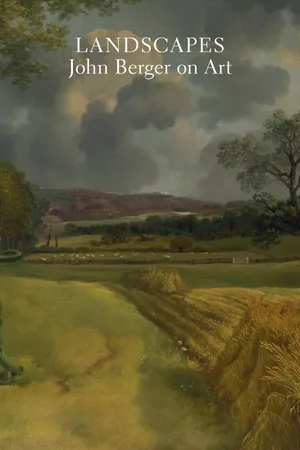
- 256 pages
- English
- ePUB (mobile friendly)
- Available on iOS & Android
eBook - ePub
About this book
Information
Topic
ArtSubtopic
Art & PoliticsPART I
Redrawing the Maps
1.
Kraków
IT WAS NOT a hotel. It was a kind of pension where, at the most, there were four or five guests. In the morning breakfast on a tray was placed on a shelf in the corridor: bread, butter, honey and slices of a sausage which is a specialty of the city. Beside the tray, packets of Nescafé and an electric water heater. Contact with the severe and serene young women who ran the place was minimal.
In the bedrooms all the furniture, made of either oak or walnut, was old and must have dated from before the Second World War. This was in the only Polish city which survived that war without serious destruction to its buildings. In the pension, as in a convent or a monastery, there was a sense inside each room that the two windows which gave on to the streets had been contemplatively looked through for several generations.
The building was situated on Miodowa Street in Kazimierz, the old Jewish quarter of Kraków. After breakfast I asked a young woman behind the reception desk where the nearest bankomat was. She regretfully put down the violin case she was holding and picked up a tourist map of the city. On it she marked in pencil where I had to go. It’s not far, she sighed, as if she would have liked to send me to the other side of the world. I bowed discreetly, opened and shut the front door, turned right, took the first right again and found myself in the Place Nowy, an open market-square.

I HAVE NEVER been in this square before and I know it by heart, or rather I know by heart the people who are selling things in it. Some of them have regular stalls with awnings to keep the sun off their goods. It is already hot, hot with the blurred, gnat heat of the Eastern European plains and forest. A foliage heat. A heat full of suggestions, that does not have the assurance of a Mediterranean heat. Here nothing is certain. The nearest thing to certainty here is a grandmother.
Other sellers – all of them women – have come from the outlying villages with their own produce in baskets or buckets. They do not have stalls and are sitting on stools they brought with them. A few stand. I wander between them.
Lettuces, red radishes, horseradishes, cut dill like green lace, small knobby cucumbers which in this heat grow in three days, new potatoes, their skins, with a little powdered earth on them, the colour of grandchildren’s knees, stick-celery with its cleansing toothbrush smell, cuttings of liveche, which the men, drinking vodka, swear is an incomparable aphrodisiac for women as well as men, bunches of young carrots swapping fern jokes, cut roses mostly yellow, cottage cheeses, which the rags pegged to the clothes line in their gardens still smell of, wild green asparagus that the children were sent to look for near the village cemetery.
The professional traders have naturally acquired all the trading tricks for persuading the public that golden opportunities never come twice. The women on their stools, by contrast, propose nothing. They are immobile, expressionless, and rely on their own simple presence to guarantee the quality of what they have brought to sell from their own gardens.
A wooden fence around a plot and a two-roomed house made from logs with a single tiled stove between the two rooms. These women live in chatas like this.
I wander between them. Different ages. Different builds. Eyes of different colour. No two women wearing the same kerchief. And each one of them has found, as she bends down to cut chives or pull out dog-tooth weed or pick red radishes, her own way of protecting, of favouring, the small of her back, so that its intermittent aches do not become chronic. When they were younger it was their hips which absorbed the shock of events, now it is their shoulders which have to do so.
I peer into the basket of a woman who is standing without a stool. The basket is full of pale golden pastries, little pies. They look like carved chessmen, more specifically like castles, castles that could be stood either way up, their regular embrasures always at the top. Each one is ten centimetres tall.
I pick up one of the castles and realise my mistake. It is far too heavy to be made of pastry.
I glance up at the face of the woman. Sixty years old, blue-green eyes. She looks back at me severely, as if at an idiot who has once again forgotten something. Oscypek, she says slowly, repeating the proper name of a cheese made from the milk of mountain sheep and smoked in the chimney between the two rooms. I buy three. Then, with the smallest gesture of her head, she suggests I get on my way.
In the centre of the square stands a low building, subdivided into small, round shops. There is a barber’s with just enough space for one chair. Several butchers’. A grocer’s where you can buy pickled cabbage from a single barrel. A kitchen for soup with a cast-iron stove, and, outside on the paving stones, three wooden tables with benches. At one of the tables sits a man with slightly dejected shoulders, long hands and a high forehead made higher by the fact that he is going bald. His spectacles have thick lenses. He looks at home here this morning, although he is not Polish.
Ken was born in New Zealand and died there. I sit on the bench opposite him. This man, sixty years ago, shared with me what he knew, although he never told me how he learnt what he knew. He never spoke about his childhood or his parents. I had the impression he left New Zealand for Europe when he was young, before he was twenty. Were his parents rich or poor? Maybe it makes as little sense to ask that question of him as it would of the people in this market at this moment.
Distances never daunted him. Wellington, New Zealand, Paris, New York, the Bayswater Road, London, Norway, Spain, and at some moment, I think, Burma or India. He earned his living, variously, as a journalist, a schoolteacher, a dance instructor, an extra in films, a gigolo, a bookseller without a shop, a cricket umpire. Maybe some of what I’m saying is false, yet it is my way of making a portrait of him for myself as he sits in front of me in the Place Nowy. In Paris he drew cartoons for a newspaper, of this I am certain. I remember distinctly the kind of toothbrushes he liked – ones with extra-long handles, and I remember the size of shoe he took – an eleven.
He pushes his bowl of borsch towards me. Then he takes a handkerchief from his right trouser pocket, wipes the spoon and hands it to me. I recognise the handkerchief of black tartan. The soup is a clear, deep red, vegetable borsch, with a little apple vinegar added to it, Polish-style, to counteract the natural sweetness of the beetroot. I drink some and push the bowl back to him and hand him back the spoon. Not a word has passed between us.
From the bag slung over my shoulder I take out a sketchbook, for I want to show him a drawing I made yesterday from Leonardo’s Lady with an Ermine in the Czartoryski Museum. He studies it, his heavy glasses slipping a little down his nose.
Pas mal! Yet isn’t she too upright? Isn’t she in fact leaning more as she takes the corner?
On hearing him speak in this way, which is so indisputably his, my love for him comes back: my love for his journeys; for his appetites, which he set out to satisfy and never suppressed; for his weariness; for his sad curiosity.
A little too upright, he repeats. Never mind, every copy has to change something, doesn’t it?
My love for his lack of illusions comes back too. Without illusions, he avoided disillusionment.
When I first met him I was eleven and he forty. For the next six or seven years he was the most influential person in my life. It was with him that I learnt to cross frontiers. In French there is the word passeur – often translated as ferryman or smuggler. Yet there is also in the word the connotation of guide, and something of the mountains. He was my passeur.
Ken flips backwards through the sketchbook. He had deft fingers and could palm cards skilfully. He tried to teach me Find the Lady: You can always make money with that! he said. Now he puts a finger between two pages and stops.
Another copy? Antonello da Messina?
Dead Christ supported by Angel, I say.
I never saw it, only in reproduction. If I could have chosen to have my portrait painted by any artist in history, I’d have chosen him, he says. Antonello. He painted like he was printing words. Everything he painted had that kind of coherence and authority, and it was during his lifetime that the first printing presses were invented.
He looks down again at the sketchbook.
Not a trace of pity on the angel’s face or in his hands, he says, only tenderness. You’ve caught that tenderness, but not the gravity, the gravity of the first printed words. That’s gone for good.
I did it last year in the Prado. Until the guards came to chuck me out!
Anyone has the right to draw there, no?
Yes, but not to sit on the floor.
Then why didn’t you draw standing up!
When Ken says this in the Place Nowy, I see him, tall, stooped, standing on the edge of a cliff making a sketch of the sea. Near Brighton, the summer of 1939. He always carried in his pocket a large black graphite pencil called a Black Prince, which, instead of being round, was rectangular like a carpenter’s pencil.
I’m too old now, I tell him, to draw for a long time standing up.
He puts down the sketchbook abruptly without glancing at me. He abhorred self-pity. The weakness, he said, of many intellectuals. Avoid it! This was the only moral imperative he ever imparted to me.
He fingers one of the cheeses I have bought.
Her name is Jagusia, he says, nodding towards the woman who sold me the oscypek, and she comes from the mountains in Podhale. Her two sons work in Germany. Black labour. Hard for them to get work permits, they’re forced to be illegal. Néanmoins, they’re building a house, a house larger than Jagusia has even dreamt of, not one storey but three, not two rooms but seven!
Néanmoins! French words cropped up in his sentences not out of affectation but because the years he had lived in Paris, before coming to London and the Bayswater Road, were the happiest of his life. It was for the same reason that he sometimes wore a black beret.
Yet Jagusia will refuse, he prophesies, to move out of her chata, with the cheesecloths on the line in the garden.
This was the man who made me believe that together we could find music in any city in the world.
What about a beer? he says now in Kraków, pointing towards the far end of the market building, beyond a clothes shop belonging to a fat woman who is sitting smoking in an armchair, surrounded by dresses.
I get up and walk towards her. As she smokes, she tells the story of what happened when she arrived in the Place Nowy; every morning she does this, and every morning the man who sells dried and pickled mushrooms listens to her, his face expressionless. When all the dresses and trousers she has on display are folded up and stacked in the little shop, there is no space for her. On the inside of the door there is a long mirror, since customers sometimes use it as a changing room. Each morning when she opens the shop, she sees herself in this mirror and each morning she is surprised by her size.
I spot the cans of beer on a stall with dried beans, Polish mustard, biscuits, honey-bread and tinned meats. There is also an open chessboard and a game in progress. The grocer behind the stand is playing Black, and a man who looks like a passer-by is playing White. Several pawns, a knight and a bishop have been taken.
The grocer studies the chessboard from a distance, then turns away and gets on with his job until the other one has made his move. The other one hovers above the game and rocks forwards and backwards on his feet, as if he were one of his own bishops, already lifted very slightly off the board between the fingers of a giant player who is cautiously trying out possible moves, being careful not to relinquish the piece until he is certain.
I ask for two beers. White moves his queen diagonally and says Check! Black takes my money and moves a knight. The queen withdraws. A woman customer asks for some of the honey-bread which has sweet candied oranges buried in it. Black cuts the slices and weighs them. White makes a careless move and realises it too late. He swallows hard, for he has an acid taste in his throat. Black takes a castle.
Kraków’s Jewish ghetto, on the other side of the Vistula, outside the old city, is from here less than ten minutes’ walk over the Powstancôw bridge. The ghetto covered an area of 600m × 400m and was sealed off by walled-up buildings, blockades and barbed wire. In the autumn of 1941, six months after it was sealed off, eighteen thousand people were imprisoned there. Thousands died from disease and malnutrition each month. Only those fit enough to work as slave labour in the German armament or clothes workshops were permitted to leave for their stints of work. All other Jews found trespassing outside the ghetto were shot, as were any Poles who helped them to pass into Aryan Kraków or who hid them.
Tyskie! Ken applauds when I return to the table. You chose the best beer!
Early training! I say.
He’s called Zedrek, Ken says, the man you were watching playing chess. He comes to play with Abram the grocer at least once a week. Zedrek could play a good game if he didn’t start drinking vodka so early. I don’t think he can stop though. Abram as a small boy survived the war in hiding.
Ken taught me most of the games I know: chess, snooker, darts, billiards, poker, table tennis, backgammon. Chess we played in his bed-sitting rooms, the others in bars. Bridge, which I had learnt before I met him, we played with my parents or when we got invited to somebody’s house, which was not often.
I met him in 1937. He was a replacement teacher in the lunatic boarding school to which I had been bundled. In front of the school assembly – fifty bare-kneed, cowed boys, each trying to find, unaided, a sense to life – the apoplectic headmaster threw a dining-room chair at the Latin teacher and Ken, who happened to be between them, caught it with one hand in mid-flight. This is how I first noticed him. He set the chair down on the podium, put his feet up on it, and the boss continued to harangue.
On the final day of that same term I invited him to a caravan my parents had on a beach near Selsey Bill in Sussex. Why not? he said. And he came for a week.
My father was pleased, for, now making a foursome, we could play bridge together.
Shall we play for money, Sir? asked Ken. Otherwise the bids don’t count.
Agreed, but the stakes shouldn’t be too high, because of John here.
Tuppence a hundred?
I’ll go and fetch my purse, said my mother.
Ken shuffled the pack and the cards cascaded between his two hands held far apart. Sometimes the cascade looked like a moving staircase, an escalator or a playing-cards ladder. Once, later, he said to me, when I was complaining of not being able to go to sleep: Imagine you’re shuffling a pack of cards! That’s how I go to sleep.
Cut for deal.
My father enjoyed the game, not only because he was a good player, but, more, because the game allowed him to recall certain easy moments with the dead, who otherwise haunted him. When the four of us were...
Table of contents
- Cover Page
- Series Page
- Title Page
- Copyright Page
- Contents
- Introduction: Down with Enclosures
- Part I: Redrawing the Maps
- Part II: Terrain
- Acknowledgements
Trusted by 375,005 students
Access to over 1.5 million titles for a fair monthly price.
Study more efficiently using our study tools.
Frequently asked questions
Yes, you can cancel anytime from the Subscription tab in your account settings on the Perlego website. Your subscription will stay active until the end of your current billing period. Learn how to cancel your subscription
No, books cannot be downloaded as external files, such as PDFs, for use outside of Perlego. However, you can download books within the Perlego app for offline reading on mobile or tablet. Learn how to download books offline
Perlego offers two plans: Essential and Complete
- Essential is ideal for learners and professionals who enjoy exploring a wide range of subjects. Access the Essential Library with 800,000+ trusted titles and best-sellers across business, personal growth, and the humanities. Includes unlimited reading time and Standard Read Aloud voice.
- Complete: Perfect for advanced learners and researchers needing full, unrestricted access. Unlock 1.5M+ books across hundreds of subjects, including academic and specialized titles. The Complete Plan also includes advanced features like Premium Read Aloud and Research Assistant.
We are an online textbook subscription service, where you can get access to an entire online library for less than the price of a single book per month. With over 1.5 million books across 990+ topics, we’ve got you covered! Learn about our mission
Look out for the read-aloud symbol on your next book to see if you can listen to it. The read-aloud tool reads text aloud for you, highlighting the text as it is being read. You can pause it, speed it up and slow it down. Learn more about Read Aloud
Yes! You can use the Perlego app on both iOS and Android devices to read anytime, anywhere — even offline. Perfect for commutes or when you’re on the go.
Please note we cannot support devices running on iOS 13 and Android 7 or earlier. Learn more about using the app
Please note we cannot support devices running on iOS 13 and Android 7 or earlier. Learn more about using the app
Yes, you can access Landscapes by John Berger, Tom Overton in PDF and/or ePUB format, as well as other popular books in Art & Art & Politics. We have over 1.5 million books available in our catalogue for you to explore.