eBook - ePub
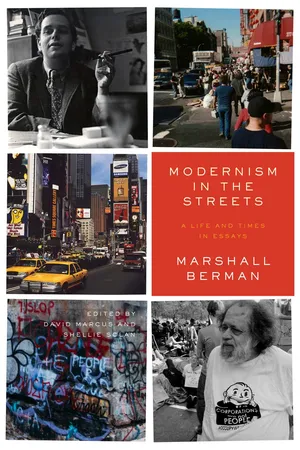
Modernism in the Streets
A Life and Times in Essays
- 400 pages
- English
- ePUB (mobile friendly)
- Available on iOS & Android
eBook - ePub
About this book
Marshall Berman was one of the great urbanists and Marxist cultural critics of the twentieth and twenty-first centuries, and his brilliant, nearly sui generis book All That Is Solid Melts Into Air is a masterpiece of the literature on modernism. But like many New York intellectuals, the essay was his characteristic form, accommodating his multifarious interests and expressing his protean, searching exuberant mind. This collection includes early essays from and on the radical '60s, on New York City, on literary figures from Kafka to Pamuk, and late essays on rock, hip hop, and gentrification. Concluding with his last essay, completed just before his death in 2013, this book is Berman's intellectual autobiography, tracing his career as a thinker through the way he read the 'signs in the street'.
Information
Topic
LiteraturSubtopic
Moderne LiteraturkritikPart I
Origin Stories
Caught Up in the Mix:
Some Adventures in Marxism
Once a theatregoer buttonholed [Arthur] Miller and put the question to him: “What’s he selling? You never say what he’s selling.” Miller quipped, “Well, himself. That’s what’s in the valise.”John Lahr, “Making Willy Loman”
Marxism has been part of me for all my life. Late in my 50s, I’m still learning and sorting out how. Until now, I think I’ve had only one real adventure in Marxism. Still, that one was formidable. It helped me grow up and figure out who I was going to be in the world. And it makes a good story. My father also had a Marxist adventure, one more tragic than mine. It’s only by working through his life that I’ll be in a position to take hold of my own. Life studies is one of the big things Marxism is for.
My father, Murray Berman, died of a heart attack in 1955, when he was just short of forty-eight, and when I wasn’t quite fifteen. He grew up on New York’s Lower East Side and in the Bronx, left school at twelve, and was thrown into “the business world”—that’s what he and my mother called it—pushing a truck in the garment center to help support his parents and nine kids in one room. He called it “the rack” and often said he was still on it. But the garment center’s friendly malevolence felt like home to him, and we would never leave that home.
Over the years, he graduated from outdoor schlepper to indoor schlepper (I guess it would be called stock clerk today) and then to various clerical and sales jobs. He was on the road a lot before I was born and when I was very young. For several years he worked, as both reporter and an advertising salesman, for Women’s Wear Daily. All those years are vague to me. But I know that in 1948, he and a friend from the Bronx made a great leap: They founded a magazine. Its theme, announced on the mast head, was “The garment industry meets the world.” My father and his friend Dave had little education and less capital but lots of foresight—the Yiddish word is sachel. Globalization in the garment center was an idea whose time was coming, and for two years the magazine thrived, selling ever more advertising space (my father’s specialty), which in capitalist economies is what keeps newspapers and magazines alive.
But then, suddenly, in the spring of 1950, there was no money to meet the payroll, and just as suddenly his friend Dave disappeared. My father took me to the Natural History Museum one Saturday morning; Saturday afternoon, we walked around the Upper East Side, searching for Dave. In his favorite Third Avenue bars, no one had seen him for two days. His doorman said the same but he directed us to Dave’s floor and said we would hear his dog barking if he was around. We didn’t, and he wasn’t, and while my father cursed and worked on a note to slip under his door, I looked into a half-open door in the hall and saw an open elevator shaft. As I looked down, curious, my father grabbed me and threw me against the wall—it was one of the two times he ever touched me violently. We didn’t talk much as we took the subway back to the Bronx. The magazine went bankrupt overnight. The next month my father had a heart attack that nearly killed him.
We never saw Dave again, but the police tracked him down. It turned out he had a mistress on Park Avenue, another in Miami, and a gambling addiction. He had emptied the magazine’s account, but when they found him there was little left, and nothing for us. My father said the whole story was such a garment center cliché (that was how I learned the meaning of the word cliché), he just couldn’t believe his friend could do it to him. Several years later, out of the blue, Dave called again, with a new name—another garment center cliché—and a new proposition. I answered the phone, then put my mother on. She said he had ruined my father’s life once, and wasn’t that enough? Dave urged her to be a good sport.
My father gradually got his strength back, and my parents were now the “Betmar Tag and Label Company.” They lived in the garment center’s interstices as brokers or jobbers, middlemen between garment manufacturers and label-makers. This company had no capital; its only assets were my father’s aptitude for schmoozing and my mother’s for figuring things out. They knew their position was precarious, but they performed a real function, and they thought they had enough local knowledge to stay afloat. For a few years, it was a living. But in September 1955 my father had another heart attack, and from this one he died.
Who killed him? This question haunted me for years. “It’s the wrong question,” my first shrink said fifteen years later. “He had a bad heart. His system wore out.” That was true; the army saw it and rejected him for service during World War Two. But I couldn’t forget his last summer, when all at once he lost several big accounts. The managers and purchasing agents were all his old friends: They had played stickball on Suffolk Street, worked together and dealt with each other for years; these guys had drunk to his health at my bar mitzvah, just two years back. Now, all of a sudden, they wouldn’t return his calls. He had said he could tell he’d been outbid by somebody; he just wanted a chance to make a bid and to be told what was what. All this was explained to us at the funeral (a big funeral; he was well liked) and during shiva week just after. Our accounts, and dozens of others, had been grabbed by a Japanese syndicate, which was doing business both on a scale and in a style new to Seventh Avenue. The syndicate had made spectacular payoffs to its American contacts. (Of course they didn’t call them payoffs.) But it had imposed two conditions: It must not be identified, and there must be no counter-bidding. We pressed his friends: Why couldn’t you tell Daddy—even tell him there was something you couldn’t tell him? They all said they hadn’t wanted to make him feel bad. Crocodile tears, I thought, yet I could see their tears were real. Much later, I thought that here was one of the first waves of the global market that Dad foresaw and understood. I think he could have lived with that better than he could live with his old friends not calling him back.
My mother carried the company on briefly, but her heart wasn’t in it. She folded it and went to work as a bookkeeper. Together, one night in the summer of 1956, near the end of our year of mourning, my mother, my sister, and I threw enormous reams of paper from the lost accounts down our incinerator in the Bronx. But my mother held on to the manila folders that they had used for those accounts. (“We can still get plenty of use out of them,” she said.) Forty years later, I’m still using those folders, containers of long-vanished entities—Puritan Sportswear, Fountain Modes, Girl Talk, Youngland—where are they now? Does it mean that, in some way, I’ve stayed in my father’s business? (Happy Loman, at the very end of Death of a Salesman: “I’m staying right in this city, and I’m gonna beat this racket!”) What racket? What business? My wife defined the relationship in a way I like: I’ve gone into my father’s unfinished business.
“The only thing you got in this world is what you can sell.” Another line from Death of a Salesman.1 It was my father’s favorite play. My parents saw Salesman at least twice on stage, starring Lee J. Cobb, and again in film form starring Fredric March. It became a primary source of material in the endless affectionate and ironic repartee they carried on till he died. I didn’t know that till I got to see the movie, just a few months before his death; then all at once the meaning of years of banter became clear. I joined in the crosstalk, tried it at the dinner table, and got all smiles, though the lines were tragic, and were about to become more tragic still. One hot day in the summer of 1955 he came home drained from the garment center and said, “They don’t know me any more.” I said, “Dad … Willy Loman?” He was happy that I knew he was quoting, but he also wanted me to know it was not only a quote but the truth. I got him a beer, which I knew he liked in the summer heat; he hugged me and said it gave him peace to know I was going to be freer than he was, I was going to have a life of my own.
Soon after he died, scholarships and good luck propelled me to Columbia. There I could talk and read and write all night and then walk to the Hudson to see the sun at dawn. I felt like a prospector who had made a strike, discovering sources of fresh energy I never knew I had. And some of my teachers had even told me that living for ideas could be a way for me to make a living! I was happier than I had ever been, steeped in a life that really felt like my life. Then I realized this was exactly what my father had wanted for me. For the first time since his death, I started thinking about him. I thought about how he had struggled and lost, and my grief turned to rage. So they don’t know you? I thought. Let me at those bastards, I’ll get them for you. They don’t remember? I’ll remind them. But which bastards? Who were “they”? How could I get them? Where would I start? I made a date with Jacob Taubes, my beloved professor of religion. I said I wanted to talk about my father and Karl Marx.
Jacob and I sat in his office in Butler Library and talked and talked. He said that he sympathized with all radical desire, but revenge was a sterile form of fulfillment. Didn’t Nietzsche write the book on that? Hadn’t I read it in his class? He said that in the part of Europe where he came from (b. Vienna 1927), the politics of revenge had succeeded far beyond anything Americans could imagine. He told me a joke: “Capitalism is the exploitation of man by man. Communism is the opposite.” I had heard that joke before, maybe even from my father; it had gone round many times, for good reasons. But it was a dark joke and it hurt to laugh at it, because what followed seemed to be a total human impasse: The system is intolerable, and so is the only alternative to the system. Oy! So what then, I asked, we all put ourselves to sleep? No, no, said Jacob, he didn’t mean to immobilize me. In fact, there was this book he had meant to tell me about: Marx wrote it “when he was still a kid, before he became Karl Marx”; it was wild, and I would like it. The Columbia Bookstore (“those fools”) didn’t have it, but I could get it at Barnes & Noble downtown. The book had “been kept secret for a century”—that was Jacob’s primal romance, the secret book, the Kabbalah—but now at last it had been released.2 He said some people thought it offered “an alternative vision of how man should live.” Wouldn’t that be better than revenge? And I could get there on the subway.
So, one lovely Saturday in November, I took the 1 train downtown, turned south at the Flatiron Building, and headed down Fifth to Barnes & Noble. B&N then was far from its 1990s monopoly incarnation, “Barnes Ignoble,” scourge of small bookshops; it was only one store, just off Union Square, and it traced itself back to Abe Lincoln and Walt Whitman and “The Battle Hymn of the Republic.” But before I could get there, I passed another place that I had always walked on by: the Four Continents Book Store, official distributor for all Soviet publications. Would my Marx be there? If it really was “really wild,” would the USSR be bringing it out? I remembered the Soviet tanks in Budapest, killing kids on the streets. Still, the USSR in 1959 was supposed to be opening up (“the Thaw, they called it), and there was a possibility. I had to see.
The Four Continents was like a rainforest inside, walls painted deep green, giant posters of bears, pines, icebergs and icebreakers, shelves stretching back toward a vast horizon, lighting that evoked a tree cover more than a modern room. My first thought was, how can anyone read in this light? (In retrospect, I realize it resembled the lighting in certain 1950s furniture stores and romantic comedies. It was the light scheme in the bachelor flat where the hero brought home Doris Day.) The staff knew just what book I wanted: Marx’s Economic and Philosophical Manuscripts of 1844, translated by Martin Milligan, and published in 1956 by the Foreign Languages Publishing House in Moscow. It was a collection of three youthful notebooks, divided into short essays. The titles didn’t seem to emanate from Marx himself; they appeared to be provided by twentieth-century editors in Moscow or Berlin. It was midnight blue, nice and compact, a perfect fit for a side pocket in a 1950s sports jacket. I opened it at random, here, there, somewhere else—and suddenly I was in a sweat, melting, shedding clothes and tears, flashing hot and cold. I rushed to the front: “I’ve got to have this book!” The white-haired clerk was calm. “Fifty cents, please.” When I expressed amazement, he said, “We”—I guess he meant the USSR—“don’t publish books for profit.” He said the Manuscripts had become one of their bestsellers, though he himself couldn’t see why, since Lenin was so much clearer.
Right there my adventure began. I realized I was carrying more than thirty dollars, mostly wages from the college library; it was probably as much as I’d ever carried in my life. I felt another flash. “Fifty cents? So for ten bucks I can get twenty?” The clerk said that, after sales taxes, twenty copies would cost about $11. I ran back to the rear, grabbed the books, and said, “You’ve just solved my Hanukkah problem.” As I schlepped the books on the subway up to the Bronx (Four Continents tied them up in a nice parcel), I felt I was walking on air. For the next several days I walked around with a stack of books, thrilled to be giving them away to all the people in my life: my mother and sister, my girlfriend, her parents, several old and new friends, a couple of my teachers, the man from the stationery store, a union leader (the past summer, I’d worked for District 65), a doctor, a rabbi. I’d never given so many gifts before (and never did again). Nobody refused the book, but I got some weird looks from people when I breathlessly delivered my spiel. “Take this!” I said, shoving the book in their faces. “It’ll knock you out. It’s by Karl Marx, but before he became Karl Marx. It’ll show you how our whole life’s wrong, but it’ll make you happy, too. If you don’t get it, just call me anytime, and I’ll explain it all. Soon everybody will be talking about it, and you’ll be the first to know.” And I was out the door, to face more puzzled people. I stopped at Jacob’s office with my stack of books, told him the story; went through the spiel. We beamed at each other. “See, now,” he said, “isn’t this better than revenge?” I improvised a comeback: “No, it’s the best revenge.”
I try to imagine myself at that magic moment: Too much, man! Was I for real? (Those are things we used to say to each other in 1959.) How did I get to be so sure of myself? (Never again!) My intellectual impulse-buying; my neo-potlatch great giveaway of a book I hadn’t even properly read; the exuberance with which I pressed myself on all those people; my certainty that I had something special, something that would both rip up their lives and make them happy; my promises of lifetime personal service; above all, my love for my great new product that would change the world: Willy Loman, meet Karl Marx. We entered the sixties together.
What was it in Marx, all those years ago, that shot me up like a rocket? Not long ago, I went through that old midnight blue Four Continents book. It was a haunting experience, with the Soviet Union dead; but Marx himself moved and lived. The book was hard to read because I’d underlined, circled, and asterisked virtually everything. But I know the ideas that caught me forty years ago are still part of me today, and it will help this book hold together if I can block out at least some of those ideas in a way that is brief but clear.3
The thing I found so striking in Marx’s 1844 essays, and which I did not expect to find at all, was his feeling for the individual. Those early essays articulate the conflict between Bildung and alienated labor. Bildung is the core human value in liberal romanticism. It is a hard word to put in English, but it embraces a family of ideas like “subjectivity,” “finding yourself,” “growing up,” “identity,” “self-development,” and “becoming who you are.” Marx situates this ideal in modern history and gives it a social theory. He identifies with the Enlightenment and with the great revolutions that formed its climax when he asserts the universal right of man to be “freely active,” to “affirm himself,” to enjoy “spontaneous activity,” to pursue “the free development of his physical and mental energy” (74–5). But he also denounces the market society nourished by those revolutions, because “Money is the overturning of all individualities” (105) and because “You must make all that is yours For Sale” (96; Marx’s emphasis). He shows how modern capitalism arranges work in such a way that the worker is “alienated from his own activity” as well as from other workers and from nature. The worker “mortifies his body and ruins his mind”; he “feels himself only outside his work, and in his work … feels outside himself”; he “is at home only when he is not working, and when he is working he is not at home. His labor therefore is not free, but coerced; it is forced labor” (74). Marx salutes the labor unions that, in the 1840s, are just beginning to emerge. But even if the unions achieve their immediate aims—even if workers get widespread union recognition and raise wages by force of class struggle—it will still be “nothing but salary for a slave” unless modern society comes to recognize “the meaning and dignity of work and of the worker” (80). Capitalism is terrible because it promotes human energy, spontaneous feeling, human development, only to crush them, except in the few winners at the very top. From the very start of his career as an intellectual, Marx is a fighter for democracy. But he sees that democracy in itself won’t cure the structural misery he sees. So long as work is organized in hierarchies and mechanical routines and oriented to the demands of the world market, most people, even in the freest societies, will still be enslaved—will still be, like my father, on the rack. Marx is part of a great cultural tradition, a comrade of modern masters like Keats, Dickens, George Eliot, Dostoevsky, James Joyce, Franz Kafka, D.H. Lawrence (readers are free to fill in their personal favorites) in his feeling for the suffering modern man on the rack. But Marx is unique in his grasp of what that rack is made of. It’s there in all his work. But in the Communist Manifesto and Capital, you have to look for it. In the 1844 Manuscripts, it’s in your face.
Marx wrote most of these essays in the midst of one of his great adventures, his honeymoon in Paris with Jenny von Westphalen. The year I had my Marxian adventure, I had just fallen in love, first love, and this made me very curious whether he would have anything to say about love and sex. The Marxists I had met through the years seemed to have a collective attitude that didn’t exactly hate sex and love, but regarded them with impatience, as if these feelings were to be tolerated as necessary evils, bu...
Table of contents
- Cover Page
- Halftitle Page
- Title Page
- Copyright Page
- Contents
- Introduction: Marxism with Soul: On the Life and Times of Marshall Berman
- Part I: Origin Stories
- Part II: Radical Times
- Part III: Living for the City
- Part IV: Jay Talking
- Part V: The Bright Book of Life
- Part VI: Signs in the Street
- Part VII: The Romance of Public Space
- Part VIII: From the Ruins
- Notes
- Index
Trusted by 375,005 students
Access to over 1.5 million titles for a fair monthly price.
Study more efficiently using our study tools.
Frequently asked questions
Yes, you can cancel anytime from the Subscription tab in your account settings on the Perlego website. Your subscription will stay active until the end of your current billing period. Learn how to cancel your subscription
No, books cannot be downloaded as external files, such as PDFs, for use outside of Perlego. However, you can download books within the Perlego app for offline reading on mobile or tablet. Learn how to download books offline
Perlego offers two plans: Essential and Complete
- Essential is ideal for learners and professionals who enjoy exploring a wide range of subjects. Access the Essential Library with 800,000+ trusted titles and best-sellers across business, personal growth, and the humanities. Includes unlimited reading time and Standard Read Aloud voice.
- Complete: Perfect for advanced learners and researchers needing full, unrestricted access. Unlock 1.5M+ books across hundreds of subjects, including academic and specialized titles. The Complete Plan also includes advanced features like Premium Read Aloud and Research Assistant.
We are an online textbook subscription service, where you can get access to an entire online library for less than the price of a single book per month. With over 1.5 million books across 990+ topics, we’ve got you covered! Learn about our mission
Look out for the read-aloud symbol on your next book to see if you can listen to it. The read-aloud tool reads text aloud for you, highlighting the text as it is being read. You can pause it, speed it up and slow it down. Learn more about Read Aloud
Yes! You can use the Perlego app on both iOS and Android devices to read anytime, anywhere — even offline. Perfect for commutes or when you’re on the go.
Please note we cannot support devices running on iOS 13 and Android 7 or earlier. Learn more about using the app
Please note we cannot support devices running on iOS 13 and Android 7 or earlier. Learn more about using the app
Yes, you can access Modernism in the Streets by Marshall Berman, David Marcus,Shellie Sclan in PDF and/or ePUB format, as well as other popular books in Literatur & Moderne Literaturkritik. We have over 1.5 million books available in our catalogue for you to explore.