Since 2011, a wave of popular mobilizations has swept the globe, from Occupy to the Arab Spring, 15M in Spain and the uprisings in Greece. Their demands were varied, but what they share is a commitment to ideals of radical democracy, and a willingness to experiment with new forms of organization to achieve this. In fact, the countries of Latin America have been experimenting with such projects since 1989-just as left projects of all stripes fell into decline across Europe-in what was a moment of rebirth. Poor residents of Venezuela's barrios took history into their own hands in a mass popular rebellion against neoliberalism, much as the movements appearing worldwide are doing today.
Twenty-five years since the experiments began, Latin America is hardly recognizable, with leftist governments consolidating a new hegemony and radical movements surging forth from below. In Building the Commune, George Ciccariello-Maher travels through the many radical experiments of Venezuela, assessing how they have succeeded and failed, and how they are continuing to operate. Speaking to community members, workers, students and government officials, Ciccariello-Maher provides a balance sheet of these projects, that movements throughout the world can look to for lessons and inspiration.
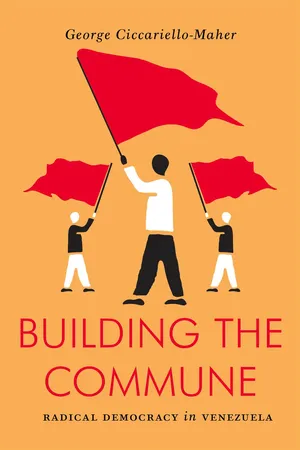
- 144 pages
- English
- ePUB (mobile friendly)
- Available on iOS & Android
eBook - ePub
About this book
Information
1
A HISTORY OF THE COMMUNE
By the time of his last major speech on October 20, 2012—soon after winning his final reelection—Hugo Chávez knew he was dying, but he looked as energetic as ever. His government ministers, on the other hand, looked sweaty and uncomfortable, with nowhere to hide as he chewed them out before the eyes of the nation, interrogating them on live television and demanding rectification for their mistakes. For more than three hours Chávez spoke, interspersed with commentary from ministers and on-the-ground reports from various sites on different aspects of the socialist project. He railed against government corruption, ineffectiveness, and inefficiency: “Will I continue to cry out in the desert?” he pleaded with increasing exasperation.
This speech would come to be known as the “Golpe de Timón,” which literally means “Strike at the Helm” but suggests a radical change in course.1 The change in question was the transition to socialism itself, long promised but only partially delivered. It’s too easy, Chávez insisted, to simply call things “socialist” without changing their fundamental structure. Since he had come to power, social welfare had improved dramatically, but the 1999 Constitution promised more: more participation, more democracy, more equality, and a new Venezuela. By 2006, this ambitious project had a name—“twenty-first-century socialism”—and it entailed far more than simply improving social welfare or reducing poverty: the goal was to transform political power itself to create something “truly new.” For Chávez, socialism was not opposed to democracy but instead synonymous with it: “Socialism is democracy and democracy is socialism.”
The building blocks for this new socialist democracy were the communal councils, established in a 2006 law. These councils—directly democratic and participatory institutions for local governance—quickly numbered in the thousands as neighbors began to come together weekly to debate and discuss how to govern themselves. Whether in a dingy room adorned with little more than a poster or mural of Chávez, or outside around a collective stew pot, the debates ranged from banal to engaging, from the local to the national and everything in between. Whether it is building new roads and basketball courts, or strategizing how to deal with increasing drug violence, these councils have become crucial spaces for political participation in Venezuela today. But as late as 2012, it was not entirely clear what this new form of socialism would look like or how to build it. Would the role of the councils be limited to local development? Would they serve as a check on the power of the central government? Or were they instead destined to be a part of something far more ambitious?
For Chávez, the answer was increasingly clear: capitalism was a “monster” that would swallow up any and all small, local alternatives, and a radical leap toward socialism was needed if the Bolivarian process was not to come to an abrupt halt. This meant that the communal councils, not to mention other cooperative or socialist enterprises, were doomed on their own. For the councils to provide a true counterweight to the corruption and bureaucracy of the oil state, they would need to be unified and consolidated into something much bigger. This something was the communes themselves, legally established in a 2010 law designed to bring the communal councils and other participatory units together in increasingly larger self-governed areas. Two years later, however, not a single commune had been established, leading the president to emphasize one question above all: “Where is the commune?”
The question was for his government ministers, and they had no answer. “We keep distributing homes, but the communes are nowhere to be seen.” This was not only a question of the absence of legally registered communes, but something far deeper: What was still lacking, according to Chávez, was “the spirit of the commune which is much more important, communal culture.” The error of government ministers was not that they had failed to create communes from above, but that they had forgotten that those communes needed to be born from below: “The commune—popular power—does not come from Miraflores Palace, nor is it from such and such ministry that we will be able to solve our problems.”
If Chávez had addressed his question—“Where is the commune?”—to those grassroots organizers who have always been the backbone of Chavismo, the answer might have been very different. Some would have no doubt pointed to the very ground on which they stood, as though to say: The commune is here, Comandante.
While the councils and communes were enshrined by law in 2006 and 2010, it is a mistake to think that the Venezuelan state created the communes or the communal councils that they comprise. Just as Chávez did not create the Bolivarian Revolution, the revolutionary movements that “created Chávez” did not simply stop there and stand back to admire their creation. Instead, they continued their formative work in and on the world by building radically democratic and participatory self-government from the bottom up.
In the 1980s, long before the communal councils existed on paper and before Chávez had become a household name, barrio residents—struggling for local autonomy against corrupt two-party rule—began forming a network of barrio assemblies to debate both local affairs and how to bring about revolutionary change on the national level. Before the communes existed on paper, many of these same organizers had begun to expand and consolidate communal control over broader swathes of territory. In fact, one of the most important organizations building communal power in the present—the National Network of Comuneros and Comuneras—was founded by former state employees who broke away in favor of a more independent organization. As Marx and others have, “revolutions are not made with laws” but by the people seizing and exercising power directly.2
These communes have existed since the very moment when those who gathered in their neighborhood councils said this is not enough. It is not enough to govern this little corner of Venezuela or that little fragment of the barrio. It is not enough to make decisions about streets and water pipes while there is a broader battle to be fought. It is not enough to have direct democracy in a four-block radius while everything the neighborhood consumes is trucked in from a distance, much of it imported from abroad. It is not enough to be a tiny island of socialism in a vast capitalist sea. Local neighborhood councils would have to connect with one another; they would have to send delegates to discuss and debate questions on a larger scale: how to govern entire parishes, how to collaborate on security and infrastructure, and how to cooperate in the production and distribution of what communities actually need.
If the state did not create the communes, what the state has done is legally recognize the existence of first the councils and later the communes, formalizing their structure—for better and for worse—and even encouraging their expansion. Some 45,000 communal councils exist today, many of which have been incorporated into the now more than 1,500 communes. Within the state apparatus, these communes found no greater ally than Chávez himself, who, fully aware of his own pressing mortality, understood his “Golpe de Timón” as a sort of political will and testament. He knew that once he was gone, Chavistas of different loyalties and stripes would inevitably begin to fight over who best represented his legacy, and—if history is any guide—some would even use his name to betray that legacy. By dedicating his last major speech to the expansion of what he called the “communal state,” Chávez was making perfectly clear that his legacy was the commune, giving radical organizers the leverage they needed to insist that to be a Chavista is to be a comunero, and that those who undermine popular power are no less than traitors.3
Today, no two communes look exactly alike. Sometimes a commune is sixty women gathered in a room to debate local road construction, berating political leaders in the harshest of terms. Other times it’s a textile collective gathering with local residents to decide what the community needs and how best to produce it. Sometimes it’s a handful of young men on motorcycles hammering out a gang truce, or others broadcasting on a collective radio or TV station. Often it’s hundreds of rural families growing plantains, cacao, coffee, or corn while attempting to rebuild their ancestral dignity on the land through a new, collective form. There are some constants, however. The coffee is always too sweet, and the process is always difficult, endlessly messy and unpredictable in its inescapable creativity.
What is a commune? Concretely speaking, Venezuela’s communes bring together communal councils—local units of direct democratic self-government—with productive units known as social property enterprises (EPS). Forming a commune is relatively straightforward: participants in a number of adjacent communal councils come together, discuss, and call a referendum among the entire local population. Once the commune is approved and constituted, each communal council and production unit sends an elected delegate to the communal parliament—the commune’s highest decision-making body. Like the councils themselves, the parliament is based on principles of direct democracy. Anyone who is elected—just like all elected officials under the 1999 Constitution—is subject to community oversight and can be recalled from power. Communes even manage local security through participatory “collective defense,” and an alternative system of communal justice seeks to resolve conflicts through “arbitration, conciliation, and mediation.”4
Economically, communes are explicitly “socialist spaces,” which means that they aim to produce the things that people need locally through socialist enterprises. These enterprises are explicitly noncapitalist and defined by who owns the means of production. They can be either state-owned or, more commonly, directly owned and managed by the communes themselves. Direct ownership means that the communal parliament itself—composed of delegates from each council—debates and decides what is produced, how much the workers are paid, how to distribute the product, and how best to reinvest any surplus into the commune itself.
The goal of the communes—with EPSs as their productive heart—is to build self-managed and sustainable communities that are oriented toward their own collective internal needs. But this local emphasis does not come at the expense of consolidating a broader communal power. Instead, the Commune Law points toward the integration of the communes into a broader regional and national confederation. The goal is ultimately to “build the communal state by promoting, driving, and developing … the exercise of self-government by the organized communities” and to construct “a system of production, distribution, exchange, and consumption rooted in social property.”
As the communes expand across the national territory, the law also encourages them to claim greater authority over their local neighborhoods: building on Article 184 of the Constitution, the law allows the communes to demand the “transfer” of authority over privately held property to the communes themselves. As we will see, this ability to demand that private property be expropriated and handed over has become a key lever for the expansion of the communes and the overarching goal of “the transition toward a socialist and democratic society of equity and social justice.”
The sources and inspirations for the Venezuelan commune are many, as any comunero or comunera will tell you. They include not only the Paris Commune of 1871 but also many more local movements before and since. Indigenous communities had long managed life collectively, and when Venezuelan slaves escaped to the hills to form maroon communities, these too often anticipated communal forms: participatory, direct, and self-governed. The long history of Venezuela’s communes thus began long before Chávez and even before the great Latin American liberator Simón Bolívar helped to free the continent from Spanish domination at the outset of the nineteenth century. These experiments were not all the same, nor were they communes, strictly speaking, and some were more democratic than others. But each moment pointed toward the fundamental demand to control one’s own everyday life, a search for the kind of collective power that Marx sought when he described the commune as the “self-government of the producers.”5
As radical social movements and grassroots organizers in the barrios were experimenting with direct self-government through popular assemblies, Chávez was building a conspiratorial movement in the army. But he and other young soldiers were also in close contact with the revolutionary underground, and in particular with a figure who would be even more important for the form that the Venezuelan communes would take: the guerrilla commander Kléber Ramírez Rojas. In fact, when Chávez and others were planning their 1992 coup against the corrupt and violent two-party system, Kléber was drafting the founding documents for a new political system to be established if the coup were successful. The goal of the conspiracy, according to these documents, was not simply to seize the state but to immediately replace it with something very different, which Kléber called a “commoner state,” and which Chávez would which later call the “communal state.”6
For Kléber, a veteran of the armed struggle, who was influenced not only by European Marxism but also by the Venezuelan struggle against slavery and colonialism, this new alternative state was in fact no state at all. Instead, building communal power meant dissolving political power into the community itself; it meant a “broadening of democracy in which the communities will assume the fundamental powers of the state.” This was not mere “decentralization,” however, the buzzword of choice for the neoliberal reformers of the 1990s, who sought to reduce the role of the state to benefit not the community but capital. The communal alternative Kléber and Chávez envisioned was never about decentralizing power but organizing power in the barrios and the country from the bottom up.
While a commoner state would thus be no state at all, it would nevertheless involve thousands upon thousands of directly democratic neighborhood councils, through which Venezuelans would increasingly take control over their own lives. They would elect their own political delegates and police forces; they would decide what to produce and for whom. Everyday people would be constantly involved in managing their local communities, and institutions would no longer stand above and apart from the people. This kind of organization was already emerging in the barrio assemblies that sprouted up around the time of the Caracazo, but Kléber saw a danger in these dispersed assemblies, with their celebrations of horizontal democracy and local autonomy. Communal power, he argued, could not remain dispersed; it needed to unify into a broad horizon for national struggle, becoming in the process a power, an alternative.
Instead of the state over the people, a communal power would instead embody a dynamic relationship between institutions and the people that Kléber would describe—provocatively and paradoxically—as a “government of popular insurgency.” This was the vision, but the 1992 coup failed, Chávez and others were jailed, and the horizon of the commune dipped once again out of sight, only to reemerge later. From prison, Chávez began to expand on these ideas to theorize the transition toward a new form of political power in Venezuela. The young soldier placed a particular emphasis on the need to build a radically reorganized, “polycentric” system of participatory power that would, in the young Chávez’s words, “be very near to the territory of utopia.” These two words—territory and utopia—are essential for grasping the communes today.
When Chávez began his “Golpe de Timón” address twenty years later, he did so holding a thick copy of István Mészáros’s Beyond Capital in his hand. Like Kléber Ramírez, Mészáros—a Hungarian Marxist—had a major impact on Chávez’s own understanding of the role of communes in the transition toward a socialist society. In particular, Mészáros had foregrounded the need for socialism to be radically democratic, even going so far as to argue that participatory self-management is the “yardstick” by which progress toward socialism can be measured. But while Chávez was citing Mészáros as an authority and inspiration, it was Chávez himself who had, in part, inspired Mészáros’s own emphasis on participatory, radical democracy.7
So where is the commune? When Chávez asked the question in 2012, the future of this ambitious communal project was far from certain. But since then—in large part due to the momentum provided by his “Golpe de Timón” speech—the communal project has advanced by leaps and bounds. After Chávez died on March 5, 2013, the newly elected president, Nicolás Maduro, named Reinaldo Iturriza commune minister. A radical with deep roots in barrio and youth movements, and with a militant emphasis on popular participation and culture, Iturriza oversaw the revitalization of Chávez’s vision and the dramatic expansion of the communes. From a small handful registered between 2010 and 2013, there were soon dozens, then hundreds, then more than a thousand communes, and Maduro was speaking openly of the need to “demolish the bourgeois state.” As I write this, the real-time tally of registered communes on the ministry’s website reads 1,546, in addition to more than 45,000 communal councils, and thousands of EPSs already registered by 2013.
In a major step forward, 2014 saw the communes begin to stretch their authority upward, consolidating an integrated national structure. Communes now elect delegates to state-level confederations with their own parliaments, which in turn send delegates to a national presidential council that interfaces directly with Maduro. While some—especially outside Venezuela—might interpret such a direct connection to the president as reinforcing the centralized authority of the president himself, many organizers reject this view. For national commune organizer Gerardo Rojas, who travels the country facilitating the establishment and consolidation of the communes, the presidential council represents a meeting among equals: the confederated force of communal power and a president who, up to this point at least, has supported the communes.
While formally working for the government—“until they fire me,” he chuckles—Rojas nevertheless has a flexible and open-ended vision of the construction of this communal power. When I ask him whether the communes have been a success or failure, whether we are winning or losing, he rightly scoffs at the naivety of the question. The project is advancing, he insists, although his words are measured. Do some communes function better and enjoy a higher degree of participation than others? Do some communes produce more than others? Yes, some produce more material goods—corn, plantains, coffee, sugar—while others, as we will see in later chapters, don’t produce much of anything at all. But these too are spaces in which residents are attempting to build a new culture and a new form of radically democratic self-government that, according to Rojas, “exists and is tangible in many parts of the country right now.”
It would be a mistake, Rojas insists, to define the commune in too rigid a way, to straitjacket it from above when its ultimate form needs to be determined by the grassroots participation of millions from below. He insists that, if anything, the commune is...
Table of contents
- Cover Page
- Halftitle Page
- Title Page
- Copyright Page
- Contents
- Introduction
- 1. A History of the Commune
- 2. The Barrios and the Struggle for Urban Space
- 3. Counterrevolution
- 4. Militias and Revolutionary Collectives
- 5. The Commune in Progress
- 6. Culture and Production
- Conclusion: A Communal Future?
- Notes
- Acknowledgements
Trusted by 375,005 students
Access to over 1.5 million titles for a fair monthly price.
Study more efficiently using our study tools.
Frequently asked questions
Yes, you can cancel anytime from the Subscription tab in your account settings on the Perlego website. Your subscription will stay active until the end of your current billing period. Learn how to cancel your subscription
No, books cannot be downloaded as external files, such as PDFs, for use outside of Perlego. However, you can download books within the Perlego app for offline reading on mobile or tablet. Learn how to download books offline
Perlego offers two plans: Essential and Complete
- Essential is ideal for learners and professionals who enjoy exploring a wide range of subjects. Access the Essential Library with 800,000+ trusted titles and best-sellers across business, personal growth, and the humanities. Includes unlimited reading time and Standard Read Aloud voice.
- Complete: Perfect for advanced learners and researchers needing full, unrestricted access. Unlock 1.5M+ books across hundreds of subjects, including academic and specialized titles. The Complete Plan also includes advanced features like Premium Read Aloud and Research Assistant.
We are an online textbook subscription service, where you can get access to an entire online library for less than the price of a single book per month. With over 1.5 million books across 990+ topics, we’ve got you covered! Learn about our mission
Look out for the read-aloud symbol on your next book to see if you can listen to it. The read-aloud tool reads text aloud for you, highlighting the text as it is being read. You can pause it, speed it up and slow it down. Learn more about Read Aloud
Yes! You can use the Perlego app on both iOS and Android devices to read anytime, anywhere — even offline. Perfect for commutes or when you’re on the go.
Please note we cannot support devices running on iOS 13 and Android 7 or earlier. Learn more about using the app
Please note we cannot support devices running on iOS 13 and Android 7 or earlier. Learn more about using the app
Yes, you can access Building the Commune by Geo Maher in PDF and/or ePUB format, as well as other popular books in Politics & International Relations & Global Politics. We have over 1.5 million books available in our catalogue for you to explore.