eBook - ePub
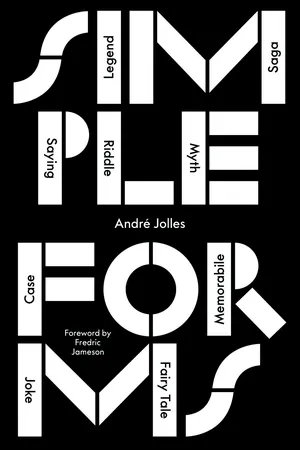
Simple Forms
Legend, Saga, Myth, Riddle, Saying, Case, Memorabile, Fairytale, Joke
- 272 pages
- English
- ePUB (mobile friendly)
- Available on iOS & Android
eBook - ePub
Simple Forms
Legend, Saga, Myth, Riddle, Saying, Case, Memorabile, Fairytale, Joke
About this book
Legend, saga, myth, riddle, saying, case, memorabile, fairy tale, joke: Andr? Jolles understands each of these nine "simple forms" as the reflection in language of a distinct mode of human engagement with the world and thus as a basic structuring principle of literary narrative. Published in German in 1929 and long recognized as a classic of genre theory, Simple Forms is the first English translation of a significant precursor to structuralist and narratological approaches to literature. Like Vladimir Propp's Morphology of the Folktale, with which it is often compared, Jolles's work is not only foundational for the later development of genre theory but is of continuing relevance today. A major influence on literary genre studies since its publication, Simple Forms is finally available in English.
Information
CHAPTER 1
Legend
I. THE SAINTS OF THE ACTA SANCTORUM
As the first of these forms I have chosen the legend, for in a particular era of Western culture we see it before us as a self-contained whole; I mean the Christian legend, as it evolved in the Catholic Church beginning in the first centuries of the Christian era and as it survives to the present day. At this point we will not survey the full range of shapes that legend can take, or its general character, but will focus instead on a fully developed individuation of the form.
It is useful to be able to grasp a form at a point where it has really come into its own, where it is really itself – which means, in our case, that we will explore legend at a time and in a place where it was read with a certain exclusiveness, where its importance cannot be discounted, and where it was one of the cardinal points on man’s compass – perhaps in fact the only one by which people could orient themselves.
Of course, this also has its dangers; we cannot simply accept the medieval legend as a paradigm, and we must take care not to extrapolate concepts so quickly from the picture we gain from it that we think that we have grasped legend in the full range of its possibilities. It is difficult to make comparisons if we identify ourselves too closely with a particular manifestation of the phenomenon. To be sure, in this case the danger is not very great, for there is much in our own modern life that divides us from Catholic legend, and our perspective on it is thus somewhat distant.
Let us begin by considering the world of medieval legend superficially, as it is presented in the sources.
Summaries of stories with testimony about the lives and deeds of the saints have been available, in large and small collections, since the first centuries of the Christian era. We find Acta Martyrum and Acta Sanctorum throughout the Middle Ages, and not just as books that people read but also as ones that had a substantial effect on literature and the visual arts. In this regard the Legendae Sanctorum or Legenda Aurea of the bishop Jacobus de Voragine, where we encounter the word legend for the first time – a collection compiled in the middle of the thirteenth century and for centuries the prototype of a certain kind of artful construction of legends, as well as a source of great influence on the Italian novella – is of particular importance.
The first large collection proper of the vitae of all the saints recognized by the Catholic Church dates from the seventeenth century, an era significant in other ways for the definition of the saint. The collection was begun by a Jesuit, Father Heribert Rosweyde, of Flanders, and was continued after his death by a member of the same order, whose name the collection bears: Jean Bolland. It is generally called the Acta Sanctorum, and its compilers the Bollandists. Even today this work has not reached completion. Strictly speaking, it can never be finished, for the number of saints is in no way historically limited: more can always be added – and they are added. Because the veneration of the saints is connected with the daily rites of the Catholic Church, the vitae and acta are ordered according to the days of the Christian year. The two volumes prepared by Bolland for the month of January appeared in 1643. By 1902 the edition comprised sixty-three volumes. Several more have been added since then; the undertaking is now managed by a commission that since 1882 has published a journal as well, the Analecta Bollandiana. Today the anthology includes roughly 25,000 saints’ lives, though one must keep in mind that on many occasions multiple vitae have survived of the same saint, all of them edited by the Bollandists.
We have thus collated sufficient material: first the lives collected in the Middle Ages, an era whose world view – to put it provisionally – contained the saint and his legends within itself; and then an incipient scholarly consciousness, of course still working within the Church, which undertook to compile them in their totality and in all their diversity.
Here Heiliger (‘saint’) and the adjective heilig (‘holy’) exist in their own world, a realm in which these words have a narrower meaning than we normally attribute to them; one more narrow, too, than the meaning we gave the words heil (‘whole’) and heilig in our introduction.
II. THE PROCESS OF CANONIZATION
What is the saint, what are the saints, whose lives are portrayed in a special way in the sources mentioned? Although they can be viewed as individuals, together they form a community by virtue of an inner fellowship and because collectively they represent the liturgical year.
The saint is thus bound to the institution of the church, and because the question, What is a saint? can be answered only in relation to this bond, it turns into a broader, more profound, and methodologically primary question: How does one become a saint? The question thus stems not from the person but from the institution by which the saint is recognized.
This recognition is accomplished in a historically developed and established form – the form of canonization standardized by Pope Urban VIII (1623–37, the same era in which the Acta Sanctorum originated).
Canonisatio means the declaration as a saint of one who is blessed (beatus); canonisare means ‘to enter into the register (canon) of saints’, and to assign to the saint the appropriate cult, including mention in the prayer the priest pronounces when consecrating the elements of the Eucharist.
Let us review the process of sanctification, as it has been followed since Urban VIII.
It occurs through the Congregatio Rituum, in which several cardinals and other dignitaries of the church have seats, and it is undertaken on the initiative of people convinced of the sanctity of the person in question, usually with the mediation of the local clergy. As a rule, a fairly long time (fifty years) must elapse between the death of the candidate for sainthood and the opening of the proceedings. The process takes the form of a trial – a court trial. It must be proved by witnesses that the person (who as soon as the trial opens is called servus Dei) demonstrated heroic virtues, first, and, second, performed miracles. The investigation begins under the jurisdiction of the bishop of the place where the servus Dei lived and is then reviewed by the Congregatio Rituum. If the examination is passed, the case can move on to the phase of beatification.
Once the beatification is achieved, the case moves on to a higher court – but for this to happen, new miracles must occur. These are verified once again; the process is reinitiated, witnesses are interrogated, objections presented, until finally, when all this has been carried out, the pope declares, ex cathedra, the beatus to be sanctus: ‘We decide and determine that [name] is a saint, and worthy of being inscribed in the Catalogue of the Saints, and we inscribe him in a catalogue of this kind, establishing that his festal day and offices should be celebrated faithfully and solemnly by the Universal Church.’1
It must be added that such virtues of the beatus as are subject to the procedural examination – the theological ones: spes, fides, caritas; and the moral ones: justitia, prudentia, fortitudo, temperantia2 – correspond to Scholastic classifications and Scholastic definitions. The concept of the miracle – the second main point at issue in the process – also follows the Scholastic definition: ‘Things which are done by God, beyond causes known to us, are called miracles.’3
The treatises that discuss the beatificatio and canonisatio place special emphasis on the trial form of the proceedings. The grounds for beatification and canonization, it is asserted, must be handled just as strictly as evidence is in a criminal trial; the facts must be proved as exactly as they are when a crime is to be punished. There is even the equivalent of a public prosecutor at the Congregatio Rituum; he is called – not officially, to be sure, but routinely – advocatus diaboli, the Devil’s Advocate.
This, then, is the procedure by which saints have been recognized since the time of Urban VIII. Were there no saints before then? On the contrary: what we see happening in the seventeenth century under the influence of the Counter-Reformation, the Council of Trent and the Jesuits is but a final, firm and possibly superficial regulation of a process that had been taking place in the Christian church, internally and of its own accord, up to the time of the Reformation. The precise, juristically organized trial form is the consummation of a cultural process. What the ecclesiastical authority here decrees by the power of its office is the formula of a form, and this formula is composed in such a way that we still recognize the form in it and can derive the form from it.
First we can derive from the formula, once again, certain outward characteristics of the form.
III. ACTIVE VIRTUE AND PUNISHABLE WRONG - OBJECTIFICATION – MIRACLES – RELICS
In a small, geographically limited area, there lives a person who attracts attention on account of his uncommon behaviour. His way of life, his manner of living, are different from those of other people; he is more virtuous than others, and his virtue also differs qualitatively. The meaning of this is made clear by the fact that the valuation of a saint occurs in and through the trial form, and here we begin to understand the significance of the trial form, the comparison with criminal law.
A person can be much more wicked than his neighbour, and yet there will be no occasion for criminal law to be concerned with this person and his wickedness. Not until this wickedness is revealed in an act, is translated into action – let us say, becomes active – does he become punishable through and in this act: we call the act a crime, and define crime in the broader sense as a punishable wrong. In the crime, the criminal differentiates himself qualitatively from all other wicked people. It is the crime that is punished, and if we punish the criminal, it is because our justice system identifies him, as an individual, with his crimen.
Accordingly, the criminal trial investigates not whether the defendant is wicked but whether a crime occurred.
If we reverse the issue, we have the process of canonization. But then we encounter the difficulty that we do not possess a word that expresses the opposite of crime, and also that we cannot change the definition punishable wrong into its opposite. We must be satisfied with the expression active virtue, or activated virtue. And we will define the conduct of the person, described above, whose virtue differs qualitatively from that of others as active virtue.
Now, in our penal law we have the fundamental provision nullum crimen sine lege (‘no crime without a law’): the written law is the norm of the act to be punished, just as in the corollary nulla poena sine lege (‘no punishment without a law’) the law becomes the norm of the punishment.4 There can be no such law in the ecclesiastical reversal of the form, and thus another norm must be sought, in a twofold manner.
First, the process of canonization, like the criminal trial, relies on witnesses. However, whereas in the criminal trial the witnesses are expected to testify solely to the facts of the case, leaving it up to the bench – however constituted – to establish whether a crime was committed, in the process of canonization the witnesses, who are in a sense also experts, must declare to what degree they believe that the servus Dei can stand as an instance of active virtue.
Second – and much more important – a higher norm is applied. The active instantiation of virtue is confirmed from on high – confirmed by the miracle, ‘quod a deo fit praeter causas nobis notas’ (‘which God does outside causes known to us’).5 And once again it is the witnesses who must not only testify to the facts of the case but also voice their conviction that miracles really happened. In the end, of course, it is up to the ecclesiastical judges to decide whether miraculous power – sanctity – is present.
We have thus examined the first phase of the saint’s trial, up to beatification. As we have noted, a good number of years must pass between the death of the servus Dei and his beatification, and often many more yet before the case of the beatus is again taken up, by a second authority, in a canonization trial. During this time, divine confirmation must again become manifest in a miracle, independently of the beatus as an individual.
How and where do these posthumous miracles happen, to which local witnesses must again testify? At his grave, in the place where he lived, through clothing he wore, through objects he touched or that touched him, through his blood, through parts of his body.
And what do they mean? It was once said, with a certain naivety, that ‘a truly Catholic people values dead saints more highly than living ones’. Many a tale from the Middle Ages confirms this statement. We read in the vita of the Italian saint Romuald by Petrus Damianus that the inhabitants of Catalonia, where he was living, sought to keep Romuald – whom they regarded during his lifetime as a saint – in their country. When that failed, they sent out assassins to kill him so that if they could not retain him alive, they could at least keep him as a corpse: ‘pro patrocinio terrae’ (‘as a protection for the land’). This story and similar ones show what is meant by posthumous miracles.
Active virtue must be perfected. It is conceivable only when detached not simply from the living person but altogether from life. Only after active virtue has gained autonomy through the death of the person does it really stand by itself, acquire a force of its own. Active virtue has become objectified.
Our penal code has a statutory period of limitation: after a certain time, the criminal can no longer be punished for his crime. The crime has lapsed. Here again we see how our penal legislation is predicated on identifying the criminal with the crime. There have been times, however, when the body of a murderer who had managed to avoid punishment during his lifetime was exhumed and hung on the gallows or bound to the wheel: the crime lived on and could be punished, had to be punished, even if the criminal was no longer living. This is how we have to imagine the virtue of the saint after his death. It endures – only now does it really come fully to life, only now is it really confirmed, not in the individual but in and of itself. We can contrast the statutory period of limitation of our penal code with the eternalization involved in the canonization process.
After the confirmation period, in which active virtue begins to live its own life and during which the servus Dei and his active virtue became separate from each other, the latter is joined again to its personal vehicle by a new authority, and in a different manner. This reunion is what is meant by the process of canonization, by sanctification. The servus Dei has become venerabilis, beatus; he is now in the beyond, among the blessed. There his virtue – now independent, objectified – returns to him. Beatus and active virtue take on a new quality: he becomes sanctus, and his festival and his cult are celebrated in the entire church, ‘faithfully and solemnly’; he has acquired his divine personality. What was once his virtue is, however – now that he has rejoined it – his power. Recall that virtus, which to the Romans already meant ‘virtue’ and ‘strength’, or ‘power’, can mean miraculum in medieval Latin, and that the German word for virtue (Tugend) is related to taugen, meaning ‘to be good for something’. If at first the miracle worked as a confirmation of virtue, now it is a sign of power. If in the beginning the miracle happened through God so as to indicate the saint, now it occurs through the saint, so to speak on God’s behalf and with his consent, on behalf of another person or thing. One can place oneself or another under the protection of the saint, one can call on him, one can ask him to perform miracles.
Now, this power is also revealed in another place, one detached from the person of the saint, if not entirely independent of it.
The posthumous miracle is attached to an object – garment, grave, instrument of martyrdom – that testifies to the sanctity of the servus Dei, just as the miracle did. This object is indispensable when his person is dead but his ac...
Table of contents
- Cover Page
- Halftitle Page
- Title Page
- Copyright Page
- Contents
- Foreword
- Translator’s Introduction
- Introduction
- Chapter 1: Legend
- Chapter 2: Saga
- Chapter 3: Myth
- Chapter 4: Riddle
- Chapter 5: Saying
- Chapter 6: Case
- Chapter 7: Memorabile
- Chapter 8: Fairy Tale
- Chapter 9: Joke
- Chapter 10: Perspectives
- Notes
- Index
Trusted by 375,005 students
Access to over 1.5 million titles for a fair monthly price.
Study more efficiently using our study tools.
Frequently asked questions
Yes, you can cancel anytime from the Subscription tab in your account settings on the Perlego website. Your subscription will stay active until the end of your current billing period. Learn how to cancel your subscription
No, books cannot be downloaded as external files, such as PDFs, for use outside of Perlego. However, you can download books within the Perlego app for offline reading on mobile or tablet. Learn how to download books offline
Perlego offers two plans: Essential and Complete
- Essential is ideal for learners and professionals who enjoy exploring a wide range of subjects. Access the Essential Library with 800,000+ trusted titles and best-sellers across business, personal growth, and the humanities. Includes unlimited reading time and Standard Read Aloud voice.
- Complete: Perfect for advanced learners and researchers needing full, unrestricted access. Unlock 1.5M+ books across hundreds of subjects, including academic and specialized titles. The Complete Plan also includes advanced features like Premium Read Aloud and Research Assistant.
We are an online textbook subscription service, where you can get access to an entire online library for less than the price of a single book per month. With over 1.5 million books across 990+ topics, we’ve got you covered! Learn about our mission
Look out for the read-aloud symbol on your next book to see if you can listen to it. The read-aloud tool reads text aloud for you, highlighting the text as it is being read. You can pause it, speed it up and slow it down. Learn more about Read Aloud
Yes! You can use the Perlego app on both iOS and Android devices to read anytime, anywhere — even offline. Perfect for commutes or when you’re on the go.
Please note we cannot support devices running on iOS 13 and Android 7 or earlier. Learn more about using the app
Please note we cannot support devices running on iOS 13 and Android 7 or earlier. Learn more about using the app
Yes, you can access Simple Forms by André Jolles, Peter J. Schwartz in PDF and/or ePUB format, as well as other popular books in Literature & Literary Criticism History & Theory. We have over 1.5 million books available in our catalogue for you to explore.