- 256 pages
- English
- ePUB (mobile friendly)
- Available on iOS & Android
eBook - ePub
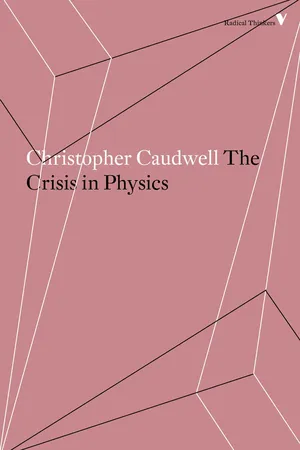
The Crisis in Physics
About this book
Christopher Caudwell's The Crisis in Physics is a stylish and readable analysis of the lines of connection between scientific theories and economic realities. Caudwell provides a trenchant critique of mechanism and positivism. In the words of J. B. S. Haldane, The Crisis in Physics offers a 'quarry of ideas' for future philosophers: a wealth of insights and arguments that demand and deserve continuing critical reflection.
Information
Topic
FilosofiaSubtopic
Storia e teoria della filosofiaCHAPTER ONE
FROM NEWTON TO EINSTEIN
1. THE NEW SCHOOL IN PHYSICS
THE crisis in physics, which a few years ago was the secret of physicists, has now become generally shared with the public. Even the man in the street is aware that all is not well with physics; and that in many cases the cracks which are rapidly developing in the structure have been stopped up by mystical notions new to science. It is proclaimed by distinguished physicists that ‘determinism’ or ‘causality’ has been expelled from physics; that the Universe is the creation of a mathematician; and that its real nature is unknowable. Jeans, Schrödinger, Heisen-berg, Dirac and Eddington are prominently associated with these ideas; all are distinguished physicists. They are opposed by Planck and Einstein, whose prestige is the chief weapon in their defence of the older positions. For their defence is a kind of stone walling; they are unable to lead any counter-attack on the enemy positions. Planck’s justification of ‘causality’ is that it is the scientist’s faith, his anchor, the unprovable fundamental of science. Einstein’s tactics are even simpler; he ‘cannot understand’ what the younger men mean.
Evidently the new school do not need to trouble about dislodging their antagonists from such ineffective philosophical positions and, with the support of the bishops and the spiritualists, they advance to occupy the new territory they have marked out. Of course it is impossible to ignore the opposition of Planck and Einstein. Einstein is the father of relativity physics and Planck of the originator of quantum physics. Both were ‘revolutionary’ in their day. Even Planck’s faith and Einstein’s incomprehension therefore have pulling power over the undecided. But the younger men include Heisenberg, Schrödinger and Dirac whose technical achievements are of a similarly ‘revolutionary’ character. There is no doubt that the new school is winning mass support in its struggle for a more mysterious Universe.
The cause of the crisis in bourgeois physics is sometimes held to be the contradiction between macroscopic or relativity physics on the one hand, and quantum or atomic physics on the other. The concepts with which each domain works are irreconcilable. But it would be wrong to suppose that this contradiction is the real cause of the present crisis in physics. The crisis is too general for that. This particular contradiction is only one of the forms in which the crisis comes to light.
2. NEWTON’S UNIVERSE
There has in fact been a contradiction between two domains of physics ever since the days of Huyghens. Newton’s system of Nature, which included the corpuscular theory of light, formed a consistent scheme of the Universe, apparently free from contradictions, built up on an atomistic basis. All particles behaved according to a simple law of motion which uniquely determined the life-line of each particle. The system was of such a character that an ‘initial push-off’ and an initial fabrication of the atoms out of nothing was necessary. These initial acts were creative acts of God. God thus appears in the Universe as force and substance alienated from Himself. But once created, these two categories. are subject to law, the laws of the conservation of matter and energy. Given its initial push-off and creation, the atomistic universe is self-running.
Newton however does not regard it in this light, for his conception of substance is such, as we shall see later, that the maintenance of these laws in fact requires the continual intervention of God.
Thus such a Universe does not exclude the possibility of divine interference with its own laws, but it is always a disruption of very simple laws, and hence is bound increasingly to appear an unaesthetic act.
In the medieval and Aristotelian schemes of the Universe, motion requires the constant expenditure of force, apart altogether from laws governing the action of forces. Hence the Universe needs the continual inflow of Divinity, as a Prime Mover, to keep it going. Evidently therefore Newton’s atomistic scheme gives a basis for deleting God from the Universe as a causal influence once it is treated. The laws of God then become qualities of matter. As compared with Aristotle’s, Newton’s laws of motion desacralize physics; and they culminate in Laplace’s divine calculator, who, knowing the speed and location of every particle in the Universe at a given time, can predict the whole future course of events throughout infinite Time. Nature becomes a machine, but of course one can still ask with Paley: ‘Who made the machine?’
Newtonian physics excludes God from Nature, but not from Reality, because it makes Nature only a part of Reality as a result of its particulate conception of Matter.
3. THE WAVE THEORY OF LIGHT
The experimental disproof of the corpuscular theory of light shattered this Universe in the eighteenth century and Laplace’s divine calculator had in fact already been proved an impossibility before he emerged from the brain of the French mathematician. It was proved that light rays did not have the character of corpuscles but of waves.
Now everyone had seen waves, and therefore there seemed nothing startling in this conception. But waves as witnessed are waves in something: they are a certain type of movement of water particles. But in the succeeding years, light waves, although they continued to behave like waves in water, proved to be waves of nothing. This raised problems of a critical kind, but the deepness of the contradiction and the gravity of the crisis were only gradually realized.
It is true that this nothing was given a name: the ether. Ether it was explained was not matter; its properties were sui generis. Unfortunately all these sui generis properties proved to be negative. Ether offered no resistance to matter. Ether had no chemical properties. Ether was frictionless, weightless, invisible, and unaffected by the passage of matter through it.
Its final and utter negativity was revealed by the Michelson-Morley experiments. Since the one certain sui generis property of the ether was that light waved in it, then at least a property peculiar to light waves in motion could be recorded of it: the speed of this motion as compared to the earth’s. An ingenious apparatus was constructed based on this argument: The earth moves through the ether; light waves are waves in the ether; hence if the movement of light waves relative to the earth across a given distance is measured first across the earth’s path and then with the earth’s path there will be a discrepancy. This discrepancy will show the earth’s real speed through the ether.
In fact the result was null. There was no discrepancy. The logical assumption was that the ether moved at the same speed as the earth. But could the earth possibly drag all the ether of infinite space with it? This was contradicted by observations of the stars; and the phenomenon of ‘aberration.’ These observations, and also experiments with ‘ether-whirling’ machines, excluded the only logical deduction from the experiment; that bodies dragged along with them the ether in their vicinity.
4. THE BEGINNING OF THE CRISIS
Hence physicists were faced with the proof that light waves were waves of nothing—evidently an unacceptable statement, for it is meaningless. The only escape from this was a theory that circumstances always mysteriously changed to prevent their observing the earth’s motion through the ether. This alternative was adopted under the name of the Fitzgerald contraction. It was assumed that matter moving through the ether contracted along the line of advance so as exactly to conceal the very discrepancy of measurement, which would reveal the speed of the earth.
This conception was not so fantastic as it sounds, for meanwhile matter had revealed electro-magnetic qualities, and electric and magnetic fields had been proved to obey a set of equations, developed by Clerk-Maxwell, which also controlled the emission of light. Light waves were special forms of electro-magnetic waves. Analysis of the electro-magnetic equations showed that they might be interpreted to mean that matter would contract to the required extent as a result of its motion through the ether. The Fitzgerald contraction was widely accepted as a fact of Nature, and the solution of the crisis.
Meanwhile the nature of ether remained unknown; its specification included factors that insured its unknow-ability. Science found on its hands that metaphysically unmanageable entity, the unknowable.
For in fact the unknowable cannot exist; even to say that it is unknowable is to say we know something about it; and when further we say it is unknowable for certain reasons (as we must if unknowable is to be more’ than a mere word) we specify certain of its qualities, although in an inverted way.
If this position was to be taken seriously, either the ether was completely unknowable and therefore did not exist, being merely the nominative of ‘to undulate’ or else relative motion through the ether was unknowable, in which case this too did not exist. In either case this unknowability defined certain definite characters of the knowable entities, light and motion. ‘Omnia determinatio est negatio.’
5. RELATIVE AND ABSOLUTE MOTION
This revealed a contradiction which was already extant in the Newtonian scheme, whereas the other contradiction had emerged as a result of the discovery empirically of what were held to be undulatory characteristics in light. All the Newtonian particles were in motion, and for example each particle’s velocity gave its kinetic energy, if squared and multiplied by its mass. Its energy and mass therefore seemed real self-subsistent entities. But no particle can move in relation to itself, only in relation to something else. Thus a car moving along a road at 30 m.p.h. encounters another at 30 m.p.h. moving in the opposite direction. Relative to each other they are moving at 60 m.p.h. However, we say each is ‘really’ moving at 30 m.p.h. because that is their speed in relation to the earth of which the road is a part. But the earth is turning on its own axis and circling the sun; and therefore that car which moves with the earth’s rotation and orbital motion is, in relation to the sun, travelling some thousands of m.p.h. faster than the other car. Indeed in relation to the sun, a more important body than the earth, the car is not moving forward at all, but hurtling backwards. Yet the sun is not fixed, but itself moves in relation to the stars, and these themselves move in relation to each other. Hence unless some body at absolute rest can be found, it is impossible to find the true speed of any particle, and hence its energy, and hence its inertia and hence its mass. These can only be found relatively, and in any case, even if such a body at absolute rest does exist, the mass, energy and inertia are still relative and not self-subsistent. Only the resting body could be regarded as self-subsistent. Newton realized these difficulties in a general way and only talked of bodies absolutely at rest with the proviso, ‘if any such exist.’
Now if the speed of the earth through the ether could have been determined, then the ether could have been assumed to be at absolute rest, and this would provide a cosmic framework for detecting the absolute of ‘true’ motion of all particles. But we have seen that motion produced the Fitzgerald contraction, exactly concealing the velocity.
However this Fitzgerald contraction itself conceals a contradiction. The length of a body through the ether contracts as a result of its motion. But this in itself implies an ‘absolute’ length, which is the length of a body at rest in the ether. But since it is impossible to establish the rest or motion of a body in the ether, absolute length is as unknowable as absolute motion. Since the Fitzgerald contraction is unknowable, it cannot be held really to exist. It is merely another negative determination of moving bodies.
Motion includes time: a certain space is traversed in a certain time. But in concrete reality time is not built up into motion. Motion is ‘broken down’ into time. The movement of a body is, in a clock, analysed into movement in space and duration of time. Hence if absolute or time motion and length (or space) are both unknowable, then this is equally so of absolute time, for the motion of bodies will be broken down into different components of space and time by different observers.
The ultimate conclusion of a chain of reasoning which we have only briefly indicated here was that the absolute dimensions, time, and velocity, energy and mass of any particle were unknowable. They did not exist in themselves, or in relation to a unique framework, but were properties of relative frameworks.
6. THE SPECIAL PRINCIPLE OF RELATIVITY
Einstein recognized that these unknowabilities were in fact important principles of knowledge about nature, and he formulated them as the special Principle of Relativity.
This states that absolute length, mass, energy, space, time, and motion do not exist. But before this Principle could be formulated as a scientific principle and not a metaphysical doctrine, it was necessary to establish the relativity of these qualities in a practical way. Although the Principle of Relativity has an epistemological content, it is not a principle of epistemology, but of science. It describes the limits of our knowledge about reality in such a way that these limits become real descriptions of the nature of matter in relation to us. This was only possible because the previous experiments which had established these limits, had furnished a fund of real knowledge about Nature. This fund could not be used by the existing theory of Nature. On the contrary, these practical results contradicted this theory, which therefore had to be recast in a form fuller of practice.
As long ago as Lucretius philosophers have advanced theories as to the relativity of motion and the secondary and defendent character of abstract Time.1 But all such theories were purely metaphysical and could be countered by opposing theories of equal logical worth. It was because the Special Principle of Relativity co-ordinated and gave a meaning to a mass of empirical observations, that it was of importance to physics, and made deeper man’s understanding of the Universe.
7. UNITY AND ATOMICITY
Yet this at once brought to light a still older contradiction, which had also been immanent in the Newtonian Scheme. The Newtonian ‘bodies’ were self-contained units which had each been created with an initial mass and an initial packet of kinetic energy in the form of mass multiplied by the square of the speed which enabled them to lead a wholly independent life in the shape of a right line. Unless they collided physically with another particle, the existence of each was self-contained and unchequered. In such a Universe, unless a collision took place, nothing ‘happened’ and even such a happening merely meant that the two particles continued on right lines at different angles and speeds. Happenings in such a Universe are therefore completely accidental in this sense, that they represent the intersections of two chains of events (the ‘life-lines’ of the particles) which are self-contained and self-subsistent. They are also completely predetermined in that, given the relative positions and velocities of the particles at any time in their history, it would have been possible to predict their collision with certainty.
Such a Universe is of course completely pluralistic. It has no organic unity. The history of the other particles has no effect on the history of one. From the point of view of the particles all happenings are complete accidents. From the point of view of observers of the particles, all happenings are completely predetermined necessities.
Such an ideal Universe is however only partly the Universe of Newton, which already contains another unifying principle, as ‘mysterious’ and ‘transcendent’ as God, contradicting the atomism of the Universe. This mysterious principle is rendered necessary by observation. In fact none of the particles travel on right lines but all are more or less curved by the effects of the other particles. This curvature is therefore of gravity, an intangible entity whose real nature is unknowable—it can only be expressed in terms of its ‘effect’ on the paths of the particles, which it causes to curve to...
Table of contents
- Cover Page
- Title Page
- Copyright Page
- Contents
- Introduction
- Chapter One: From Newton to Einstein
- Chapter Two: The World as Machine
- Chapter Three: Man as Idea
- Chapter Four: The Distortion of Philosophy
- Chapter Five: The Collapse of Determinism
- Chapter Six: The Meaning of Causality
- Chapter Seven: Bell and earth—Universal determinism … contradictory to causality?—Like and unlike—Time and Space—Mutually determining—Modern views: Probability (accident)—Determinism—Causality— Freedom—Iron bourgeois determinism—Freedom: ignorance of necessity
- Chapter Eight
- Chapter Nine
- Chapter Ten
- Chapter Eleven
- Chapter Twelve
- Index
Trusted by 375,005 students
Access to over 1.5 million titles for a fair monthly price.
Study more efficiently using our study tools.
Frequently asked questions
Yes, you can cancel anytime from the Subscription tab in your account settings on the Perlego website. Your subscription will stay active until the end of your current billing period. Learn how to cancel your subscription
No, books cannot be downloaded as external files, such as PDFs, for use outside of Perlego. However, you can download books within the Perlego app for offline reading on mobile or tablet. Learn how to download books offline
Perlego offers two plans: Essential and Complete
- Essential is ideal for learners and professionals who enjoy exploring a wide range of subjects. Access the Essential Library with 800,000+ trusted titles and best-sellers across business, personal growth, and the humanities. Includes unlimited reading time and Standard Read Aloud voice.
- Complete: Perfect for advanced learners and researchers needing full, unrestricted access. Unlock 1.5M+ books across hundreds of subjects, including academic and specialized titles. The Complete Plan also includes advanced features like Premium Read Aloud and Research Assistant.
We are an online textbook subscription service, where you can get access to an entire online library for less than the price of a single book per month. With over 1.5 million books across 990+ topics, we’ve got you covered! Learn about our mission
Look out for the read-aloud symbol on your next book to see if you can listen to it. The read-aloud tool reads text aloud for you, highlighting the text as it is being read. You can pause it, speed it up and slow it down. Learn more about Read Aloud
Yes! You can use the Perlego app on both iOS and Android devices to read anytime, anywhere — even offline. Perfect for commutes or when you’re on the go.
Please note we cannot support devices running on iOS 13 and Android 7 or earlier. Learn more about using the app
Please note we cannot support devices running on iOS 13 and Android 7 or earlier. Learn more about using the app
Yes, you can access The Crisis in Physics by Christopher Caudwell in PDF and/or ePUB format, as well as other popular books in Filosofia & Storia e teoria della filosofia. We have over 1.5 million books available in our catalogue for you to explore.