- 224 pages
- English
- ePUB (mobile friendly)
- Available on iOS & Android
eBook - ePub
About this book
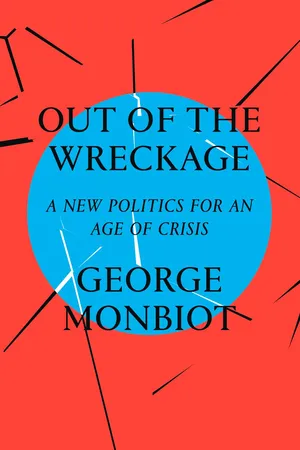
Today, our lives are dominated by an ideology of extreme competition and individualism. It misrepresents human nature, destroying hope and common purpose. But we cannot replace it without a positive vision, one that reengages people in politics and lights a path to a better world. Urgent and passionate, George Monbiot shows how new findings in psychology, neuroscience and evolutionary biology cast humans in a radically different light: as the supreme altruists and cooperators. He shows how both democracy and economic life can be radically reorganised from the bottom up, enabling us to take back control and overthrow the forces that have thwarted our ambitions for a better society. Out of the Wreckage explains just how communities can be rebuilt with the help of a new "politics of belonging".
Information
1
A Story of Our Times
You cannot take away someone’s story without giving them a new one. It is not enough to challenge an old narrative, however outdated and discredited it may be. Change happens only when you replace it with another. When we develop the right story, and learn how to tell it, it will infect the minds of people across the political spectrum. Those who tell the stories run the world.
The old world, which once looked stable, even immutable, is collapsing. A new era has begun, loaded with hazard if we fail to respond, charged with promise if we seize the moment. Whether the systems that emerge from this rupture are better or worse than the current dispensation depends on our ability to tell a new story, a story that learns from the past, places us in the present and guides the future.
The Power of the Story
Stories are the means by which we navigate the world. They allow us to interpret its complex and contradictory signals. We all possess a narrative instinct: an innate disposition to listen for an account of who we are and where we stand. In his illuminating book Don’t Even Think About It, George Marshall explains that ‘stories perform a fundamental cognitive function: they are the means by which the Emotional Brain makes sense of the information collected by the Rational Brain. People may hold information in the form of data and figures, but their beliefs about it are held entirely in the form of stories.’1 When we encounter a complex issue and try to understand it, what we look for is not consistent and reliable facts but a consistent and comprehensible story. When we ask ourselves whether something ‘makes sense’, the ‘sense’ we seek is not rationality, as scientists and philosophers perceive it, but narrative fidelity. Does what we are hearing reflect the way we expect humans and the world to behave? Does it hang together? Does it progress as stories should progress?
Drawing on experimental work, Marshall shows that, even when people have been told something is fictitious, they will cling to it if it makes a good story and they have heard it often enough. Attempts to refute such stories tend only to reinforce them, as the disproof constitutes another iteration of the narrative. When we argue, ‘It’s not true that a shadowy clique of American politicians orchestrated the attack on the World Trade Centre’, those who believe the false account hear that ‘a shadowy clique of American politicians orchestrated the attack on the World Trade Centre’. The phrase ‘It’s not true that’ carries less weight than the familiar narrative to which it is attached.
A string of facts, however well attested, has no power to correct or dislodge a powerful story. The only response it is likely to provoke is indignation: people often angrily deny facts that clash with the narrative ‘truth’ established in their minds.
The only thing that can displace a story is a story.
Effective stories tend to possess a number of common elements. They are easy to understand. They can be briefly summarised and quickly memorised. They are internally consistent. They concern particular characters or groups. There is a direct connection between cause and effect. They describe progress – from a beginning through a middle to an end. The end resolves the situation encountered at the beginning, with a conclusion that is positive and inspiring.
Certain stories are repeated across history and through different cultures. For example, the story of the hero setting out on a quest, encountering great hazard (often in the form of a monster), conquering it in the face of overwhelming odds, and gaining prestige, power or insight is common to cultures all over the world, some of which had no possible contact with each other. Ulysses, Beowulf, Sinbad, Sigurd, Cú Chulainn, Arjuna, St George, Lạc Long Quân and Glooskap are all variants of this universal hero. Our minds appear to be attuned not only to stories in general, but to particular stories that follow consistent patterns.
In politics, there is a recurring story that captures our attention. It goes like this:
Disorder afflicts the land, caused by powerful and nefarious forces working against the interests of humanity. The hero – who might be one person or a group of people – revolts against this disorder, fights the nefarious forces, overcomes them despite great odds and restores order.
Stories that follow this pattern can be so powerful that they sweep all before them: even our fundamental values. For example, two of the world’s best-loved and most abiding narratives – The Lord of the Rings and the Narnia series – invoke values that were familiar in the Middle Ages but are generally considered repulsive today. Disorder in these stories is characterised by the usurpation of rightful kings or their rightful heirs; justice and order rely on their restoration. We find ourselves cheering the resumption of autocracy, the destruction of industry and even, in the case of Narnia, the triumph of divine right over secular power.
If these stories reflected the values most people profess – democracy, independence, industrial ‘progress’ – the rebels would be the heroes and the hereditary rulers the villains. We overlook the conflict with our own priorities because the stories resonate so powerfully with the narrative structure for which our minds are prepared. Facts, evidence, values, beliefs: stories conquer all.
Heroes and Villains
The two most successful political stories of the twentieth century – both of which have survived into the twenty-first – are diametrically opposed to each other, but follow the same narrative pattern.
The social-democratic story explains that the world fell into disorder – characterised by the Great Depression – because of the self-seeking behaviour of an unrestrained elite. The elite’s capture of both the world’s wealth and the political system resulted in the impoverishment and insecurity of working people. By uniting to defend their common interests, the world’s people could throw down the power of this elite, strip it of its ill-gotten gains and pool the resulting wealth for the good of all. Order and security would be restored in the form of a protective, paternalistic state, investing in public projects for the public good, generating the wealth that would guarantee a prosperous future for everyone. The ordinary people of the land – the heroes of the story – would triumph over those who had oppressed them.
The neoliberal story explains that the world fell into disorder as a result of the collectivising tendencies of the over-mighty state, exemplified by the monstrosities of Stalinism and Nazism, but evident in all forms of state planning and all attempts to engineer social outcomes. Collectivism crushes freedom, individualism and opportunity. Heroic entrepreneurs, mobilising the redeeming power of the market, would fight this enforced conformity, freeing society from the enslavement of the state. Order would be restored in the form of free markets, delivering wealth and opportunity, guaranteeing a prosperous future for everyone. The ordinary people of the land, released by the heroes of the story (the freedom-seeking entrepreneurs) would triumph over those who had oppressed them.
In the next two chapters, I will show how both stories ran into trouble, encountering problems that, if facts and evidence ruled the world, would have forced either the radical modification or abandonment of these doctrines. But because of their narrative power and a disastrous failure to develop effective countervailing stories, they have yet to be replaced. The facts changed, but our minds did not.
If the rupture is to be resolved for good rather than for ill, we need a new story. Our challenge is to produce one that is faithful to the facts, faithful to our values, and faithful to the narrative patterns to which we respond.
The Sound of Silence
Like many people who seek a generous, inclusive politics, I have been listening for such a story, waiting for its bugle call to resound, so that we can rally in the expectation of a better future. The wait continues. Most mainstream parties seek only to tweak existing narratives. This is why they often seem effete, passionless and exhausted.
Beyond the established parties, popular movements suffer, if anything, from the opposite problem. A thousand fragments of story clamour to be heard, creating, for those who stand outside, an unintelligible cacophony. Without a coherent and stabilising narrative, these movements remain reactive, disaggregated and precarious, always at risk of burnout and disillusion.
Despair is the state we fall into when our imagination fails. When we have no stories that describe the present and guide the future, hope evaporates. Political failure is, in essence, a failure of imagination.
Without a new story, a story that is positive and propositional rather than reactive and oppositional, nothing changes. With such a story, everything changes.
In seeking to develop a restorative political story around which we can gather and mobilise, we should first identify the values and principles we want to champion. This is because the stories we tell propagate the beliefs around which they are built.
I am not suggesting that those who read or watch The Lord of the Rings are provoked to leap from their sofas shouting ‘bring back feudalism!’ The story was not intended to create political change, and there has been no attempt (as far as I know) to use it to advance autocracy. But when stories are designed for a political purpose and circulated to advance this purpose, they have the power to change or strengthen our values. The most grotesque doctrines can look like common sense when embedded in a compelling narrative, as Lenin, Hitler, Georges Sorel, Gabriele D’Annunzio and Ayn Rand discovered.
The failure to tell a new story has been matched by an equally remarkable omission: the failure to discern and describe the values and principles that might inform our politics.
Know Your Values
Values are the bedrock of effective politics. They represent the importance we place on fundamental ways of being, offering a guide to what we consider to be good and worthwhile. They can often be described with single words.
For example, a person’s dominant values may be wisdom, strength, honesty and freedom. This does not mean that these are the only values they hold, let alone that they always live by them, but that these are the aspirations they consider most important.
Our values tend to cluster around certain poles.2 Social psychologists sometimes describe these poles as intrinsic and extrinsic. Intrinsic values, in their purest form, are expressed as compassion, connectedness and kindness towards all living beings, including oneself.3 Extrinsic values are expressed as a desire for self-enhancement, through gaining, for example, status or power.
People with a strong set of intrinsic values and a weaker set of extrinsic values have high levels of self-acceptance, strong bonds of intimacy and a powerful desire to help other people. They are strongly inclined towards empathy, understanding, and independent thought and action. Research across seventy nations suggests that intrinsically motivated people are more open to change, have a stronger interest in universal rights and equality, and a stronger desire to protect and cherish both human beings and the natural world than more extrinsically motivated people.4
Most people, when asked what they care about, prioritise intrinsic values, placing community, friendship and equality at the top of the list.5 Surveys of both children and adults reveal that the value which tends to be favoured above all others is what psychologists call ‘benevolence’, by which they mean protecting or advancing the welfare of people we know.6
The smaller number of people at the extrinsic end of the spectrum are more attracted to prestige, status, image, fame, power and wealth. They are strongly motivated by the prospect of individual reward and praise. They have little interest in cooperation or community. People who emphasise these values tend to report higher levels of stress, anxiety, anger, envy, dissatisfaction and depression than those at the intrinsic end.7
We are not born with these values. They are strongly shaped by our social environment, by the cues and responses we receive from other people, and by the stories we tell ourselves and each other. They are also shaped by the political environment.8 If people live under a cruel and grasping political system, they tend to normalise and internalise it, absorbing its dominant trends and translating them into extrinsic values. This, in turn, permits an even crueller and more grasping political system to emerge.
If, by contrast, people live in a country in which no one is allowed to fall out of the boat, in which social norms are characterised by kindness, empathy, community and freedom from want and fear, their values are likely to shift towards the intrinsic end. This process is known as policy feedback, or the Values Ratchet.
Whether or not people become involved in civic life is influenced by their perceptions of their culture’s dominant values. For example, research by the Common Cause Foundation reveals that if people perceive others to be mostly extrinsically motivated, they are less likely to vote in elections.9
When political parties dilute or abandon their values and adopt the values, phrases and stories of their opponents (a process known as triangulation), they change the political environment in which they operate. Like yeast in a barrel of beer, they generate the toxic conditions that eventually kill them.
If our purpose is to create a kinder world, we should embed within the politi...
Table of contents
- Cover Page
- Halftitle Page
- Title Page
- Copyright Page
- Dedication
- Contents
- 1. A Story of Our Times
- 2. A Captive Audience
- 3. Don’t Look Back
- 4. Alienation
- 5. Belonging
- 6. Our Economy
- 7. Framing the Economy
- 8. Our Politics
- 9. Making It Happen
- Conclusion: The Politics of Belonging
- Acknowledgements
- Notes
- Index
Trusted by 375,005 students
Access to over 1.5 million titles for a fair monthly price.
Study more efficiently using our study tools.
Frequently asked questions
Yes, you can cancel anytime from the Subscription tab in your account settings on the Perlego website. Your subscription will stay active until the end of your current billing period. Learn how to cancel your subscription
No, books cannot be downloaded as external files, such as PDFs, for use outside of Perlego. However, you can download books within the Perlego app for offline reading on mobile or tablet. Learn how to download books offline
We are an online textbook subscription service, where you can get access to an entire online library for less than the price of a single book per month. With over 1.5 million books across 990+ topics, we’ve got you covered! Learn about our mission
Look out for the read-aloud symbol on your next book to see if you can listen to it. The read-aloud tool reads text aloud for you, highlighting the text as it is being read. You can pause it, speed it up and slow it down. Learn more about Read Aloud
Yes! You can use the Perlego app on both iOS and Android devices to read anytime, anywhere — even offline. Perfect for commutes or when you’re on the go.
Please note we cannot support devices running on iOS 13 and Android 7 or earlier. Learn more about using the app
Please note we cannot support devices running on iOS 13 and Android 7 or earlier. Learn more about using the app
Yes, you can access Out of the Wreckage by George Monbiot in PDF and/or ePUB format, as well as other popular books in Politique et relations internationales & Histoire et théorie politique. We have over 1.5 million books available in our catalogue for you to explore.