- 304 pages
- English
- ePUB (mobile friendly)
- Available on iOS & Android
eBook - ePub
About this book
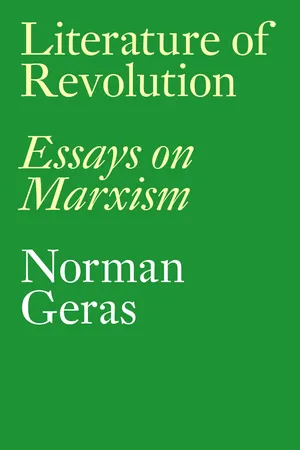
This influential collection explores the pivotal texts and topics in the Marxist tradition. Ranging over questions of social theory, political theory, moral philosophy and literary criticism, it looks at the thought of Marx and Trotsky, Luxemburg, Lenin and Althusser. They include Geras's influential and widely-cited treatment of fetishism in Capital, his comprehensive review of recent debates on Marxism and justice, discussions on political organisation, revolutionary mass action and party pluralism, and a novel analysis of the literary power of Trotsky's writing. In close dialogue with common themes and arguments in the literature of revolutionary Marxism, Geras brings some of his persistent preoccupations to the fore; with the normative foundations and some of the epistemological assumptions of this tradition, with issues of socialist democracy, working class self-education and emancipation.
Information
I
Mainly Marx
1.
The Controversy About Marx
and Justice
1984
In this essay I review a fast growing sector of the current literature on Marx and the controversy that has fuelled its growth. During the last decade or so, the keen interest within moral and political philosophy in the concept of justice has left its mark on the philosophical discussion of his work. It has left it in the shape of the question: did Marx himself condemn capitalism as unjust? There are those who have argued energetically that he did not; and as many who are equally insistent that he did—a straight-forward enough division, despite some differences of approach on either side of it. To prevent misunderstanding, it is worth underlining at the outset that the question being addressed is not that of whether Marx did indeed condemn capitalism, as opposed just to analysing, describing, explaining its nature and tendencies. All parties to this dispute agree that he did, agree in other words that there is some such normative dimension to his thought, and frankly, I do not think the denial of it worth taking seriously any longer. The question is the more specific one: does Marx condemn capitalism in the light of any principle of justice?
I shall survey the case for thinking he does not and the case for thinking that he does; the textual evidence adduced and supporting argument put forth on behalf of each. Given the extent of the literature being surveyed—some three dozen items (all but one of which have appeared since 1970; and incidentally, of largely, indeed overwhelmingly, North American provenance, twenty-one of the twenty-four authors cited here either writing or hailing from that continent)—each case as I present it is a kind of composite. No one of its proponents necessarily makes use of all the texts and arguments I shall enumerate and they sometimes emphasize or formulate differently those that they do use in common. Still, I give what I hope is an accurate overall map of this dispute, before going on to venture my own judgement on it. The main body of the essay falls, therefore, into three parts. First, I review the texts and arguments put forward by those who deny that Marx condemned capitalism as unjust. Second, I review the texts and arguments put forward by those who claim he did so condemn it. I try in these two sections to present each case broadly as made, with a minimum of critical comment. Third, I then offer some conclusions, and argument in support of them.1
Before getting under way, however, there is one indispensable preliminary and that is to sketch briefly a part of the theoretical background to this debate, the general lines of Marx’s account of capitalist exploitation. One may speak for this purpose of the ‘two faces’ of it distinguishable in the wage relation. The first and more benign of them is seen in the sphere of circulation, where there is according to Marx an exchange of equivalent values, wages on the one side for labour-power on the other. The workers sell their commodity—the capacity to work—and from the capitalist they receive in exchange, in the form of wages, the value of the commodity they sell, which is to say the value of what goes into producing it, of the things workers consume by way of their historically defined subsistence. What they receive from the capitalist, Marx goes out of his way to insist, is the full equivalent in value of what they sell and so involves no cheating. The second and uglier face of the relationship now shows itself, however, in the sphere of production. Here the workers, whose labour is itself the source of the value that commodities contain, will have to work longer than the time which is necessary to reproduce the value of their own labour-power, longer than is necessary to replace the value of the wage they have received. They will perform, that is to say, surplus labour, and the surplus-value they create thereby will be appropriated by the capitalist as profit. Labour-power in operation creates a value greater than the value labour-power itself embodies and is sold for. The two faces by turns reveal their contrasting features across the pages of Capital, complementary aspects of the wage relation: in the sphere of circulation, an equal exchange freely contracted; in the sphere of production, the compulsion to labour some hours without reward.
This, then, is the character of capitalist exploitation. Does Marx think it unjust?
I. Marx Against Justice
(i) A first and, on the face of it, compelling piece of evidence against supposing so is that he actually says it is not. Once the purchase of labour-power has been effected, according to Marx, this commodity belongs to the capitalist as of right, and so therefore does its use and so do the products of its use.2 Or, expressed from the worker’s point of view, ‘As soon as his labour actually begins, it has already ceased to belong to him.’3 The capitalist, Marx says in the passage most often referred to in this connection, has paid for the value of labour-power, and the fact that the use of the latter now creates a greater value, this ‘is a piece of good luck for the buyer, but by no means an injustice towards the seller.’4 Similarly: ‘The fact that this particular commodity, labour-power, possesses the peculiar use-value of supplying labour, and therefore of creating value, cannot affect the general law of commodity production. If, therefore, the amount of value advanced in wages is not merely found again in the product, but augmented by a surplus-value, this is not because the seller has been defrauded, for he has really received the value of his commodity; it is due solely to the fact that this commodity has been used up by the buyer.’5
(ii) Consistently with this denial that the wage relation is unjust, Marx also rails against socialists who want for their part to appeal to considerations of justice. The best known occasion is his polemic, in Critique of the Gotha Programme, against the notion of a fair distribution of the proceeds of labour. ‘What is a “fair distribution”?’ he asks pointedly. ‘Do not the bourgeois assert that the present-day distribution is “fair”? And is it not, in fact, the only “fair” distribution on the basis of the present-day mode of production? Are economic relations regulated by legal conceptions or do not, on the contrary, legal relations arise from economic ones? Have not also the socialist sectarians the most varied notions about “fair” distribution?’ Shortly afterwards, he refers to such notions as ‘obsolete verbal rubbish’ and ‘ideological nonsense about right and other trash so common among the democrats and French Socialists’—the gist of all of which seems clear enough.6 Again, in a letter of 1877, he writes contemptuously of ‘a whole gang of half-mature students and super-wise diplomaed doctors who want to give socialism a “higher, idealistic” orientation, that is to say, to replace its materialistic basis (which demands serious objective study from anyone who tries to use it) by modern mythology with its goddesses of Justice, Liberty, Equality, and Fraternity.’7 On the one occasion when Marx himself makes use of some phrases about rights and justice—in his Inaugural Address to, and Preamble to the Rules of, the First International—he explains carefully in a letter to Engels: ‘I was obliged to insert two phrases about “duty” and “right” into the Preamble to the Rules, ditto about “truth, morality and justice”, but these are placed in such a way that they can do no harm.’8
(iii) What motivates the above polemics, as well as Marx’s denial of any injustice in the wage relation, is perhaps already evident. It is what is suggested to many, including those whose interpretation we are presently rehearsing, by another formulation from Critique of the Gotha Programme; namely, that ‘Right can never be higher than the economic structure of society and its cultural development conditioned thereby.’9 Standards of justice, this may be taken to mean, are relative or internal to specific historical modes of production. It is not merely that they are generated by these—that juridical relations and the ‘forms of social consciousness’ corresponding to them ‘originate in the material conditions of life’10—but that, in addition, they are only applicable to and valid for them. The only principles of justice which are appropriate to judging a particular mode of production are those that in fact ‘correspond’ to it, that are functional to sustaining and legitimating it. In the words of another much quoted passage: ‘It is nonsense for Gilbart to speak of natural justice in this connection [interest payment on loans—NG]. The justice of transactions between agents of production consists in the fact that these transactions arise from the relations of production as their natural consequence. The legal forms in which these economic transactions appear as voluntary actions of the participants, as the expressions of their common will and as contracts that can be enforced on the parties concerned by the power of the state, are mere forms that cannot themselves determine this content. They simply express it. The content is just so long as it corresponds to the mode of production and is adequate to it. It is unjust as soon as it contradicts it. Slavery, on the basis of the capitalist mode of production, is unjust; so is cheating on the quality of commodities.’11 Now, if by relativism in this regard we understand a conception in which what is just is simply a matter of subjective viewpoint, then Marx’s conception may be said not to be a relativist one. It has, on the contrary, a firmly objective basis, since it construes the standards of justice appropriate to any society as being so by virtue of the real social function they perform.12 It remains relativist, however, in the different sense of tying every principle of justice to a specific mode of production in the way described, and thus rendering each such principle unfit to provide a basis for trans-historical judgement. On this account of things, there cannot be an independent standard of justice, external to capitalism, yet appropriate to assessing it. There can be no principle transcending historical epochs and in the light of which Marx would have been able to condemn capitalism as unjust.
(iv) We can put the same point in another way. Moral norms and notions come within the compass of Marx’s theory of ideology. Not only, therefore, do ideas about justice, but so does morality more generally, belong to the superstructure of any social formation. As The German Ideology has it, ‘Morality, religion, metaphysics, and all the rest of ideology as well as the forms of consciousness corresponding to these, thus no longer retain the semblance of independence.’13 It is not consistent with his views on ideology that Marx should have found capitalist society to be unjust by reference to historically quite general norms of justice.14
Reformism
(v) Justice being an essentially distributive value, it is argued furthermore, to attribute to Marx a concern with it is to inflect his critique of capitalism in a direction he explicitly repudiated and leads to a reformist conclusion he did not accept. For it focuses attention too narrowly on the distribution of income and the differentials within it: on the share of the social product received by the workers, the inadequate level of their remuneration. And it suggests that their exploitation might be eliminated by alteration and regulation of this sphere, in other words, merely by reforms in the distribution of income. As we know, however, for Marx exploitation is in the very nature of capitalism, integral to its relations of production on which the distribution of income largely depends. His preoccupation is with this more fundamental issue of the production relations and the need for a thoroughgoing revolution in them. As important as they are, reforms in the matter of wage levels simply cannot lead to the abolition of exploitation.15 So, Marx chides the authors of the Gotha Programme with having made a fuss about ‘so-called distribution’. The distribution of ‘the means of consumption’ cannot be treated independently of the mode of production.16 So too, in Wages, Price and Profit, he speaks of ‘that false and superficial radicalism that accepts premises and tries to evade conclusions’, and he goes on: ‘To clamour for equal or even equitable retribution on the basis of the wages system is the same as to clamour for freedom on the basis of the slavery system. What you think just or equitable is out of the question. The question is: What is necessary and unavoidable with a given system of production?’ Later in the same work Marx proclaims, ‘Instead of the conservative motto, “A fair day’s wage for a fair day’s work!” they [the workers—NG] ought to inscribe on their banner the revolutionary watchword, “Abolition of the wages system!”’17
(vi) The focus on distributive justice, some say, is also reformist in another way. It leads back from Marx’s materialist enterprise of seeking the real revolutionary tendencies which will overturn the capitalist order to projects of moral enlightenment and legal reform. As one commentator puts this, it ‘directs attention toward confused abstract ideals of justice and away from concrete revolutionary goals.’18 The line of thought here is that for Marx it is a form of idealism to believe historical progress occurs through a change for the better in people’s moral or juridical ideas. Such a change is secondary, derivative of the transformations in society’s production relations. What counts, therefore, is to identify the actual historical tendencies that make for this sort of transformation and the social forces and movements at work that are capable of consummating it. Relative to this materialist task, a critique of capitalism in the name of justice represents a retreat—just equipping the would-be revolutionary, determined and passionate as may be, ‘to deliver the keynote address at the next Democratic Convention’.19
(vii) Principles of justice are, in any case, precisely juridical principles. As such, they have their place within that whole institutional apparatus of state, law, sanctions and so on, by which obligatory modes of conduct are imposed upon the members of a social order. According to Marx, however, a communist society will not have this sort of apparatus. The state here withers away. Communism as envisaged by him cannot then be seen as realizing a juridical principle like one of distributive justice, as conforming to and institutionalizing this where capitalism is to be criticized for violating it.20
Beyond Scarcity
(viii) A communist society as Marx envisages it, indeed, is a society beyond justice. That is the claim of the commentators whose case we are presenting and the main textual authority for it is the same section from Critique of the Gotha Programme we have already cited, in which Marx speaks his mind about ‘fair distribution’ and about ‘right’. For, in that context, he also anticipates two sorts of distributional criterion for the different phases of a post-capitalist society and discusses them in a way these commentators take to prove their point. For convenience, I refer hereafter to the two principles involved as, respectively, the contribution principle and the needs principle. The former will apply, Marx thinks, during an earlier period of emergent communism, ‘still stamped with the birth marks of the old society’. After some necessary deductions from the total social product have been made—for infrastructural and similar social purposes and the provision of public goods—each individual will receive from it, by way of means of personal consumption, an amount in proportion to his or her labour contribution. Each will be rewarded, therefore, according to an equal standard, constitutive of a situation of ‘equal right’. But this is an equal right, Marx says, ‘still constantly stigmatized by a bourgeois limitation’. Though it no longer permits class differences or privileges, nevertheless by measuring people solely according to their labour contribution, it allows those relatively well endowed, whether with physical or with intellectual ability, to benefit from the greater contribution they can thereby make, and it entails, conversely, for those with relatively large needs or responsibilities, greater burdens and disadvantages than others will have to bear: ‘It is, therefore, a right of inequality, in its content, like every right. Right by its very nature can consist only in the application of an equal standard; but unequal individuals (and they would not be different individuals if they were not unequal) are measurable only by an equal standard in so far as they are brought under an equal point of view, are taken from one definite side only, for instance, in the present case, are regarded only as workers and nothing more ...
Table of contents
- Cover Page
- Halftitle Page
- Title Page
- Copyright Page
- Contents
- Dedication
- Introduction
- Acknowledgements
- I. Mainly Marx
- II. Mainly Trotsky
- Notes
- Index
Trusted by 375,005 students
Access to over 1.5 million titles for a fair monthly price.
Study more efficiently using our study tools.
Frequently asked questions
Yes, you can cancel anytime from the Subscription tab in your account settings on the Perlego website. Your subscription will stay active until the end of your current billing period. Learn how to cancel your subscription
No, books cannot be downloaded as external files, such as PDFs, for use outside of Perlego. However, you can download books within the Perlego app for offline reading on mobile or tablet. Learn how to download books offline
Perlego offers two plans: Essential and Complete
- Essential is ideal for learners and professionals who enjoy exploring a wide range of subjects. Access the Essential Library with 800,000+ trusted titles and best-sellers across business, personal growth, and the humanities. Includes unlimited reading time and Standard Read Aloud voice.
- Complete: Perfect for advanced learners and researchers needing full, unrestricted access. Unlock 1.5M+ books across hundreds of subjects, including academic and specialized titles. The Complete Plan also includes advanced features like Premium Read Aloud and Research Assistant.
We are an online textbook subscription service, where you can get access to an entire online library for less than the price of a single book per month. With over 1.5 million books across 990+ topics, we’ve got you covered! Learn about our mission
Look out for the read-aloud symbol on your next book to see if you can listen to it. The read-aloud tool reads text aloud for you, highlighting the text as it is being read. You can pause it, speed it up and slow it down. Learn more about Read Aloud
Yes! You can use the Perlego app on both iOS and Android devices to read anytime, anywhere — even offline. Perfect for commutes or when you’re on the go.
Please note we cannot support devices running on iOS 13 and Android 7 or earlier. Learn more about using the app
Please note we cannot support devices running on iOS 13 and Android 7 or earlier. Learn more about using the app
Yes, you can access Literature of Revolution by Norman Geras in PDF and/or ePUB format, as well as other popular books in Politics & International Relations & Political Philosophy. We have over 1.5 million books available in our catalogue for you to explore.