In recent decades there has been an immense global surge in the numbers both of universities and of students. In the UK alone there are now over 140 institutions teaching more subjects than ever to nearly 2.5 million students. New technology offers new ways of learning and teaching. Globalisation forces institutions to consider a new economic horizon. At the same time governments have systematically imposed new procedures regulating funding, governance, and assessment. Universities are being forced to behave more like business enterprises in a commercial marketplace than centres of learning.
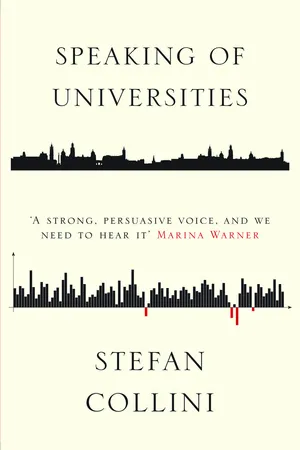
In Speaking of Universities, historian and critic Stefan Collini analyses these changes and challenges the assumptions of policy-makers and commentators. Does "marketisation" threaten to destroy what we most value about education; does this new era of "accountability" distort what it purports to measure; and who does the modern university "belong to"? Responding to recent policies and their underlying ideology, the book is a call to "focus on what is actually happening and the cliches behind which it hides; an incitement to think again, think more clearly, and then to press for something better".
- 304 pages
- English
- ePUB (mobile friendly)
- Available on iOS & Android
eBook - ePub
Speaking of Universities
About this book
Information
Topic
DidatticaSubtopic
Didattica generalePART I
ANALYSES
CHAPTER 1
What’s Happening to Universities?
Historical and Comparative Perspectives
I
Readers will doubtless have noticed how, in the past two or three decades, businesses across the world have been pressured into making themselves look more and more like universities. Companies have been exhorted to abandon commercial competition and to model their behaviour on patterns of scholarly collaboration. Stock-market-listed corporations now have to make returns detailing the intellectual and scholarly value of their products and services. Targets and benchmarks are being replaced by informed judgement; HR divisions are shrinking; and companies are doing less self-advertising and producing fewer glossy brochures. They have also had to adopt a more collegiate and bottom-up form of governance; CEOs are increasingly being replaced by committees drawn from the professoriate, and places on major companies’ Boards of Directors have been reserved for experienced Senior Lecturers in Medieval History.
At first sight, it may seem obvious why the changes that are actually taking place are the exact reverse of those I have just fancifully sketched. It has become almost commonplace to observe how universities are now subject to ‘incessant hectoring’ for their failure to be more like businesses. But it is worth reminding ourselves that capitalism had, in some form, been around a long time before the recent epidemic of business-envy. We should not fall into ahistorical essentializing where either capitalism or universities are concerned – and there is more to be said about the changes over time in both – but in some form they had managed to coexist for a century or more without universities being required to adopt the goals, structures or procedures of corporations, or at least of some business-school model of how corporations should be run. Indeed, for about 150 years after universities started to assume something like their modern form in the early nineteenth century, the fact that they represented in some sense an alternative ethic or antidote to the commercial world was precisely one of the justifications for their existence. This was a view shared even by those who have retrospectively been cited as the champions of applied science, such as T.H. Huxley, who declared in 1894: ‘The primary business of universities has to do merely with pure knowledge and pure art – independent of all application to practice; with the advancement of culture and not with the increase of wealth or commodities.’ This conception was endorsed by one of the iconic leaders of that commercial world, Joseph Chamberlain, Mayor of Birmingham as well as, later, a cabinet minister, who greeted the establishment in his fiefdom of what was to become the University of Birmingham by saying: ‘To place a university in the middle of a great industrial and manufacturing population is to do something to leaven the whole mass with higher aims and higher intellectual ambitions than would otherwise be possible to people engaged entirely in trading and commercial pursuits.’ And something similar was reasserted in the most downright terms by Ernest Rutherford, the Nobel-winning ‘father of nuclear physics’, when he warned the University of Bristol in 1927 that he ‘would view as an unmitigated disaster the utilization of university laboratories for research bearing on industry’.
I cite those views precisely because they sound so unimaginably distant from the assumptions about relations between universities and the economy that we increasingly take for granted, though they were a strong, perhaps even the dominant, strain in thinking about universities well into the second half of the twentieth century, especially in Britain and British-influenced parts of the world. But they were never, of course, the only strain even there, for versions of the conflict between those asserting priority for practical concerns and those claiming to represent non-instrumental values have a very long history. The fact is that what societies have wanted from their universities has been historically variable, internally contradictory, and only ever partly attainable. We should certainly begin by recognizing that universities have always in part served practical ends and have always helped to prepare their graduates for employment in later life. Once upon a time their primary role was to teach true religion and provide learned men for the church; once upon another time it was to inculcate virtue or judgement or good manners or any of the other supposed attributes of a gentleman; once upon yet another time it was to select, equip and mould those who were to fill leading positions in state, empire or society; and often it was as much to keep the young out of mischief as to keep alive the flame of learning. What, if anything, therefore, is distinctive about the changes of the last two or three decades? Are critics exaggerating and are the changes just one more mutation in the continuing story of how universities necessarily adapt to serve society’s changing needs, or is there something distinctive going on that may do longer-term damage than we currently realize? Perhaps this is where historical and comparative perspectives may help. But first I must warn readers that this chapter contains material of an ethically explicit nature. For, if we confine ourselves to the language of the company report, with its relentlessly upbeat account of productivity, income streams, commercial partnerships and international ventures, then we shall have no way to distinguish the activities of universities from those of the business corporations in whose image they are being remade.
II
From the early nineteenth century onwards, it was the Humboldtian ideal that did most to shape universities over the next 150 years. This emphasized the pursuit and transmission of knowledge and its elaboration into Wissenschaft: the professional autonomy of the scholar was essential to this model, and teaching was often conceived as a form of apprenticeship. But alongside various forms of preparation for employment, two further ideals complicated this conception of the university as the protected home of free enquiry. The collegiate ideal focused on close student–teacher relations in a residential setting with character-formation as the aim, whether through inspirational teaching, athletic endeavour or the contagion of one’s peers. And the civic ideal prioritized the making of citizens, the inculcation of a shared ethic, whether elite or republican or democratic, that involved developing talents and forms of expertise that were to help define and strengthen the identity of the polity. Most of the universities of continental Europe involved some mixture of the Humboldtian and civic ideals; the English tradition, deriving from Oxbridge, though not the distinctive Scottish tradition, tended to foreground the collegiate ideal, while different types of institution in the US managed to accommodate all three in various proportions.
But at the heart of the implicit contract between university and society in all these places was an acceptance that the distinctive value of the higher learning lay in its cultivation of those forms of scholarship, science and culture whose relation to the instrumental and mundane concerns of practical life was indirect and long term, even at times downright antagonistic. It also entailed granting those who pursued such enquiries a degree of professional autonomy, a convention made to seem natural both by the strictly elite character of higher education until the later decades of the twentieth century and by the persistence of associated forms of cultural and social deference.
The decades after 1945 saw expansion in all systems of higher education, led by the US, but the growth in numbers did not involve fundamental changes to either the conception or the structure of universities. If anything, the reverse was true, as universities that had been founded to pioneer a new model – whether of close engagement with local industry, or of non-departmental forms of interdisciplinarity – increasingly came to resemble the dominant models. In Britain and elsewhere in the English-speaking world they were to a considerable extent self-governing; faculty senates were not merely decorative bodies; the humanities and the pure sciences preponderated and set the intellectual tone; and at undergraduate level (there were still relatively few postgraduates) they were highly selective in entry, residential by design, and usually well equipped with sports facilities. The new universities of the 1960s, in both Britain and elsewhere, may have aspired to draw up ‘a new map of learning’, but in practice they enabled a larger slice of the children of the middle class, especially the daughters, to attend what were fundamentally quite traditional institutions. It would be an oversimplification, but perhaps a helpful one, to say that in their governance, their intellectual character, and their relations with their host societies, universities in the 1970s were probably closer to those of fifty or even seventy years earlier than to those of thirty or forty years later.
The dramatic changes that have occurred in those last few decades, notably in Britain, have called into question many of the assumptions that had sustained universities over the previous century or more. One of the things most forcibly borne in on me by recent discussions with those involved in debates about higher education in other countries has been the way that many of these people, as I remarked in the Introduction above, have been watching developments in Britain with some mixture of sadness and trepidation: sadness because it was a university system that they once very much admired, and trepidation because they sense that many of the changes that have been imposed on universities in Britain may soon be coming their way, especially in other centralized European systems, but also in more plural and diverse systems elsewhere in the world.
In part, this is because there is an element of copy-catting as some governments or university administrations adopt measures from other countries that they believe would play with advantage in their own circumstances. But when we look more closely we can see that the patterns are sufficiently marked, and sufficiently in synch with similar changes in other areas of society, to suggest that what we are witnessing here is not simply a matter of the policies or politics of a group currently in power in any of these countries, but the working out of certain longer-term social and economic changes. So, largely setting cultural specificity aside, let me simply summarize a story that is now being told, in pretty much these terms, in many of the so-called developed societies of the world. As will be immediately apparent, this story applies most obviously to the experiences of universities in the United States and Britain, but since for much of the relevant period they have been the dominant or leading models that is only to be expected.
So here is the best version of this story about the recent history of universities. The years from 1945 to the mid-1970s were years of expansion in all developed societies, what the French call les trente glorieuses, three decades of recovery and prosperity. As part of this general growth, higher education and research grew at an unprecedented rate. Numbers expanded everywhere, nowhere more so than in the US, partly prompted by the GI Bill in the first instance but fed by the promise of social mobility for millions who were among the first members of their families ever to experience higher education. Moreover, governments everywhere, again led by the US, poured money into scientific research in ways that increased the size and expanded the role of universities in general. During these years, universities retained much of the status and autonomy that they had built up during the century or more when they were much smaller and much more intimately bound up with the dominant elites; from the late nineteenth through to the mid-twentieth centuries, their rather more limited functions had been accorded a broadly consensual respect, but for the most part they had played only a minor role in their societies and economies, usually well out of the public eye. From the 1940s, however, they were increasingly the object both of government policies and of public attention. But although their scale and their visibility changed, their fundamental character changed rather little. Academic faculty still by and large set the tone of their institutions; the humanities and the pure sciences were still the most prestigious and institutionally dominant disciplines; and society was still respectful of universities as one of the chief homes of a traditionally conceived ‘culture’, which it was the aspiration of the historically less privileged classes to acquire. Expansion began to subject all these features of universities to pressure, but economic prosperity and a major growth of public funding in Europe, or a mix of federal and foundation funding in the US, meant that hard choices among the various functions of universities could, for now, be glossed over.
But this, so the story goes, was only ever a temporary and unstable equilibrium. Universities were living on borrowed cultural capital as well as a soon-to-be-reduced flow of actual capital. As developed societies, led by the US, moved from elite to mass higher education, as traditional deference to or regard for elite culture waned, as the demand for professional training and for various vocational and applied sciences increased, and as these societies replaced the ideal of professional autonomy with that of public accountability, so, it was held, universities needed to change. And from the 1980s onwards they did change, despite the protests of academics who had mistaken the contingent good fortune of the decades after 1945 for the timeless essence of universities. In the past thirty years – which critics are prone to think of as les trente inglorieuses – universities have begun to modernize. Their primary role as engines of economic growth is coming to be acknowledged, and their activities are becoming more closely aligned with the needs of industry, finance and commerce. Their financing is falling into line with the principles of a market economy, with debt-conscious students seeking value for money and research-users commissioning and paying for research projects. Customer satisfaction is coming to be recognized as the true test of their success in a competitive marketplace. Management has replaced administration, with a senior management team at the apex of an executive structure and all institutions now having a proper business plan. And internally, professional schools and vocational and biomedical disciplines are coming to have a preponderant weight commensurate with their position as the chief income-generating programmes.
These are good and necessary adaptations to the changed world of modern societies competing in a global economy, says the story, but the changes have not gone far enough. As with all other large retail enterprises, universities have to price their goods differentially according to demand, so there needs to be more variation of price among universities and among courses. Proper key performance indicators need to be used systematically throughout an organization to measure achievement and weed out failure. Commercial corporations need to have a larger say in what is taught, what is researched, and how these services are delivered. Tenure is an obstacle to rational management decisions about labour mobility and needs to be removed. And new technology and more intensive use of time and plant need to be embraced to accelerate throughput and reduce costs. Compared with universities of thirty years ago, many current institutions have changed almost out of recognition; but compared to the benchmark of a rigorous McKinsey organizational assessment, they are badly underperforming, carrying excessive fixed costs and an inflexible labour market, wedded to an outdated collective ethos, poor at marketing their services, and slow to adapt to technological change. More particularly, there are still large elements within universities, especially the tenured academics and especially in the humanities, who resist these changes and cling to some nostalgic ideal of the university which only ever partially suited the social conditions of the day before yesterday. Their criticism of any of these changes in the name of some ‘idea of the university’ must be exposed, and disregarded, as the self-interested whingeing of a featherbedded elite who simply fail to understand, or want to deny, the nature and pace of social and economic change. In short, what is needed is (in the idiom of debased management-speak that is sweeping all before it) more strategic dynamism.
So, that’s the story – or at least a story. It is an influential story at present, and, what’s more, one with just enough evidence behind it to make it seem plausible. After all, some of what it says about the history of universities in their relations to their host societies since 1945 is true. But it is worth making three immediate observations. The first is that, like all quasi-determinist theories of history, this story is in a tangle about agency. Acknowledging and adapting to the specified social changes is regarded as a freely chosen rational action, but attempting in some way to ‘resist’ them is represented as self-defeating and ultimately impossible. Second, it assumes that changes in society will simply be reproduced in the same form in universities, rather than recognizing that the relationship will necessarily be more dialectical than that. And third, this story offers no account of what might be distinctive about universities and what they do. A university is regarded as a business like any other and so subject to the same laws which govern change in all businesses.
So, how might those of us who do not find this story totally compelling go about challenging it? Readers will have noticed that as I narrated this brief version of the story I increasingly employed the vocabulary of the business consultants, the vocabulary which has more and more coloured discussion of this and other topics in politics and the media. Clearly, one major step we might take towards telling a more adequate story would be to use a vocabulary appropriate to the activities being discussed. That would, in turn, involve us in some reflection about what it is that distinguishes the university from other social institutions. And, as always, one way to counter bad, selective and tendentious history is to write better, more extended, and more analytical history. This chapter attempts to illustrate, necessarily very briefly, some of the benefits of pursuing all three of these strategies, and it may be that one thing I can do here is to give some sense of how these general issues have played out recently in public debate and policy in Britain. For those in other countries, this will, at the very least, serve the same function as the ‘coming attractions’ trailers do in the cinema, since these are all issues that will soon be coming to a university near you, albeit with subtitles.
But before I go any further, let me just try to forestall three possible misunderstandings. First, I am not, either here or in my earlier book, proposing some ideal or essence, some way of distinguishing supposedly ‘real’ universities from institutions that do not deserve the name. I am, rather, reflecting on the very variety of types that have grown up across the world, especially in the past two centuries, and on their relations to their host societies. Secondly, therefore, I am not proposing some story of decline, some claim that there used to be so-called ‘real’ universities but now they have been debased or destroyed – not at all. I believe, as I have tried to make clear on many occasions, that the expansion of tertiary-level education has been a great democratic gain and it is one that we should continue to support. And thirdly – and I’d like to be very emphatic about this – I’m not saying that universities don’t or shouldn’t also serve various practical ends. They always have and, I assume, always will. Once upon a time, as I’ve already suggested, this meant that they principally prepared a small number of men for service in the church, later for service in the state. Once upon a later time they helped put a little polish and a legible social stamp on a gentleman, and later still they helped inculcate Christian morality and build character. They came to provide a home for the ‘higher learning’, understood as embracing a chiefly curatorial form of scholarship and, increasingly, original work in the natural sciences. By the first half of the twentieth century, their chief roles were to form an elite for leadership positions in society, to cultivate original scholarship and scientific research, and to provide beacons of culture in their local communities. But they were also constantly being loaded with various practical tasks by national and local political leaders, by captains of industry, by churches, by the military, and by any number of other groups in society who were well funded or well meaning, or, just occasionally, both.
Still, however important or worthwhile these successive external tasks have been, they are not the whole story, and one way to begin to think about the distinctiveness of universities is to say that they provide a partly-protected space within which trying to extend and deepen human understanding has priority over any other purposes in a way which it would be madness – or, at the very least, disruptive – for other institutions in society even to countenance. I’m not suggesting (it should be unnecessary to say) that good thinking is only done, or can only be done, in universities. But universities are, I think, the only institutions where pursuing such thinking is in principle not subordinate to any other purpose. As a result, there has been, throughout their long history, a constant tension between the practical ends which society thinks it is furthering by founding or supporting universitie...
Table of contents
- Cover Page
- Halftitle Page
- Title Page
- Copyright Page
- Contents
- Introduction: Hand-wringing for Beginners
- Part I: Analyses
- Part II: Critiques
- Part III: Occasions
- Acknowledgements
- Appendix: Short Work
- Notes
Trusted by 375,005 students
Access to over 1.5 million titles for a fair monthly price.
Study more efficiently using our study tools.
Frequently asked questions
Yes, you can cancel anytime from the Subscription tab in your account settings on the Perlego website. Your subscription will stay active until the end of your current billing period. Learn how to cancel your subscription
No, books cannot be downloaded as external files, such as PDFs, for use outside of Perlego. However, you can download books within the Perlego app for offline reading on mobile or tablet. Learn how to download books offline
Perlego offers two plans: Essential and Complete
- Essential is ideal for learners and professionals who enjoy exploring a wide range of subjects. Access the Essential Library with 800,000+ trusted titles and best-sellers across business, personal growth, and the humanities. Includes unlimited reading time and Standard Read Aloud voice.
- Complete: Perfect for advanced learners and researchers needing full, unrestricted access. Unlock 1.5M+ books across hundreds of subjects, including academic and specialized titles. The Complete Plan also includes advanced features like Premium Read Aloud and Research Assistant.
We are an online textbook subscription service, where you can get access to an entire online library for less than the price of a single book per month. With over 1.5 million books across 990+ topics, we’ve got you covered! Learn about our mission
Look out for the read-aloud symbol on your next book to see if you can listen to it. The read-aloud tool reads text aloud for you, highlighting the text as it is being read. You can pause it, speed it up and slow it down. Learn more about Read Aloud
Yes! You can use the Perlego app on both iOS and Android devices to read anytime, anywhere — even offline. Perfect for commutes or when you’re on the go.
Please note we cannot support devices running on iOS 13 and Android 7 or earlier. Learn more about using the app
Please note we cannot support devices running on iOS 13 and Android 7 or earlier. Learn more about using the app
Yes, you can access Speaking of Universities by Stefan Collini in PDF and/or ePUB format, as well as other popular books in Didattica & Didattica generale. We have over 1.5 million books available in our catalogue for you to explore.