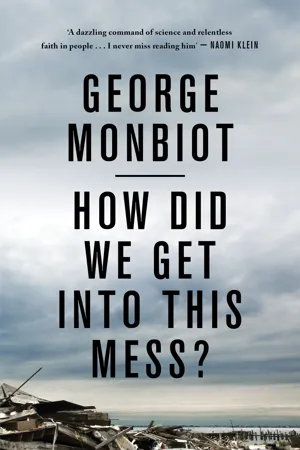
George Monbiot is one of the most vocal, and eloquent, critics of the current consensus. How Did We Get into this Mess?, based on his powerful journalism, assesses the state we are now in: the devastation of the natural world, the crisis of inequality, the corporate takeover of nature, our obsessions with growth and profit and the decline of the political debate over what to do.
While his diagnosis of the problems in front of us is clear-sighted and reasonable, he also develops solutions to challenge the politics of fear. How do we stand up to the powerful when they seem to have all the weapons? What can we do to prepare our children for an uncertain future? Controversial, clear but always rigorously argued, How Did We Get into this Mess? makes a persuasive case for change in our everyday lives, our politics and economics, the ways we treat each other and the natural world.
- 352 pages
- English
- ePUB (mobile friendly)
- Available on iOS & Android
eBook - ePub
About this book
Information
Part 1
There Is Such a
Thing as Society
1
Falling Apart
What do we call the age we live in? It’s no longer the information age. The collapse of popular education movements left a void filled by marketing and conspiracy theories. Like the Stone Age, Iron Age and space age, the digital age says plenty about our artefacts, but little about society. The Anthropocene, in which humans exert a major impact on the biosphere, fails to distinguish this century from the previous twenty. What clear social change marks out our time from those that precede it? To me it’s obvious. This is the Age of Loneliness.
Thomas Hobbes could not have been more wrong when he claimed that in the state of nature, before authority arose to keep us in check, we were engaged in a war ‘of every man against every man’. We were social creatures from the start, mammalian bees, who depended entirely on each other. The hominids of East Africa could not have survived one night alone. We are shaped, to a greater extent than almost any other species, by contact with others. The age we are entering, in which we exist apart, is unlike any that has gone before.
In the past few years, we have seen loneliness become an epidemic among young adults.1 Now we learn that it is just as great an affliction for older people. A study by Independent Age shows that severe loneliness in England blights the lives of 700,000 men and 1.1 million women over fifty,2 and is rising with astonishing speed.
Ebola is unlikely ever to kill as many people as the disease of loneliness. Social isolation is as potent a cause of early death as smoking fifteen cigarettes a day, while loneliness, research suggests, is twice as deadly as obesity.3 Dementia, high blood pressure, alcoholism and accidents – all these, like depression, paranoia, anxiety and suicide, become more prevalent when connections are cut.4 We cannot cope alone.
Yes, factories have closed, people travel by car instead of by bus, use YouTube rather than go to the cinema. But these shifts alone fail to explain the speed of our social collapse. These structural changes have been accompanied by a life-denying ideology, which enforces and celebrates our social isolation. The war of every man against every man – competition and individualism, in other words – is the religion of our time, justified by a mythology of lone rangers, sole traders, self-starters, self-made men and women, going it alone. For the most social of creatures, who cannot prosper without love, there is now no such thing as society, only heroic individualism. What counts is to win. The rest is collateral damage.
British children no longer aspire to be train drivers or nurses. More than a fifth now say they ‘just want to be rich’ – wealth and fame being the sole ambitions of 40 per cent of those surveyed.5 A government study in June 2014 revealed that Britain is the loneliness capital of Europe.6 We are less likely than other Europeans to have close friends or to know our neighbours. Who can be surprised, when everywhere we are urged to fight like stray dogs over a dustbin?
We have changed our language to reflect this shift. Our most cutting insult is ‘loser’. We no longer talk about people. Now we call them individuals. So pervasive has this alienating, atomising term become that even the charities fighting loneliness use it to describe the bipedal entities formerly known as human beings.7 We can scarcely complete a sentence without getting personal. Personally speaking (to distinguish myself from a ventriloquist’s dummy), I prefer personal friends to the impersonal variety and personal belongings to the kind that don’t belong to me. Though that’s just my personal preference, otherwise known as my preference.
One of the tragic outcomes of loneliness is that people turn to their televisions for consolation: two-fifths of older people now report that the one-eyed god is their principal company.8 This self-medication enhances the disease. Research by economists at the University of Milan suggests that television helps to drive competitive aspiration.9 It strongly reinforces the income–happiness paradox: the fact that, as national incomes rise, happiness does not rise with them. Aspiration, which increases with income, ensures that the point of arrival, of sustained satisfaction, retreats before us.
The researchers found that those who watch a lot of television derive less satisfaction from a given level of income than those who watch only a little. Television speeds up the hedonic treadmill, forcing us to strive even harder to sustain the same level of satisfaction. You have only to think of the wall-to-wall auctions on daytime TV, Dragon’s Den, The Apprentice and the myriad forms of career-making competition the medium celebrates, the generalised obsession with fame and wealth, the pervasive sense, in watching it, that life is somewhere other than where you are, to see why this might be.
So what’s the point? What do we gain from this war of all against all? Competition drives growth, but growth no longer makes us wealthier. New figures show that while the income of company directors has risen by more than a fifth, wages for the workforce as a whole have fallen in real terms over the past year.10 The bosses now earn – sorry, I mean take – 120 times more than the average full-time worker. (In 2000, it was forty-seven times.) And even if competition did make us richer, it would make us no happier, as the satisfaction derived from a rise in income would be undermined by the aspirational impacts of competition.
The top 1 per cent now own 48 per cent of global wealth,11 but even they aren’t happy. A survey by Boston College of people with an average net worth of $78 million found that they too are assailed by anxiety, dissatisfaction and loneliness.12 Many of them reported feeling financially insecure: to reach safe ground, they believed, they would need, on average, about 25 per cent more money. (And if they got it? They’d doubtless need another 25 per cent.) One respondent said he wouldn’t get there until he had $1 billion in the bank.
For this we have ripped the natural world apart, degraded our conditions of life, surrendered our freedoms and prospects of contentment to a compulsive, atomising, joyless hedonism, in which, having consumed all else, we start to prey upon ourselves. For this we have destroyed the essence of humanity: our connectedness.
Yes, there are palliatives, clever and delightful schemes like Men in Sheds and Walking Football developed by charities for isolated older people.13 But if we are to break this cycle and come together once more, we must confront the world-eating, flesh-eating system into which we have been forced.
Hobbes’s pre-social condition was a myth. But we are now entering a post-social condition our ancestors would have believed impossible. Our lives are becoming nasty, brutish and long.
14 October 2014
2
Deviant and Proud
To be at peace with a troubled world: this is not a reasonable aim. It can be achieved only through a disavowal of what surrounds you. To be at peace with yourself within a troubled world: that, by contrast, is an honourable aspiration. This essay is for those who feel at odds with life. It calls on you not to be ashamed.
I was prompted to write it by a remarkable book, by a Belgian professor of psychoanalysis, Paul Verhaeghe.1 What about Me?: The Struggle for Identity in a Market-Based Society is one of those books that, by making connections between apparently distinct phenomena, permits sudden new insights into what is happening to us and why.
We are social animals, Verhaeghe argues, and our identity is shaped by the norms and values we absorb from other people. Every society defines and shapes its own normality – and its own abnormality – according to dominant narratives, and seeks either to make people comply or to exclude them if they don’t.
Today the dominant narrative is that of market fundamentalism, widely known in Europe as neoliberalism. The story it tells is that the market can resolve almost all social, economic and political problems. The less the state regulates and taxes us, the better off we will be. Public services should be privatised, public spending should be cut and business should be freed from social control. In countries such as the UK and the US, this story has shaped our norms and values for around thirty-five years, since Thatcher and Reagan came to power. It’s rapidly colonising the rest of the world.
Verhaeghe points out that neoliberalism draws on the ancient Greek idea that our ethics are innate (and governed by a state of nature it calls the market) and on the Christian idea that humankind is inherently selfish and acquisitive. Rather than seeking to suppress these characteristics, neoliberalism celebrates them: it claims that unrestricted competition, driven by self-interest, leads to innovation and economic growth, enhancing the welfare of all.
At the heart of this story is the notion of merit. Untrammelled competition rewards people who have talent, who work hard and who innovate. It breaks down hierarchies and creates a world of opportunity and mobility. The reality is rather different. Even at the beginning of the process, when markets are first deregulated, we do not start with equal opportunities. Some people are a long way down the track before the starting gun is fired. This is how the Russian oligarchs managed to acquire such wealth when the Soviet Union broke up. They weren’t, on the whole, the most talented, hard-working or innovative people, but those with the fewest scruples, the most thugs and the best contacts, often in the KGB.
Even when outcomes are based on talent and hard work, they don’t stay that way for long. Once the first generation of liberated entrepreneurs has made its money, the initial meritocracy is replaced by a new elite, who insulate their children from competition by inheritance and the best education money can buy. Where market fundamentalism has been most fiercely applied – in countries like the US and UK – social mobility has greatly declined.2
If neoliberalism were anything other than a self-serving con, whose gurus and think tanks were financed from the beginning by some of the richest people on earth (the American tycoons Coors, Olin, Scaife, Pew and others), its apostles would have demanded, as a precondition for a society based on merit, that no one should start life with the unfair advantage of inherited wealth or economically determined education. But they never believed in their own doctrine. Enterprise, as a result, quickly gave way to rent.
All this is ignored, and success or failure in the market economy is ascribed solely to individual effort. The rich are the new righteous, the poor are the new deviants, who have failed both economically and morally, and are now classified as social parasites.
The market was meant to emancipate us, offering autonomy and freedom. Instead it has delivered atomisation and loneliness. The workplace has been overwhelmed by a mad, Kafkaesque infrastructure of assessments, monitoring, measuring, surveillance and audits, centrally directed and rigidly planned, whose purpose is to reward the winners and punish the losers. It destroys autonomy, enterprise, innovation and loyalty, and breeds frustration, envy and fear. Through a magnificent paradox, it has led to the revival of a grand old Soviet tradition, known in Russian as tufta. It means the falsification of statistics to meet the diktats of unaccountable power.
The same forces afflict those who can’t find work. They must now contend, alongside the other humiliations of unemployment, with a whole new level of snooping and monitoring. All this, Verhaeghe points out, is fundamental to the neoliberal model, which everywhere insists on comparison, evaluation and quantification. We find ourselves technically free but powerless. Whether in work or out of work, we must live by the same rules or perish. All the major political parties promote them, so we have no political power either. In the name of autonomy and freedom we have ended up controlled by a grinding, faceless bureaucracy.
These shifts have been accompanied, Verhaeghe writes, by a spectacular rise in certain psychiatric conditions: self-harm, eating disorders, depression and personality disorders. Performance anxiety and social phobia are rising fast; both of them reflect a fear of other people, who are perceived as both evaluators and competitors, the only roles for society that market fundamentalism admits. Depression and loneliness plague us. The infantilising diktats of the workplace destroy our self-respect. Those who end up at the bottom of the pile are assailed by guilt and shame. The self-attribution fallacy cuts both ways: just as we congratulate ourselves for our successes, we blame ourselves for our failures, even if we had little to do with them.
So if you don’t fit in; if you feel at odds with the world; if your identity is troubled and frayed; if you feel lost and ashamed, it could be because you have retained the human values you were supp...
Table of contents
- Cover Page
- Halftitle Page
- Title Page
- Copyright Page
- Dedication
- Contents
- Introduction
- Part 1: There Is Such a Thing as Society
- Part 2: Lost Youth
- Part 3: The Wild Life
- Part 4: Feeding Frenzy
- Part 5: Energy Vampires
- Part 6: Riches and Ruins
- Part 7: Dance with the One Who Brung You
- Part 8: Out of Sight, Out of Mind
- Part 9: Holding Us Down
- Part 10: Finding Our Place
- Acknowledgements
- Notes
- Index
Trusted by 375,005 students
Access to over 1.5 million titles for a fair monthly price.
Study more efficiently using our study tools.
Frequently asked questions
Yes, you can cancel anytime from the Subscription tab in your account settings on the Perlego website. Your subscription will stay active until the end of your current billing period. Learn how to cancel your subscription
No, books cannot be downloaded as external files, such as PDFs, for use outside of Perlego. However, you can download books within the Perlego app for offline reading on mobile or tablet. Learn how to download books offline
Perlego offers two plans: Essential and Complete
- Essential is ideal for learners and professionals who enjoy exploring a wide range of subjects. Access the Essential Library with 800,000+ trusted titles and best-sellers across business, personal growth, and the humanities. Includes unlimited reading time and Standard Read Aloud voice.
- Complete: Perfect for advanced learners and researchers needing full, unrestricted access. Unlock 1.5M+ books across hundreds of subjects, including academic and specialized titles. The Complete Plan also includes advanced features like Premium Read Aloud and Research Assistant.
We are an online textbook subscription service, where you can get access to an entire online library for less than the price of a single book per month. With over 1.5 million books across 990+ topics, we’ve got you covered! Learn about our mission
Look out for the read-aloud symbol on your next book to see if you can listen to it. The read-aloud tool reads text aloud for you, highlighting the text as it is being read. You can pause it, speed it up and slow it down. Learn more about Read Aloud
Yes! You can use the Perlego app on both iOS and Android devices to read anytime, anywhere — even offline. Perfect for commutes or when you’re on the go.
Please note we cannot support devices running on iOS 13 and Android 7 or earlier. Learn more about using the app
Please note we cannot support devices running on iOS 13 and Android 7 or earlier. Learn more about using the app
Yes, you can access How Did We Get Into This Mess? by George Monbiot in PDF and/or ePUB format, as well as other popular books in Politics & International Relations & Political Economy. We have over 1.5 million books available in our catalogue for you to explore.