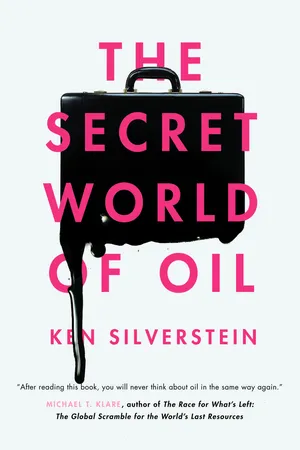
Oil is the lifeblood of modern civilization, and the industry that supplies it has been the subject of intense interest and scrutiny, as well as countless books. And yet, almost no attention has been paid to little-known characters vital to the industry-secretive fixers and oil traders, lobbyists and PR agents, gangsters and dictators-allied with competing governments and multinational corporations. Virtually every stage in oil's production process, from discovery to consumption, is greased by secret connections, corruption, and violence, even if little of that is visible to the public. The energy industry, to cite just one measure, violates the US Foreign Corrupt Practices Act more often than any other economic sector, even weapons. This book sets out to tell the story of this largely hidden world.
Based on trips to New York, Houston, New Orleans, Paris, Geneva, and Phnom Penh, among other far-flung locales, The Secret World of Oil includes up-close portraits of Louisiana oilmen and their political handlers; an urbane, captivating London fixer; and an oil dictator's playboy son who had to choose among more than three dozen luxury vehicles before heading out to party in Los Angeles. Supported by funding from the prestigious Open Society Foundations, this is both an entertaining global travelogue and a major work of investigative reporting.
- 288 pages
- English
- ePUB (mobile friendly)
- Available on iOS & Android
eBook - ePub
The Secret World of Oil
About this book
Information
1
The Fixers: Ely Calil
A lot of my business comes from someone who has a problem and who knows someone who knows me. Then the first someone gets directed to me and asks, “Can you fix it?”
—Ely Calil
On a cold, damp November night several years ago, a Mercedes sedan looped through the semicircular drive of the Saint James Paris, a century-old château-style hotel across the Seine from the Eiffel Tower. As the car rolled to a halt at the hotel’s main entrance, a well-tailored, trim man named Ely Calil walked unhurriedly out the lobby door and down wide stone steps, talking into an earpiece that was connected, through a thin black wire, to a tiny cell phone tucked in the closed palm of one hand. The driver stepped from the car and opened the door for Calil, who interrupted his conversation to give the driver instructions. He spoke in a voice a little above a whisper, perhaps just a touch softer than his normal cool, flat tone. The driver returned to his seat and steered the car out through the granite-pillared entryway and onto Avenue Bugeaud.
That night Calil’s destination was Spring, a popular restaurant in the ninth arrondissement that offers a set four-course menu to sixteen diners nightly. He was meeting Friedhelm Eronat, a close friend and sometime business partner who is equally reclusive and press-averse. Like Calil, he is one of the world’s leading oil fixers, having grown rich brokering deals for Mobil (before it merged with Exxon) in Russia, Kazakhstan, and Nigeria. A confidential corporate due diligence report about Eronat that I obtained said that the precise nature of his relationship with Mobil was the “subject of much conjecture,” but his contacts “went straight to the top.” More recently he has done business in Argentina, Brazil, and China.
Calil had flown to Paris earlier that day from London, where he resides. Born in Nigeria in 1945 to a prominent family of Lebanese origin, Calil belongs to a small group of middlemen, a few dozen at most. They quietly arrange deals and financial transfers—not necessarily illegal—that are vital to the oil industry’s operations. Calil has funneled money to African dictators to obtain concessions for oil companies, traded oil from Russia following the collapse of the Soviet Union, and advised presidents and exiled political leaders.
Along the way he has not only amassed an immense personal fortune but has established a web of political ties stretching from Africa to the Middle East and the United States. “He’s built a very effective network of contacts and allegiances and loyalties through money and allowances,” a former senior CIA official who has worked with Calil told me, not without admiration. “It’s sort of like The Godfather. One day he’ll come to ask for a favor, and you’ll have to comply.”
A former friend of Calil’s, who broke with him over a business deal gone bad, spoke bitterly about him but conceded, “He’s a lovable rogue and a very shrewd operator, there’s no doubt about that.”
A fixer’s business demands discretion. “If you go and blab about your contacts, and talk about being a friend of the president, the next thing you know the president doesn’t want to be your friend,” one middleman told me. Calil, for his part, largely avoided publicity for most of his lengthy career. Although he is said to be one of the wealthiest men in Britain, and is a regular on the London club circuit, his name rarely surfaced in the press; for decades, the only photograph newspapers could find to accompany articles about him was a snapshot from his 1972 wedding to the American tobacco heiress Frances Condon, the first of his three wives. Little was known about the man himself, and the few news stories about him described him variously as “reclusive,” “secretive to the point of obsession,” and a businessman “whose privacy is guarded like a Mogul emperor.”
However, in 2004 Calil became the subject of intense and unflattering press scrutiny. That year a group of about sixty South African and European mercenaries were arrested in Zimbabwe, where they were buying weapons. The men were said to be en route to Equatorial Guinea. It was a tale straight from The Dogs of War, and Obiang’s regime and the alleged ringleader, Simon Mann, subsequently claimed that Calil had financed the coup plot in hopes of installing in power an exiled political leader named Severo Moto. The accusations have never been proven, and Calil vociferously denies he had any role in the affair. But the scandal that followed received worldwide publicity and embroiled well-known acquaintances of his, including Mark Thatcher, the son of former British prime minister Margaret Thatcher, and Lord Jeffrey Archer, whom scandal had twice forced to resign from parliament and who did prison time for perjury.
My acquaintance with Calil began two years before the alleged coup attempt, when I received a call from Victoria Butler, a Washington public-relations specialist who was then helping Moto meet with government officials and journalists. I’d written frequently about the Obiang regime, and so I went to see Moto at Butler’s townhouse on Capitol Hill. He had already met with a number of Bush administration officials and members of Congress, and he expressed a naive optimism that the administration might eventually turn against Obiang because of his undeniably appalling human rights record.
As Moto and I chatted on a sofa, another man sat nearby in an armchair and scrolled through his e-mails on a BlackBerry. It was Calil, who told me that he and a number of other businessmen had sponsored Moto’s trip and had retained Butler through a PR office. I had never heard of Calil, and when I returned home that day and used Google to try to find out more, I turned up little outside of a few small clips in European oil-industry publications. His name had briefly surfaced in a bribery scandal in France, where reports alleged that he funneled money to former Nigerian dictator Sani Abacha on behalf of Elf Aquitaine, a French oil company (which later was bought by a French competitor, Total).
Since that first meeting, Calil and I became unlikely friends. My family and I get together with him when he comes to Washington, and on a number of occasions I’ve visited him at his home in London. I’ve always liked Calil, and enjoyed his company, and appreciated the fact that he rarely tried to dress up his motives as altruistic, as oil company executives and industry players so often do. Oil had made Calil rich and that was why he was in the business.
By the time of his meeting in Paris with Eronat, the worst of the Equatorial Guinea–related publicity had blown over, and Calil had regained a measure of his preferred anonymity. I’d long wanted to profile him and having finally convinced him, was with him that night.
Eronat was awaiting us at a corner table when we arrived at the restaurant. Eronat used to live in a Victorian mansion down the road from Calil in London’s Chelsea section but following an acrimonious separation and pending divorce, he was spending most of his time in Geneva and Paris, where he owns an apartment near the Saint James. He was waiting with his longtime partner, a tall, blond Russian attired in a dark dress and knee-length black boots, and her friend, Angelika, a Russian model who had dark hair and porcelain skin, and wore jeans, a white cotton shirt, and a dark vest. Whereas Eronat’s partner was gregarious and chatty, Angelika, perhaps because of her halting English, sat quietly at the table and occupied much of her time checking text messages on her cell phone.
I had never met Eronat or seen his photograph, but based on his name I had envisioned a refined, stuffy Central European aristocrat. It turns out that he was born Romanian1 but came with his mother to Louisiana when he was a young boy. Tall and hefty, he looked quite a bit younger than his fifty-five years, and was dressed casually, in light-brown corduroys and a tan pullover. Eronat studied petroleum engineering at Louisiana State University in the 1970s and got a job as an engineer after graduating, then went to work for an oil-trading firm before branching out on his own.
Eronat met Calil in the early 1980s, in Nigeria. “Ely was the man to see,” Eronat recalled, after sampling a red wine and then ordering several bottles for the table. “Back then,” he added, “it was a very small club, and we all knew one another. You did business by gentleman’s agreement. When you called and said you had a cargo of crude, you confirmed the price and details over the phone. If your word wasn’t honored, you were finished.”
Eronat’s own contacts in Nigeria were also strong. The due diligence report said his influence in the country was “based on his ability to sustain long-term relationships with key members of several Nigerian administrations,” including military leaders and powerful civilians like Rilwanu Lukman, who in the 1980s was minister for petroleum and later was named secretary general of OPEC.
For years Calil and Eronat attended the twice-a-year meetings of OPEC oil ministers. “There were twenty regulars, if you want to be generous,” Calil said. “You’d meet all the ministers and entertain them.” Eronat pulled out his cell phone and showed me a picture from the 2008 meeting in Saudi Arabia of OPEC heads of state (which is one level up from the ministerial meetings). It was hard to make out much on the small cell phone screen, but I could just see a beaming Eronat, dressed in a Western business suit and surrounded by people in Middle Eastern garb.
The two men have partnered together numerous times, though “we never had anything in writing, Friedhelm and I, not once,” Calil said of their dealings. One particularly profitable stretch involved exporting oil from Russia in the early post-Soviet days. Calil recounted that they had met many of the country’s future oligarchs “when they were wearing funny suits and selling shoes and cigarette lighters.”
The two men spoke of some old comrades who had fallen on hard times following the global market turmoil of the late 2000s. “They’re all selling their yachts,” Eronat said with a grim look. One mutual friend, an oligarch they called Sascha, “had $44 billion, and now he’s down to a billion.”
“It happens,” Calil deadpanned.
The waiter brought a bouillabaisse, small plates of scallops in a truffle sauce, and veal loin with poached pear. Everyone agreed the food was delicious, but there were complaints about the “presentation.” Calil and Eronat, serious gourmets, seemed particularly dismayed. The two men decided to head to the famous brasserie L’Ami Louis for a proper meal. (This would include more wine, a plate of potatoes baked with dollops of goose fat and topped with shaved garlic, foie gras, and toast and cornichons, scallops, and snails in butter and garlic.)
For years L’Ami Louis was a sort of headquarters for their mutual operations, and they reminisced about a dinner there in the mid-1990s when they hosted fourteen well-connected Russians. “It was just them and the two of us,” Eronat recalled while we were still at Spring. “We ordered a bottle of wine, and then another and another”—he mimed guzzling directly from the bottle—“until the waiter just brought a case of wine and put it on the ground next to our table.” It was an extraordinarily expensive meal, the two men recalled, but well worth it, in that it played an important role in advancing their Russia business.
Calil asked for the check before dessert was served and called L’Ami Louis from his cell phone. “You don’t ask for a table, you just say you’re coming,” he said as he hung up.
The next morning, when I sat down for coffee with Calil and Eronat at the Saint James, Eronat was reading the International Herald Tribune. He folded the paper, pushed it my way, and pointed to a story: Spain’s government was hesitating to allow the Russian company Lukoil to buy a controlling stake in Repsol YPF, Spain’s largest oil firm. “Oil is not a commodity,” Eronat said. “It’s a political weapon.”
“Absolutely,” Calil said as picked up his espresso cup. “That’s why the Americans made that stop in Iraq.”
Eronat told me that there used to be “about forty people” who ran the oil-trading business. “The world got bigger, especially when the oil market boomed and the hedge funds came in, but it’s still a pretty small group of people,” he said.
Calil and Eronat spoke about a mutual friend of theirs named James Giffen, a New York business consultant who was charged by the US government with allegedly funneling more than $78 million to Nursultan Nazarbayev, the president of Kazakhstan. The money was said to come from fees paid to Giffen by American oil companies that subsequently won stakes in Kazakh oil fields. Giffen also gave Nazarbayev and his wife gifts, including his-and-hers snowmobiles and hundreds of thousands of dollars worth of jewelry. “Oil fields are a battleground,” said Eronat. “If Jim had not been involved, other [non-American] firms would have gotten the contracts, and the loser would have been the US government.”
The federal indictment of Giffen, who established close ties to governments in the former Soviet Union during the Cold War, alleged that Nazarbayev assigned him to negotiate deals with foreign oil companies seeking to invest in Kazakhstan after the country’s independence in 1991. Giffen accompanied the Kazakh leader to Washington for meetings with American officials and in 1998 even assembled a team of political consultants to lobby the US government on Nazarbayev’s behalf. “He was Washington’s de facto ambassador to Kazakhstan,” Robert Baer, a former CIA officer, told me.
Giffen never specifically denied funneling money to Nazarbayev but claimed his role and actions were fully known by the US government. A filing from his lawyers claimed that Giffen’s acts might seem unusual, but that “imposing American domestic conceptions of honest services on all the world’s governments” would “wreak havoc” on the workings of international law.
Calil, who had recently visited Giffen in New York, concurred. “Jim never worked for the CIA, but he continuously informed the CIA,” he said, a line of argument that Giffen advanced in court. “He was never discouraged, and in fact was encouraged to have that relationship with Nazarbayev. You don’t take him to court—you give him a medal.”
The judge in the case, William Pauley, agreed. In late 2010, after the Justice Department dropped all bribery counts in exchange for a misdemeanor tax plea, Pauley imposed no jail time on Giffen, called him a Cold War “hero,” and said the government should never even have brought the case. “He was one of the only Americans with sustained access to high levels of government in the region,” Pauley said. “These relationships, built up over a lifetime, were lost the day of his arrest. This ordeal must end. How does Mr. Giffen reclaim his reputation? This court begins by acknowledging his service.”
In 2002, Calil himself was arrested by French police and briefly jailed in connection with the payments of enormous commissions to Sani Abacha by a subsidiary of Elf Aquitaine. During a judicial investigation, Philippe Jaffré, a former Elf CEO, confirmed that the payments were made. “The Nigerian oil fields were extraordinarily profitable,” he said. “There was no other way to reach a friendly agreement.” Jaffré said, however, that Calil and two other Lebanese intermediaries—Gilbert Chagoury and Samir Traboulsi—“apparently received more money than foreseen.” By Jaffré’s account, the three split $70 million among them for their role in moving the funds.
Despite a lengthy investigation, Calil was never formally charged in the affair (though a number of Elf executives were sent to jail for embezzling millions of dollars from the company). He acknowledged having received commissions from Elf in order to funnel payments to Abacha, saying, “From a strictly legal standpoint, there was nothing strictly illegal about it. It has become illegal now. The commissions I took from the French companies were sanctioned by the French Ministry of Finance. They had to declare the commissions on their taxes. If it’s wrong, then arrest the minister of finance. Why are you arresting me? Was it legal? Yes. Was it moral? I don’t know. But business isn’t about not making money. I’m not a philosopher, but the law is there to be tested. If you’re on the wrong side you should be sanctioned, and if you’re not you should be left alone.
“Americans want their gasoline cheap,” Calil added. “But it’s not possible without cutting a few corners.”
Among the thornier political issues surrounding oil is that most of it is extracted from undeveloped nations and shipped to rich ones, whose home companies pump it. Sometimes, a company will reach out to rulers of oil-rich states on its own, negotiating and striking deals with them through official emissaries. That’s especially true of multinational giants such as ExxonMobil and Chevron, who have worked around the globe, in high-risk and low-risk countries, and can handle such matters on their own. “We were so damn big that we usually didn’t need middleman,” a former BP executive told me. “We worked directly with heads of states in the countries where we operated, and we could deliver [to those heads of state] geopolitical contacts back home that served their aspirations. When you’re with BP, you can always arrange a meeting with the prime minister or tea with the Queen.”
But often companies (including the giants) will instead work through men like Calil and Eronat: independent fixers, whose job it is to kno...
Table of contents
- Cover
- Title Page
- Copyright
- Dedication
- Acknowledgement
- Contents
- Introduction: The Secret World of Oil
- 1. The Fixers: Ely Calil
- 2. The Dictators: Teodorin Obiang
- 3. The Traders: Glencore
- 4. The Gatekeepers: Bretton Sciaroni
- 5. The Flacks: Tony Blair
- 6. The Lobbyists: Louisiana
- 7. Coda: The Hustler: Neil Bush
- Notes
Trusted by 375,005 students
Access to over 1.5 million titles for a fair monthly price.
Study more efficiently using our study tools.
Frequently asked questions
Yes, you can cancel anytime from the Subscription tab in your account settings on the Perlego website. Your subscription will stay active until the end of your current billing period. Learn how to cancel your subscription
No, books cannot be downloaded as external files, such as PDFs, for use outside of Perlego. However, you can download books within the Perlego app for offline reading on mobile or tablet. Learn how to download books offline
Perlego offers two plans: Essential and Complete
- Essential is ideal for learners and professionals who enjoy exploring a wide range of subjects. Access the Essential Library with 800,000+ trusted titles and best-sellers across business, personal growth, and the humanities. Includes unlimited reading time and Standard Read Aloud voice.
- Complete: Perfect for advanced learners and researchers needing full, unrestricted access. Unlock 1.5M+ books across hundreds of subjects, including academic and specialized titles. The Complete Plan also includes advanced features like Premium Read Aloud and Research Assistant.
We are an online textbook subscription service, where you can get access to an entire online library for less than the price of a single book per month. With over 1.5 million books across 990+ topics, we’ve got you covered! Learn about our mission
Look out for the read-aloud symbol on your next book to see if you can listen to it. The read-aloud tool reads text aloud for you, highlighting the text as it is being read. You can pause it, speed it up and slow it down. Learn more about Read Aloud
Yes! You can use the Perlego app on both iOS and Android devices to read anytime, anywhere — even offline. Perfect for commutes or when you’re on the go.
Please note we cannot support devices running on iOS 13 and Android 7 or earlier. Learn more about using the app
Please note we cannot support devices running on iOS 13 and Android 7 or earlier. Learn more about using the app
Yes, you can access The Secret World of Oil by Ken Silverstein in PDF and/or ePUB format, as well as other popular books in Politics & International Relations & Energy Industry. We have over 1.5 million books available in our catalogue for you to explore.