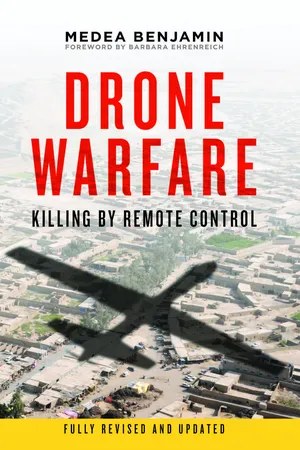
Drone Warfare is the first comprehensive analysis of one of the fastest growing-and most secretive-fronts in global conflict: the rise of robot warfare. In 2000, the Pentagon had fewer than fifty aerial drones; ten years later, it had a fleet of nearly 7,500, and the US Air Force now trains more drone "pilots" than bomber and fighter pilots combined. Drones are already a $5 billion business in the US alone. The human cost? Drone strikes have killed more than 200 children alone in Pakistan and Yemen.
CODEPINK and Global Exchange cofounder Medea Benjamin provides the first extensive analysis of who is producing the drones, where they are being used, who controls these unmanned planes, and what are the legal and moral implications of their use. In vivid, readable style, this book also looks at what activists, lawyers, and scientists across the globe are doing to ground these weapons. Benjamin argues that the assassinations we are carrying out from the air will come back to haunt us when others start doing the same thing-to us.
- 224 pages
- English
- ePUB (mobile friendly)
- Available on iOS & Android
eBook - ePub
About this book
Information
1
A Sordid Love Affair with Killer Drones
At the 2004 Radio and Television Correspondents’ Dinner, President Bush joked about searching for weapons of mass destruction under Oval Office furniture, since they had never been found in Iraq. The joke backfired when parents who had lost their children fighting in Iraq said they found it offensive and tasteless. Senator John Kerry said Bush displayed a “stunningly cavalier” attitude toward the war and those fighting it.
Six years later, at the White House Correspondents’ Dinner, President Obama made his own not-so-funny joke about weapons and war. When the pop band Jonas Brothers was about to play to the packed room, Obama furrowed his brow and sent them a warning to keep away from his daughters. “Sasha and Malia are huge fans, but boys, don’t get any ideas. Two words for you: Predator drones. You’ll never see it coming.”
For people in Pakistan, where American drones have been dropping their Hellfire missiles, Obama’s joke lost something in translation. According to Pakistani journalist Khawar Rizvi, few Pakistanis had ever heard of the Jonas Brothers or understood the reference to the President’s daughters. “But one thing we do know: There’s nothing funny about Predator drones,” said Rizvi.1
That seemed to be the opinion of Faisal Shahzad, a thirty-year-old Pakistan-born resident of Bridgeport, Connecticut. On May 1, 2010, just one day after President Obama made his offensive drone joke, Shahzad tried to set off a car bomb in New York City’s Times Square. The would-be bomber had left his explosive-laden Nissan Pathfinder parked in the middle of the busiest intersection in New York City at the busiest time: 6:30 p.m. on a Saturday night. Luckily, the bomb failed to explode, and the authorities—tipped off by local T-shirt vendors—disarmed it before it caused any casualties.
Questioned about his motives by the authorities, Shahzad talked about US drone attacks killing children in Pakistan and Afghanistan.
“You know what would have made a great punch line for Barack Obama’s joke about Predator drones last night at the White House correspondents’ dinner?” suggested writer Jonathan Schwarz after hearing about the bomb scare.2 “If the car bomb in Times Square had gone off at exactly that moment, and it turned out it was, in fact, in retaliation for strikes by Predator drones. Then the next night, when they were still washing blood and viscera off the streets of New York, the head of the Pakistani Taliban could have made a quip about killing people with car bombs at a fancy black tie dinner in Peshawar. And then the US could have blown up more Pakistani civilians with drones. And the cycle of funniness would begin anew!”
Some say the name “drone” comes from the constant buzzing noise that some of the machines make in flight. According to other military lore, the name derives from a use of robotic aircraft as training targets for World War II gun crews.3 The United States manufactured 15,000 small drones for anti-aircraft practice during the war at a plant in Southern California. Many were marked with black stripes along the tail part of the fuselage, making them look like drones (the bees).
The technology for flying remotely has existed for decades. Unmanned aerial vehicles were first tested by the military way back during World War I. In the 1930s the US, UK, and Germany, later joined by the USSR and others, all began to use drones for anti-aircraft targeting exercises. Unmanned crafts were used as guided missiles by the US military in World War II and the Korean War. In a tragic World War II experiment gone awry, President Kennedy’s older brother Joe, a Navy pilot, died at age 29 in a secret drone operation against the Germans. It wasn’t until the Vietnam War that unmanned aircraft were used to gather intelligence.4
Anyone who wants to build an unmanned aircraft can order the parts online and assemble them in their garage. By October 2012, the U.S.-based do-it-yourself drones group, DIY Drones, had over 30,000 members.
The prototype for the most popular killer drone, the Predator, was built by Israeli aviation engineer Abraham Karem in his garage in southern California in the 1980s.5
Abraham Karem had worked on developing unmanned aircraft for an Israeli defense contractor in the 1970s, and then moved to southern California in 1980 to develop his own company.
With grants from the US military’s Defense Advanced Research Projects Agency (DARPA) and the CIA, Karem began building a new model at home in his three-car garage. In 1981 he unveiled what he called the Albatross, an unmanned plane that could stay in the air for up to 56 hours, and later a new version with a powerful flight control computer called the Gnat 750.
But Karem was financially strapped and decided to sell his company to Hughes Aircraft, which then sold it to General Atomics, keeping Karem on as a consultant.
In 1993 CIA director James Woolsey, unhappy with the intelligence he was receiving from satellites flying over Bosnia, turned to Karem and General Atomics for help. A year later, the Gnat 750 was flying over Bosnia with a crew that was not in the aircraft but launching it from an abandoned airfield in neighboring Albania.
The data it gathered still had a circuitous path to reach the CIA—traveling from the drone to a manned aircraft to a ground station to a satellite. So the engineers re-rigged the drone with its own satellite communications system, adding the now characteristic bulbous nose to the fuselage.
Thus the Predator drone was born and was used in the Balkan wars to gather information on refugee flows and Serbian air defenses. It was not until the 1999 NATO Kosovo campaign, however, that someone came up with the idea of equipping these planes with missiles, transforming them from spy planes into killer drones.6
Today drones are used for both lethal and non-lethal purposes. Outside the military, unmanned aircraft are being drafted for everything from tracking drug smugglers and monitoring the US–Mexico border to engaging in search operations after earthquakes and spraying pesticides on crops. Environmentalists are using them to catch illegal whalers and illegal loggers. The potential commercial uses are endless, from delivering packages to delivering tacos. And you can buy your own miniature drone on Amazon.com for $300 and control it with your smartphone. But the driving force behind the most sophisticated drones, and the source of immense funds for research and devlopment, is the military.
The Israeli military has a long history of using drones to gather intelligence, as decoys, and for targeted killings. Their use of drones dates back to the occupation of the Sinai in the 1970s, and was further developed in the 1982 war in Lebanon and the ongoing conflicts in the Palestinian territories.
The Israeli unmanned aircraft pioneered in the late 1970s and 1980s were eventually integrated into the United States’ inventory. Impressed with Israel’s use of UAVs during military operations in Lebanon in 1982, then Navy Secretary John Lehman decided to acquire UAV capability for the Navy. One of the UAVs purchased from Israel, the Pioneer, was used to gather intelligence during Desert Storm. According to a Congressional Research Service Report in 2003, “Following the Gulf War, military officials recognized the worth of UAVs, and the Air Force’s Predator became a UAV on a fast track, quickly adding new capabilities.” 7
But it was the 9/11 World Trade Center attacks that led to an explosion in the US military’s use of drones and a host of other robotic weapons. The hundreds of billions of dollars that Congress allocated for the wars in Afghanistan and Iraq made the Pentagon flush with funds to buy up all manner of robotic weapons that military contractors from General Atomics to Northrop Grumman had been developing.
The various branches of the military filled their shopping carts with every robot they could find: tiny surveillance robots that can climb walls and stairs, snake-like robots that slither in the grass, unmanned tanks mounted with .50 caliber weapons, and ground robots to carry the soldiers’ heavy loads.
They snatched up every type of drone on the production lines and commissioned new ones. They bought the 38-inch-long Raven that is launched by simply throwing it into the air; the 27-foot-long Predator with its Hellfire missiles, and later the more powerful Reaper version; the 40-foot-long Global Hawk with sci-fi surveillance capabilities.
The Pentagon was ordering these machines faster than the companies could produce them. In 2000, the Pentagon had fewer than fifty aerial drones; ten years later, it had nearly 7,500. Most of these were mini-drones for battlefield surveillance, but they also had about 800 of the bigger drones, ranging in size from a private aircraft to a commercial jet. Then Secretary of Defense Robert Gates said that the next generation of fighter jet, the F-35 that took decades to develop at a cost of more than $500 million each, would be the Pentagon’s last manned fighter aircraft.8
From 2002 to 2010, the Department of Defense’s unmanned aircraft inventory increased more than forty-fold.9 Even during the financial crisis that started brewing in 2007 and led to the slashing of government programs from nutrition supplements for pregnant women to maintenance of national parks, the Defense Department kept pouring buckets of money into drones. At the height of government deficit-reducing cuts in 2012, the US taxpayer was shelling out $3.9 billion for the procurement of unmanned aircraft, not counting the separate drone budgets for the CIA and the Department of Homeland Security.10
Most military drones are still used for surveillance purposes. The photo sensors the UAVs carry have become increasingly powerful, allowing the on-the-ground pilots to watch individuals from an aircraft 30,000–60,000 feet up in the air. The infrared and ultraviolet imaging captures light outside the spectrum visible to the human eye. UV imaging is useful in space and for tracking rockets; IR imaging shows heat emitted by an object, making it ideal for identifying humans in the dark.
One reason for the great demand in drones was that they graduated from simply tracking and monitoring targets to actually killing them. In Afghanistan, drones were credited for killing senior Al Qaeda and Taliban militants. In the Iraq invasion, they were used for everything from tracking supporters of Saddam Hussein to blowing up government agencies. In 2003, US Air Force Chief of Staff General T. Michael Moseley said, “We’ve moved from using UAVs primarily in intelligence, surveillance, and reconnaissance roles before Operation Iraqi Freedom, to a true hunter-killer role.” 11
Another reason that drones were in such demand was the very nature of the Afghan and Iraqi wars. The US military had a hard time even finding its enemies, as many local fighters blended in among the civilian populations. Drones gave the military a way to conduct persistent surveillance and to strike quickly.
Armed drones are used in three ways. They supply air support when US ground troops attack or come under attack; they patrol the skies looking for suspicious activity and, if they find it, they attack; and they conduct targeted killings of suspected militants.
The main advantage of using drones is precisely that they are unmanned. With the operators safely tucked in air-conditioned rooms far away, there’s no pilot at risk of being killed or maimed in a crash. No pilot to be taken captive by enemy forces. No pilot to cause a diplomatic crisis if shot down in a “friendly country” while bombing or spying without official permission. If a drone crashes or is shot down, the pilot back home can simply get up and take a coffee break.
Drones are considered ideal for “3D missions”—actions that are too “dull, dirty, or dangerous” for manned aircraft. On daring missions, they can fly low and slow over hostile terrain, hovering for several hours or all day, if need be. With their astonishing sensors, from several miles in the air they can follow the route of a suspicious-looking pick-up truck or track a sniper on a rooftop. The Predator’s infrared camera can even identify the heat signature of a human body from 10,000 feet in the air. From 8,000 miles away in Nevada, a drone pilot can watch an Afghan as he lights up cigarettes, sits talking to friends on a park bench, or goes to the bathroom—never imagining that anyone is watching him.
Without the need to provide space for aircrew, and without a human crew to become tired, unmanned aircraft can have extremely long endurance. The Reaper can linger in the air for about eighteen hours and hybrid air vehicles have an endurance of weeks. In July 2012 Lockheed Martin announced that it had successfully completed an indoor flight test using laser power to recharge its electric drone, the Stalker, in midair. In the future, high-altitude UAVs using solar power—or powered by ground-based lasers, or using air-to-air refueling—will be able to remain airborne indefinitely.
Unmanned aircraft can fly to remote areas where our troops, and those of the host country, are unable or unwilling to go. They can share data immediately with troops on the ground. They can weave and dive and perform high-speed aerobatics that would cause a human pilot to lose consciousness.
Drone proponents insist that their ability to linger for hours over their target allows for a thorough assessment of potential collateral damage before acting, and their ability to guide weapons to designated targets with pinpoint accuracy means fewer civilian casualties. Certainly compared to the carpet bombing of World War II or the aerial bombardment of Vietnam or even the “dumb bombs” used by the US military in the Gulf War, drone missiles are more precise—but these same missiles can be used by manned aircraft.
Drones are also significantly cheaper to purchase than the manned aircraft they are replacing. Lockheed Martin’s F-22 fighter jets cost around $150 million apiece, while F-35s clock in at $90 million and the F-16s at $55 million. By contrast, the 2011 price of the Predator was $5 million and the Reaper was $28.4 million—but the (slow, vulnerable) Reaper hardly replaces the (fast, stealthy, air-air combat dominant) F-22.12
Even these figures can be misleading. The cost of fueling, operating and maintaining drones is not fully known, as the CIA, which is responsible for their increasing use in undeclared wars in places like Pakistan and Yemen, includes those costs in its classified “black budget.” But every hour a drone is up in the air is estimated to cost between $2,000 and $3,500, and the number of flight hours has skyrocketed. Between 2001 and 2010 the time the Air Force devoted to flying missions went up 3,000 percent. The Defense Department reported clocking in 10,000 UAV flight hours in 2005; by 2010 that number was more than 550,000. In Afghanistan and Iraq, Predators and Reapers were in the air 24/7. And they were firing thousands of Hellfire missiles at $68,000 a pop.
A huge cost associated with drones is personnel. While it might seem counterintuitive, it takes significantly more people to operate unmanned aircraft than it does to fly traditional warplanes. According to the Air Force, it takes a jaw-dropping 168 people to keep just one Predator aloft for twenty-four hours! For the larger Global Hawk surveillance drone, that number jumps to 300 people. In contrast, an F-16 fighter aircraft needs fewer than one hundred people per mission.13
UAVs need constant attention and control from ground crew. They need ground-based pilots and crews for take-off and landing, ground-based technicians and mechanics to maintain the heavily used aircraft, crews back in the US for piloting and operating the sensors. On top of that, they need intelligence analysts to scrutinize nonstop surveillance feeds and to analyze the massive amount of data they generate. Every day, the Air Force alone processes almost 1,500 hours of full-motion video and another 1,500 still images. By 2010, this required about nineteen analysts per drone.14
This information overload will get significantly more labor intensive with use of even more sophisticated technology, such as the “Gorgon Stare” that can video an entire city, requiring 2,000 analysts to process the data feeds from but a single drone.15 By 2011, the Air Force had already converted seven Air National Guard squadrons into intelligence units to help analyze drone video and was training an additional 2,000 Air Force intelligence analysts.16 So the cost of drones must not only include this enormous expense, but the trade-off of seconding thousands of the National Guard and other personnel.
The Congressional Budget Office in 2011 questioned the whole idea of “cheap drones.” Their study remarked that the original concept was that these would be very low-cost, essentially expendable aircraft. “As of 2011, however, whether substantially lower costs will be realized is unclear. Although a pilot may not be on board, the advanced sensors carried by unmanned aircraft systems are very expensive and cannot be viewed as expendable.” 17 The electro-optical/infrared cameras on small UAVs cost several times the drones themselves. And on the other end of the size spectrum, the sensors on the massive Global Hawk make up over half the vehicle’s price tag. In general, as the technology becomes more and more sophisticated, the price of high-tech drones is expected to go up.
The Congressional study noted another big problem with drones that greatly affects the ultimate price tag. They crash—a lot. “Excessively high losses of aircraft can negate cost advantages by requiring the services to purchase large numbers of replacement aircraft,” the report concluded.18
In 2009, the Air Force made an astonishing admission: more than a third of their unmanned Predator spy planes had crashed, mostly in Iraq and Afghanistan.19 As of July 2010, 38 Predators and Reapers had been lost during combat operations in Afghanistan and Iraq, with another nine crashing during training operations in the US.20 Altogether, the US Air Force said there had been seventy-nine drone accidents.21
A Predator crashed in the Afghan mountains in September 2010 a...
Table of contents
- Cover
- Title Page
- Table of Contents
- Foreword
- Introduction
- 1. A Sordid Love Affair with Killer Drones
- 2. It’s a Growth Market
- 3. Here a Drone, There a Drone, Everywhere a Drone
- 4. Pilots Without a Cockpit
- 5. Remote-Controlled Victims
- 6. Murder by Drone: Is It Legal?
- 7. Morality Bites the Dust
- 8. The Activists Strike Back
- 9. Opposition to Drones Goes Global
- Conclusion
- Further Resources
- Endnotes
- Acknowledgments
- Copyright
Trusted by 375,005 students
Access to over 1.5 million titles for a fair monthly price.
Study more efficiently using our study tools.
Frequently asked questions
Yes, you can cancel anytime from the Subscription tab in your account settings on the Perlego website. Your subscription will stay active until the end of your current billing period. Learn how to cancel your subscription
No, books cannot be downloaded as external files, such as PDFs, for use outside of Perlego. However, you can download books within the Perlego app for offline reading on mobile or tablet. Learn how to download books offline
We are an online textbook subscription service, where you can get access to an entire online library for less than the price of a single book per month. With over 1.5 million books across 990+ topics, we’ve got you covered! Learn about our mission
Look out for the read-aloud symbol on your next book to see if you can listen to it. The read-aloud tool reads text aloud for you, highlighting the text as it is being read. You can pause it, speed it up and slow it down. Learn more about Read Aloud
Yes! You can use the Perlego app on both iOS and Android devices to read anytime, anywhere — even offline. Perfect for commutes or when you’re on the go.
Please note we cannot support devices running on iOS 13 and Android 7 or earlier. Learn more about using the app
Please note we cannot support devices running on iOS 13 and Android 7 or earlier. Learn more about using the app
Yes, you can access Drone Warfare by Medea Benjamin in PDF and/or ePUB format, as well as other popular books in Politics & International Relations & Military & Maritime History. We have over 1.5 million books available in our catalogue for you to explore.