The toppling of Hosni Mubarak marked the beginning of a revolutionary restructuring of Egypt's political and social order. Jeannie Sowers and Chris Toensing bring together updated essays from Middle East Report-the premier journal covering the region-that offer unrivaled analysis of the major social and political trends that underpinned these tumultuous events.
Starting with the momentous eighteen days of street protest that compelled Mubarak's resignation, the volume moves back in time to plumb the state's strategies of repression and examine the mounting dissent of workers, democracy advocates, anti-war activists, and social and environmental campaigners. Leading analysts of Egypt detail the demographic and economic trends that produced wealth for the few and impoverishment for the many. The collection brings clear-headed, first-hand understanding to bear on a moment of intense hope and uncertainty in the Arab world's most populous nation.
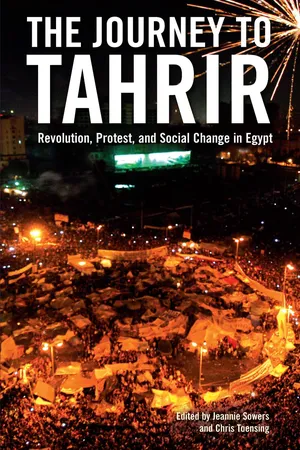
eBook - ePub
The Journey to Tahrir
Revolution, Protest, and Social Change in Egypt
- 256 pages
- English
- ePUB (mobile friendly)
- Available on iOS & Android
eBook - ePub
The Journey to Tahrir
Revolution, Protest, and Social Change in Egypt
About this book
Information
CHAPTER 1
Egypt in Transformation
Jeannie Sowers
At sunset on June 6, 2011, Egyptians once again demonstrated their creativity and tenacity in staging public protests. Activists stood motionless on Cairo’s Qasr al-Nil bridge, shoulder to shoulder, facing each other across four lanes of choked traffic, garbed in black. A few talked in quiet voices, others held signs, but most kept silent with folded hands as taxis, microbuses, and cars filled with passengers crawled past. Occasionally a young man came down the line, reminding participants they would soon move across the bridge, through the streets near Tahrir Square, and assemble in front of the Ministry of Interior, the government authority responsible for the detested internal security forces.
This silent stand-in was in memory of Khalid Sa‘id, a twenty-eight-year-old man beaten to death on an Alexandria sidewalk by security forces exactly one year before. The brazen brutality had galvanized citizens across the country, coordinated anonymously through the “We Are All Khalid Sa‘id” Facebook page and other social media, to take to the streets. On July 23, 2010, activists mounted the first in the series of stand-ins. To avoid the draconian restrictions on public gatherings enshrined in Egypt’s Emergency Law, organizers in Alexandria and Cairo asked participants to stand a few meters apart, facing the sea or the Nile if possible, in quiet contemplation or prayer. The novel form of protest attracted unexpectedly large crowds, prompting one commentator to wonder if “the thunderous silence on the Nile” in the summer of 2010 presaged greater civil unrest.1
And indeed it did. In early 2011, after Tunisia’s long-standing dictator fled in the face of a mass uprising, millions of people turned out on the streets of Cairo and other Egyptian cities to demand that President Husni Mubarak step down. The Qasr al-Nil bridge, like other thoroughfares, became the site of some of the most visible clashes between state security forces and protesters during the January 25 revolution, as it is known in Egypt. Defying the black-clad conscripts of the regime’s Central Security Forces, protesters tried to make their way across the bridge to converge on Tahrir Square. They encountered tear gas, bullets, water cannons mounted on armored vehicles, and phalanxes of state security. As captured on videos posted on the Internet and viewed around the world, however, the protesters regrouped, pushed forward behind improvised barricades, and sometimes broke through as the security forces retreated in disorder.
The battles on the Qasr al-Nil bridge were only some of many attacks on protesters across Egyptian cities, often at night, in places with far less media coverage. The courage and determination of many ordinary Egyptians to stay in the streets forced the military to remove Mubarak from office and assert direct control over the country after a mere eighteeen days. Those who participated in the uprising were not simply out to end Mubarak’s thirty-year hold on power. Like their counterparts in Tunisia, protesters wanted to create a political regime that would respect dignity, rights, and justice, not trample upon them.
Embedding such principles in any political system, even consolidated democracies, is an ongoing challenge. But it is a particularly difficult task when the key institutions and personnel of the ancien régime are entrusted with revolutionary goals. Egyptians were initially grateful that the military eased Mubarak out of power, preventing an escalation of the repression and atrocities that unfolded in Syria, Bahrain, Yemen, and Libya. By the summer of 2011, activists became frustrated by the military council’s refusal to repeal the Emergency Law, restructure the security services, or make concrete preparations for elections. The military, a pillar of the Mubarak regime, continued to employ many of the techniques of control and repression that security forces had used in previous years. The Supreme Council of the Armed Forces (SCAF) criminalized protests and strikes through new laws issued by decree, arrested protesters and tried civilians in military courts, and detained individuals on vague and often questionable charges of subversion, espionage, and treason. Some pro-democracy activists bravely questioned these tactics in blogs, TV interviews, and the press, and were then “invited” in for questioning by the military council. At the same time, however, the public trials of former President Mubarak and his former interior minister went ahead as announced, an unthinkable event just six months earlier, while there is no indication that the SCAF has retreated from its commitment to hold substantive parliamentary and presidential elections.
The January 25 revolution has thus already reshaped the political landscape of Egypt in new and profound ways. The significant gains made by the protesters, and their tenacity in returning to the streets, open up possibilities for systemic institutional transformation in the months and years to come. Success in creating a more accountable, inclusionary political system is far from assured. But for those who took to the streets, and those who did not but watched their compatriots persevere, the uprising has already wrought substantial changes. These can be summed up as the dissolution of fear and its replacement with willingness to challenge practices of political control and hierarchy. As one Egyptian engineer put it, “We feel that a great weight, the weight of zulm [oppression], has been lifted. We know what we are capable of. We can go to the streets again.”2
This lack of fear has concrete roots in victories achieved through peaceful protest and pitched battles like those on the Qasr al-Nil bridge and elsewhere. The old regime inadvertently helped create collective assertiveness and self-sufficiency when it pulled the security and police forces in their entirety off the streets during the January uprising. This decision, like those to unleash gangs of thugs and to free criminals from prisons, proved to be self-defeating, part of a desperate bid to create insecurity and turn public opinion against the protesters. Instead, local watch committees (ligan sha‘biyya) emerged in every neighborhood to address the threat of armed thugs, looting, and disorder. Streets and neighborhoods were self-organized and self-policed. Cairo, a metropolitan area of approximately 22 million people, continued to function, without the traffic police, the security forces, or any other external apparatus of coercion. City streets, it turned out, were not just spaces of protest, but of participatory self-governance.
UNDERSTANDING EGYPT’S UPRISING IN CONTEXT
This book situates Egypt’s January uprising in terms of the key trends in Egyptian society and economy of the past decade. It also covers the unfolding of the January 25 revolution and the initial impact of the revolution on Egypt’s politics and economy. The volume originated as essays published in Middle East Report, a quarterly journal providing independent, in-depth analysis of the region’s political economy since 1971. Many chapters have been reworked and updated to include recent developments; others are reprinted as originally written, to capture a particular historical moment.
The contributors to the volume have all lived, worked, and conducted research in Egypt, and include some well-known Egyptian activists and civil society organizers. The authors hail from a range of academic disciplines, including anthropology, history, sociology, and political science, and their work provides original, empirically grounded knowledge of past trends and unfolding developments in Egypt.
In compiling such a volume, we do not claim that the January 25 uprising was either inevitable or anticipated. No one was more surprised at the escalation of the protests than the youthful organizers themselves; they did not foresee, any more than did the regime, the extent to which the protests would escalate. “The miracle of the Egyptian revolution,” recalled one middle-aged professional who strolled to Tahrir Square on the first day with all of his coworkers, “was that we all decided simply to walk in the streets (mashawir fi shawari‘). It was such an ordinary thing to do, but when millions of us did it, it was extraordinary.”3
While the uprising seemed spontaneous even to participants, veteran activists had rethought their protest strategies in light of the Tunisian success. Rather than announcing protest locations in advance, allowing security forces to overwhelm discrete demonstrations, activists dispersed to various streets and neighborhoods, gathering crowds as they went along and converging on major thoroughfares, bridges, and squares.4 A series of miscalculations by the regime and its supporters in the National Democratic Party (NDP) also contributed to rapid escalation and growing public support. These included sending thugs to attack protesters in Tahrir Square for twelve hours during the infamous “Battle of the Camel,” without any interference from the security forces or the army. Carried live on satellite television, the camel-borne assault placed the contempt of the regime for Egyptian citizens on full display.
While the January uprising was not predictable, momentum for significant political change was building during the 2000s.5 The Mubarak regime was widely viewed as out of touch, corrupt, and heavy-handed. During the 1990s and 2000s, the ruling clique expanded the reach of the internal security and intelligence agencies, employing hundreds of thousands as informants, thugs, police officers, and other personnel to conduct ever more extensive monitoring of the citizenry. Human Rights Watch and local human rights organizations chronicled the systematic use of torture, widespread illegal and indefinite detentions in police stations across the country, and even cases of abductions and disappearances.6 Once limited to targeting political opponents and Islamists, these tactics now spread as a routine use of state power.7 In a prescient 2006 essay, Robert Springborg outlined how these policies, designed to forestall the possibility of mass protest, instead undermined its ability to gauge public opinion and react appropriately.8 In other words, the Mubarak regime became progressively less capable of governing during the 2000s, as its reliance on security agencies overshadowed its limited avenues of engagement with political and civil society.
THE JANUARY 25 REVOLUTION: TAHRIR AND BEYOND
As Mona El-Ghobashy argues in Chapter 2, during the 2000s the police and security forces came into direct confrontation with increasing numbers of Egyptians across class and communal lines. She notes that “by January 25, 2011, every protest sector had field experience with police rule . . . but no population group had come close to shifting the balance of resources in its favor.” All this changed in the first four days of the January 2011 street battles, she argues, as the police encountered an unprecedented, cascading situation. Protest, strikes, and vigils diffused rapidly through cities across the country, and protesters returned to the streets in ever greater numbers despite extensive and often lethal police violence. The protesters also literally destroyed key parts of the hated police and security infrastructure, storming and burning police stations, armored vehicles, and government party headquarters in the capital and the provinces.
The epicenter of the protests quickly became Tahrir Square in downtown Cairo. In Chapter 3, Ahmad Shokr chronicles from firsthand experience how the days and nights spent in Tahrir transformed participants and their expectations. When people recall their time in Tahrir, many describe living in a utopia where they felt freed from their own circumscribed identities as well as from fear of the regime. As the protesters repeatedly fought to hold Tahrir in the face of attacks by police forces and hired thugs, and organized the routine tasks of sustaining everyday life, such as providing food, shelter, and medical care, staying in the square became far more than a political demonstration. As Shokr observes, the square “became a tent city where people of every political stripe and social class gathered to exchange views about everything.”
Many participants felt that they were collectively involved in creating a political community for the first time. Jessica Winegar, in Chapter 6, shows how this sense of community persisted when young people embarked on cleaning up Tahrir and other urban spaces in the aftermath of the protests. She sees efforts at collecting garbage, painting, and sweeping the streets as part of a broader reclaiming of public space by marginalized youth.
Patriotism, communal purpose, and joy: all these were facilitated in Tahrir and elsewhere by protest leaders leading crowds in chants and slogans. After January 2011, protest in Tahrir and other public spaces continued, hoping to push forward the goals of the uprising in the face of a recalcitrant security state. The most talented sloganeers kept the crowds engaged with satire, humor, and wordplay worthy of a talented rap artist.9 As Elliott Colla demonstrates in Chapter 4, Egypt has a long and rich history of sloganeers, poets, and songwriters galvanizing and sustaining street protest and social movements. Colla illustrates how the political poetry of Tahrir poked fun at officials and kept fear at bay even as chants also conveyed the serious political demands of the demonstrators.
Another critical factor sustaining street action during the uprising was the nonstop media coverage provided by Al Jazeera and other media outlets, which kept Egyptians all over the country informed of developments despite the campaign of state-run media to discredit the protesters. Ursula Lindsey chronicles in Chapter 5 how the uprising was not simply a contest for control of the streets, but for public opinion more broadly. The independent, private, and foreign media provided staunchly supportive coverage of the protesters and their aims, in stark contrast to government-owned outlets. Lindsey shows how young activists also used social media, cell phones, and interviews on privately owned satellite stations to counter the regime’s propaganda.
STREET PROTEST AND POLITICAL
MOBILIZATION UNDER MUBARAK
MOBILIZATION UNDER MUBARAK
Part II of this volume places the January uprising in the context of intensifying, contentious street politics across Egypt during the 2000s. In Chapter 7, Asef Bayat argues that the “Arab street” is not only a physical space of contestation, but also “an expression of the collective sensibilities, shared feelings, and public judgment of ordinary people.” Bayat argues that with the increased policing of streets and public spaces during the 1980s and early 1990s, Islamist and leftist activists moved to informal mosques, universities, and professional associations. Activists returned to street protests in the 2000s, however, to demonstrate in support of the Palestinians (2002), oppose the US invasion of Iraq (2003), and support democracy and labor demands.
Street protest in Cairo against the 2003 Iraq war looked much like a dress rehearsal for January 2011, as Paul Schemm shows in Chapter 8. Protesters occupied Tahrir Square and fought pitched battles with battalions of riot police in the surrounding streets. Popular criticism of Mubarak’s foreign policies escalated when Egypt helped Israel seal off the Hamas-controlled Gaza Strip after 2007. Ursula Lindsey, in Chapter 10, shows how public anger mounted against Egypt’s blockade of Gaza, a policy that included building a subterranean steel wall on the Egyptian–Gazan border with American assistance.
In parallel with the revival of street protest, labor activism also intensified. Joel Beinin argues in Chapter 9 that workers felt threatened on several fronts by accelerating economic reforms. As the state restructured state-owned enterprises for privatization, many workers were laid off. Wages in the public and private sectors failed to keep pace with rising prices for food and other basic commodities, while employers often arbitrarily withheld pay and bonuses.
As a result of these increasingly difficult conditions, labor leaders launched approximately 2,623 collective actions involving over 1.7 million workers between 1998 and 2008, while the number of strikes, sit-ins, demonstrations, and campaigns accelerated in subsequent years.10 The government responded to major strikes not only with police repression but also with strategic concessions on bonuses and wages. Thus, despite draconian laws and government-controlled unions designed to contain activism, workers quickly learned that direct action was effective. After the fall of Mubarak, as strikes spread, the SCAF issued a new law criminalizing work stoppages. With strikes and sit-ins showing little sign of abating, however, there is little indication that Egypt’s workers will be so easily intimidated.
CONTESTED RULES AND INSTITUTIONS
Part III moves from the domain of street protest and civic activism to analyze the dynamics of contention over the rules and practices of formal political institutions. The Mubarak regime appeared for years to have the upper hand in managing participation in formal political life through a combination of patronage, elaborate legal restrictions, a...
Table of contents
- Cover
- Title Page
- Copyright
- Dedication
- Contents
- Acknowledgments
- CHAPTER 1
- Part I: The January 25 Revolution
- Part II: Protest Under Authoritarian Rule
- Part III: Political Participation and Political Institutions Under Mubarak
- Part IV: Economic Reform, Demography, and Environment
- Part V: The Cultural Politics of Youth, Gender, and Marriage
- Contributors
- Index
Trusted by 375,005 students
Access to over 1.5 million titles for a fair monthly price.
Study more efficiently using our study tools.
Frequently asked questions
Yes, you can cancel anytime from the Subscription tab in your account settings on the Perlego website. Your subscription will stay active until the end of your current billing period. Learn how to cancel your subscription
No, books cannot be downloaded as external files, such as PDFs, for use outside of Perlego. However, you can download books within the Perlego app for offline reading on mobile or tablet. Learn how to download books offline
Perlego offers two plans: Essential and Complete
- Essential is ideal for learners and professionals who enjoy exploring a wide range of subjects. Access the Essential Library with 800,000+ trusted titles and best-sellers across business, personal growth, and the humanities. Includes unlimited reading time and Standard Read Aloud voice.
- Complete: Perfect for advanced learners and researchers needing full, unrestricted access. Unlock 1.5M+ books across hundreds of subjects, including academic and specialized titles. The Complete Plan also includes advanced features like Premium Read Aloud and Research Assistant.
We are an online textbook subscription service, where you can get access to an entire online library for less than the price of a single book per month. With over 1.5 million books across 990+ topics, we’ve got you covered! Learn about our mission
Look out for the read-aloud symbol on your next book to see if you can listen to it. The read-aloud tool reads text aloud for you, highlighting the text as it is being read. You can pause it, speed it up and slow it down. Learn more about Read Aloud
Yes! You can use the Perlego app on both iOS and Android devices to read anytime, anywhere — even offline. Perfect for commutes or when you’re on the go.
Please note we cannot support devices running on iOS 13 and Android 7 or earlier. Learn more about using the app
Please note we cannot support devices running on iOS 13 and Android 7 or earlier. Learn more about using the app
Yes, you can access The Journey to Tahrir by Chris Toensing, Jeannie Sowers, Chris Toensing,Jeannie Sowers in PDF and/or ePUB format, as well as other popular books in Politics & International Relations & Middle Eastern History. We have over 1.5 million books available in our catalogue for you to explore.