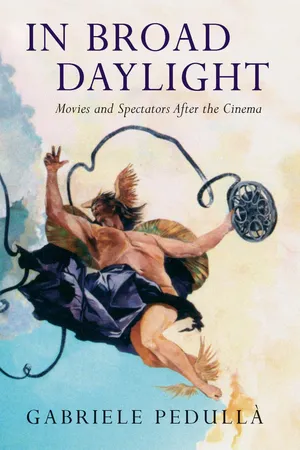
eBook - ePub
In Broad Daylight
Movies and Spectators After the Cinema
- 256 pages
- English
- ePUB (mobile friendly)
- Available on iOS & Android
eBook - ePub
About this book
From plasma screens to smartphones, today moving images are everywhere. How have films adapted to this new environment? And how has the experience of the spectator changed because of this proliferation? In Broad Daylight investigates one of the decisive shifts in the history of Western aesthetics, exploring the metamorphosis of films in the age of individual media, when the public is increasingly free but also increasingly resistant to the emotive force of the pictures flashing around us. Moving deftly from philosophy of mind to film theory, from architectural practice to ethics, from Leon Battista Alberti to Orson Welles, Gabriele Pedull? examines the revolution that is reshaping the entire system of the arts and creativity in all its manifestations.
Trusted by 375,005 students
Access to over 1.5 million titles for a fair monthly price.
Study more efficiently using our study tools.
Information
1
The Cave and the Mirror
To die, to sleep—to sleep, perchance to dream.
William Shakespeare, Hamlet
Everybody says, “You go to the movies to dream.” That’s a load of crap. In the outskirts, you went to the movies to go to the movies.
Marco Ferreri
In the twentieth century, the auditorium was the true blind spot of film theory. Omnipresent, it remained invisible and unknowable. And yet this blindness coincided only in part with silence about the movie theatre as architectural device. Some critics did ask the question, but then—convinced it had been answered once and for all—hurried on to issues that must have seemed more necessary and urgent: photogenic quality, cinematic language, the relationship of images to physical reality, the power of editing, films’ place in mass culture, the artistic charter of the new discipline . . . The paths they took to incorporate the movie theatre swiftly into reflections on the cinematic apparatus are quite interesting, though; like silences, shortcuts can be instructive—especially in a case like this, where we see a substantial unanimity of vision. It is noteworthy that, here, the main intellectual instrument used to displace the question was the analogy. Instead of beginning with the spectators’ tangible conditions during the film and the way these conditions influence aesthetic reactions, as early as the 1910s film enthusiasts began to ask what a spectator resembled—as if the picture house’s functioning could only be understood through a comparison.
Of the key analogies proposed—essentially two—the first and most famous is that of the cave. In the seventh book of the Republic, Plato had compared the philosopher to a man chained since birth in an underground den. Long convinced that movements projected on the walls of the cavern were the only form of reality, and then having escaped, this man, the story goes, turned back in order to convince his ancient prison companions of the wonders that awaited them outside of the cave, but he received in return only scorn and derision. There are, in fact, some impressive similarities between the cinema experience and Plato’s story, and it is easy to see how the myth immediately became popular among early-twentieth-century film enthusiasts in a society where Latin and Greek classics still constituted a universal cultural reference. The prisoners chained to their seats, the dark, the light at their backs, the silhouettes reproducing the shapes of objects, the wall of the cave where the moving shadows are imprinted; the perfect illusion . . . How to resist the analogy’s charm? How could the idea of men duped, and satisfied, by the pseudo-reality of appearances not remind us of a movie audience (despite the potentially anti-cinematic moral implicit in the Platonic condemnation of any fiction as a copy of a copy, and therefore simply a lie)?
Some probably perceived the risk in presenting spectators as prisoners of a nonexistent world, but the possibility of following Plato must have been too enticing to refuse. In search of a cultural ennobling for cinema, the contributors to film journals of the 1910s and ’20s (the very first to have proposed the image of the cave as an interpretive model for the picture house) had good reason to hope that the classical allusion would offer the newcomer the quarterings of nobility required for admission into the empyrean of the respectable arts. Since then, the danger of providing cinema’s detractors with an argument against it seems to have been of no great concern. On the contrary, the lengthy list of those who, if only in passing, drew on the image of the cave (Edgar Morin, Jean-Louis Baudry, Christian Metz, Vilém Flusser . . .) best confirms the difficulty of doing without the illustrious antecedent. Even Jacques Derrida, in an interview with Cahiers du cinéma in 2001, could not avoid using the same parallel.
Once it was established that the movie theatre reproduced the Platonic cave and that films were able to captivate and deceive spectators with a force of persuasion unknown by any other art, it did not seem necessary to further interrogate the nature, the powers, and the functions of this marvelous engine. All we needed to know about the auditorium was that Plato had in some ways “foreseen” it, not unlike how Leonardo da Vinci had “invented” the tank or the helicopter. In the name of Socrates, Cratylus, and Phaedo, any question could be laid to rest.
It is maybe in part for this reason that the second analogy appeared much later; in its mature form it dates back just to the 1970s, when for the first time—facing the crisis of the traditional circuits—spectators, critics, and directors began to realize that one of the fundamental pieces of the filmic experience as they had known it was disappearing. At the heart of the new theory was the conviction (psychoanalytic in origin, but having taken root enough in common parlance) that this experience is fundamentally like dreaming though we are awake—a condition similar to hypnosis. From here the logic was simple. If going to the movies is equivalent to dreaming, and if indeed there exists a specific relationship between the effects induced by film and by hypnosis (enrapture, the breaking down of barriers, projecting oneself into the picture), the movie theatre cannot help but encourage the spectator’s total relaxation: make him receptive to being kidnapped by the flow of images. The dark, the silence, and the comfortable seats would be all the elements needed to conquer the last resistance of those present, putting them in a state of passivity quite similar to that of a person who sleeps. Exactly as a hypnotic (or psychoanalytical) session has its rituals incorporating metallic pendulums, leather sofas, and commands, to work correctly cinema would also need a precise ceremonial; the auditorium with its darkness, its silence, and its immobility would play a part. The movie palace as gigantic psychoanalytical sofa.
Though the cave analogy remained at a purely intuitive level, its implications never fully developed except by those who used it to revile cinema’s deception outright, the analogy with the dream and hypnosis has a richer history. Less “cultured” (one need not have read Plato, or even Freud, to understand its premises), in the end it offered the only real attempt to explain “scientifically” how viewing conditions influence the spectator during the projection of a film. The credit goes to French critic and novelist Jean-Louis Baudry, who, examining the relationship between dream activity and the cinematic experience, proposed an elaborate theoretical model at the beginning of the 1970s. According to Baudry, who took as his points of departure Lacan’s psychoanalysis and Althusser’s Marxism, cinema’s allure—before that of any single film—lies in the resemblance between the position of the spectator and the mental condition of the infant during the so-called “mirror phase,” when the child produces a first sketch of the idea of “I” while observing his or her own reflection. The physical immaturity of the motor apparatus and the precocious development of the infant’s vision correspond exactly to the experience of the public watching a film. Both are characterized by the dark, the absence of movement, the predominance of viewing over any other activity, the impression that the images are real, and the impossibility of verifying this reality—not to mention the fact that some psychoanalysts describe dreams as images projected on a screen, just as in a film. The desire to relive one’s own infancy with an illusory sense of control over moving pictures would thus be sufficient to explain the twentieth century’s burning passion for the new art. For Baudry, in fact, cinema’s appeal lay entirely in its capacity to transform any audience member into a “transcendental subject,” virtually placed at the center of the universe. From this would stem the medium’s ideological nature—idealizing and potentially conservative—but also its strength and its necessity, if one must read the Platonic myth as a psychic projection of a primitive desire inscribed in the minds of man since the beginning of time.
Baudry’s proposal, taken up by Roland Barthes and Christian Metz, is still quite popular, especially among scholars who include psychoanalysis (not necessarily Lacanian) in their arsenals. Problem solved, then? Absolutely not. Despite the undeniable kinship, there are plenty of reasons to think that neither the cave nor the dream parallel adequately explains what happens in the movie theatre. The problem, of course, is not in the use of analogy; authoritative philosophers have shown that even logic sometimes works through analogic reasoning. However, comparisons can be good or bad, indispensable or completely misleading. Everything depends on their ability to show the similarities of essential elements without being led astray by superficial affinities. And as soon as we look less hastily, the two analogies reveal themselves to be deceitful, that is, built upon dubious consonances.
The American cognitive film theorists—and in particular Noël Carroll—have shown the argumentative fallacies behind the image of the movie theatre as a modern Platonic cave. Unlike the Republic’s prisoners, spectators can always get up and leave, or move their heads; the projected image does not always come from behind the spectators (there is such thing as rear-projection); nothing requires us to read the Platonic myth as the manifestation of an atavistic desire to return to infancy; and so forth. Just as facile, then, is the comparison of a film to dream or hypnosis that is so fundamental to Baudry’s thesis. In this case the list of objections is impressive: even if it is less comfortable, the cinematic apparatus works just as well with spectators who are not seated; movies are not solipsistic like dreams, because anyone can discuss his response with the person next to him; the public is always aware it is in a dark room (an awareness we lose while we sleep); frames are detailed, whereas dream images are often partial and incomplete . . .
Here, too, the list could go on. Yet for our discussion the decisive point is a different one: the extreme confusion about why the movie theatre was made and why people love to see films. The analogies with the cave and the mirror become objectionable first of all because they obscure the particular nature—artistic, or even just recreational—of the cinematic experience. French symbolist Rémy de Gourmont put it well back in 1907, when the idea of the equivalence of film and dream began to spread among the first timid admirers of the new art (Sigmund Freud’s book on the interpretation of dreams, not by chance, had come out in 1900): “The public doesn’t go to the cinema to dream; they go to enjoy themselves.” It would be hard to find a more perfect formula to clear away the relics of the analogies with the cave and the mirror phase. The argument that the pleasure of going to the movies really depends on a desire to regress to infancy lacks validity, too, because in this case it would be necessary to explain how it is therefore possible that people watch films with the same satisfaction on television or on their laptop: that is to say, in radically different conditions than those which Baudry judges essential for the full unfolding of the seductive power of moving images.
What we risk losing with such interpretations is first and foremost the aesthetic function for which the movie house was imagined. When this banal observation—that people go freely to the theatre to take pleasure from moving pictures—is accounted for, the spectator’s resemblance to Plato’s prisoner or Lacan’s infant becomes irrelevant. Let us begin with Plato. How do we ignore the fact that at the movies spectators are not deceived, but rather buy a ticket to attend a show and have a story told to them, just as when they read a novel or go to the playhouse? That we appreciate films not as an alternative to life but as a pause, an intermission, a parenthesis in our daily activities, while Plato’s men are spellbound from the start in a copy of the world which for them constitutes the only reality (“from their childhood,” as specified in the Republic)? That Samuel Taylor Coleridge’s “willing suspension of disbelief,” implicit in every fiction, presupposes a kind of illusion completely different from that experienced by Plato’s men, prisoners of shadows and therefore incapable of seeing the only things that truly exist—namely, ideas?
Not every viewing experience is the same viewing experience, just as not every deception is the same deception—especially if we participate knowingly and willingly. When we consider this simple point, very little remains of the similarities that at the beginning seemed so significant. This is all the truer because the comparison with Plato’s cave seems designed to justify a rejection of cinema for being an instrument of ideological falsification and oppression: an argument against the new medium that was made often throughout the twentieth century, from the right and from the left, by such authoritative figures as Theodor W. Adorno and Georges Duhamel.
The original sin resides in this confusion, and the same could be said of the dream analogy. Cinema is not a machine for taking people back to their childhood through hypnosis, or at least no more than it is a process for distancing them from the direct contemplation of ideas. Just like Lacan’s children, Plato’s prisoners see something, but they do not attend a show in the same way a paying spectator does. And precisely because the Greek philosopher’s preoccupations remain strictly ontological and gnoseological (What is really real? How can I recognize it?), whereas the French psychoanalyst is interested in the process leading the child to acquire the first elements of an adult consciousness (How is the subject born?), every attempt to explain cinema through an analogy with the cave or with the mirror phase enacts an undue slippage. So, we need a new strategy, as we will begin to understand the movie theatre’s function only if we study it as an integral part of the cinematic apparatus: a special device, the equal of the camera or the projector, conceived for giving the spectator a kind of experience different from all others.
Compared to the Platonic myth and the child’s discovery of the subject, the real workings of a movie house in action undoubtedly look less exciting. A few elements suffice: a room, not necessarily big; a white wall or a big screen to project images onto; a series of seats or armchairs (though in old-time theatres people sat on the floor or stood if there were no places left); an opening opposite the screen for light to pass through. Such simple furnishings discouraged additional investigation. And yet, in its minimalism, this structure is the result of a long process of definition led by tradespeople and architects so that the film could work, if not in the best way (as we shall see, in fact, there was not just one), at least in the way that they thought best served their interests—that is to say, to maximize the spectators’ reactions and, in so doing, sell more seats.
The apparent simplicity of the solutions adopted for the movie house might remind us of another twentieth-century aesthetic device: the art gallery. In this case, comparison can be useful. As Brian O’Doherty has recounted, this too is a locale that seems neutral, but whose every detail has been studied in advance so as to obtain the desired effect: to favor the appreciation of the works by a viewer who is always also a potential buyer. So that this can happen—so that the art can “take on its own life”— a gallery must meet a series of extremely precise requirements or risk rapid failure. The size and shape of the spaces, color, lighting, furniture, acoustics: nothing can be left to chance. The fact that the code remains implicit does not mean that its prescriptions—its musts and must nots—are not managed extremely rigorously; on the contrary, as always, the most constricting laws are those of which we are not even aware.
Unlike film historians, though, art historians began long ago to interrogate the conventions of the gallery device, and now we can devise a sort of elementary pentalogy for the aspiring gallery manager, from the shaded windows (to keep the outside world out) and the ceiling lights as the only illumination, to the uniform white of the walls and the parquet flooring or soft moquette (evidently to lend a sense of luxury and comfort that puts the visitor at ease, preparing her for the encounter with beauty), all the way to the imperative of keeping the spaces completely empty, except for the works of art, properly separated so that each can “breathe” (a modest desk at the entrance being the only piece of furniture allowed).
As common and insignificant as they might seem, each of these elements makes its own contribution, at once real and symbolic, to the institution that connoisseurs call simply “the white cube.” This is the official residence of Art: a room without shadows, white, clean, and artificial—ascetic as a clinic and cold as a cenotaph to the unknown soldier. Comfortable but also a tad inhospitable (just enough to make visitors maintain the required respectful attitude), purposely conceived so that the works of art can display themselves in a sort of defensive eternity, removed from time and its vagaries.
From the moment they cross the threshold, visitors must clearly perceive that they have entered a separate space. In the end it is precisely this separation that guarantees the gallery’s efficacy, almost as if the closed space has the power to transform the most banal object into a work of art simply because it is on display there. An aesthetic response will inevitably follow an aesthetic question: this is the first and perhaps principal lesson of Marcel Duchamp’s ready-mades. Urinals, torn posters, shit in a box: anything can be worthy of appreciation when placed in the right context, given that the gallery itself is “art-in-potency” in its purest state.
All of this, naturally, has its price. The gallery not only encourages the aesthetic participation of its visitors, but also, in an anxiety of purity, proclaims its own distance from the outside world, imposing pre-emptive sanctions on any attempt to break down boundaries. Protected from the effects of contact with everyday life, which goes on undisturbed, the white cube resembles a limbo where, while the eyes and the mind are always welcome, the body is barely tolerated, giving rise to a curious Cartesian paradox in which the visitor is and is not there at the same time, entirely absorbed in the contemplation of the work—the only legitimate activity in a space dedicated to this single end.
But the picture house? At first glance, it seems a world away from the white cube. Child of the Boulevard theatre...
Table of contents
- Cover
- Title Page
- Copyright
- Dedication
- Contents
- Epigraph
- Introduction
- 1 The Cave and the Mirror
- 2 Toward the Dark Cube
- 3 Vitruvius’s Sons
- 4 The Age of Freedom
- 5 The Aesthetic of the Shark
- 6 Desdemona Must Die
- 7 Low-Impact Catharsis
- Bibliographical Note
- Index
Frequently asked questions
Yes, you can cancel anytime from the Subscription tab in your account settings on the Perlego website. Your subscription will stay active until the end of your current billing period. Learn how to cancel your subscription
No, books cannot be downloaded as external files, such as PDFs, for use outside of Perlego. However, you can download books within the Perlego app for offline reading on mobile or tablet. Learn how to download books offline
Perlego offers two plans: Essential and Complete
- Essential is ideal for learners and professionals who enjoy exploring a wide range of subjects. Access the Essential Library with 800,000+ trusted titles and best-sellers across business, personal growth, and the humanities. Includes unlimited reading time and Standard Read Aloud voice.
- Complete: Perfect for advanced learners and researchers needing full, unrestricted access. Unlock 1.5M+ books across hundreds of subjects, including academic and specialized titles. The Complete Plan also includes advanced features like Premium Read Aloud and Research Assistant.
We are an online textbook subscription service, where you can get access to an entire online library for less than the price of a single book per month. With over 1.5 million books across 990+ topics, we’ve got you covered! Learn about our mission
Look out for the read-aloud symbol on your next book to see if you can listen to it. The read-aloud tool reads text aloud for you, highlighting the text as it is being read. You can pause it, speed it up and slow it down. Learn more about Read Aloud
Yes! You can use the Perlego app on both iOS and Android devices to read anytime, anywhere — even offline. Perfect for commutes or when you’re on the go.
Please note we cannot support devices running on iOS 13 and Android 7 or earlier. Learn more about using the app
Please note we cannot support devices running on iOS 13 and Android 7 or earlier. Learn more about using the app
Yes, you can access In Broad Daylight by Gabriele Pedulla,Gabriele Pedullà in PDF and/or ePUB format, as well as other popular books in Media & Performing Arts & Film History & Criticism. We have over 1.5 million books available in our catalogue for you to explore.