Marc Perelman pulls no punches in this succinct and searing broadside, assailing the 'recent form of barbarism' that is the global sporting event. Forget the Olympics and consider, under Perelman's guidance, the ledger of inequities maintained by such supposedly harmless games.
They have provided a smokescreen for the forcible removal of 'undesirables'; aided governments in the pursuit of racist agendas; affirmed the hypocrisy of drug-testing in an industry where doping is more an imperative than an aberration; and developed the pornographic hybrid that Perelman dubs 'sporn', a further twist in our corrupt obsession with the body.
Drawing examples from the modern history of the international sporting event, Perelman argues that today's colosseums, upheld as examples of 'health', have become the steamroller for a decadent age fixated on competition, fame and elitism.
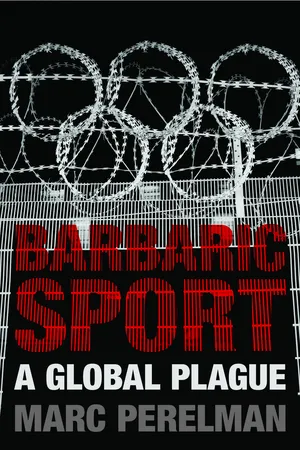
- 144 pages
- English
- ePUB (mobile friendly)
- Available on iOS & Android
eBook - ePub
About this book
Information
1. THE REAL NATURE OF THE OLYMPIC GAMES: BERLIN 1936, MOSCOW 1980. THE FOOTBALL WORLD CUP, ARGENTINA 1978
We were warned a long time ago by the philosopher Vladimir Jankélévitch, whose experience of Nazi Germany taught him that
it is advisable to be reserved on the youth myth when it is linked with exaltation of strength. The Jugendbewegung was born in Germany along with its pseudo-metaphysics; it developed in the Hitler Youth and has invisibly contaminated democratic youth movements, socialist sport and the ‘Olympic spirit’, all of which have unguardedly aped the Nuremberg style with its monstrous liturgies. Nazi juvenilism rests entirely on the sacralization of brute strength and intoxicating pagan vitality … Make no mistake: exaltation of the youthful body is in many cases a suspect myth fabricated by the triumphant male’s prestige. Beware of beautiful athletes.
At the end of the Berlin Olympics, in Le Journal of 27 August 1936, the founder of the IOC, Baron Pierre de Coubertin defended the event in these terms:
What! The Games disfigured, the Olympic Idea sacrificed to propaganda? That’s completely wrong! The grandiose success of the Berlin Games served the Olympic ideal magnificently.… The Olympic Idea must be allowed to blossom freely, without fear of the passion and excess which create the necessary excitement and enthusiasm.… People are worried in France by the fact that the 1936 Games were illuminated by Hitlerite strength and discipline. How could it have been otherwise? On the contrary, it is eminently desirable for the Games to be thus clothed, with the same success, in the garment woven for them over four years by each people.
All through the period of Hitler’s dictatorship, sport was one of the main vectors for propagating Nazi ideology, and rapidly became a veritable social and political plague afflicting a population in thrall to totalitarian order. In August 1936, three and a half years after Hitler’s accession to power, the Berlin Olympic Games and their grandiose production, both inside the stadium and outside it in the city itself, revealed the real function of sport in a totalitarian society. The Games demonstrated that sport played a key part in a militarized system that was persecuting intellectuals, brutalizing Jews before trying to exterminate them, and preparing to mobilize the youth for a future war of conquest across Europe.
Contrary to what used to be thought (and is still thought today, whether through naivety or simple ignorance), the 1936 Olympic Games in Berlin – a priori a neutral, innocent, pure and spotless sporting event – were not instrumentalized by the Nazi government; they were not taken over or appropriated by Nazi policy. Instead the Games by nature simply were an effective instrument, an efficient tool, a great practical apparatus for pursuing racist, anti-Semitic and repressive policies against domestic opponents of the regime, just as they were one of the main vectors of an intense phase of preparation for the Second World War which began three years later.
The Nazi aediles and Hitler himself, initially sceptical about the political advantages of such an event, but courted by the International Olympic Committee from 1931 and the end of the Weimar Republic, were able to rely on the IOC’s support throughout the competition. The preparation as well as the conduct of the Berlin Olympics provided cover for the intensified activities of the Hitlerite state, helping to conceal its decision to invade neighbouring countries and, inside Germany, to justify redoubling the violent repression of those opposed to the regime that had been developing since 1933, especially trade unionists, communists and Jews.
The IOC kept its gaze averted from such matters before, during and after the Games, even though the current Olympic Charter, dating from 1933, seemed – albeit in rather cumbersome terms – to be calling for beneficial encounters between peoples and individuals:
[The reviver of the Olympic Games, as well as his first collaborators] thought quite rightly that those gatherings of young men were one of the best ways to make the different classes in a country as well as units of different civilizations well acquainted with each other and to promote better understanding. Those who followed did their utmost to improve that wonderful manifestation, which is the sporting criterion of the races of the world, and contributed worthily to bring together those who have taken part in the Games.
The swastika flag and the five-ringed Olympic flag thus flew side by side during the ‘festival of youth’, and together decorated the main streets of the new Reich’s cities. The linking of the two flags helped immeasurably to mask the sinister reality of Nazi power and hide the triumph of a declared policy of aggression, conjuring out of sight its wish to enslave non-Aryan peoples and its schemes for their programmed destruction – all the fevered groundwork for the barbaric state’s future crimes.
That screen, that curtain of dreamy well-being, the affecting imagery of exulting masses intoxicated by the sporting spectacle of the Berlin Olympic Games, thus served to cloak a much darker reality already horribly at work in Germany. The 1936 Olympics did not mark a period of peace, nor did they make one more likely, even though many individuals were spellbound by the near-perfect organization that delivered such a colossal, magical spectacle. On the contrary, the 1936 Games enabled the Nazis to fettle their weapons unmolested, despite numerous calls for a boycott including some from the US. It seemed this sporting festival for the world’s youth, with added art and culture, really had become what Baron Pierre de Coubertin called it a year earlier: the new ‘religion’ of the ‘philosophic foundations of modern Olympism’, in which ‘the modern athlete exalts his fatherland, his race, his flag’. During the festival – with the festival, perhaps – a vast project was taking shape, one that led to world catastrophe.
Forty-four years later in 1980, the power of the Moscow Olympics helped for the whole period of the Games to dissimulate the existence of labour camps and psychiatric asylums on Soviet territory. The Games had also been used to justify the invasion of Afghanistan by Red Army tanks the previous year.
Two years before that, in 1978, the football World Cup held in Argentina had enabled the blood-stained Videla dictatorship to establish itself by crushing all dissent, smashing all opposition, arresting people en masse and cutting up opponents with chainsaws 300 yards from the River Plate stadium in Buenos Aires. The roaring of the crowds in the stadium drowned the screams of the tortured; local fans, their awareness and conscience mutilated by football, fervently applauded their national team which finally emerged victorious, giving the dictatorship a further boost. Football, that modern emotional plague, was doing its job.
There are other examples. A few days before the 1968 Olympics in Mexico came the massacre of several hundred students in Three Cultures Square, organized with astonishing cynicism by the government of the time. When members of the Israeli team were murdered during the 1972 Munich Olympics, the IOC president Avery Brundage (1952–72) – a former Nazi sympathizer and member of the isolationist and xenophobic America First Committee – said famously that ‘The Games must go on’.
But those three major events – the Berlin and Moscow Olympics, and the World Cup held in Argentina – remain outstanding for the determining socio-political place occupied by sport, not as an annexe to the internal political situation but, on the contrary, playing a fundamental role in the advent and consolidation of the regimes and governments in question, and of the institutions and individuals associated with them. The more recent example of the 2008 Beijing Olympics is a perfect case in point.
2. BEIJING 2008: THE GAMES OF SHAME
The 2008 Beijing Olympics were not all that different from the 1980 Moscow Olympics, and quite similar to the 1936 Berlin ones. They were framed in the same way as those Games by an omnipresent police force and army hunting down dissidents, itinerant workers, trade unionists, beggars, prostitutes and riff-raff. The strident nationalist mobilization of the masses, the party’s will to impose permanent control and the generalized stupidity were as striking as they were in 1936 Berlin.
More importantly, the major themes being developed by China and its President Hu Jintao shared some of the ideological elements of Olympism as set out in the Olympic Charter. Since 2006, the diplomatic and political reorganization of China had sought to open up the country against a background of reformist policies. Three insistent themes recurred: lasting peace, common prosperity and a harmonious world. In China’s view, the idea of a harmonious world should be judged by its willingness to question the hegemony of the great powers, especially the US, to remedy North–South contradictions or to deal with the environmental crisis. Chinese leaders seized every opportunity to make speeches rehashing the same arguments: we must all struggle for peace, seek peaceful solutions, avoid resorting to military force or sanctions. ‘Harmonious coexistence’ between the US and China replaced the former ‘peaceful coexistence’ between the US and the USSR. To better understand the current political thematics in China, it is helpful to compare them with Olympian thematics, in particular the ones contained in the Olympic Charter.
Thus, when the Olympic Games are described as the ‘youth festival of the entire world’, it is profitable to be able to read between the lines. The Beijing Games exhibited from the outset a large deployment of police and security forces. China had announced that
a total of 80,000 persons, including police officers, professional security agents and volunteers will be deployed as protection for the 29th Olympic Games which will take place in Beijing in August 2008. ‘Beijing is making every effort to establish a high-quality professional security force for Chinese and foreign participants in the Beijing Olympic Games,’ said Ma Zhenchuan, director of the Municipal Bureau of Public Security, on Monday during a conference on international cooperation to ensure security at the Beijing Olympic Games. A set of special manuals, comprising seventeen categories and totalling 180,000 characters, has been prepared for training purposes, covering elementary knowledge of the Olympic Games, essential words and expressions for security personnel, international decorum and courtesy, basic knowledge of the religions, customs and conventions of different peoples, and first aid. So far, 25,000 persons have completed training courses for this purpose. According to Liu Jing, vice-minister of public security, the department of security for the Beijing Olympic Games has established fifty-two General Security Plans, counting those for the gymnasiums and stadiums. (chine-informations.com)
This comprehensive coverage of public space by police and troops was not really a novelty when any Olympic Games were installed in the city designated by the IOC. What was new in this case was the fact that the Chinese police were themselves under close surveillance. China had launched a campaign to ‘improve the image’ of police officers in Beijing and other cities involved in the Games, the official media reported. In particular, officers were forbidden to smoke, eat or converse among themselves while on duty. Policemen would be supervised by ‘inspectors’ in uniform and plain clothes ‘to see how they behave when people ask for their help’, the sources said, citing police ministry spokesman Wu Heping. Any citizen who spotted a policeman smoking, eating or chatting while on duty should ‘report’ them by telephoning 110, added Jia Chunming, a senior Beijing police official.
The campaign was being launched in the six cities where the 2008 Games would be held – Beijing, Shanghai, Qingdao, Shenyang, Tianjin and Qinhuangdao – and would be extended to a number of major tourist sites at the beginning of 2008, the official sources said. In June, a directive had banned police officers from wearing ‘scarves, jewellery, beards or strangely dyed hair’, Reuters reported in September 2007. And all that was only the foundation of the comprehensive strengthening of security: part of the population of Beijing was also to be mobilized, to back up police perhaps thought deficient or not sufficiently numerous. Who better to supervise the people than the people themselves! ‘More than 600,000 Beijing residents are to be asked to supplement the security forces during the 2008 Olympic Games,’ AFP reported on 9 March 2007. ‘During the Games, security professionals will not be acting alone. They will have the support of several hundred thousand volunteers and fans,’ according to the deputy secretary of the Beijing Communist Party, Qiang Wei, quoted by the daily Beijing News. He added that 100,000 police officers, in addition to other security professionals, would be on duty from 8 to 24 August 2008 to eliminate any risk of trouble during the Games. Berlin 1936 and Moscow 1980 had found a worthy successor.
The IOC, as represented by its current president, Jacques Rogge, was equally up to speed on events linked to the Games, especially those sited in Tibet. Having maintained a shameful silence throughout the worst of the repression there, Rogge dismissed calls for a boycott of the Games from human-rights campaigners, saying he believed China ‘would change’ as a result of organizing the Games:
‘The Olympic Games are a force for good. They are a catalyst for change, not a cure for all ills,’ affirmed a press release distributed in Olympia, Greece, where the Olympic Flame is scheduled to be ignited next Monday. ‘The IOC is respectful of human rights. We respect NGOs and campaigning groups, as well as the causes they support – and we also hold regular talks with them – but we are neither a political organization nor a campaigning organization,’ Jacques Rogge explained. (Le Monde, 23 March 2008.)
With the IOC, Count Rogge organized the Beijing Games in close cooperation with the Chinese Organizing Committee, itself under the thumb of the Party-State. The president of the French National Olympic and Sporting Committee (CNOSF), Henri Sérandour, had been given a three-month suspended prison sentence and fined 20,000 euros in October 2006 for ‘prise illégale d’intérêt’ – unlawful conflict of interest in a public official – and ‘reprimanded’ by the IOC in December 2007, just days before the end of his mandate. But as in the capitals of other nations to be visited by the Olympic flame, in Paris daily meetings were held with Chinese Embassy officials … presided by Sérandour. With the IOC and China making common cause over all else, defence of the Games meant trampling the Tibetans underfoot by ignoring the violent repression they suffered, involving many deaths and a thousand campaigners in jail.
That, in turn, made it impossible for the IOC to escape implication in the Tibetan repression. After all, it was surely no more coerced by the Chinese dictatorship than the dictatorship was coerced by the Olympic Games. On the contrary, the IOC and the Chinese Party-State, convinced of their common interests, together did their utmost to ensure that these Games would have the grand scale of a planetary sporting spectacle. For the Chinese dictatorship, that meant relying totally for the mounting of the Games on inputs from the IOC and its national committees. Since 1984 or even earlier, China had understood that the Olympic Games were a vast sporting/commercial enterprise able to concentrate the attention of all nations; and that it could act through the IOC and its national committees to assert its own viewpoint as a dictatorial great power, thus ensuring acquiescence in its acts of internal repression and terror.
‘URBAN REGENERATION’: THE ROLE OF THE OLYMPICS
The run-up to the Olympic Games saw an acceleration of the vast campaign of demolition in the old city, the radical extirpation of its historic kernel. The brand-new, instant, cultural (and above all sporting) Beijing represented a bald denial of the city’s history: the gnarled human-scale palimpsest of millennia had been briskly erased and replaced with gigantic, Western-style towers and slabs. The Olympics played a direct role in the destructive climax of a razing of the urban landscape begun in the 1950s and amplified some years later by the Deng Xiaoping regime. The city had always been the very arena of history, and its centre concentrated the essences of liberty and tyranny alike. Perhaps more the latter since, to quote Karl Marx, society has always tended to ‘subordinate the countryside to the town’; but the current tendency of the Chinese city is self-liquidation in a disquietingly overheated economy, involving the insistent display of its chosen face and a mushrooming of gigantic urban objects planted as close as possible to its heart.
The grandiose engineering and architectural achievements represented by stadiums, swimming pools and gymnasiums, as well as the offices of mass communications (the new TV centre designed by Rem Koolhaas) or culture (the Opera House by Paul Andreu) together contaminate the fabric of Beijing, spreading like a stain, driven by the new economic policy: a ravening, all-devouring capitalism running at record speed. Most of the sports structures were built to far tighter deadlines than is usual for that sort of architecture, and consequently under very harsh working conditions. The work had to be ready on time. The flat-out rhythm of these immense building sites bristling with cranes even started to worry IOC aediles accustomed to hard competition. ‘ “The Chinese were so far ahead that for the first time in its history, the IOC had to ask a city hosting the Games to slow down a bit,” says Kevan Gosper, a senior spokesman of the IOC’s Press Commission’ (Sport, No. 163, 8 February 2008).
In the space of a few years China’s cities had exploded out of their historic boundaries, with their population steadily inc...
Table of contents
- Cover
- Title Page
- Copyright
- Contents
- Preface
- 1. The Real Nature of The Olympic Games: Berlin 1936, Moscow 1980. The Football World Cup, Argentina 1978
- 2. Beijing 2008: The Games of Shame
- 3. The Olympic Charter
- 4. Competitive Sport: Globalized Sports-Spectacle and National Fetish
- 5. Sport: As Old as the World?
- 6. Origin and Development of the Theses on the Critique of Sport
- 7. The Stadium: Consolidation of the Masses
- 8. Sport, Culture and Youth
- 9. The Sporting Champion: Addiction and Drugs
- 10. The Globalization of Sport through Doping
- 11. The Globalization of Sport and the Sporting Mode of Production
- 12. The Show Stadium
- 13. The Power of Images
- 14. A Standardized Aesthetic
- 15. Sexuality and Sport
- 16. The Religion of Sport
- 17. The Critique of Sport as It Was
- 18. The Arrival of Sport as an Academic Discipline
- 19. The Future of the Critique of Sport
- Appendix One: Twenty Theses on Sport
- Appendix Two: Stop Building Stadiums in Europe Now!
- Select Bibliography
Trusted by 375,005 students
Access to over 1.5 million titles for a fair monthly price.
Study more efficiently using our study tools.
Frequently asked questions
Yes, you can cancel anytime from the Subscription tab in your account settings on the Perlego website. Your subscription will stay active until the end of your current billing period. Learn how to cancel your subscription
No, books cannot be downloaded as external files, such as PDFs, for use outside of Perlego. However, you can download books within the Perlego app for offline reading on mobile or tablet. Learn how to download books offline
Perlego offers two plans: Essential and Complete
- Essential is ideal for learners and professionals who enjoy exploring a wide range of subjects. Access the Essential Library with 800,000+ trusted titles and best-sellers across business, personal growth, and the humanities. Includes unlimited reading time and Standard Read Aloud voice.
- Complete: Perfect for advanced learners and researchers needing full, unrestricted access. Unlock 1.5M+ books across hundreds of subjects, including academic and specialized titles. The Complete Plan also includes advanced features like Premium Read Aloud and Research Assistant.
We are an online textbook subscription service, where you can get access to an entire online library for less than the price of a single book per month. With over 1.5 million books across 990+ topics, we’ve got you covered! Learn about our mission
Look out for the read-aloud symbol on your next book to see if you can listen to it. The read-aloud tool reads text aloud for you, highlighting the text as it is being read. You can pause it, speed it up and slow it down. Learn more about Read Aloud
Yes! You can use the Perlego app on both iOS and Android devices to read anytime, anywhere — even offline. Perfect for commutes or when you’re on the go.
Please note we cannot support devices running on iOS 13 and Android 7 or earlier. Learn more about using the app
Please note we cannot support devices running on iOS 13 and Android 7 or earlier. Learn more about using the app
Yes, you can access Barbaric Sport by Marc Perelman, John Howe in PDF and/or ePUB format, as well as other popular books in Politics & International Relations & Political Ideologies. We have over 1.5 million books available in our catalogue for you to explore.