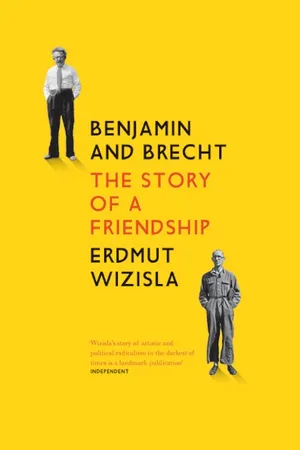
Germany in the mid 1920s, a place and time of looming turmoil, brought together Walter Benjamin-acclaimed critic and extraordinary literary theorist-and Bertolt Brecht, one of the twentieth century's most influential playwrights. It was a friendship that would shape their writing for the rest of their lives.
In this groundbreaking work, Erdmut Wizisla explores what this relationship meant for them personally and professionally, as well as the effect it had on those around them. From the first meeting between Benjamin and Brecht to their experiences in exile, these eventful lives are illuminated by personal correspondence, journal entries and private miscellany-including previously unpublished materials-detailing the friends' electric discussions of their collaboration. Wizisla delves into the archives of other luminaries in the distinguished constellation of writers and artists in Weimar Germany, which included Margarete Steffin, Theodor Adorno, Ernst Bloch and Hannah Arendt. Wizisla's account of this friendship opens a window on nearly two decades of European intellectual life.
- 280 pages
- English
- ePUB (mobile friendly)
- Available on iOS & Android
eBook - ePub
About this book
Information
Topic
PhilosophySubtopic
European Literary CollectionsEndnotes
Notes to Chapter I
1.Benjamin Correspondence, p. 350. See p. 219 above for List of Abbreviated Titles and Sources.
2.Benjamin to Scholem, 24 June 1929, in Scholem, Benjamin, p. 159.
3.Quoted in Scholem, Benjamin, p. 166.
4.Hannah Arendt, Walter Benjamin. Bertolt Brecht. Zwei Essays, Munich, 1971, p. 10 (Arendt’s essay on Benjamin in this German edition is the basis of, but is not identical to, the version in her Men in Dark Times; wherever possible, reference is made here to the latter).
5.‘Walter Benjamin’, p. 172.
6.Scholem, Benjamin, p. 146.
7.Benjamin to Scholem, 30 January 1928, Benjamin Correspondence, p. 322.
8.Arendt, Men in Dark Times, p. 174.
9.Scholem, Benjamin, pp. 158–9.
10.SW, vol. 1, p. 253.
11.ibid., p. 293.
12.ibid., p. 460.
13.ibid., p. 444.
14.Benjamin to Scholem, 7 July 1924, Benjamin Correspondence, p. 245.
15.SW, vol. 2, p. 215.
16.Benjamin to Scholem, 22 December 1924, Benjamin Correspondence, p. 257.
17.Benjamin to Scholem, 21 July 1925 and 29 May 1926, ibid., pp. 276 and 300.
18.Benjamin, Moscow Diary, p. 73.
19.Fritz Sternberg, Der Dichter und die Ratio. Erinnerungen an Bertolt Brecht, Göttingen, 1963, p. 25.
20.ibid., pp. 22 and 27.
21.Walter Benjamin to Max Rychner, 7 March 1931, GB IV, p. 18, Benjamin Correspondence, p. 372 (see Chapter III below).
22.Bernard Guillemin, ‘On What Are You Working? A Talk with Bert Brecht (1926)’ in As They Knew Him.
23.Brecht on Art and Politics, p. 73.
24.Brecht on Theatre, pp. 23–4.
25.ibid., p. 30.
26.Brecht, Collected Plays, vol. 3, p. 325.
27.ibid., p. 319.
28.ibid.
29.Brecht, Collected Plays, vol. 2, pp. 345ff.
30.Brecht on Theatre, p. 28.
31.In As They Knew Him, p. 19.
32.ibid., p. 39.
33.Benjamin/Adorno, p. 7.
34.GB III, p. 444.
35.Benjamin to Gretel Karplus, beginning of June 1934, GB IV, p. 440.
36.Asja Lacis, Revolutionär im Beruf (‘Revolutionary by Profession’), p. 59.
37.Adorno/Benjamin, 31 May 1935, p. 89.
38.See Benjamin to Gretel Karplus, early June 1934, GB IV, p. 440.
39.Adorno/Benjamin, 31 May 1935, GB V, p. 89.
40.Benjamin to Friedrich Pollock, draft, c. mid July 1938, GB VI, p. 132.
41.See Adorno, ‘Benjamin the Letter Writer’ in Notes to Literature, vol. 2, p. 239.
42.‘Walter Benjamin’. p. 189.
43.Scholem, Benjamin, p. 159.
44.‘Walter Benjamin’, p. 189.
45.Scholem, Benjamin, pp. 197–8.
46.Adorno/Benjamin, 4 May 1938, p. 250.
47.Scholem to Adorno, 8 February 1968, in Gershom Scholem, Briefe II, Munich, 1995, p. 203.
48.Arendt, Men in Dark Times, p. 165 and n.
49.Scholem, Benjamin, p. 228.
50.ibid., p. 176.
51.Benjamin to Karplus, after 3 December 1935, GB V, p. 205.
52.Adorno, ‘The Threepenny Opera’, in Kurt Weill, The Threepenny Opera, edited by Stephen Hinton, Cambridge, 1989, p. 133
53.Adorno/Benjamin, 10 November 1938, p. 284.
54.Adorno, Notes to Literature, vol. 2, p. 230.
55.ibid., pp. 82–7
56.Adorno, Prsims, p. 234.
57.ibid., p. 241.
58.Peter von Haselberg, ‘Wiesengrund-Adorno’, in Text +Kritik (Adorno special issue), Munich, 1977, p. 14.
59.Adorno/Benjamin, 6 November 1934, p. 53.
60.ibid.
61.ibid., 2–5 August, p. 108.
62.Horkheimer to Adorno, 22 January 1936, GB V, p. 225.
63.Adorno, ‘Interimsbescheid’, in Über Walter Benjamin, p. 94.
64.See Adorno, Notes to Literature, vol. 2, p. 237.
65.Ernst Bloch to Karola Piotrkowska, 5 November 1930, in Anna Czajka, ‘Rettung Brechts durch Bloch?’, in The Brecht Yearbook (Madison), vol. 18, p. 122 (see Chapter III below).
66.Scholem, Benjamin, pp. 164ff.
67.Günther Anders, ‘Bertolt Brecht: Geschichten vom Herrn Keuner’, in Merkur (Stuttgart), vol. 33, no. 6, September 1979, p. 890.
68.ibid., p. 38.
69.Günther Anders to the author, 23 September 1988.
70.Asja Lacis, letter to Hildegard Brenner of 14 November 1967, in alternative, nos 56/7, 1967, p. 213.
71.See the letters of Elisabeth Hauptmann to Benjamin in WBA 57, published in part in Geret Luhr (ed.), ‘was noch begraben lag’, op. cit., pp. 93–114, also Sabine Kebir, Ich fragte nicht nach meinem Anteil. Elisabeth Hauptmanns Arbeit mit Bertolt Brecht, Berlin, 1997, pp. 168–79.
72.Jewish National University Library, Jerusalem, Arc. 4° 1706.
73.Hans Bunge (ed.): Brechts Lai-tu. Erinnerungen und Notate von Ruth Berlau, Darmstadt, 1985, p. 105.
74.See Anna Maria Blaupot ten Cate to Benjamin, 27 November 1933 (WBA 22/3), in Geret Luhr, (ed.), ‘was noch begraben lag’, op. cit., p. 131.
75.Blaupot ten Cate to Walter Benjamin, first half of June 1934 (WBA 22), in ibid., pp. 150ff.
76.Dora Benjamin to Karl Thieme, 20 September 1943, in ibid., p. 280.
* See Scholem, Benjamin, pp. 137ff. for the background. For the letter see Benjamin Correspondence, p. 359. Significantly, this letter about Benjamin’s plans to give up learning Hebrew and turn to German literature was written in French. Scholem entitled the chapter in Scholem, Benjamin on Benjamin’s Jerusalem plans ‘The Failed Project’.
* Dora Sophie Benjamin to Scholem, 29 November 1933, in Benjamin/Scholem, p. 89. She referred to the same conversation in her statement that, at a gathering, the prevailing opinion was that Benjamin wrote ‘the best German of all persons living’ (Dora Sophie Benjamin to Walter Benjamin, 7 December 1933 (WBA 17/05), in Geret Luhr (ed.): ‘was noch begraben lag’ in Zu Walter Benjamins Exil. Briefe und Dokumente (Berlin, 2000, p. 37)).
* Three examples: first, the view of Benjamin’s work expressed by the translator Richard Peters was certainly not an isolated one. On 18 May 1928, Benjamin had reviewed Peters’s German edition of Leopardi’s Pensieri in the Literarische Welt, criticizing the fact that Peters had not referred to a more recent translation by Gustav Glück and Alois Trost. In a letter published by the Literarische Welt, together with Benjamin’s response, Peters wrote that Benjamin’s criticism was ‘all the more painful for me, because I retain, as always, the greatest possible admiration for you personally as well as for your literary achievements’ (GS III, p. 120). Second, the Literarische Welt’s esteem for its author could be seen, for example, in an editorial comment on a partial publication of Benjamin’s article on Goethe for the ‘Great Soviet Encyclopedia’, in its issue of 7 December 1928 (see SW, vol. 2, pp. 161–87 for this text). This (partial) version, on Goethe’s politics and attitude to nature, represented ‘in our opinion the most intelligent and thorough analysis we have ever read of this problematic, decisively important as it is for German intellectual history – and expressed in the most concentrated form’. Finally, Max Rychner, the editor of the Neue Schweizer Rundschau, in its February 1931 edition referred to Benjamin as a ‘critic of high intellectual status’.
† Die Literarische Welt, 1 June 1928, quoted here from the facsimile in Brodersen, A Biography, p. 147. Benjamin commented drily: ‘Since we are speaking of such voices, I would like to tell you that Hermann Hesse commented in a very friendly, specific and unprompted manner on One-Way Street. This one swallow – nebbich (poor thing) – is already summer for us’ (Benjamin to Siegfried Kracauer, GB III, 2 May 1928, p. 372).
‡ Significantly, Hans Heinrich Schaeder, an Orientalist, and Werner Milch, a critic on the popular daily, the Berliner Abendblatt, both wrote disapprovingly, the form...
Table of contents
- Cover Page
- Halftitle Page
- Title Page
- Copyright Page
- Contents
- List of Illustrations
- Publisher’s Note
- Chronology of the Relationship
- Time chart and map of Benjamin’s and Brecht’s main locations in Europe
- I. A Significant Constellation
- II. The Story of the Relationship
- III. ‘Krise und Kritik’
- IV. Benjamin on Brecht
- V. Brecht on Benjamin
- Appendix: Documentation and Minutes of ‘Krise und Kritik’
- Endnotes
- List of Abbreviated Titles and Sources
- List of Works Cited
- Acknowledgements and Permissions
- Annotated Name Index
- Index of Works by Bertolt Brecht
- Index of Works by Walter Benjamin
Trusted by 375,005 students
Access to over 1.5 million titles for a fair monthly price.
Study more efficiently using our study tools.
Frequently asked questions
Yes, you can cancel anytime from the Subscription tab in your account settings on the Perlego website. Your subscription will stay active until the end of your current billing period. Learn how to cancel your subscription
No, books cannot be downloaded as external files, such as PDFs, for use outside of Perlego. However, you can download books within the Perlego app for offline reading on mobile or tablet. Learn how to download books offline
Perlego offers two plans: Essential and Complete
- Essential is ideal for learners and professionals who enjoy exploring a wide range of subjects. Access the Essential Library with 800,000+ trusted titles and best-sellers across business, personal growth, and the humanities. Includes unlimited reading time and Standard Read Aloud voice.
- Complete: Perfect for advanced learners and researchers needing full, unrestricted access. Unlock 1.5M+ books across hundreds of subjects, including academic and specialized titles. The Complete Plan also includes advanced features like Premium Read Aloud and Research Assistant.
We are an online textbook subscription service, where you can get access to an entire online library for less than the price of a single book per month. With over 1.5 million books across 990+ topics, we’ve got you covered! Learn about our mission
Look out for the read-aloud symbol on your next book to see if you can listen to it. The read-aloud tool reads text aloud for you, highlighting the text as it is being read. You can pause it, speed it up and slow it down. Learn more about Read Aloud
Yes! You can use the Perlego app on both iOS and Android devices to read anytime, anywhere — even offline. Perfect for commutes or when you’re on the go.
Please note we cannot support devices running on iOS 13 and Android 7 or earlier. Learn more about using the app
Please note we cannot support devices running on iOS 13 and Android 7 or earlier. Learn more about using the app
Yes, you can access Benjamin and Brecht by Erdmut Wizisla, Christine Shuttleworth in PDF and/or ePUB format, as well as other popular books in Philosophy & European Literary Collections. We have over 1.5 million books available in our catalogue for you to explore.