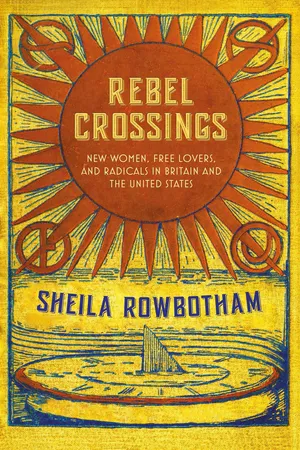
In a feat of extraordinary archival research Sheila Rowbotham uncovers six little-known women and men whose lives were both dramatic and startlingly radical. Rowbotham tells a story that moves from Bristol, Belfast and Edinburgh to Massachusetts and the wildernesses of California, showing how rebellious ideas were formed and travelled across the Atlantic.
Rebel Crossings offers fascinating perspectives on the historical interaction of feminism, socialism, anarchism and on the incipient consciousness of a new sense of self, so vital for women seeking emancipation. Their influences ranged from Unitarianism, High Church Anglicanism, and esoteric spirituality through to Walt Whitman, William Morris, Edward Carpenter, Eleanor Marx, Peter Kropotkin, Benjamin Tucker, and Max Stirner. In differing ways they sought to combine the creation of a co-operative society with personal freedom, enhanced perception and loving friendships, experimenting with free love, rational dress, health diets and deep breathing.
A work of significant originality in terms of historical scholarship, this book also speaks to the dilemmas of our own times.
eBook - ePub
Rebel Crossings
New Women, Free Lovers and Radicals in Britain and the United States
- 512 pages
- English
- ePUB (mobile friendly)
- Available on iOS & Android
eBook - ePub
Rebel Crossings
New Women, Free Lovers and Radicals in Britain and the United States
About this book
Information
PART I
HOPES
ONE
Radical Endeavour: Helena Born
Helena’s origins were in the Devon countryside. Her grandfather Richard Born farmed 120 acres at Coham, near the small village of Black Torrington, and Helena was born there on 11 May 1860. By the time the 1871 Census was taken, forty-one-year-old Richard Born, his wife Elizabeth, aged forty-nine, and their young daughter, Mary Helena, were living a few miles away with relatives, the Southcombes, at Moorhead Farm.1 Perched high up on the edge of Hatherleigh Moor, the farm looked out upon a breath-taking vista of yellow heath, backed by greener fields and grey blue hills just visible in the far distance. They were only about a mile from the bustle of the market town of Hatherleigh, but the short walk would have seemed a long way to a small child and Helena’s world in her early years revolved around the farmhouse.
The 1871 Census records Richard Born’s ‘Work, Profession or Occupation’ as being ‘Out of Business – Interest of Money’. He had somehow acquired capital and no longer worked on the land. Helena’s father is classified as a lodger, while John Southcombe and his sister, Susannah, ‘Milliner and Dress Maker’, were joint heads of the household. The connection between the two families was close, and, after Elizabeth Southcombe was born in 1873, Helena adopted a protective and affectionate relationship towards her younger ‘cousin’ who was always known as ‘Minnie’.2
Hatherleigh had developed as a centre for the woollen trade, and its poor inhabitants, known as ‘potboilers’, retained a medieval right to graze their sheep on the Moor. Decline set in during the eighteenth century, leaving it a tiny market town by the 1860s. Nevertheless, its trading ethos, marked by a Stock Market and several inns, distinguished it from the surrounding villages. The Anglican church, St John the Baptist’s, loomed over the cottages in the narrow streets below.3 According to Helen’s ‘Biographical Introduction’ to Whitman’s Ideal Democracy, Helena went to a day school in the village, possibly the Anglican National School, still attended by most local children. However, the Borns may have been Nonconformists, for, in an 1885 essay, ‘A Chat about Bazaars’, Helena recalls assisting at a bazaar to raise money for a ‘Dissenting body’ in a small town so ‘bigoted’ that few graced the event, compelling the sellers to duplicate as buyers.4 Her training for life with a minority outlook began early.
Shortly after the 1871 Census, the Born family moved to Stoke St Mary near Taunton, a town with strong Dissenting traditions, and Helen records that Richard Born sent his daughter to ‘an academy’ in Taunton. The school was clearly advanced in its approach to girls’ education, for she states that the young countrywoman ‘excelled in her studies, evinced a taste for mathematics, and looked longingly toward a college training’.5 But this was not to be.
On 16 February 1876, when Helena was fifteen, the Exeter Flying Post announced the sale of the Born’s ‘FURNITURE’, ‘Pianoforte’, ‘Hack Horse, Dog Cart and Harness’.6 An abrupt change was afoot: Richard Born had become sufficiently wealthy to move the family to Bristol, which had prospered from trading in slaves, sugar and tobacco. By the mid 1870s, its ancient port was being overtaken by competitors, but the city had developed a varied range of industries and a strong financial sector.7
The Borns’ new rented home was 65 Whiteladies Road, in the elegant suburb of Clifton. Helena’s father appears to have invested in land and property, for the 1881 Census states that he derived his income ‘from House’.8 In the early part of the nineteenth century Clifton had attracted impoverished aristocrats, along with up and coming manufacturers, retired army officers and professionals. From the 1860s, as more and more of the aspiring middle class settled high above the city’s slums, Clifton turned into a distinctive suburb of Bristol. With its magnificent Downs, its origins as a watering place, its links to the powerful Society of Merchant Venturers and its grand Regency houses, Clifton was no ordinary suburb. In 1862, a new public school for boys, Clifton College, was established there with spacious grounds and playing fields. During the 1860s and ’70s many churches and chapels were built, their charities extending the ethos of high-minded endeavour through the city.
By the late nineteenth century Clifton had acquired an unusually large number of women paying rates and heading their own households. These independent middle-class women became a force, not only in the suburb’s religious and charitable projects, but in its politics and culture. They established organisations for women’s rights, agitating for suffrage and higher education, along with the anti-vivisection cause. They also played a crucial part in the controversial movement for the repeal of the 1860s Contagious Diseases Acts, which had introduced the seizure, forced inspection and confinement of women (but not men) suspected of having venereal disease. The long campaign that resulted in the Acts’ repeal in 1886 raised not just individual rights, but the demand for women’s control over their own bodies and persons, in a startling assertion of autonomous self-ownership that crossed boundaries of class and gender.9
With its Debating Society, Antiquarian Club, Shakespeare and Browning Societies, Clifton pulsated with meetings, not to mention art exhibitions and concerts. It even evolved its own styles – with just a hint of daring. Some aesthetic Clifton women were to be seen in clinging Pre-Raphaelite garments, others favoured voluminous velvet dresses signalling a distinguished intellectual and aesthetic recoil from conformity. The genteel and cultured suburb on the hill thus allowed for choice and diversity among its female inhabitants – albeit those who belonged to its variegated elites. Though Helena was never able to study at university, her surroundings educated and changed her nonetheless.
In 1879 Helena started to keep a scrapbook, and it reveals how her preoccupations alter. Initially devout and patriotic, she carefully cut out reports of addresses by famous preachers along with verses about the Royal Family. Within a year, however, the scrapbooks’ contents become more radical. The stimulus most likely derived from the Unitarian church she attended on Oakfield Road near her home. Built in 1862 with local red stone in Gothic style, the church’s architecture epitomised rational, harmonious aspiration. Its first incumbent had been the enlightened J. Estlin Carpenter, a probing scholar of comparative religion who supported women’s rights. When Helena went to Oakfield church the broad religious tolerance and radicalism he personified still persisted. The current preacher, Revd William Hargrave, shared Helena’s scientific interests; he had an MA in Botany and was a keen member of the British Naturalists’ Society. Politically he was a Radical Liberal, part of a growing current in the Liberal Party opposed to the old Whig aristocracy, and Helena came to share many of his views.
Radical Liberals like Hargrave wanted to remove all impediments restricting individual freedom and development. He and his wife, Jane, participated in the agitation against the Contagious Diseases Acts and defended women’s rights to suffrage and legal independence. Hargrave’s commitment to individual freedom extended to a critique of class prejudices and he was prepared to defend trade unions and land nationalisation. Moreover, he was a supporter of the radical secularist MP, Charles Bradlaugh, expelled from the House of Commons in 1880 after refusing to take the religious oath of allegiance. From that year, cutting after cutting on the protracted Bradlaugh case appear in Helena’s scrapbook.10
Living without God was being debated in the newspapers and journals Helena perused so assiduously. The erosion of religious faith removed the reassurance of immortality, opening a space for alternative kinds of spirituality and secular ethical values. It also reinforced aspirations for individual fulfilment on earth rather than in heaven. Yet a revulsion against a mechanical materialism was widespread. Like many Victorian young women, Helena’s passions, spiritual and sensuous, were aroused by the Romantic poets, especially Percy Bysshe Shelley and John Keats. Algernon Swinburne and Robert Browning appealed too, perhaps because they explored parameters of doubt while intimating realms of personal free expression. Browning, like the novels by William Thackeray and George Eliot that Helena read, also probed the generation of individual personality – a pursuit Helena would make her life quest.
A favourite of Helena’s was the less known Bristol poet, John Gregory, a self-educated shoemaker employed at Clifton College to mend the boys’ shoes. His poems appeared in local papers, such as the Bristol Mercury, mixing sentiment with protest against social injustice. In 1880 Helena cut out his ‘Beauty’s Choice’, with its rejection of worldly esteem, and his ‘Reward of Labour’, exhorting the reader to ‘look onward, upward’.11 Despite their differing circumstances, Helena could identify with Gregory’s call to resist the thwarting of spiritual and creative aspiration. Over the next few years many more verses by this remarkable man were to be pasted into the scrapbook.
Born in 1831, Gregory’s radicalism reached back to the Chartist movement, for he had read the Northern Star as an apprentice in Wales. In Bristol, Gregory became active in the Boot and Shoe Union and the Bristol and District Labour League, an organisation formed to promote working-class candidates. He denounced the upper classes graphically as ‘fat calves of Fortune [who] lay at ease as Caterpilars [sic] basking in the sunshine on leafs [sic] of Cabbages’, and was a supporter of the Bristol Socialist Society which Helena later joined.12
The Bristol Socialist Society began as a discussion group started by two brothers who were supporters of Bradlaugh, John Sharland, an engineer, and Robert Sharland, a wire-puller, along with a Republican carter called William Baster. Then another Sharland brother, Will, enrolled, bringing along his neighbour, a Christian Socialist factory worker, Robert Weare. They had become friends through talking over the garden wall about socialism and the ideas of the American land nationaliser, Henry George. In 1884, this little band of working-class dissidents turned themselves into the Bristol branch of the recently formed Marxist Social Democratic Federation (S.D.F.) before becoming autonomous early in 1886.13
Committed to ending the ‘private ownership of land and the means of production, distribution, and exchange’, the Bristol Socialist Society also aspired to ‘the attainment of the higher ideals of life’ regardless of class or sex.14 They met in local coffee houses, wrangling over politics and economics or enjoying readings from their favourite poets – Gregory, Whitman, Shelley, William Morris – and the musical Sharland brothers singing rousing glees.
Edward Carpenter was one of their most popular speakers. In August 1885, his message of love, liberty and equality at the Castle Street Coffee House gained a new recruit for the Bristol Socialists, the Labour League member, Robert Gilliard. Gilliard, a solicitor’s clerk, wanted more than working-class men in Parliament or even public ownership. A profoundly spiritual man, he was concerned about creating alternative values of loving association, alongside external social and economic changes.15 So from the early days of Bristol socialism various kinds of Christian Socialists rubbed shoulders with secularists.
Before long Gilliard was addressing the group on one of his heroes, John Ruskin, whose ethical and aesthetic revolt against capitalism attracted many on the left regardless of his Tory views. The future Labour Prime Minister, Ramsay MacDonald, recalled hearing the talk in 1885, after winding his way up a ‘long wooden staircase’ to a ‘dimly-lit small upper room’ and sitting with the Bristol socialists on their ‘hard penitential forms’ amid ‘the odour of sawdust and steaming coffee’ in the ‘coffee-shop’ below.16
Within a few years Gilliard, the Sharlands, Baster and Weare all became close friends of Helena’s.
The shocks to the seemingly unstoppable progress of the British economy began to provoke questioning among the well-to-do. In Bristol, as elsewhere, social unease was fed by religious doubt. From the early 1880s Helena’s interest in the Bradlaugh case gradually broadened and her scrapbook entries suggest a questioning of the status quo. In ...
Table of contents
- Cover Page
- Halftitle Page
- Title Page
- Dedication
- Copyright Page
- Contents
- List of Illustrations
- Introduction
- Part I: Hopes
- Part II: Quests
- Part III: Echoes
- Acknowledgements
- Notes
- Bibliography
- Index
Trusted by 375,005 students
Access to over 1.5 million titles for a fair monthly price.
Study more efficiently using our study tools.
Frequently asked questions
Yes, you can cancel anytime from the Subscription tab in your account settings on the Perlego website. Your subscription will stay active until the end of your current billing period. Learn how to cancel your subscription
No, books cannot be downloaded as external files, such as PDFs, for use outside of Perlego. However, you can download books within the Perlego app for offline reading on mobile or tablet. Learn how to download books offline
Perlego offers two plans: Essential and Complete
- Essential is ideal for learners and professionals who enjoy exploring a wide range of subjects. Access the Essential Library with 800,000+ trusted titles and best-sellers across business, personal growth, and the humanities. Includes unlimited reading time and Standard Read Aloud voice.
- Complete: Perfect for advanced learners and researchers needing full, unrestricted access. Unlock 1.5M+ books across hundreds of subjects, including academic and specialized titles. The Complete Plan also includes advanced features like Premium Read Aloud and Research Assistant.
We are an online textbook subscription service, where you can get access to an entire online library for less than the price of a single book per month. With over 1.5 million books across 990+ topics, we’ve got you covered! Learn about our mission
Look out for the read-aloud symbol on your next book to see if you can listen to it. The read-aloud tool reads text aloud for you, highlighting the text as it is being read. You can pause it, speed it up and slow it down. Learn more about Read Aloud
Yes! You can use the Perlego app on both iOS and Android devices to read anytime, anywhere — even offline. Perfect for commutes or when you’re on the go.
Please note we cannot support devices running on iOS 13 and Android 7 or earlier. Learn more about using the app
Please note we cannot support devices running on iOS 13 and Android 7 or earlier. Learn more about using the app
Yes, you can access Rebel Crossings by Sheila Rowbotham in PDF and/or ePUB format, as well as other popular books in Social Sciences & 20th Century History. We have over 1.5 million books available in our catalogue for you to explore.