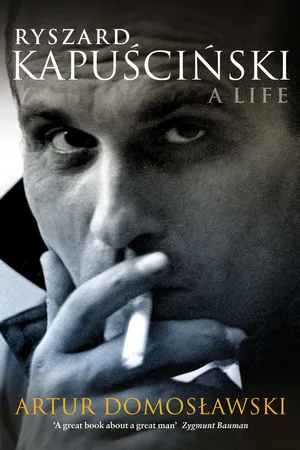
The life and work of Ryszard Kapu?ci?ski was dangerously bold and deeply enigmatic. This controversial biography opens up the secrets and contradictions of this globally renowned Polish journalist and writer.
Artur Domos?awski travels the globe, following in Kapu?ci?ski's footsteps, delving into his private conflicts and anxieties and discovering the relationships that were the catalyst for his unique style of 'literary reportage'. The result is a compelling and uncompromising portrait of a conflicted and brilliant individual.
- 256 pages
- English
- ePUB (mobile friendly)
- Available on iOS & Android
eBook - ePub
About this book
Information
1
Daguerreotypes
In one of the last photographs, Kapuściński, smiling of course, is surrounded by a group of young people. These are boys and girls from the Leonardo da Vinci Lycée and the University of Trento, on 17 October 2006 at a mountain inn not far from the city of Bolzano in Italy. One of the participants, Anna, asked if he would be willing to answer a personal question. Kapuściński coyly replied that there was nothing that hadn’t already been written about him, that no secrets remained. (Now, after an almost three-year journey through his life, I know that a great deal has been written about his work, but almost nothing about the man himself.) The girl is well prepared and quotes one of Kapuściński’s own poems to him:
Only those clad in sackcloth
are able to take upon themselves
the suffering of another
to share his pain1
Then she asks why he has devoted his life to writing about poor people. Kapuściński replies that 20 percent of the people in the world are wealthy, and the rest are poor. And that if you belong to the chosen few, you are extremely privileged. You live in a paradise beyond the reach of most people on the planet. He shares some discoveries about life: a man can be impoverished not because he is hungry or has no possessions, but because he is ignored and despised: ‘Poverty is a state of inability to express your opinion.’2 That is why he speaks in their name. Someone has to.
This Promethean manifesto is his last public statement in that vein. By this point, Kapuściński is feeling overwhelmed by pessimism and a presentiment of the approaching end. A few days later, he refuses to meet a friend for coffee. Some interesting, but unfamiliar, people were to be joining them. ‘There comes a moment in life when we can no longer take in new faces,’ he notes afterwards. To meet with strangers he would have to ‘furnish his face’, stick on the smile, but he no longer has the desire or the strength to do so.3
Here’s a picture taken a few years earlier, in Oviedo in 2003, when Kapuściński is still in good shape. He is receiving the Prince of Asturias Award for Communications and Humanities, regarded as the Nobel Prize of the Latin American world (and how proud he was of it!). He is stunned. Fulfilled and appreciated. As he thanks Prince Felipe, he finds it hard to hide his emotion. In justification of its choice, the jury wrote that he embodied the independence of the reporter; and that for half a century, at risk of life and health, he monitored wars and conflicts on several continents. Nor did the jury fail to acknowledge that he was on the side of the disadvantaged.
Kapuściński was filled with pride at receiving the award jointly with the Peruvian priest Gustavo Gutiérrez, father of liberation theology, defender of the excluded and critic of social inequality. As a thirty-something correspondent working in Latin America for the Polish Press Agency, Kapuściński had been fascinated by the rebel movement. But he never met Father Gutiérrez at the time. For a reporter from poor, socialist Poland, with limited funds, gaining access to an intellectual star such as Gutiérrez would have been difficult. More than three decades later, he stood next to his hero as joint winner of a coveted award.
And here are some photographs with great writers, including a series with the Nobel Prize–winner Gabriel García Márquez during journalism workshops in Mexico City. García Márquez invited Kapuściński, as a master of the craft, to run workshops for reporters from Latin America. I remember his being adamant that Gazeta Wyborcza use one of these photos to illustrate an interview with him about the transformations in Latin America, and that he almost withdrew the text shortly before the deadline, when it turned out that the picture wouldn’t fit on the page. (‘This interview is worthless! It should go in the bin if no one knows the reason I was in Mexico!’ he cried in boyish pique. He calmed down when I told him that alongside our conversation would be a short piece about his workshops with García Márquez and a picture of them together.)
Another photo shows him having dinner with Salman Rushdie in the 1980s, in New York or perhaps London. After reading Kapuściński’s book about the war in Angola, and fascinated by his descriptions of the wooden city floating away, Rushdie wrote that numerous reporters had seen the wooden city, but Kapuściński was the only one to have noticed it. He called him a ‘codebreaker’ of the encrypted dark century.
One photograph attracts my attention, not because of what it depicts, but because of something written later in connection with the moment immortalized in it. It shows an open air café in San Sebastian in 1996. Here is Kapuściński with the Polish philosopher Father Józef Tischner, the Polish editor-in-chief of Gazeta Wyborcza Adam Michnik and Jorge Ruiz, Warsaw correspondent for the Spanish news agency, EFE. All four were taking part in seminars at a summer university in the Basque country. After Kapuściński’s death, Michnik wrote that he had asked him that summer when he’d stopped believing in communism. Kapuściński had replied that 1956 was decisive, though he had remained permanently on the side of the poor and the disadvantaged.
This picture has no date. Nor is Kapuściński in it – he took it himself, but it says more than many of the portraits. It shows a small table, with several necessities for his next journey lying on it: books (one of the titles, surprisingly, is Africa for Beginners), notebooks, folders, several small wallets, a camera, some pills, little bottles of heart drops and Amol (a herbal tonic). I call this picture ‘life on the road’.
The pills and bottles remind me of another photograph, which I saw at the home of Kapuściński’s friends Agnieszka and Andrzej Krzysztof Wróblewski. In it, he seems thinner than in all the other photos from that era – or is that just auto-suggestion? It’s September 1964, Paris. As they walk past one of the many cafés, his friends notice a book in Polish lying on a table. Shortly after, Kapuściński appears; he has just briefly stepped away. He is there with his wife, Alicja, gathering his strength after suffering from cerebral malaria and tuberculosis in Africa. One of his rare holidays, because he doesn’t know how to relax – he gets bored, and doing nothing makes him twitchy. On their way home that night from the café, they lose their way. Kapuściński remembers a petrol station next to the campsite where they are to spend the night. Because he had no sense of direction, they wander till dawn. (‘How on earth did he manage in Africa?’ say his friends, clutching their heads.)
Only now does it occur to me that the photographs are arranged in reverse chronology, but I need to tell – and I want to understand – from what sort of place, in what way and by what road he reached the students at Bolzano, Gabriel García Márquez and Salman Rushdie, how he came to his faith and lack of faith in socialism, and a hundred other things besides.
So, before the reporter sets off on a journey, climbing rocky paths and fighting his way through hostile bush, before he comes to Africans who mistrust whites, or discovers the confused world of the conquerors and the conquered, before he investigates the mysteries of rebellions and revolutions, gets to know a hundred other places and sees a thousand mind-boggling things, there is Pińsk, a house on Błotna Street, and a wooden rocking horse on which little Rysio sits, putting on a smile, making an impatient face, or squinting because of the sunlight shining in his eyes.
2
Pińsk: The Beginning
This is one of the earliest photographs. It differs from the one on the balcony of the house on Błotna Street, but again features the rocking horse, now in the yard. Little Rysio’s hair is combed slightly to the right and he wears a warm jacket but no hat, so it must be spring or autumn. He may be three or four years old. It is the essence of childhood, nothing more.
A few later photographs have survived: showing him wrapped up as he walks along a street in winter, holding his father’s hand. A shop window in the background is inscribed ‘Józef Izaak’. In a similar photo of him with his mother, on the same street, he wears shorts; it is a sunny day in the summer of 1937, when he was five years old.
These photographs were taken in Pińsk, a city then in eastern Poland and now in Belarus. His parents, Maria and Józef, were from elsewhere. His mother, whose maiden name was Bobkowa, was the granddaughter of a baker known locally as ‘the Magyar’. (Because of a dark complexion? because he was an immigrant?) Maria came to Pińsk from Bochnia, near Kraków; Józef, the son of a local civil servant, was from the Kielce region. The government of the new Polish state, which came into existence after the First World War, wanted Poles to resettle along the eastern border, where they could disseminate Polish education, but few were keen to uproot themselves and go to a distant, culturally alien region.
Polish was the minority language in Pińsk. Two-thirds of the citizens were Jews and the rest were Belarusians, Ukrainians and Russians, plus a handful of Germans. Shortly before the outbreak of the Second World War, following the influx of settlers from the heart of Poland, almost one in four of Pińsk’s 35,000 citizens was an ethnic Pole.
Going to Pińsk (or Polesie, as the surrounding region is called) from central or southern Poland was a cross between exile and missionary work. Kapuściński used to say that his parents were told, in effect, ‘If you want jobs, go to teacher training college, and when you graduate, go to Polesie.’ And that is just what Maria and Józef did.
The two young teachers arrived in Pińsk on the eve of the Great Depression. ‘I was born the child of settlers,’ said Kapuściński. It was 1932. Just over a year later, his sister, Basia (short for Barbara), was born.
Thirty years after the war, Kapuściński goes to visit the city of his childhood for the first time. It is the mid-1970s, and Pińsk now lies within the Soviet Union.
Standing in Kościuszko Street (then, as today, Lenin Street), he immediately recognizes his surroundings. That is Gregorowicz’s restaurant, where Mama used to take him for ice cream. Over there is 3 May Square and there, Bernardyńska Street. Some images from his childhood, ‘though they are covered up by other ones, still exist’. Later he will say, ‘I feel that if I don’t write about it, the world of pre-war Pińsk will cease to exist, because it probably remains only in my head.’1
Does the seven-year-old boy from the remote province dream of the journeys inspired by Pińsk’s location or by the landscape beyond the window? Does the sight of the Riverine Flotilla of the Polish Navy stationed there stir his imagination? Knowing who the boy would become, one would like to conjure up a story of this kind.
‘Polesie was truly exotic,’ he told an interviewer. ‘Lots of rivers and canals, great floodplains. If you boarded a boat, you could sail the seas without disembarking. Pińsk was connected by water to all the oceans.’2 How do you sail to the oceans from Pińsk? Along rivers to the Baltic Sea, then via the Baltic Sea to the Atlantic; or along the River Dnieper to the Black Sea, and from there via the Bosporus, the Mediterranean and the Suez Canal to the Indian Ocean . . .
The folk beliefs of Polesie say more about the world Kapuściński came from than all the historical stories about dukes, wars and sacred relics. Country people tell stories about the suicide, whose soul wanders the local woods, still wearing his body:
People regard a dead man remaining on earth and wandering as a punishment imposed on his soul by the Lord God. This soul cannot get into heaven. According to folk belief, there is always a penitent soul of this kind inside a whirlwind, and if one were to throw a knife at it, blood would be shed. But naturally it is hard to hit!3
This is like an Eastern European version of Macondo, the mythical land invented by Gabriel García Márquez in One Hundred Years of Solitude. In Macondo people fly around the village on carpets, or rise and hover in the air after drinking a cup of chocolate; they also have epidemic outbreaks of insomnia and memory loss.
Kapuściński sees associations with Africa. Among his handwritten notes I find a comparison, titled Polesie found in Africa, of the land of his childhood years with the continent he described as a reporter. Apart from poverty, hunger and disease, he lists belief in a spirit world, a cult of ancestors, and consciousness of tribal identity. Also, like Africa, Polesie is ‘colonized terrain’. There is, moreover, a handful of tangible similarities: no electricity, no surfaced roads, no shoes.
In other words, a description of t...
Table of contents
- Cover
- Title
- Copyright
- Epigraph
- Contents
- INTRODUCTION
- 1 Daguerreotypes
- 2 Pińsk: The Beginning
- 3 War
- 4 Legends 1: His Father and Katyń
- 5 Inspired by Poetry, Storming Heaven
- 6 Lapidarium 1: The Poet
- 7 On the Construction Site of Socialism
- 8 Lapidarium 2: Lance Corporal Kapuściński
- 9 On the Construction Site of Socialism, Continued
- 10 Alicja, Maminek, Zojka
- 11 Alicja, Maminek, Zojka
- 12 The Third World: A Clash and a Beginning
- 13 In ‘Rakowski’s Gang’
- 14 Legends 2: Sentenced to Death by Firing Squad
- 15 In ‘Rakowski’s Gang’, Continued
- 16 Life in Africa
- 17 Objects of Fascination: The African Icons
- 18 Life in Africa, Continued
- 19 In the Corridors of Power
- 20 Lapidarium 3: The Reporter as Politician
- 21 On the Trail of Che Guevara
- 22 Legends 3: Che, Lumumba, Allende
- 23 On the Trail of Che Guevara, Continued
- 24 Objects of Fascination: The Latin American Icons
- 25 On the Trail of Che Guevara, Continued Further
- 26 Zojka’s Escapes
- 27 A Committed Reporter, a Black-and-White World
- 28 Christ with a Rifle in a Czech Comedy at the Emperor’s Court
- 29 On Love and Other Demons
- 30 The Final Revolution, the Final Coup
- 31 Worth More Than a Thousand Grizzled Journofantasists
- 32 Lapidarium 4: Why Did Kapuściński Have No Critics in Poland?
- 33 The Reporter Amends Reality, Or, Critics of All Nations, Unite!
- 34 Legends 4: Kapuściński and Kapuściński
- 35 Our Friend Rysiek
- 36 Where to from Socialism?
- 37 Lapidarium 5: Was Kapuściński a Thinker?
- 38 Where to from Socialism? Continued
- 39 The File
- 40 Legends 5: The Price of Greatness
- 41 Maestro Kapu
- 42 Unwritten Books
- 43 No Strength to Furnish the Face
- Notes
- Index
Trusted by 375,005 students
Access to over 1.5 million titles for a fair monthly price.
Study more efficiently using our study tools.
Frequently asked questions
Yes, you can cancel anytime from the Subscription tab in your account settings on the Perlego website. Your subscription will stay active until the end of your current billing period. Learn how to cancel your subscription
No, books cannot be downloaded as external files, such as PDFs, for use outside of Perlego. However, you can download books within the Perlego app for offline reading on mobile or tablet. Learn how to download books offline
Perlego offers two plans: Essential and Complete
- Essential is ideal for learners and professionals who enjoy exploring a wide range of subjects. Access the Essential Library with 800,000+ trusted titles and best-sellers across business, personal growth, and the humanities. Includes unlimited reading time and Standard Read Aloud voice.
- Complete: Perfect for advanced learners and researchers needing full, unrestricted access. Unlock 1.5M+ books across hundreds of subjects, including academic and specialized titles. The Complete Plan also includes advanced features like Premium Read Aloud and Research Assistant.
We are an online textbook subscription service, where you can get access to an entire online library for less than the price of a single book per month. With over 1.5 million books across 990+ topics, we’ve got you covered! Learn about our mission
Look out for the read-aloud symbol on your next book to see if you can listen to it. The read-aloud tool reads text aloud for you, highlighting the text as it is being read. You can pause it, speed it up and slow it down. Learn more about Read Aloud
Yes! You can use the Perlego app on both iOS and Android devices to read anytime, anywhere — even offline. Perfect for commutes or when you’re on the go.
Please note we cannot support devices running on iOS 13 and Android 7 or earlier. Learn more about using the app
Please note we cannot support devices running on iOS 13 and Android 7 or earlier. Learn more about using the app
Yes, you can access Ryszard Kapuscinski by Artur Domoslawski, Antonia Lloyd-Jones in PDF and/or ePUB format, as well as other popular books in Media & Performing Arts & Literary Biographies. We have over 1.5 million books available in our catalogue for you to explore.