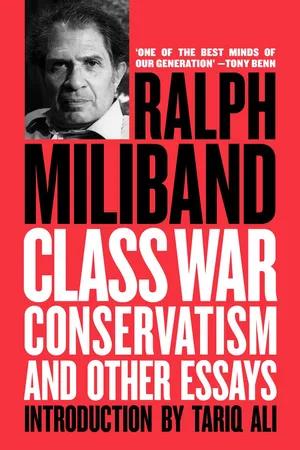
When, in 2013, the Daily Mail labeled Ralph Miliband "The Man Who Hated Britain," a diverse host rallied to his defense. Those who had worked with him - from both left and right - praised his work and character. He was lauded as "one of the best-known academic Marxists of his generation" and a leading figure of the New Left.
Class War Conservatism collects together his most significant political essays and shows the scope and brilliance of his thinking. Ranging from the critical anatomy of capitalism to a clear-eyed analysis of the future of socialism in Britain, this selection shows Miliband as an independent and prescient thinker of great insight. Throughout, his writing is a passionate and forcefully argued demand for social justice and a better future.
- 384 pages
- English
- ePUB (mobile friendly)
- Available on iOS & Android
eBook - ePub
About this book
Information
II
Marxism
and the Problem of Power
7
Political Action, Determinism
and Contingency*
1979
I
The main concern of this essay is with various questions that arise in relation to ‘the role of the individual in history’ and the degree to which individuals, singly or in small groups, can significantly affect the historical process.* The subject is obviously crucial for any theory of history and politics. But it is particularly important for Marxism. This is so for at least two related reasons: first, because Marxism has always and pre-eminently been concerned with the forces that determine the historical process: and second, because that question has a direct bearing on political strategy and practice.
Yet, Marxist historical and other work has not paid much attention to ‘the role of the individual in history’. Plekhanov’s pamphlet bearing this title was published in 1898; and when Marxists have considered the question at all since then, they have tended to rely on a few key concepts and formulations to declare it resolved. On closer examination, however, these concepts and formulations appear to be very inadequate.
In one sense, it is very odd that more should not have been done to meet the challenge which the subject presents to Marxist theory, given the various cults of ‘great men’ which have been such a pronounced (and awful) feature of ‘Marxism-Leninism’—the cult of Lenin after his death, of Stalin, of Mao, and so on. The clear message has been that there were indeed ‘makers of history’: but there would seem to have been very little attempt to draw out the theoretical implications of the message. Instead, resort has been had to banalities about the indissoluble links which were forged between the ‘great man’, his party, and the people at large and which made possible the achievement, under his inspired leadership, of revolution, the building of socialism, or whatever. But this belongs to the realm of edification, not theory. The problems remain.
I speak of ‘the degree’ to which individuals, singly or in small groups, can significantly affect the historical process and intend thereby to exclude from the start two positions that I take to be untenable.
One of these positions is that the whole of human life, past, present and to come, is determined by a force or forces that are not susceptible to modification by human intervention, and of which human actions are only the expression or manifestation. In its extreme forms, this position belongs to a particular form of religious perspective on history, according to which every event and action from the smallest to the largest is a manifestation of the divine will and is altogether predetermined and preordained by that will. Thus, anything that has happened had to happen; nothing else, by definition, could. And what was true of the past will, of course, be true of the future. This is not a view that can be argued with: it can only be accepted or rejected. I reject it, and pass on.
At what might appear to be the opposite extreme, there is a view of history, politics, and life in general, which sees them as altogether contingent, unpatterned, accidental, ‘a tale’, as Macbeth said when retribution and death were imminent, ‘told by an idiot, full of sound and fury, signifying nothing’. In the strong version of this position, there is no historical determination of any kind, only a succession of specific events, produced by a combination of chance and will, whose outcome is altogether uncertain. Accident rules.
In this strong version the accidental view of history, far from escaping determinism, is but another version of it, namely accidental determinism. But what makes it untenable and absurd is its clear implication that anything goes, anywhere, at any time. It is impossible to take this seriously, simply because there is always some degree of determination in history, if only in terms of time and place; the French Revolution, whatever view is taken of its ‘causes’, could not have occurred in the sixteenth century, or in China.
It is in fact a weak version of the role of ‘accident’ in history that is usually defended. Thus, J.B. Bury, in an essay entitled ‘Cleopatra’s Nose’, once wrote that ‘the course of history seems … to be marked at every stage by contingencies, some of greater, some of smaller import. In some cases, they produce a situation to which the antecedent situation does not logically lead. In others they determine the form and means of the realization of a logical tendency’.1
Whether it is taken to be right or wrong, this is not an absurd view; and it can be situated in a spectrum of historical theories distinguished from each other, in respect of the question of determination and contingency, by the different emphasis they place upon one or the other; and also by the factors to which they attribute greater or lesser importance, or which they deem to be determinant. Great differences between these theories do of course exist, but not on the basis of total pre-determination as against total indeterminacy. In all plausible theories of history, there is allowed some degree to which individual intervention can affect the historical process—that indeed may be taken as one of the essential criteria of plausibility. The question is how much.
In classical Marxism the answer is unquestionably: not much. The classical Marxist position is expressed in a number of well-known formulations. One is to be found in The Eighteenth Brumaire of Louis Bonaparte:
‘Men make their own history but not of their own free will; not under circumstances they themselves have chosen but under the given and inherited circumstances with which they are directly confronted. The tradition of the dead generations weighs like a nightmare on the minds of the living….2
Another equally, if not even more, familiar formulation occurs in the Contribution to the Critique of Political Economy, where Marx states that
‘in the social production which men carry on they enter into definite relations that are indispensable and independent of their will; these relations of production correspond to a definite stage of development of their material powers of production. The totality of these relations of production constitutes the economic structure of society—the real foundation on which legal and political superstructures arise and to which definite forms of social consciousness correspond. The mode of production of material life determines the general character of the social, political and spiritual processes of life. It is not the consciousness of men that determines their being, but, on the contrary, their social being determines their consciousness.’3
The basic premise which informs historical materialism is not in doubt: it is that men and women, organized in classes, are the collective actors of history, but that the play itself is very largely shaped by forces which are not greatly affected by any single will or by the will of small groups of people. History is the history of class struggles, Marx and Engels said in The Communist Manifesto, and many elements—economic, social, political, cultural, historical, and so forth—contribute to the shaping of the form and content of these struggles. Individuals, singly and in groups, can certainly make a difference at a particular moment to the ways in which class struggles work themselves out: but that difference, in classical Marxism, is not very great and certainly should not be taken as being decisive. Marxism is a determinism, though not an economic determinism; and it is a determinism in which individual will and activity, though not to be ignored or dismissed, are only allowed a relatively small part. This is grounded in Marx and Engels’s understanding of historical materialism; it also results from their rejection of a certain kind of romantic adventurism, pseudo-revolutionary ‘elitism’, and sectarian voluntarism, according to which anything is possible at any time, provided a group, sect or brotherhood of sufficiently determined and dedicated individuals wills it. Throughout their political life, and with remarkable consistency, Marx and Engels fought against any such view and against those whom Marx contemptuously called the ‘alchemists of revolution’, for whom ‘the only condition for a revolution is the proper organization of their conspiracy’.4
II
In the 1869 Preface to The Eighteenth Brumaire of Louis Bonaparte, Marx noted that he had shown in that work how ‘the class struggle in France created circumstances and conditions which allowed a mediocre and grotesque individual to play the hero’s rule’.5 On this view, individuals, great or ordinary, mediocre or brilliant, can play a ‘hero’s role’, provided that class struggle creates the appropriate circumstances and conditions for it.
This may be entirely reasonable, although I will want to come back to this point later. But the circumstances and conditions, whatever they are deemed to be, which enable the individual to play such a role do not thereby determine specifically what that role will be. The ‘hero’ could not perform any role without the circumstances and conditions; but what precise role he performs, and with what effect, is not predetermined and settled by the circumstances and conditions in which he acts. At the most, the part of the ‘hero’ is roughly sketched out, but much that is important about it remains to be filled in. It is clearly not tenable to argue that circumstances and conditions determine in advance every action taken by the ‘hero’ or their results. To argue this would be to revert to a totally predeterminist ‘model’, which I have excluded from the start. On the contrary, there is room here for what are rather loosely termed ‘accidents’.
Marx’s answer to this objection is to be found in a remark he made in a letter to Kugelmann in April 1871, in the midst of the Paris Commune:
‘World history,’ he wrote, ‘would indeed be very easy to make, if the struggle were taken up only on conditions of infallibly favourable chances. It would, on the other hand, be of a very mystical nature, if “accidents” played no part. These accidents naturally form part of the general course of development and are compensated for by other accidents. But acceleration and delay are very much dependent upon such “accidents”, including the “accident” of the character of the people who first head the movement.’6
Engels put the same point somewhat differently when he suggested, more than twenty years later, that
‘the further the particular sphere which we are investigating is removed from the economic sphere and approaches that of pure abstract ideology, the more shall we find it exhibiting accidents in its development, the more will its curve run zigzag. But if you plot the average axis of the curve, you will find that this axis will run more and more nearly parallel to the axis of economic development the longer the period considered and the wider the field dealt with’.7
These and other such formulations, some of which will be referred to later, are for various reasons unsatisfactory. But before discussing why this is so, reference must be made to Plekhanov’s pamphlet on The Role of the Individual in History, to which I alluded earlier, and which makes an interesting addition to the interpretation of ‘accidents’ (in the form of individual intervention) put forward by Marx and Engels.
Like Marx, Plekhanov sought to dispose of the question of ‘the individual in history’ by suggesting that it is ‘circumstances’ which ‘produce’ the required individual, the ‘great man’, or which turn the mediocrity into the great man. But he then went on to explain why the great man appears unique and providential: this is because of what he called an ‘optical illusion’. Plekhanov writes:
‘In discussing the role great men play in history we nearly always fall victims to a sort of optical illusion … in coming out in the role of the “good sword” to save public order, Napoleon prevented all the other generals from playing this role; and some of them might have performed it in the same way or almost the same way as he did. Once the public need for an energetic ruler was satisfied, the social organization barred the road to the position of military ruler for all the other talented soldiers. Its power became a hindrance to the appearance of other talents of a similar kind. This is the cause of the optical illusion.’8
In essence, then, these are the main propositions which Marxist theory has brought to bear on the subject under discussion; and these propositions may be discussed in terms of three distinct problems (or objections) which they raise.
The first of these has to do with the proposition that, where circumstances so demand, they will produce the required individual and that great men are ‘invented’ when they are needed. Second, it is claimed that, whoever fills the available space, the results will be more or less the same. Third, there is the view that what such intervention does is to ‘accelerate’ or ‘delay’ what Marx called the ‘general course of development’, which is in any case proceeding; and moreover, ‘accidents’ of one kind are ‘compensated’ for by ‘accidents’ of another kind.
The first of these propositions is exceedingly vulnerable. In the letter to Starkenburg already quoted, Engels had also written as follows:
‘That such and such a man and precisely that man arises at a particular time in a particular country is, of course, pure chance. But cut him out and there will be a demand for a substitute, and this substitute will be found, good or bad, but in the long run he will be found. That Napoleon, just that particular Corsican, should have been the military dictator whom the French Republic, exhausted by its own warfare, had rendered necessary, was chance; but that, if a Napoleon had been lacking, another would have filled the place, is proved by the fact that the man was always found as soon as he became necessary: Caesar, Augustus, Cromwell, etc.’9
The argument, as Sidney Hook points out, is obviously circular: ‘Engels tells us that a great man is a necessary response to a social need for him. But how do we know that there is a social need for him? Surely not after the event! That would be viciously circular.’10
In any case, the notion of necessity is here much too loose and allows for every kind of self-confirming, post hoc ergo propter hoc sort of argument: where a ‘great man’ was needed, he appeared or was ‘invented’; where he did not appear or was not ‘invented’, there was no necessity for him. This is not only self-confirming but historically arbitrary and restrictive. For there have been periods in history when dominant classes very badly needed a ‘great man’ to help them meet a revolutionary challenge or a major crisis, but where the need was not met: for instance the ancien regime on the eve of 1789 or the tsarist regime in and after February 1917. That no such individual or group of individuals was able to display qualities of ‘greatness’ at the time can be very adequately explained in terms of a cluster of economic, social, political and ideological conditions that made such a display very difficult.11 But this is also to say that ‘necessity’ is not enough, and that there are circumstances where there is a very great ‘necessity’ for the kind of hero Engels had in mind, yet with no real possibility of that necessity being met. The question is not that there was no one to save the ancien regime or tsarism, but that there was no possibility for anyone to provide adequate leadership to the forces wanting to save these regimes. It may be assumed that there were many people who, in terms of personal qualities, could have provided that leadership, but that the conditions did not allow them to do so. At any rate, it is not permissible to argue that the ‘necessity’ for such people was absent.
Nor can it be said that the inability to meet this need is only characteristic of dominant classes in decline and disarray: it clearly applies also to subordinate classes in general and to working-class movements over the course of time. Indeed, it has been a constant theme of much Marxist history of working-class movements in different countries that working-class challenges to the established order were defeated on many occasions because of the absence of the necessary leadership. Here too, the issue is not so much one of absence of leadership as of the inability of would-be revolutionary leaders to intervene effectively. An obvious instance is that of Germany in 1918. At a point of extreme ‘necessity’, the German working class did not follow the revolutionary leadership that was available; and it is sufficient to evoke the name of Rosa Luxemburg to suggest that it was available. Conditions, stretching back over many years, did not allow such people to provide the leadership of which they were capable; or, to put the same point somewhat differently, a complex of conditions led the German working class to reject their leadership. This fact, too, can be explained within the framework of historical materialism. But there is no question of the ‘necessity’, at least in a revolutionary perspective, of a leadership which circumst...
Table of contents
- Cover Page
- Halftitle Page
- Title Page
- Copyright Page
- Contents
- Introduction: A Political-Biographical Sketch
- Preface
- I. The Capitalist State
- II. Marxism and the Problem of Power
- III. Britain
- IV. After 1989
- Index
Trusted by 375,005 students
Access to over 1.5 million titles for a fair monthly price.
Study more efficiently using our study tools.
Frequently asked questions
Yes, you can cancel anytime from the Subscription tab in your account settings on the Perlego website. Your subscription will stay active until the end of your current billing period. Learn how to cancel your subscription
No, books cannot be downloaded as external files, such as PDFs, for use outside of Perlego. However, you can download books within the Perlego app for offline reading on mobile or tablet. Learn how to download books offline
Perlego offers two plans: Essential and Complete
- Essential is ideal for learners and professionals who enjoy exploring a wide range of subjects. Access the Essential Library with 800,000+ trusted titles and best-sellers across business, personal growth, and the humanities. Includes unlimited reading time and Standard Read Aloud voice.
- Complete: Perfect for advanced learners and researchers needing full, unrestricted access. Unlock 1.5M+ books across hundreds of subjects, including academic and specialized titles. The Complete Plan also includes advanced features like Premium Read Aloud and Research Assistant.
We are an online textbook subscription service, where you can get access to an entire online library for less than the price of a single book per month. With over 1.5 million books across 990+ topics, we’ve got you covered! Learn about our mission
Look out for the read-aloud symbol on your next book to see if you can listen to it. The read-aloud tool reads text aloud for you, highlighting the text as it is being read. You can pause it, speed it up and slow it down. Learn more about Read Aloud
Yes! You can use the Perlego app on both iOS and Android devices to read anytime, anywhere — even offline. Perfect for commutes or when you’re on the go.
Please note we cannot support devices running on iOS 13 and Android 7 or earlier. Learn more about using the app
Please note we cannot support devices running on iOS 13 and Android 7 or earlier. Learn more about using the app
Yes, you can access Class War Conservatism by Ralph Miliband in PDF and/or ePUB format, as well as other popular books in Politics & International Relations & Communism, Post-Communism & Socialism. We have over 1.5 million books available in our catalogue for you to explore.