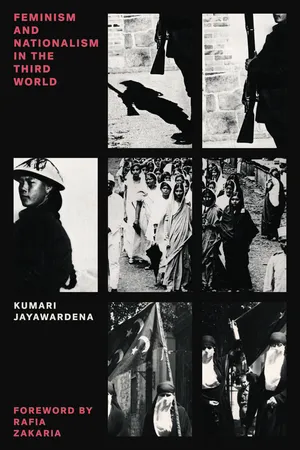
For twenty-five years, Feminism and Nationalism in the Third World has been an essential primer on the late nineteenth- and early twentieth-century history of women's movements in Asia and the Middle East. In this engaging and well-researched survey, Kumari Jayawardena presents feminism as it originated in the Third World, erupting from the specific struggles of women fighting against colonial power, for education or the vote, for safety, and against poverty and inequality.
Journalist and human rights activist Rafia Zakaria's foreword to this new edition is an impassioned letter in two parts: the first to Western feminists; the second to feminists in the Global South, entreating them to use this "compendium of female courage" as a bridge between women of different nations.
Feminism and Nationalism in the Third World was chosen as one of the top twenty Feminist Classics of this Wave, 1970-1990, by Ms. magazine, and won the Feminist Fortnight Award in the UK.
- 304 pages
- English
- ePUB (mobile friendly)
- Available on iOS & Android
eBook - ePub
Feminism and Nationalism in the Third World
About this book
Information
1.Introduction
I see here the representatives of only half the population of Egypt. May I ask where is the other half? Sons of Egypt, where are the daughters of Egypt? Where are your mothers and sisters, your wives and daughters?Bhikaiji Cama of India, at a meeting of the Egyptian National Congress at Brussels in 1910. (Kaur 1985: 102)
This study deals with the rise of early feminism and movements for women’s participation in political struggles in selected countries of the ‘East’ in the late 19th and early 20th centuries. The developments in the countries chosen—Egypt, Iran, Turkey, India, Sri Lanka, China, Japan, Korea, the Philippines, Vietnam and Indonesia—show certain parallels and similarities of experience as well as some clear differences of strategy based on their specific historical backgrounds, and provide interesting material for comparative study.
The countries dealt with have one factor in common: they have either been directly subjected to aggression and domination by imperialist powers interested in establishing themselves in the region, or indirectly manipulated into serving the interests of imperialism. While India, Sri Lanka, Indonesia, Vietnam and the Philippines became part of colonial empires, Egypt and Iran were reduced to semi-colonial status, the Turkish Empire was progressively dismembered, Japan was put under pressure from Western countries to open up the country to trade, and China became prey to the encroachments of foreign trading powers who wanted to exploit Chinese resources. Although all these countries fall into what, for the sake of convenience, has been termed ‘the East’, they also present certain specificities linked to their cultural and ideological backgrounds. Egypt, Turkey and Iran have an Islamic history that has shaped their attitudes and responses. India and Sri Lanka inherited civilizations based on Hindu and Buddhist doctrines and show similarities with, and differences from, one another. Further East, China, Japan and Korea have certain common characteristics that are partly due to their Confucian ideology. In between, such countries as Vietnam, the Philippines and Indonesia have felt at various times the pressures of the two dominant ancient civilizations of Asia: the Indian and the Chinese. In responding to the pervasive presence of imperialism, their attitudes showed the different influences of their ideological heritages—ideologies which had an impact on the position and role of women as well as on the modes and characteristics of women’s movements, as the detailed country studies in this book reveal.
The words ‘feminism’ and ‘feminist’ have become emotive words that often evoke hostile reactions. Feminism is generally thought of as a recent phenomenon, rooted in Western society, and people tend to overlook the fact that the word was in common usage in Europe and elsewhere in the 19th and early 20th centuries, to signify agitation on issues concerning women. The meaning of the word has now been expanded to mean an awareness of women’s oppression and exploitation within the family, at work and in society, and conscious action by women (and men) to change this situation. Feminism, in this definition, goes beyond movements for equality and emancipation which agitate for equal rights and legal reforms to redress the prevailing discrimination against women. While such movements often advance the struggle for equality, they do not tackle such basic issues as women’s subordination within the family or challenge the existing framework of men-women relations in which the subordination of women is located. In this study the word ‘feminism’ is used in its larger sense, embracing movements for equality within the current system and significant struggles that have attempted to change the system.
The concept of feminism has also been the cause of much confusion in Third World countries. It has variously been alleged by traditionalists, political conservatives and even certain leftists, that feminism is a product of ‘decadent’ Western capitalism; that it is based on a foreign culture of no relevance to women in the Third World; that it is the ideology of women of the local bourgeoisie; and that it alienates or diverts women, from their culture, religion and family responsibilities on the one hand, and from the revolutionary struggles for national liberation and socialism on the other. In the West, too, there is a Eurocentric view that the movement for women’s liberation is not indigenous to Asia or Africa, but has been a purely West European and North American phenomenon, and that where movements for women’s emancipation or feminist struggles have arisen in the Third World, they have been merely imitative of Western models.
As a result of this, I have thought it necessary to take up some of these issues and to show that feminism was not imposed on the Third World by the West, but rather that historical circumstances produced important material and ideological changes that affected women, even though the impact of imperialism and Western thought was admittedly among the significant elements in these historical circumstances. Debates on women’s rights and education were held in 18th-century China and there were movements for women’s social emancipation in early 19th-century India; the other country studies show that feminist struggles originated between 60 and 80 years ago in many countries of Asia. In a way, the fact that such movements for emancipation and feminism flourished in several non-European countries during this period has been ‘hidden from history’. Only recently, with the rise of feminist movements all over the world, has attention been directed to early feminists and feminism in the Third World.
The movement towards women’s emancipation described and analysed in this book was acted out against a background of nationalist struggles aimed at achieving political independence, asserting a national identity, and modernizing society. During the period dealt with in this study, the countries under consideration were trying to shake off imperialist domination. All had faced the reality of foreign conquest, occupation or aggression. They had resisted in diverse ways, but their resistance had three common facets: first, the desire to carry out internal reforms in order to modernize their societies, it being felt that this was necessary if they were successfully to combat imperialism; second, the dismantling of those pre-capitalist structures, especially ruling dynasties and religious orthodoxies, that stood in the way of needed internal reforms; and third, the assertion of a national identity on the basis of which people could be mobilized against imperialism. These forces can be seen to be at work in all the countries studied.
The external and internal forces were thus closely interlinked. The forcible domination or opening-up of the countries to capitalist penetration had created unequal trading relations and promoted the expansion of a local class of merchants, commission agents and collaborators of foreign capitalists. In all the countries under consideration, some sections of the capitalists, primarily those who went into industry and whose products had to face foreign competition, conflicted with imperialism; their dissatisfactions were shared by intellectuals and professionals who had studied abroad or were products of the modern schools and colleges that had been started in the 19th century. This local bourgeoisie and petty bourgeoisie faced the continuing fact of foreign occupation and economic domination. In some countries, they attempted to throw out the occupiers and to develop on a basis of autonomy; in others, they tried to negotiate more advantageous positions for themselves. In all cases, however, they felt the need to sweep away crumbling ruling groups and monarchies which tended to submit to imperialism (the Qajars in Iran, Manchus in China, the sultanate in Turkey and the Shogun in Japan); this was considered a necessary step towards the modernizing, reforming and strengthening of internal structures which were essential if an effective opposition to imperialism were to be mounted.
This resistance, which used the paradoxical strategy of adopting Western models in order to combat Western aggression, reinforce cultural identity and strengthen the nation, took various forms. Japan, for example, industrialized rapidly, becoming a powerful country within the framework of a highly authoritarian imperial system and a traditional hierarchy. China, in contrast, swept away the feudal monarchy and challenged Confucian attempts in order to modernize the country, resist imperialism, and build up democratic forces. India, while purifying internal structures of the worst excesses, concentrated on the political struggle and achieved a political, but not a social revolution, and in Sri Lanka the emerging bourgeoisie successfully negotiated a transfer of political power which left the existing social structure unchanged. Turkey and Iran associated ‘civilization’ with capitalist development and Europeanization, programmes that were carried out by dictatorial regimes which imposed the necessary reforms on the people. Egyptian reformism and nationalism developed within the framework of the prevailing class structures and the monarchical system.
As nationalism grew, the struggle of the local bourgeoisie in most of these countries developed on two fronts simultaneously: internally against the pre-capitalist structures, and externally against imperialism. In this agitation, which took on a bourgeois democratic form, the bourgeoisie had to assert the national cultural identity in the form of patriotic appeals intended to unite and arouse the consciousness of the people, while also promoting reforms aimed at educational, scientific, technological and industrial advancement. The liberal slogans of democratic rights, including representative government, universal suffrage, the rights of man and the rights of nations, which were used in the struggle, thus had a material base in the striving of the local bourgeoisie to gain political and economic power.
The creation and assertion of a cultural identity was itself dialectically related to the growth of imperialism. One of the by-products of imperial aggression was a mutual interaction between the cultures of Europe and of the non-European world. Eighteenth-century Europe experienced a new wave of interest in the ‘Orient’, which led to voyages of further discovery and colonial conquest, and to an interest in Eastern cultures and social structures. The Orientalists, as the new scholars became known, were particularly active in India after Britain gained its initial foothold in the 1750s and the colonial scholar-officials began to ‘discover the East’, as well as in France, where Napoleon’s 1798 expedition to Egypt was accompanied by a shipload of French scholars who set about studying all aspects of Egyptian society. Similar studies undertaken in other Asian countries helped to uncover much of their history through archaeological and historical research; in the course of time they also led to the creation of a concept that became an instrument of cultural domination—a concept of non-European cultures seen through the prism of European cultural and intellectual development. This is the construct that Edward Said has called ‘Orientalism’:
The Orient is an integral part of European material civilisation and culture. Orientalism expresses and represents that part culturally and even ideologically as a mode of discourse with supporting institutions, vocabulary, scholarship, imagery, doctrines, even colonial bureaucracies and colonial styles … a Western style for dominating, restructuring and having authority over the Orient. (Said 1979: 2–3)
The interaction between cultures proved to be a two-way process, however. The beliefs that the older cultures of the East were the ‘source of civilization’, that the quest for origins lay in the East and that European languages were linked to Sanskrit, were to have a profound influence on Western political thinking in the 19th century. Similarly, in those countries of Asia and Africa which had been exposed to ‘Occidentalism’, the attempts to emulate Western economic development were associated with an appreciation of Western cultural values and specially of such concepts as natural rights, liberalism and parliamentary democracy, which were perceived as the foundations for such growth.
Within this framework, those nationalists who challenged foreign aggression had to tackle the problem of asserting a national identity by combating obscurantism, and by reforming and rationalizing existing structures and religious and cultural traditions. In short, they had to challenge and change the old order, sometimes radically, while reviving what were defined as the true and pristine traditions of a distant and independent past. In doing so, they were influenced by European Orientalists who had glorified Asian civilizations and cultural traditions, as well as by Western political thought. In particular, they were inspired by the slogans of liberty, equality and fraternity and the anti-religious views of French revolutionary thinkers of the 18th century.
In addition, the 19th-century flowering of liberalism, especially associated with the ideas of Jeremy Bentham and John Stuart Mill in Britain, and the socialist challenge of the French Utopians and later of the Marxists, were to strongly influence sections of Asian intellectuals. One must also stress the influence in Asia of Darwinism, the freethinkers, theosophy, and all the anti-Christian, anti-clerical movements of the 19th century, including the bitter political struggles between state and church, the separation of religion and politics, and the secularization of society which occurred in many European countries. In a colonial or semi-colonial context, resistance to Christianity and to missionary activities had anti-imperialist implications, and the challenge to Christianity in Europe gave an impetus to national movements of cultural revival that already existed (as in India and Sri Lanka). Similarly, European rationalism, Freemasonry, secularism and positivism were also to influence those liberal and socialist groups in Asia and Africa who were less concerned with religious revival than with social change.
Religious revival and opposition to tradition generally took the same form in most Asian countries, linking together the reinterpretation of sacred texts and the reform of clerical structures; this led, in some cases, to the reduction of clerical influence. In the Middle East, Islam as it existed was seen as an obstacle to nationalist political and economic development; much was written not only about the need to return to the ‘pure’ Islam of an earlier period, but also about the idea that Islam, if reinterpreted correctly, was a rational religion compatible with social advance. Similar movements were at work with regard to other religions in Asia. In India, there was an attempt to reinterpret Hinduism on the basis of the concept of one God and the unity of all humans; repugnant social practices such as caste and sati were seen as the result of accretions or misinterpretations. In Sri Lanka, reformers went back to the texts of Buddhism and reinterpreted them as being indicative of a rational system of ethics, totally compatible with modern scientific knowledge.
In many Asian countries, clerical authority was seen as retrograde and supportive of corrupt feudal regimes and, therefore, as conducive neither to the growth of nationalism nor to necessary superstructural reforms of the social system, such as measures to emancipate women. Efforts to reduce the power of clerical authorities were perhaps most marked in those countries with well-established hierarchies as in Islam. The drive towards a secular state was seen particularly in the ‘Young Turks’ movement of the early 20th century, which in turn influenced policies in the neighbouring Muslim countries. The anti-Brahmin content of religious and political reformism in India shows another facet of this same tendency.
We thus have a situation where Western secular thought is a crucial factor in fashioning a consciousness and in devising structures that would make possible an escape from the domination of Western political power. The traditional political and religious élites were well aware of the dangers of this emerging consciousness and tried to meet the challenge in various ways: total isolationism in some countries, a return to fundamentalism in others. But in almost all the countries under study, the new body of ideas was seized on by the bourgeoisie and used as an instrument in their attempt to forge a new national consciousness and modern secular political structures. It must be noted, however, that the early fervour with which such ideals were pursued has now somewhat diminished; the old precapitalist dogmas and religions have proved to be surprisingly enduring.
Another important factor in the formation of this consciousness was education. In almost all the countries under consideration, education had been closely linked with religion and generally confined to the religious and upper strata of society. Mass education was a concept of the bourgeois world, brought into these countries by the colonizing powers. Even though in most cases education began as a process of proselytization, and for the training of local administrative cadres, it paved the way for the spread of literacy among the masses. Ultimately this education also became the means of imparting a knowledge of modern science. The spread of literacy in turn formed the foundation on which newspapers and journals could be established. The specific ways in which women’s consciousness was fashioned by education will be made clear in the following case studies.
The spread of literacy and of newspapers had another far-reaching effect. Political events in one country can have a rapid effect on nationalists and revolutionaries in another. An important turning-point in Asian nationalism, for example, was Japan’s victory in 1905 over Tsarist Russia in the Manchurian war. Asians had admired Japan for the success of her rapid modernization and industrialization policies, and many students and political exiles had been attracted from neighbouring countries (especially China, Korea and Vietnam). Japan’s military victory showed that Asians were able decisively to challenge and defeat Europeans in armed warfare. Sun Yat-Sen claimed that the Japanese victory gave ‘unlimited hope’ and ‘raised the standing of all Asians’ (Spector 1962: 30), and Nehru declared that Japan was ‘the representative of Asia battling Western aggression. If Japan could make good against one of the powerful European countries, why not India?’ (Nehru 1949: 440–4). The Russian revolution of 1905 also gave Asian democrats and revolutionaries the conviction that absolute governments, however firmly entrenched, could be toppled:
The Russo-Japanese war underlined the possibility of the overthrow of Western imperialism. The Russian Revolution of 1905 indicated the feasibility of the overthrow of autocracy, native or foreign. In most Asian countries, where the two objectives were fused, Russia’s defeat and Russia’s revolution together produced a resounding and durable impact. (Spector 1962: 30)
Other striking events which evoked a strong response among Third World nationalists included the struggles of the Irish against British domination, especially the martyrdom of the freedom fighters and hunger strikers. Many Asians and Africans who were in Europe in the early 20th century made a point of visiting Ireland; Nehru did so in 1907, and the visit strengthened his ‘extremist sympathies’ (Gopal 1975: 22). Moreover, the political changes that occurred in some countries of Asia and Africa caused hope to grow in other areas where the struggles continued. The deposition of the Manchu dynasty and the proclamation of the Chinese Republic by Sun Yat-Sen in 1912 had a tremendous impact on nationalists in other countries. Similarly, the Young Turks’ revolution of 1908 and Mustapha Kemal’s declaration of the republic in 1922 were dramatic events which influenced other struggles, while news of nationalist upsurges in India, Egypt, Iran, Vietnam and many other countries, which were constantly highlighted in the newspapers, served to provide mutual encouragement. Perhaps the most influential event was the Russian Revolution of 1917 which caused reverberations throughout the non-European world, and in the colonized countries aroused hopes of major change. At the time, a Sri Lankan radical journal expressed the enthusiasm of young Asian nationalists and revolutionaries: ‘Czardom that for ages manacled human liberty has vanished from unhappy Russia with the heralding of the dawn of a better day’ (Jayawardena 1972: 227). Influenced by the events in Russia, Communist parties which had arisen in Asia by the early 1920s—in China, India, Japan, Iran, Egypt and Turkey among others—launched revolutionary movements for social and political change.
It is in the context of the resistance to imperialism and various forms of foreign domination on the one hand, and to feudal monarchies, exploitative local rulers and traditional patriarchal and religious structures on the other, that we should consider the democratic movement for women’s rights and the feminist struggles that emerged in Asia. The country studies, in which we examine the situation of each country in detail, will show that struggles for women’s emancipation were an essential and integral part of national resistance movements. In all these countries, the ‘woman question’ forcefully made its appearance during the early 20th century. The debate on the role and status of women had of course started earlier, but in the era of imperialist and capitalist expansion the question assumed new dimensions; the growth of capitalism changed the old social order and gave birth to new classes and new strata whose women had to pose the old question in a new dynamic. In short the issue was one of democratic rights.
To foreign and local capitalists and landowners, women were the cheapest source of labour for plantations, agriculture and industry. To the colonial authorities and missionaries, local women had to be educated to be good (preferably Christian) wives and mothers to the professional and white-collar personnel who were being t...
Table of contents
- Cover Page
- Halftitle Page
- Title Page
- Copyright Page
- Contents
- Dedication
- Foreword: Saving Solidarity
- Preface
- 1. Introduction
- 2. ‘Civilization’ Through Women’s Emancipation in Turkey
- 3. Reformism and Women’s Rights in Egypt
- 4. Women’s Struggles and ‘Emancipation from Above’ in Iran
- 5. Attempts at Women’s Emancipation in Afghanistan: A Note
- 6. Women, Social Reform and Nationalism in India
- 7. Emancipation and Subordination of Women in Sri Lanka
- 8. The Movement for Equal Rights for Women in Indonesia
- 9. Women’s Struggles for Democratic Rights in The Philippines
- 10. Feminism and Revolutionary Struggles in China
- 11. Women Reformists and Revolutionaries in Vietnam
- 12. Women and Resistance in Korea
- 13. The Challenge of Feminism in Japan
- Conclusion
- Bibliography
- Index
Trusted by 375,005 students
Access to over 1.5 million titles for a fair monthly price.
Study more efficiently using our study tools.
Frequently asked questions
Yes, you can cancel anytime from the Subscription tab in your account settings on the Perlego website. Your subscription will stay active until the end of your current billing period. Learn how to cancel your subscription
No, books cannot be downloaded as external files, such as PDFs, for use outside of Perlego. However, you can download books within the Perlego app for offline reading on mobile or tablet. Learn how to download books offline
Perlego offers two plans: Essential and Complete
- Essential is ideal for learners and professionals who enjoy exploring a wide range of subjects. Access the Essential Library with 800,000+ trusted titles and best-sellers across business, personal growth, and the humanities. Includes unlimited reading time and Standard Read Aloud voice.
- Complete: Perfect for advanced learners and researchers needing full, unrestricted access. Unlock 1.5M+ books across hundreds of subjects, including academic and specialized titles. The Complete Plan also includes advanced features like Premium Read Aloud and Research Assistant.
We are an online textbook subscription service, where you can get access to an entire online library for less than the price of a single book per month. With over 1.5 million books across 990+ topics, we’ve got you covered! Learn about our mission
Look out for the read-aloud symbol on your next book to see if you can listen to it. The read-aloud tool reads text aloud for you, highlighting the text as it is being read. You can pause it, speed it up and slow it down. Learn more about Read Aloud
Yes! You can use the Perlego app on both iOS and Android devices to read anytime, anywhere — even offline. Perfect for commutes or when you’re on the go.
Please note we cannot support devices running on iOS 13 and Android 7 or earlier. Learn more about using the app
Please note we cannot support devices running on iOS 13 and Android 7 or earlier. Learn more about using the app
Yes, you can access Feminism and Nationalism in the Third World by Kumari Jayawardena in PDF and/or ePUB format, as well as other popular books in Social Sciences & Nationalism & Patriotism. We have over 1.5 million books available in our catalogue for you to explore.